

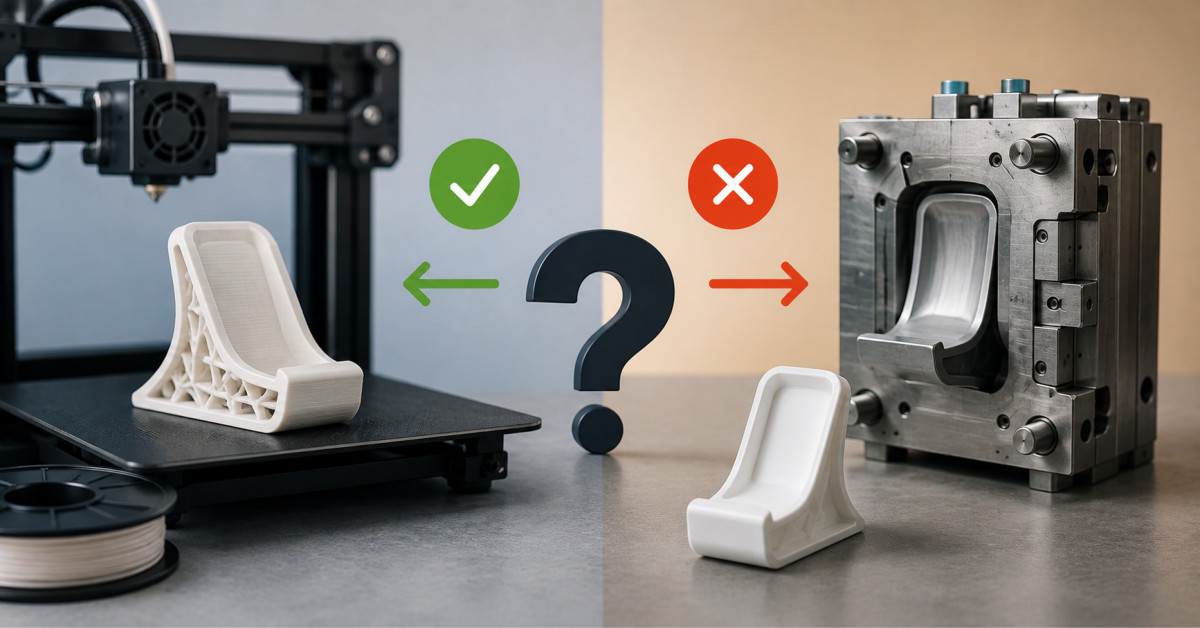
3D printing lets DTC brands launch a new product without the tooling cost of injection molding, typically five to six figures, which makes it a strong fit for testing an unproven design. Once demand is proven, most brands still move to traditional manufacturing for better unit economics at volume.
A mold for a new footwear design can run tens of thousands of dollars before a single unit ships. Additive manufacturing skips that bill entirely, which is exactly why it is worth understanding before you commit capital to your next product.
Nexbie’s Cloud slipper looks like a novelty until you notice what it skips: no separate midsole, no bonded outsole, no six week wait for an injection mold before the first pair exists. That skip is the actual story, and it applies well beyond footwear. Any DTC brand weighing a new product category runs into the same fork eventually: build a mold and commit real capital before you know if the design sells, or find a manufacturing method that lets you test first and commit later. Additive manufacturing, the process behind 3D printed products, is one answer to that fork, and it’s worth understanding on its own terms before you decide whether it fits your next launch.
Additive manufacturing removes the tooling step, the single biggest cost and time barrier standing between a product idea and a sellable unit. Traditional manufacturing, whether injection molding, cut and sew construction, or CNC machining, requires a mold or die built before the first finished unit exists, and that upfront tool typically costs five to six figures and takes weeks to months before a brand sees a single piece. Additive manufacturing builds directly from a digital file, layer by layer, which is why MIT Sloan’s research on additive manufacturing describes it as a shift from “you go directly from digital to physical.” That directness is the entire value proposition for a brand testing a new product category: no mold to commission, no minimum order to justify, no long wait between “we like this design” and “we can sell this design.” Additive manufacturing can also build structures traditional cutting and molding methods struggle to produce, including open lattice sections that save material and weight without a corresponding jump in tooling complexity. For a Founder weighing a new SKU, that’s the practical question worth asking before any conversation about aesthetics: does this product need a mold, and if it does, does 3D printing let you answer that question with real sales data before you commit to one?
The Nexbie Cloud slipper is a working example of what additive manufacturing lets a brand skip. A traditional slipper is built from separate layers: fabric upper, foam midsole, bonded outsole, stitched together as distinct components sourced from different suppliers. The 3D printed slipper replaces that with a single printed structure, where the open lattice design creates cushioning, flexibility, and airflow as properties of one continuous print rather than the sum of several bonded parts. That one piece construction is the part worth studying, more than the slipper itself. Consolidating multiple components into a single printed part is a well documented advantage of additive manufacturing: it cuts assembly steps and removes the failure points that come with bonding separate materials together. For a DTC brand outside footwear, the transferable question is whether your own product has a multi part assembly that a single printed structure could replace: a phone case with a separate grip insert, a kitchen tool with a bonded handle, hardware assembled from stamped metal and molded plastic. Nexbie’s 3D printed footwear line is one brand’s answer in one category. The pattern generalizes further than the product does.
3D printing beats a traditional mold for a first production run whenever your order volume is too small to justify the tooling cost, which for most consumer products sits somewhere under a few thousand units. Protolabs Network’s 2024 3D Printing Trend Report, based on a survey of more than 700 engineers and manufacturers, found that 82% of respondents reported meaningful cost savings from 3D printing over other methods, and 47% named lead time as their primary reason for choosing it. That’s the same math that’s already familiar to anyone who’s looked at how on-demand manufacturing has spread across industries beyond apparel: pay a slightly higher per unit price in exchange for zero fixed cost and zero unsold inventory risk. If you’re testing a $10K idea, that trade is close to obvious. There’s no scenario where committing $30,000 to a mold for a design you haven’t sold a single unit of makes sense. If you’re scaling a proven product at $500K and above, the calculation starts to flip, because the fixed cost of a mold amortized across thousands of units usually beats the per unit premium of continued printing.
Traditional manufacturing still wins once your order volume climbs high enough and stays stable enough that the mold’s fixed cost, spread across those units, drops below the ongoing per unit cost of printing. There’s no single volume threshold that applies to every product, since it depends on part size, material, and design complexity, but many consumer goods brands find the crossover somewhere in the low thousands of units per year. Volume isn’t the only factor worth weighing. Consumer footwear and apparel carry durability and comfort expectations that some print materials still struggle to match at scale, and a founder moving from a 200 unit test batch to a 5,000 unit reorder needs the same kind of operational stress-testing that catches founders off guard at scale in fulfillment and quality control, whether the product came off a printer or out of a mold. The safer sequence, in both directions, is to let real sales data decide the switch rather than a forecast or a hunch about where the brand will be in a year.
You can test a new product category without a mold by partnering with an on-demand or small batch 3D printing manufacturer, launching a limited run, and using real sales data instead of a forecast to decide whether the category earns a traditional tooling investment. Manufacturing marketplaces like Fictiv, Shapeways, and Protolabs Network exist specifically to let brands print short runs without owning equipment or committing to a factory relationship, which mirrors the same low risk approach to testing new product ideas before committing to inventory that print-on-demand apparel brands have used for years. Start with a small batch, priced to cover the higher per unit print cost, and treat the first 90 days of sales as your actual market research rather than relying on pre-launch survey data alone. If the category sells through consistently and volume points toward that few-thousand-unit crossover, that’s your signal to start pricing out a mold. The broader discipline here isn’t specific to 3D printing: it’s the same sequencing that applies to any new product launch, proving demand before committing capital, just with one more manufacturing option on the table than most brands are used to considering.
3D printing is typically cheaper than traditional manufacturing for a new product whenever your order volume is too low to justify building a mold. Traditional manufacturing methods like injection molding require an upfront tool that can cost five to six figures depending on part complexity, and that cost is fixed whether you sell 50 units or 50,000. 3D printing has no equivalent fixed cost: each unit is priced roughly the same whether you print one or one hundred. That makes 3D printing the cheaper option at low volumes and the more expensive option once volume climbs high enough for the mold’s fixed cost to amortize below the per unit cost of printing.
Injection mold tooling for a moderately complex consumer product typically costs between $10,000 and $50,000 or more before a single unit is produced, while 3D printing carries no comparable upfront tool cost and instead prices each unit individually. The mold cost depends heavily on part complexity, the number of cavities, and the material being molded, and it’s a sunk cost regardless of how many units eventually sell. 3D printing shifts that same money into a higher per unit price, which is a better trade for a brand that hasn’t yet proven demand. Once a design is validated and volume climbs into the thousands of units, the math typically flips and the mold becomes the cheaper path.
A DTC brand should switch from 3D printing to injection molding once order volume is high enough and stable enough that the mold’s upfront cost, spread across those units, drops below the per unit cost of continuing to print. There’s no single volume threshold that applies to every product, since it depends on part size, material, and design complexity, but many brands find the crossover somewhere in the low thousands of units per year. The safer sequence is to prove the design and the demand with 3D printing first, then commission a mold once sales data, not a forecast, justifies the fixed cost.
Yes, 3D printed products can handle everyday retail volume, though throughput becomes the limiting factor rather than cost as volume grows. A single printer’s cycle time stays roughly fixed for a given part, so scaling output past a certain point means adding more printers, floor space, and staffing rather than simply running the same machine faster. Brands selling a few hundred to a few thousand units a month can typically meet demand with 3D printing alone or a mix of printing and a manufacturing partner network. Beyond that volume, most brands find traditional manufacturing delivers more consistent unit economics and faster fulfillment at scale.
3D printing and additive manufacturing describe the same underlying process: building an object layer by layer directly from a digital file, rather than removing material from a solid block or forcing material into a mold. “3D printing” is the term most consumers and DTC brands use, while “additive manufacturing” is the term used in industrial and engineering contexts, particularly for production grade parts rather than prototypes or consumer novelties. The distinction that matters for a DTC brand isn’t the terminology but the application: whether the technology is being used for one-off prototypes, small batch production, or full scale manufacturing.




