

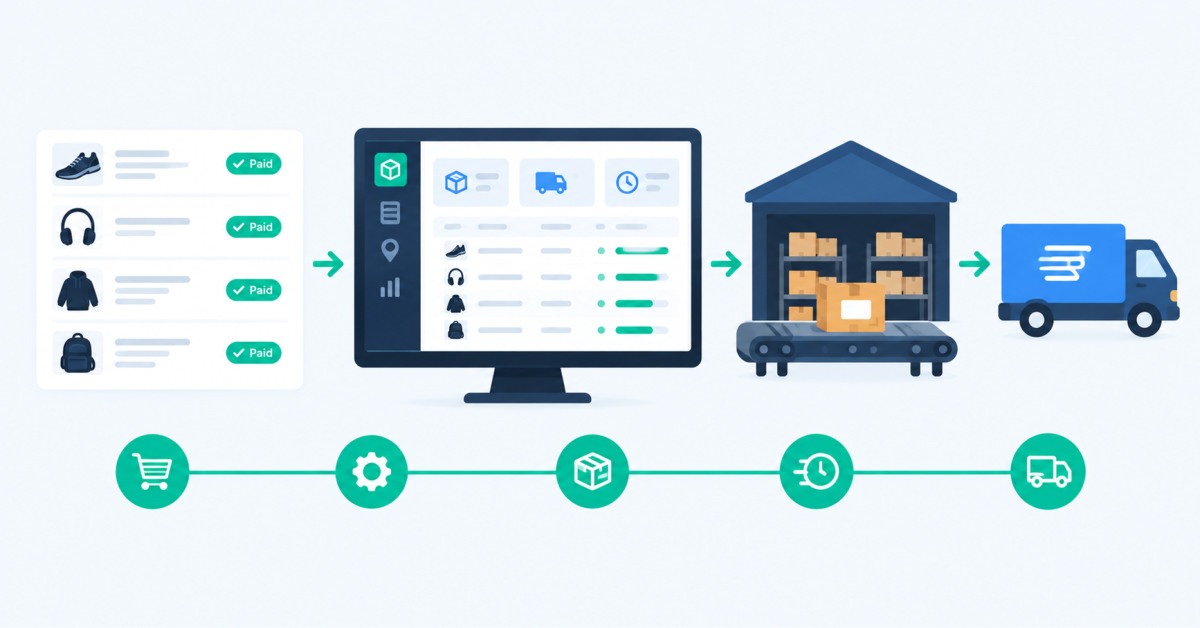
3PL WMS software speeds ecommerce fulfillment by automating order intake, pick-path decisions, barcode verification, carrier selection, and returns processing. For multi-client warehouses, the fastest gains come from removing manual handoffs while keeping inventory, shipping, and exception data accurate in real time.
Fast fulfillment is not created at the packing station. It is created when the warehouse removes the manual decisions and unnecessary movement that delay every order before it reaches the box.
Order fulfillment speed directly dictates customer satisfaction and retention in e-commerce. As consumer expectations for same-day or next-day shipping continue to rise, third-party logistics (3PL) providers cannot afford bottlenecks caused by manual order processing.
Implementing dedicated 3PL WMS Software streamlines physical and digital workflows across the entire warehouse floor. By removing manual touchpoints and automating decision-making, 3PL software dramatically reduces order cycle times from hours to minutes.
Fulfillment delays do more than frustrate shoppers. They directly impact a logistics provider’s operational capacity and profitability.
Industry data demonstrates the clear connection between automation and fulfillment speed:
Modern logistics platforms eliminate unnecessary steps in the fulfillment chain, allowing warehouse teams to move goods from receiving docks to delivery trucks as efficiently as possible.
Manual order entry creates significant delays between the moment a customer clicks “buy” and when a warehouse picker receives the order ticket.
3PL software connects directly to e-commerce platforms like Shopify, WooCommerce, and Amazon via automated APIs. When an order is placed online, the system instantly imports the details, validates the shipping address, and routes the order to the correct warehouse zone without requiring human intervention. This cuts hours off the initial handling phase.
In a non-automated warehouse, pickers take individual order slips and walk back and forth across the building to gather items. This creates unnecessary foot traffic and slows down fulfillment.
A 3PL software uses algorithms to combine similar orders into batches or waves. The system calculates the shortest, most efficient physical walking path through the warehouse aisles for the picker. Instead of visiting the same rack ten times for ten separate orders, a picker retrieves all necessary items in a single pass, saving thousands of steps per day.
Relying on paper pick lists forces workers to double-check SKU numbers manually, slowing picking speeds and increasing error rates.
Equipping staff with mobile devices and barcode scanners speeds up verification. Pickers scan the bin location, scan the item SKU, and receive immediate visual feedback on their screen. If a worker picks the wrong size or color, the device alerts them instantly. This eliminates the need for slow manual double-checking at the packing station.
Manually selecting shipping carriers and printing labels creates severe bottlenecks at the final packing station.
Modern 3PL software includes automated rate-shopping tools. The system compares real-time shipping rates and delivery timelines across multiple carriers within milliseconds. It selects the most cost-effective service that meets the delivery deadline and automatically prints the shipping label as soon as the item is packed.
Slow returns processing locks up inventory that could otherwise be resold quickly to fulfill new customer orders.
3PL warehouse systems automate reverse logistics by generating scannable return labels and providing standardized receiving workflows for returned items. When a returned package arrives, workers scan it, inspect the product status, and immediately re-enter sellable items into available inventory. This fast-tracks stock availability for future fulfillment cycles.
3PL WMS software is a warehouse management system designed for third-party logistics providers that store, pick, pack, ship, and process returns for multiple merchant clients. It connects order channels, inventory records, warehouse locations, picking workflows, barcode scanning, carrier services, client-specific rules, and reporting in one operational system. Unlike a basic inventory tool, a 3PL WMS must manage separate client inventory, different service requirements, shipping logic, user permissions, and billing or activity records. Its main purpose is to help a logistics provider fulfill orders accurately, quickly, and consistently as order volume and client complexity increase.
A WMS improves ecommerce fulfillment speed by automating order intake, inventory allocation, pick-task creation, path optimization, item verification, carrier selection, label generation, and shipment updates. These workflows reduce the time orders spend waiting for a manual export, data entry step, supervisor decision, or paper-based check. A WMS also helps warehouse staff batch compatible orders, follow more efficient travel routes, and identify errors before they reach the packing station. The largest gain is often not faster physical labor. It is removing the small delays and avoidable decisions that accumulate between checkout and carrier handoff.
Yes, 3PL WMS software can integrate with Shopify when the platform supports Shopify through a direct connection, API integration, or approved connector. A strong integration should import new orders, synchronize fulfillment status, send tracking information back to Shopify, maintain inventory visibility, and apply merchant-specific shipping and fulfillment rules. Before choosing a WMS, confirm how the integration handles order edits, cancellations, split shipments, pre-orders, bundles, partial fulfillment, returns, multiple warehouse locations, and inventory adjustments. The best connection reduces manual work while ensuring that Shopify, the warehouse, and the customer see consistent order information.
A 3PL should look for warehouse management software with multi-client inventory controls, ecommerce integrations, mobile barcode scanning, batch or wave picking, location management, carrier rate shopping, automated label printing, returns workflows, client-specific fulfillment rules, real-time inventory updates, and exception reporting. The right feature mix depends on the warehouse’s bottleneck. High-volume facilities may prioritize pick-path optimization and automation, while multi-merchant operations may prioritize client separation, billing support, integrations, and role-based controls. Ask vendors to demonstrate your real workflow, including exceptions, rather than evaluating features from a generic product tour.
A WMS reduces picking errors by directing workers to the correct location, requiring barcode confirmation for the bin and product, validating quantities, and flagging mismatches immediately. This prevents similar SKUs, sizes, colors, and client inventory from being confused during a busy shift. The system can also standardize picking instructions, maintain location records, create more logical waves, and record every movement for auditability. Barcode verification is especially valuable because it catches an error at the moment it occurs instead of allowing the wrong item to move through packing, shipping, delivery, return processing, and customer-service resolution.




