

Dotdigital blog
SMS sends are up 57% year-on-year. WhatsApp is delivering click rates over 50%. Email open rates keep climbing. Your customers are active, engaged, and reachable, and we have 6 ways to make sure your cross-channel campaigns reach them every time.

Most marketing teams are already doing cross-channel in some form. There’s an email program and SMS campaigns. Maybe some WhatsApp and retargeting ads are in the mix too. The channels exist, and the campaigns go out, but the results feel a bit flat.
Chances are, there’s a gap in the strategy. Channels like SMS have grown by 57% year-on-year globally, according to Dotdigital’s 2026 Global benchmark report, which means marketers are sending more. But getting results from a cross-channel campaign is about more than adding volume; it’s about:
In this quick guide, we’ll show you six simple ways you can get more from your cross-channel marketing campaigns. The good news is, it’s not a case of rebuilding everything from scratch. These are six practical places to sharpen what you’re already doing to deliver better results.
Every strong cross-channel campaign starts somewhere unglamorous: the data audit. Because you can’t personalize what you can’t see, and you can’t coordinate channels that are feeding off different, disconnected information.
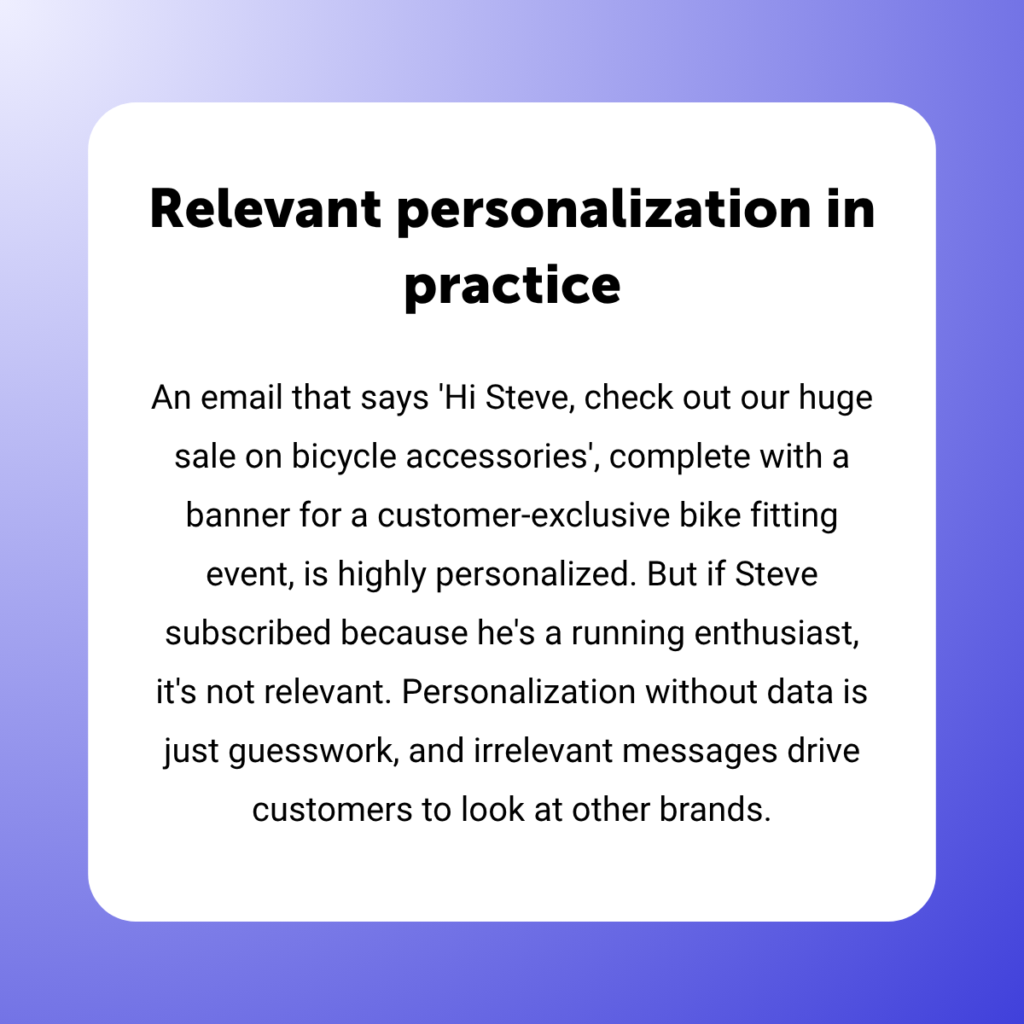
The gap between personalization and relevance is worth pausing on. Dotdigital’s upcoming Customer trend index reveals that 61% of consumers feel brands personalize their marketing at the right level, but only 15% consider those messages to be genuinely relevant. That’s a significant gap, and it’s almost always a data problem.
The solution is a single customer view: one unified profile that captures what someone clicked, what they bought, what they ignored, and how they move between touchpoints. Not five separate records living in five different tools.
That doesn’t mean rebuilding your entire tech stack. It means asking:
When purchase history, browse behavior, email engagement, SMS opt-ins, and on-site activity all feed into one place, campaigns stop being guesswork.
A customer experience data platform (CXDP) like Dotdigital brings all of this together so your data is doing the work, not just sitting in a spreadsheet.
More channels don’t automatically mean better results. But knowing what each channel is built for and combining them with intention is where cross-channel strategy gets interesting.
Here’s a look at the toolkit and what the data tells us about how each one performs:
Email is still the workhorse of all marketing channels, and the numbers back it up. Global email open rates rose 6.5% year-on-year to 55%, even as send volumes climbed 16.1%. Audiences aren’t tiring of the channel; in fact, they’re more open to it than ever. Email is ideal for anything that needs space to breathe. Messages like nurture sequences, post-purchase flows, re-engagement, and detailed product storytelling are perfect for this channel.
The click picture is more nuanced. Click-through rates (CTR) rose 12% to 3.7%, but the click-to-open rate dipped 8.3%, meaning more people are opening, but clicking more slowly. That reflects a broader behavioral shift. People are scanning and absorbing in email rather than always clicking through. Which makes the case for pairing email with more action-oriented channels even stronger.
Short, direct, and hard to ignore. SMS click-through rates hit 25.7% globally in 2025; seven times higher than email. SMS sends grew 57% year-on-year, suggesting marketers are increasingly aware of just how effective the channel is when it’s used well.
SMS is best used for time-sensitive moments, such as flash sales, order updates, appointment reminders, and limited-time offers. To get the most out of the channel, keep messages brief, make the action clear, and respect the channel’s personal nature. Unsubscribe rates sit at just 0.43% globally for well-run SMS programs, so when you get it right, engagement levels are high.
With the immediacy of SMS, MMS adds a visual punch to mobile messaging by allowing images, GIFs, or short videos. MMS click-through rates came in at 15% with a unique CTR of 12%; strong numbers for a channel that’s still finding its feet with many marketing teams. This channel is great for product launches, seasonal campaigns, or anything where a compelling visual does the work that words alone can’t.
WhatsApp is the newest channel in many marketers’ toolkit and the early results are remarkable. WhatsApp can easily deliver open rates above 90% and a click-through rate of 51%. To put that in context, that’s over ten times the email CTR. The channel is conversational and personal by nature; it works best for high-value customer relationships, two-way interactions, and markets where WhatsApp is already part of daily life. With over 2.5 billion people using it every month, the audience is there; you just have to tap into it.
Perfect for bringing back the browsers that didn’t convert, retargeting ads are more powerful when they’re synced with your email and on-site behavioral data. This guarantees the ad someone sees actually reflects what they were looking at, not just a generic brand message. Connecting your marketing automation or data warehouse tools with Facebook Audiences, Google Ads, and TikTok Audiences means retargeting lists update automatically based on behavior across your other channels.
Websites are often the most overlooked channel in a cross-channel strategy. Campaigns and visuals may be consistent, but messaging can miss the mark. If your emails are personalized and your SMS is targeted, but your website serves the same homepage to everyone, there’s a gap in the journey. Adding dynamic website personalization that adapts to who’s visiting (like returning customers, high-value segments, or lapsed buyers) closes the loop on the experience and drives engagement like no other channel.
Remember: the point isn’t to use all of them at once. It’s about choosing the right combination for your audience, ensuring they share data, and letting each channel do what it does best.
Most marketing teams already have tools they rely on: a CRM, an ecommerce platform, a loyalty program, analytics tools; the list goes on. To get more out of your cross-channel campaigns, you don’t have to replace the whole stack, but you do have to connect it.
When your marketing automation platform talks to the rest of your wider stack, campaigns get smarter without requiring more manual work. Purchase data automatically triggers a post-purchase flow. CRM segments feed directly into email campaigns. Loyalty status changes how a customer is messaged across every channel. None of that happens when your tools are working in silos.
Some of the highest-impact integration wins are more straightforward than they sound:
Your martech stack should be making your job easier. If it’s not, something isn’t properly connected, and that gap is showing up in your results.
Segmentation is a staple of email marketing, but the question is whether that segmentation is actually changing what gets sent, to whom, and on which channel.
Demographic segmentation by things like age or location is helpful, but it’s not enough by itself to build a complete strategy. The bigger opportunity is behavioral segmentation: using data like purchase history, browsing behavior, email engagement patterns, product category affinity, and time since last interaction to connect with customers at key moments in their journey.
A good place to start is segmenting your audience by channel preference. Dotdigital’s benchmark data shows that SMS and WhatsApp drive click rates far outpacing email, but that doesn’t mean every customer wants to hear from you on those channels. Some customers reliably open emails and convert there. Others need an SMS nudge. Some are increasingly responding to a well-timed WhatsApp message.
When channel preference becomes part of your segmentation logic, you stop making assumptions about where someone wants to be reached and start letting their behavior make the call. This results in fewer messages that feel like interruptions and more that feel like they arrived at exactly the right moment.
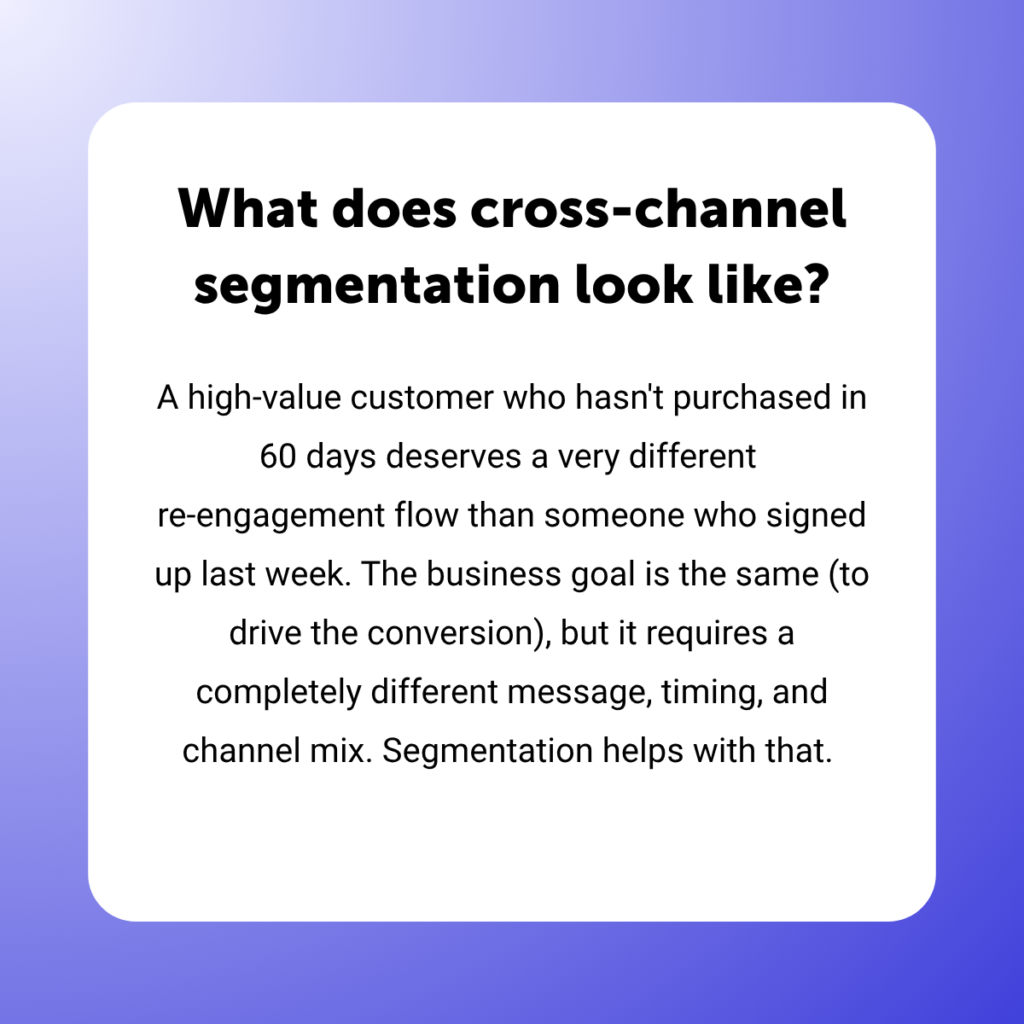
Good segmentation doesn’t just change the content of your campaigns; it also changes the way you deliver them. It changes which channels you use, when you send, and what you ask people to do next. That’s what makes the difference between a campaign that feels like marketing and one that feels made for them.
If, for you, personalization still means putting someone’s first name in a subject line, the bar needs to be raised. Real, relevant personalization means showcasing the right product or delivering the right message, on the right channel, at the right moment. When that’s working across a cross-channel strategy, marketing stops feeling generic and starts feeling like a one-to-one conversation.
Here’s what that looks like in practice across the channel toolkit:
Every interaction should feel like it knows who the customer is, even when they switch channels halfway through their journey. That’s the standard worth building toward.
There’s a meaningful difference between a campaign and a strategy. Campaigns push messages out, while strategies adapt and respond to your audience.
The data from Dotdigital’s 2026 benchmarks tells an interesting story: email click-to-open rates declined 8.3% year-on-year, while SMS click rates rose 25.7%, seven times higher than email. That’s not a sign that email is fading. It’s a sign that people are using channels differently, and a strategy built around a single channel means you’re relying on a single behavior pattern to carry all your conversions, missing the customers who need a different kind of nudge to get there.
The answer is automation that responds to real behavior rather than just following a schedule. A practical example of what a well-built cross-channel flow looks like in practice:
Every step responds to real behavior. Automation platforms handle the timing and channel logic, while you focus on how the flow is designed and what the messages should be. That’s what makes it feel personal rather than mechanical.
And the channel complementarity matters here too. Success lies in knowing when to inspire, when to prompt, and when to act. Email builds context and meaning. SMS and WhatsApp deliver the concise prompts that move customers forward. Each channel is doing its job in sequence.
Looking at channels in isolation means you get a fragmented view of what’s actually driving results. The real story is in the connections between them.
Some metrics worth tracking across the full strategy:
Your data should be telling you a story. If you’re reading one chapter at a time, you’re missing the whole plot.
Cross-channel marketing is simply how customers actually move through the world now, across channels, devices, and moments, on their own terms and their own timeline.
Brands that get results aren’t necessarily the ones with the biggest budgets. They’re the ones who’ve connected the right data, chosen channels based on what they’re actually good at, and built campaigns that respond to real behavior rather than follow a schedule. None of that requires starting from scratch; it just requires being intentional about how your marketing channels fit together.





