





Quick Decision Framework
- Who This Is For: Shopify brand owners and operators doing $50K to $2M+ annually who are ready to stop treating email and SMS as campaign channels and start building a retention system that compounds over time.
- Skip If: You are pre-revenue or under $10K/month and still searching for product-market fit. Retention infrastructure requires a customer base to work with. Come back when you have 90 days of order history and at least 500 customers.
- Key Benefit: A structured retention system that moves your repeat purchase rate from the industry average of 28% toward the top-performer threshold of 40% or above, without increasing ad spend.
- What You’ll Need: Access to your Shopify analytics, an email platform (Shopify Email at minimum, Klaviyo at $50K+ monthly), and 90 days of focused implementation time.
- Time to Complete: 15 minutes to read. 90 days to build the full system in three sprints.
The brands winning in 2026 are not the ones spending the most on acquisition. They are the ones that figured out what happens after the first sale.
What You’ll Learn
- Why the economics of customer acquisition have broken the old growth playbook and what the data says about where the money actually is.
- How the repeat purchase probability curve works and why the window between your customer’s first and second order is the single highest-leverage moment in your entire business.
- How to build the six automation flows that move customers from first-time buyer to repeat purchaser to advocate, and which ones most Shopify brands are skipping entirely.
- What RFM segmentation is, why it is the foundational framework for retention marketing, and how Klaviyo’s predictive analytics make it accessible without a data team.
- Which three retention levers most brands overlook completely, and how loyalty programs, subscription models, and customer service each change the math on lifetime value.
Why Retention Is the Only Sustainable Growth Lever Left
The average ecommerce brand loses money on every new customer it acquires. Not metaphorically. Literally. After accounting for marketing costs and returns, the average ecommerce business loses $29 per new customer acquired today, compared to a $9 loss per customer in 2013. That is a 222% increase in the cost of getting someone to buy from you for the first time, and it shows no sign of reversing.
Customer acquisition costs have risen 222% over the past eight years. In competitive DTC categories, brands are paying between $68 and $84 to acquire a single customer. Supplements brands pay up to $89. And the paid channels driving most of that spend keep getting more expensive. Meta CPMs hit all-time highs in 2025. Google Shopping CPCs climbed alongside them. The old playbook of pouring money into top-of-funnel paid social and hoping the math works out on the back end is no longer viable for most brands.
Meanwhile, the average Shopify store has a repeat purchase rate of 28.2%. That means roughly 7 out of every 10 customers who buy from you once never come back. They are gone before you have had a chance to recover what you spent to get them. Top-performing stores push above 40%, and the best-in-class operators with subscription models or strong loyalty programs reach 55% or higher. That gap between average and top-tier is not a marketing problem. It is a systems problem.
Here is the number that should change how you think about your business: repeat buyers generate 41% of total ecommerce revenue despite representing only 8% of the customer base. A 5% increase in retention can boost profits by 25% to 95%, according to Bain and Company research that has held up across decades of ecommerce data. You have a 60 to 70% chance of selling to an existing customer. You have a 5 to 20% chance of selling to a new prospect. The economics are not close. The brands doing $2M and above know this and have built systems around it. The ones stuck at $300K usually have not.
The Customer Journey Most Brands Abandon After the First Sale
Most Shopify brands have a well-developed acquisition funnel. Awareness, consideration, purchase. They have spent real money on ads, on creative, on landing pages. And then the customer buys, gets a shipping confirmation, and the brand moves on to the next acquisition. The post-purchase experience is an afterthought at best, an empty silence at worst.
That silence is expensive. A first-time buyer is not a loyal customer. They are someone who decided to take a chance on you once. They are evaluating whether you are worth returning to, and most of that evaluation happens in the 7 to 30 days after their order arrives. Did the product meet expectations? Did anyone follow up? Was there a reason to come back? Most brands answer none of those questions, and so most customers quietly disappear.
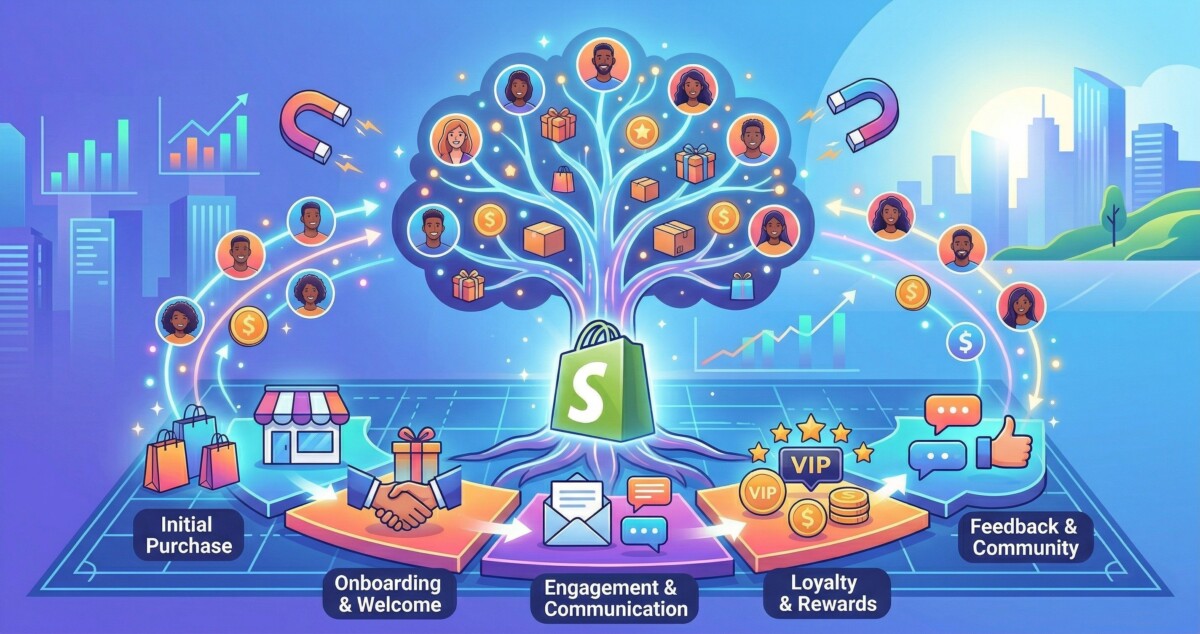
The full post-purchase journey runs through five stages: first purchase, onboarding, second purchase, repeat engagement, and advocacy. The real revenue lives in stages two through five. Onboarding is where you reinforce the customer’s decision and set expectations for the relationship. The second purchase is the inflection point where someone shifts from experimenter to repeat buyer. Repeat engagement is where lifetime value accumulates. Advocacy is where it multiplies, through reviews, referrals, and word of mouth that costs you nothing to generate.
Building a retention system means building for all five stages, not just the first one.
The Second Purchase Is Your Highest-Leverage Moment
After a first purchase, a customer has roughly a 28% to 32% chance of returning, according to repeat purchase probability research across millions of ecommerce transactions. That is a hard number to sit with. Nearly three-quarters of your customers are statistically unlikely to come back after their first order. But here is where the math gets interesting: once a customer makes a second purchase, the probability of a third jumps to 45%. After a third purchase, 54% return for a fourth. The curve keeps climbing with each transaction, and by the time someone has made five or more purchases, they are on a path to becoming one of your highest-value customers.
This means the window between first and second purchase is the most important stretch of the entire customer lifecycle. It is where most brands lose customers, and it is where the highest-ROI retention work happens. Brands with a structured post-purchase sequence targeting the second order see repeat purchase rates 20 to 35 percentage points higher than those relying on transactional emails alone. The second purchase is not just a transaction. It is the moment someone decides you are worth coming back to.
Build a Retention Mindset, Not a Batch-and-Blast Mentality
Most merchants think about email and SMS the wrong way. They optimize for opens. They celebrate high click rates. They measure the performance of individual campaigns in isolation. None of that is wrong exactly, but it is optimizing for the wrong thing. The metric that matters is repeat purchase rate. Everything else is a signal, not a goal.
The shift is from “how do we get more opens” to “how do we get more second purchases.” When you change the metric you are optimizing for, everything downstream gets sharper. Your welcome series stops being a brand introduction and becomes a conversion machine with one job: get the first purchase as fast as possible. Your post-purchase flow stops being a shipping notification sequence and becomes the most important retention investment you make. Your win-back flow stops being a last-ditch discount blast and becomes a predictive intervention triggered 30 to 60 days before a customer would have lapsed.
There are three things to optimize for, in this order: reduce time to first purchase (your welcome series should drive conversion, not just introduce the brand), increase repeat purchase rate (the second purchase is the hardest but the most valuable), and maximize lifetime value (optimize for the total relationship, not individual transactions). Our ecommerce customer retention marketing guide goes deeper on how each of these metrics connects to revenue. When you are building flows, ask one question before every decision: does this move a customer closer to their next purchase?
Segment Strategically, Not Superficially
Most brands stop at engaged versus unengaged, which tells you almost nothing actionable. Engaged by what measure? Unengaged since when? Start with the basics as table stakes: engaged versus unengaged, buyers versus non-buyers. Then move to behavior-based triggers: browsed but did not buy, bought once but never again, buys frequently, only buys on sale. Those segments let you send meaningfully different messages to meaningfully different people.
The next layer is RFM segmentation, which is the foundational framework for retention marketing in ecommerce and one that most Shopify merchants have never heard of despite it being the most powerful segmentation model available to them. RFM stands for Recency, Frequency, and Monetary value. Recency tells you how recently someone bought, which is the single strongest predictor of whether they will buy again. Frequency separates habitual customers from experimenters. Monetary value identifies your highest-revenue segments so you can treat them differently from the start.
Klaviyo has native RFM-style predictive analytics on all paid tiers. For Shopify stores doing $500K or above, this feature alone justifies the platform investment. You can see which customers are at risk of churning before they lapse, which ones are predicted to be high-LTV, and which ones are due for a replenishment order based on their purchase history. Brands that segment post-purchase flows by customer stage (first purchase versus repeat versus VIP) report 31% higher email revenue per recipient compared to single-flow approaches. The goal is not a million segments. It is the right segments that let you send the right message at the right time. Our full Klaviyo review covers exactly when the platform investment pays off and when a simpler tool is the smarter choice.
Use Email and SMS for What They Are Actually Good At
Email and SMS are not interchangeable channels. Using them as if they are is one of the most common and most expensive mistakes in retention marketing. Email is for storytelling, brand building, education, product explanations, visual content, and longer-form context. It is the channel where you build the relationship over time. SMS is for urgency, time-sensitive offers, frictionless transactions, high-intent moments, and short direct calls to action. It is the channel where you drive the next action.
When combined strategically, they amplify each other. Use email to build context and SMS to drive action. Do not send the same message across both channels. SMS campaigns on Shopify see average click-through rates of 6% to 8%, far above email benchmarks. That performance comes from using SMS for moments where urgency is real: restock alerts, shipping updates, VIP early access, expiring offers. When you use SMS for anything that could have been an email, you train your customers to ignore it.
The practical advantage of running both channels through Klaviyo is that you get one customer view and one set of segments across email and SMS. That eliminates the data silos that come from running separate tools. If a customer opens every SMS but ignores email, Klaviyo learns that and adjusts channel priority automatically. At the growth stage and above, that kind of intelligence is the difference between a retention system and a retention attempt.
The Core Automation Flows That Actually Drive Retention
These flows work together as a system. They are designed to move customers through the journey from first purchase to repeat buyer to advocate. None of them work in isolation. The brands that see 8 to 15 percentage point improvements in repeat purchase rate are the ones that have all of them running, not just the obvious ones.
For a deeper look at how these flows connect to the broader retention ecosystem, including how loyalty tools and subscription platforms layer on top of them, see our piece on how Klaviyo, Smile.io, and other retention tools work together across the full customer journey.
Welcome Series
The welcome series is not a brand introduction. It is a conversion machine with one job: get the first purchase as fast as possible. Include product education, social proof, and a clear path to purchase within the first 48 hours. The welcome coupon, if you use one, should be tracked: if used, trigger a thank-you and move the customer into your post-purchase onboarding flow. If unused, send a reminder before it expires. Brands with a properly structured welcome series convert subscribers to first-time buyers at 2 to 3 times the rate of brands with a generic introduction sequence.
Abandoned Cart and Browse Abandonment
Cart abandonment on Shopify averages 70% to 75%. The cart reminder is table stakes. What separates average brands from top performers is how they handle it. Do not just remind customers they left something behind. Address the objection. Add urgency. Make it easy to complete the purchase. Browse abandonment is the underused sibling: it targets people who viewed products but never added to cart. Both flows should use dynamic product blocks that show exactly what the customer was looking at, and escalating urgency across a two to three touch sequence.
Post-Purchase Onboarding
This is the most underleveraged flow in ecommerce. Order confirmation emails get 65% to 75% open rates, the highest of any email you will ever send. Almost no one uses them to drive the next purchase. A structured post-purchase sequence looks like this: Day 1, order confirmation with a soft cross-sell based on what they bought. Day 7, delivery follow-up with a review request and usage tips. Day 14, a personalized product recommendation based on purchase history. Day 21, a social proof email with customer stories and a natural path to the next order. Stores running a 3 to 5 email post-purchase sequence see 35% higher repeat purchase rates than those relying on a single confirmation email.
Second Purchase Accelerator
This is the most underutilized flow in ecommerce. After someone’s first purchase, a dedicated sequence should have one goal: drive the second buy. Offer complementary products. Incentivize a second order with a time-limited offer. Make it feel like the natural next step in the relationship, not a sales push. Brands with this flow in place see 8 to 15 percentage point improvements in repeat purchase rate within the first 90 days of implementation. If you only build one new flow this quarter, make it this one.
Replenishment Reminders
For consumable products, time this based on actual product usage. If someone bought a 30-day supply, reach out around day 25. Klaviyo’s predicted next order date feature automates this timing using purchase history. Replenishment reminder emails see 38% to 52% open rates with 8% to 15% conversion rates for consumable products. For non-consumable brands, this might be a seasonal refresh or a “time for an upgrade” sequence triggered by time since last purchase.
Win-Back Flows
When someone goes quiet, trigger a win-back sequence based on their previous behavior. The timing matters more than the offer. Klaviyo’s predictive analytics can flag customers showing early churn signals 30 to 60 days before they would have lapsed, giving your flows time to work before the relationship is actually gone. Win-back campaigns recover 3% to 8% of churned customers when triggered at the right moment. Triggered too late, after the customer has mentally moved on, the recovery rate drops significantly.
Three Retention Levers Most Brands Overlook
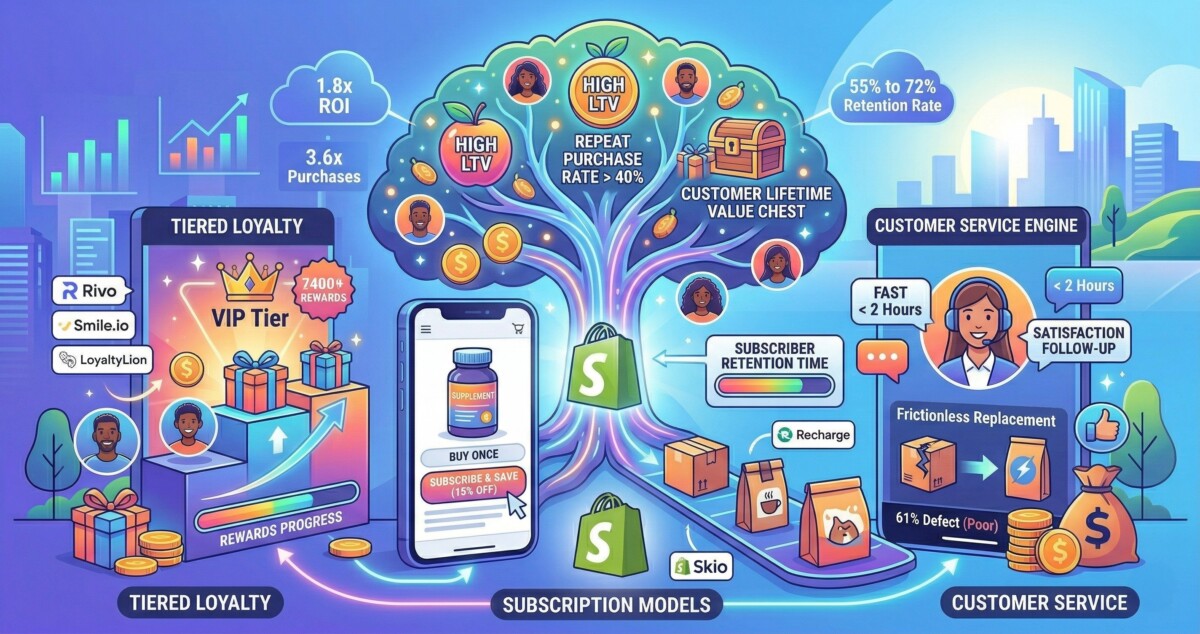
The automation flows above are necessary but not sufficient. The brands pushing repeat purchase rates above 40% are running three additional levers that most merchants either ignore or implement poorly. Each one changes the math on lifetime value in a way that flows alone cannot.
Loyalty Programs That Actually Change Behavior
Loyalty programs are not just points and perks. They change the psychological calculus of where a customer shops. Once someone has 200 points toward a reward at 500, they have a tangible reason to choose you over a competitor even if the competitor is slightly cheaper. That is the behavioral lock-in that makes loyalty programs worth building.
The data on tiered programs is compelling. Tiered loyalty structures generate 1.8x higher ROI than flat programs, according to Antavo research cited by LoyaltyLion. VIP tier members make 3.6x more purchases annually than non-tier customers and generate 73% higher average order value. A customer who joins your loyalty program is 47% more likely to make a second purchase than a customer who does not. The key is making rewards feel attainable and keeping the program visible. A rewards progress bar shown at every shopping touchpoint is one of the most effective ways to increase engagement. Shopify apps to evaluate: Rivo, Smile.io, and LoyaltyLion, each with different strengths depending on your stage and complexity needs.
Subscription Models for Consumable Products
For supplements, skincare, coffee, pet food, cleaning supplies, and personal care, subscription is the most powerful repeat purchase tool available. A subscriber has a 3x to 5x higher lifetime value than a one-time buyer. Subscription-based Shopify stores see 12-month retention rates of 55% to 72%, compared to 28% for standard stores. The “subscribe and save” model is now expected in consumable categories, typically offering 10% to 20% off the regular price. Customers who subscribe on their first order have dramatically higher LTV than those who convert to subscription later.
The platform choice matters. Recharge holds 35% to 40% of the Shopify subscription market and integrates deeply with Klaviyo, Gorgias, and most major retention tools. Skio has the best subscriber self-service experience and consistently reports lower churn among merchants who have migrated to it. The right choice depends on your revenue volume and how much flexibility your subscribers need. Place the subscription option directly on the product page alongside the standard buy-once button, with clear savings displayed and reassurance copy (“skip, pause, or cancel anytime”) to reduce friction at the point of conversion.
Customer Service as a Retention Engine
Retention marketing gets all the attention. Customer service gets treated as a cost center. That is backwards. Research consistently shows that 89% of customers are more likely to repurchase after a positive service experience, and a single poor experience causes 61% to defect permanently. The brands with the highest retention rates are almost always the ones with the fastest, most friction-free support operations. Respond to every inquiry within 24 hours, and aim for 2 to 4 hours on anything related to a recent order. Replace damaged products without friction. Follow up 3 to 5 days after resolution to ensure satisfaction. Gorgias is purpose-built for Shopify customer support, connecting order data, conversation history, and automation in one place. At the growth stage and above, it is the infrastructure that makes fast, personalized support operationally possible.
Let AI Handle the Grunt Work, Not the Strategy
AI can make retention faster and more scalable. It cannot replace the judgment that makes retention marketing work. The distinction matters because a lot of brands are using AI to generate more content faster without asking whether the content is actually serving the customer.
Where AI genuinely helps: first-draft generation for emails and SMS (write it fast, then edit it into your voice), data analysis to surface patterns in customer behavior you would miss manually, and personalization at scale. Brands using AI-driven personalization see 60% of recipients convert to repeat purchasers. Brands using AI earn 40% more revenue from personalization than those without it. These are real numbers, and they come from AI doing the work that humans cannot do at scale: analyzing behavioral signals across thousands of customers and serving each one a relevant experience.
Where AI falls short: understanding emotional brand nuance, making strategic positioning decisions, and building the kind of relationship that makes a customer choose you over a competitor when the price is the same. Klaviyo’s K:AI Marketing Agent represents the current state of the art for Shopify brands. It reads your site, learns your brand voice, and generates launch-ready campaigns. Use it for the repetitive and data-heavy work. Keep strategic thinking and brand voice in human hands.
Track Metrics That Tell You What Is Actually Working
List size does not matter. Revenue per email does. There are five metrics worth tracking in 2026, and most brands are measuring the wrong ones.
Repeat purchase rate is the primary health metric for your retention system. If this number is below 25%, your retention is not working regardless of what your open rates say. Time to second purchase tells you how long it takes for a first-time buyer to return. The faster this is, the better your onboarding and second purchase accelerator flows are performing. Active subscribers measures engagement, not total list size. An engaged list of 10,000 is worth more than a dead list of 100,000, and the only way to know which one you have is to measure active engagement, not raw count.
Lifetime value by cohort is the metric that separates the operators who understand their business from those who are guessing. Track LTV by the month or quarter someone became a customer to see which acquisition channels bring the most valuable customers over time. If your Meta customers have higher CAC but also higher LTV than your Google customers, that changes how you allocate budget. Revenue from repeat customers versus new customers is the directional metric for your overall strategy. The goal is to shift more revenue to repeat over time. Email and SMS combined should drive at least 25% to 30% of total revenue when flows are properly configured at the growth stage.
Build This Incrementally: The 90-Day Sprint
Do not try to overhaul everything overnight. The brands that build durable retention systems do it in focused 30-day sprints, each one adding a layer of capability on top of what came before.
Sprint 1 (Days 1 to 30): Get segmentation right. Separate engaged from unengaged, buyers from non-buyers, and build your behavior-based trigger segments. Optimize your welcome series to drive first purchases faster. If you are still on Shopify Email and doing under $500K annually, that may be enough for now. If you are above that threshold, this is the sprint where you migrate to Klaviyo and start capturing behavioral data you cannot retroactively recover.
Sprint 2 (Days 31 to 60): Build or fix your abandoned cart, post-purchase onboarding, and second purchase accelerator flows. These three flows together form the foundation of your retention system. Add a loyalty program if you do not have one. Rivo and Smile.io both have free entry points that let you test the concept before committing to a full implementation.
Sprint 3 (Days 61 to 90): Add predictive analytics, integrate SMS strategically, implement subscriptions for consumable products, and start testing AI-powered personalization. This is the layer that separates brands doing 28% repeat purchase rates from brands doing 40% and above. The tools are available. The question is whether you have built the foundation in sprints one and two to make them work.
Retention Is a System, Not a Campaign
Every touchpoint in your retention system should be built around five principles. Value: are you giving the customer something worth their attention, or just asking for another sale? Timing: are you reaching them at the right moment in their journey? Relevance: is this message tailored to where they actually are? Relationship: are you building trust or just transacting? Progression: are you moving the customer forward or keeping them stuck in a loop?
If your retention strategy checks all five, you are not just keeping customers. You are building a profit center that compounds over time. The repeat buyer who started as a $60 first order becomes a $215 two-year customer, then a $480 loyal customer, then a $920 VIP. That progression does not happen by accident. It happens because someone built a system that made it possible.
In 2026, the brands that win are not the ones spending the most on acquisition. They are the ones that turned first-time buyers into repeat customers, repeat customers into advocates, and advocates into the most efficient acquisition channel they have.
Frequently Asked Questions
What is a good repeat purchase rate for a Shopify store in 2026?
The industry average repeat purchase rate for Shopify stores sits at 28.2%, meaning roughly 7 out of 10 customers never return after their first order. A healthy benchmark is 30% to 35% for an established store with 1 to 3 years of history. Top-performing stores push above 40%, and subscription-based stores reach 55% to 72%. If your repeat purchase rate is below 20%, your retention system is not working and acquisition is carrying a disproportionate load. The fastest lever to improve it is a structured post-purchase onboarding sequence targeting the second buy, which alone can move the number by 8 to 15 percentage points within 90 days.
When should I switch from Shopify Email to Klaviyo for retention marketing?
The trigger is $30K to $50K in monthly revenue with a growing customer list. Below that threshold, Shopify Email handles the basics at no additional cost and the investment in Klaviyo will not return enough to justify the platform fees. Above $50K monthly, Klaviyo’s behavioral segmentation, predictive LTV scoring, and flow automation become genuine revenue multipliers. Brands at the growth stage consistently report email driving 25% to 40% of total revenue when Klaviyo flows are properly configured. Every month you stay on a less sophisticated platform is a month of behavioral data you are not capturing and cannot retroactively recover.
How do I get more second purchases from first-time buyers?
Build a dedicated second purchase accelerator flow that triggers immediately after the first order is delivered. The sequence should offer complementary products based on what the customer bought, include a time-limited incentive for a second order, and frame the next purchase as the natural next step rather than a sales push. First-time buyers receiving personalized post-purchase communications show 45% higher second-purchase rates than those receiving only transactional emails. The timing matters: reach out within 7 to 14 days of delivery while the product experience is fresh and the relationship is still warm. Brands with this flow in place see repeat purchase rates 20 to 35 percentage points higher than those without it.
Are loyalty programs worth it for small Shopify stores?
Yes, with one important caveat: the program needs to be visible and the rewards need to feel attainable. A loyalty program that lives in a forgotten corner of your site and requires 1,000 points for a $5 reward will not change behavior. A well-designed program with a visible progress bar and achievable rewards changes the psychological calculus of where a customer shops. A customer who joins your loyalty program is 47% more likely to make a second purchase than one who does not. Rivo and Smile.io both have free entry points that make sense for stores under $50K monthly. At the growth stage, LoyaltyLion adds the deeper analytics and segmentation integration that justify the investment.
What is RFM segmentation and how do I use it for my Shopify store?
RFM stands for Recency, Frequency, and Monetary value. It is the foundational segmentation model for ecommerce retention and the most actionable framework most Shopify merchants have never implemented. Recency tells you how recently a customer bought, which is the strongest single predictor of whether they will buy again. Frequency separates habitual customers from one-time experimenters. Monetary value identifies your highest-revenue segments so you can treat them differently. In practice, you use these three dimensions to create segments like “bought once 90 days ago, low value” (needs a win-back) versus “bought three times in 60 days, high value” (ready for VIP treatment and loyalty program enrollment). Klaviyo’s predictive analytics on paid tiers automate most of this scoring, making RFM-style segmentation accessible without a data team.
