





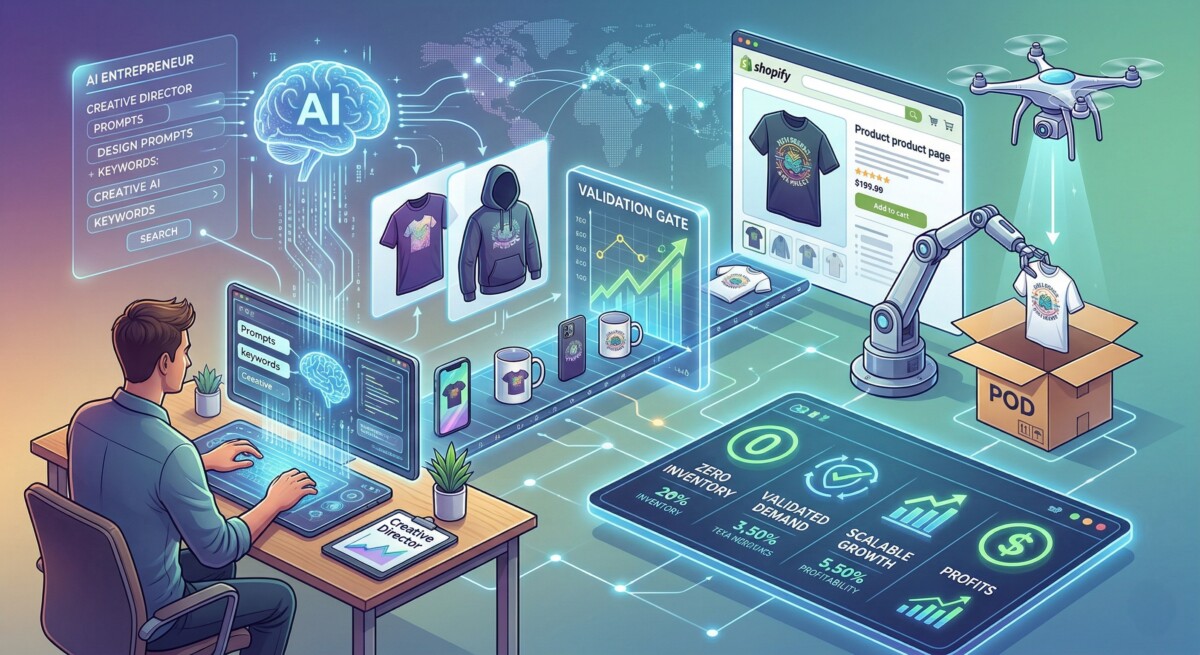
Quick Decision Framework
- Who This Is For: Shopify merchants already running a store who want to add print on demand as a zero-inventory revenue stream, test new product categories without supply chain risk, or build a branded merch line alongside their existing catalog.
- Skip If: You are looking for a fully managed dropshipping business where someone else handles everything. POD still requires creative direction, platform decisions, and ongoing margin management. If you are not willing to own those, this model will frustrate you.
- Key Benefit: A complete, stage-aware system for launching and scaling an AI-powered POD operation on Shopify, including platform selection by revenue stage, the real unit economics behind a custom hoodie, and the workflow stack that lets one person manage hundreds of SKUs without burning out.
- What You’ll Need: An active Shopify store, accounts on at least one POD platform (Printful, Printify, or Gelato), and access to at least one AI design tool. Budget for sample orders before you scale.
- Time to Complete: 18-minute read. First product live in 7 days if you follow the launch framework in section four.
The Printful and Printify merger created the largest POD entity in history. Most content covering print on demand in 2026 does not even mention it. That gap is where your opportunity lives.
What You’ll Learn
- Why the FYUL merger reshapes platform choice for Shopify merchants and what Gelato’s independence means for your sourcing strategy right now.
- How to choose between Printful, Printify, and Gelato based on your current revenue stage, not generic feature comparisons.
- What the practical AI design stack looks like in 2026, including which tools handle 80% of the work and where human judgment is still non-negotiable.
- How to go from zero to live product in seven days using a stage-gated workflow that does not require design experience or a development background.
- What the unit economics of a custom hoodie actually look like, and where the 24% three-year survival rate reveals the failure pattern most sellers repeat.
Forty-three percent of new Shopify stores that add print on demand as a revenue stream never see their first profitable month. Not because the model is broken. Because they picked the wrong platform for their stage, launched 150 designs without testing ten, and treated AI as a magic solution instead of a first-draft tool. The merchants scaling past $20K a month in POD revenue are doing something structurally different, and it has nothing to do with finding a better niche.
The global print on demand market sits at $12.96 billion today, projected to reach $102.99 billion by 2034 at a 26% compound annual growth rate, according to Grand View Research’s POD market analysis. There are roughly 228,000 POD stores operating right now. About 5% of all online shops are POD-focused. And only 24% of those shops are still running three years after launch. That last number is the one worth sitting with, because it tells you exactly where the model breaks down and what to do differently.
This guide is for Shopify merchants who already have a store and want to add POD intelligently, not for people starting from scratch with no context. If you are running $10K to $500K a year and want to understand whether POD belongs in your revenue mix, and how to set it up in a way that actually compounds, this is where to start.
What Print on Demand Actually Is (What Changed in 2026)
The Business Model Shopify Merchants Need to Understand
Print on demand is a fulfillment model where products are manufactured only after a customer places an order. No inventory. No upfront production cost. No warehouse. A customer buys a custom hoodie from your Shopify store, the order routes to your POD platform, that platform produces and ships the item directly to the buyer, and you keep the margin between your retail price and the platform’s base cost.
For merchants already running a Shopify store, this is not a replacement for your existing business. It is an additive revenue stream with zero inventory risk. You can test whether your audience wants branded merchandise without committing to a minimum order run. You can launch seasonal designs, limited-edition drops, or category expansions without touching your current fulfillment operation. The supply chain risk stays with the POD platform. Your job is creative direction, platform management, and margin optimization.
The market data supports the opportunity. A 26% compound annual growth rate over the next decade means this is not a trend that is peaking. It is a category that is still forming. The 228,000 stores currently operating represent early market penetration, not saturation. The merchants who build sustainable POD operations now, with the right platform infrastructure and AI workflow, will have a compounding advantage as the category matures.
The honest caveat: the 24% three-year survival rate is not a reason to avoid POD. It is a diagnostic. The stores that fail almost always follow the same pattern: they launch volume before validating demand, they pick platforms based on feature lists instead of stage fit, and they treat design creation as a solved problem the moment they get access to an AI image generator. The guide you are reading is designed to help you avoid all three.
The FYUL Merger and Why It Reshapes the Competitive Landscape
In November 2024, Printful and Printify announced a merger that created FYUL, now the largest combined POD entity globally. As of April 2026, all three brands under the FYUL umbrella, Printful, Printify, and Snow Commerce (the enterprise merch operation behind Paramount and Warner Bros. licensed products), continue to operate independently. Separate catalogs, separate pricing, separate accounts. The integration is ongoing.
This matters for Shopify merchants for two reasons. First, the combined entity now controls both in-house production facilities (Printful’s model) and the largest third-party print provider network in the industry (Printify’s 85-plus providers). That concentration gives FYUL significant pricing leverage and geographic reach as the integration matures. Second, the short-term uncertainty during consolidation is real. Provider quality consistency, platform roadmap priorities, and support responsiveness are all in flux as two large organizations merge their operations.
Gelato’s position in this landscape is worth understanding directly. Gelato operates 140-plus production partners across 32 countries, and their differentiation is local production: the item is manufactured as close to the customer as possible, which reduces shipping time and carbon footprint. In a consolidating market where the dominant player is focused on internal integration, Gelato’s independence and localized model make it a strategically valuable alternative. Their AI tooling, including CreateAI for design generation, Magic Mockups, AI-powered listing optimization, and the Velocity Switch for automated platform migration, is also more developed than what FYUL’s brands currently offer natively.
The practical implication: merchants who are currently on Printful or Printify should not panic, but they should understand that platform dynamics are shifting. Merchants evaluating POD for the first time should treat Gelato as a genuine first-tier option rather than an alternative to the “big two,” because the big two are now one entity in transition.
Choosing the Right Print on Demand Platform for Your Shopify Store
Printful vs. Printify vs. Gelato: What Actually Matters by Revenue Stage
The most common mistake in platform selection is treating this as a feature comparison exercise. The right platform depends on your current revenue stage, your margin requirements, and whether you are prioritizing speed, quality, or geographic reach. Here is how the three platforms actually stack up against those criteria.
At under $10K a month, Printify’s free tier and lower base costs make it the right starting point. The marketplace model, where you choose from 85-plus third-party print providers, means you can optimize for price during the validation phase. A custom t-shirt base cost on Printify typically runs $7 to $10 depending on provider and style, compared to $12 to $15 on Printful for comparable quality. When you are testing whether ten designs have any demand at all, that margin difference matters. The tradeoff is quality consistency: different providers use different equipment, and your product on a Monday from one provider might look slightly different from the same product on a Friday from another. Sample ordering before you scale is not optional at this stage.
At $10K to $100K a month, Printful’s in-house production model starts to earn its premium. Printful manufactures the majority of its products in its own facilities, which means quality control is centralized and more predictable. The branding options, custom packaging, branded inserts, and inside label printing, become meaningful when you are trying to build a brand rather than just move units. Printful’s premium plan, which unlocks up to 20% off base product costs, becomes economically justified when your volume supports it. The margin compression from Printful’s higher base costs is offset by lower return rates and stronger brand perception at this stage.
At $100K a month and above, Gelato’s localized production network delivers advantages that neither Printful nor Printify can match for international-facing brands. If a meaningful portion of your orders ship outside North America, Gelato’s local production model reduces both shipping time and cost significantly. A product printed in Germany and shipped to a German customer arrives faster and cheaper than the same product shipped from a US facility. For brands with sustainability positioning, the carbon footprint reduction from local production is a genuine, quantifiable differentiator. Gelato’s subscription plans offer up to 25% off product costs, and their Velocity Switch tool automates the migration of existing products from other platforms, which removes the operational friction of adding a second platform to your stack.
The most profitable sellers at scale are not mono-platform. They run Printify for domestic volume where cost matters most, Gelato for international orders where speed and sustainability positioning drive conversion, and occasionally Printful for premium branded products where quality consistency is non-negotiable. That is not complexity for its own sake. It is stage-appropriate platform strategy.
Platform Integration Depth with Shopify and Where Merchants Get Stuck
All three platforms integrate natively with Shopify through official apps, but the integration depth varies in ways that matter operationally. Gelato’s Velocity Switch is the most differentiated feature: it analyzes your existing product catalog from another POD platform and maps products automatically to equivalent Gelato items, handling variant matching, pricing, and listing transfer with minimal manual intervention. For merchants considering a platform migration or wanting to add Gelato as a parallel fulfillment option, this removes the single biggest barrier to switching.
Printful’s Shopify integration is the most polished for branding operations. Custom packaging, branded inserts, and inside label printing are all configurable directly within the Shopify integration without requiring separate setup in the Printful dashboard. If brand experience at unboxing is part of your strategy, Printful’s integration handles this more cleanly than the alternatives.
Printify’s marketplace model creates an operational consideration that most content glosses over: when you select a print provider for a product, you are selecting a specific facility. If that facility has an outage, a quality issue, or a capacity problem, Printify does not automatically reroute your orders. You need to monitor provider performance and be prepared to switch providers manually when issues arise. At low volume this is manageable. At high volume it requires a monitoring system.
The return handling reality is also worth naming directly. POD returns are complicated because the product was manufactured on demand. Most POD platforms do not accept returns for buyer’s remorse on custom products. What this means operationally is that your return policy needs to be explicit about what is and is not eligible for return, and your customer service workflow needs to be prepared to handle quality complaints, which POD platforms generally do cover, separately from preference-based returns, which they do not. Building this into your Shopify store’s return policy before you launch saves significant customer service friction later.
The AI Toolkit That Actually Powers a POD Business in 2026
AI Design Creation: From Concept to Print-Ready Asset
The practical reality of AI design tools in 2026 is that no single tool handles the full workflow from concept to production-ready file. The merchants running efficient design operations are using a connected stack, not searching for one perfect solution.
Midjourney and ChatGPT’s image generation excel at concept exploration and visual ideation. They are fast, flexible, and capable of generating dozens of direction options in the time it would take a human designer to sketch one. But their outputs require cleanup for commercial POD use. Transparent backgrounds need to be created separately. Production sizing, typically 300 DPI at print dimensions, requires upscaling. Text reliability in AI-generated images remains inconsistent, which means any design where typography is central needs additional processing. These are not dealbreakers. They are workflow steps that need to be planned for.
Printify’s built-in AI image generator is underutilized by most merchants. It is free, auto-upscales outputs to print quality, and integrates directly into the product creation workflow without requiring file export and re-import. For merchants who want to test design concepts quickly without leaving the platform, it is the fastest path from idea to mockup. The creative ceiling is lower than Midjourney, but for validation testing, the speed advantage matters more than the quality ceiling.
Adobe Firefly is the strongest option for merchants with IP risk concerns. Firefly is trained on licensed content and Adobe Stock, which means the commercial use rights are cleaner than most AI image generators. If you are building a brand where design ownership matters, or if you are creating designs that could be interpreted as derivative of existing IP, Firefly’s training data provenance is a genuine differentiator.
Canva Magic Studio and Kittl fill the gap for text-heavy designs and layout refinement. Both handle typography and graphic composition more reliably than image generation models, and both have direct integrations with POD platforms for mockup creation. For designs where the primary element is a phrase, a typographic treatment, or a graphic-plus-text combination, these tools outperform pure image generators.
The honest calibration: AI handles approximately 80% of design work in a modern POD operation. The remaining 20%, file preparation for print specifications, color accuracy verification, background removal, and resolution confirmation, still requires human judgment. Merchants who treat AI as a complete solution and skip the file prep step end up with products that look different in person than they did in the mockup. That is the source of the quality complaints, not the AI itself.
For merchants already using Shopify’s AI tools for other catalog operations, the Shopify AI Toolkit for store management covers how AI clients can connect directly to your store’s live data, which becomes relevant as you scale your POD catalog and need to manage product data at volume.
AI for Product Listings, SEO, and the Answer Engine Optimization Shift
Product copy generation has been the most obvious AI application in ecommerce for the past two years. Tools like Shopify Magic, ChatGPT, and Jasper can produce SEO-optimized titles, descriptions, and tags for a POD product in seconds. Gelato’s AI optimization writes marketplace-ready copy natively within the platform. For a merchant launching 50 products at once, this is the difference between a two-week listing process and a two-day one.
The emerging shift that most POD content is not addressing is the move from keyword optimization toward Answer Engine Optimization. AI shopping tools, including ChatGPT’s shopping features and Perplexity’s product discovery, are now surfacing products directly inside conversational interfaces. When a user asks “what is a good gift for a runner who loves vintage design,” the AI is not scanning keyword density. It is looking for product listings that answer questions clearly, provide specific details, and match the semantic intent of the query. Listings optimized purely for traditional search terms are increasingly invisible in these environments.
The practical implication for POD listings is that description quality matters more than keyword density. A hoodie listing that explains the weight of the fabric, the fit style, the print durability after washing, and who the design is specifically for will outperform a listing stuffed with “custom hoodie Shopify print on demand” in AI-mediated discovery. Bulk listing tools that use AI to analyze artwork and auto-generate keyword-rich metadata are becoming essential for catalog velocity, but they need to be configured to produce genuinely descriptive copy, not keyword-optimized filler.
For a deeper look at why raw AI output underperforms in both search and AI-mediated discovery, and how to build a post-generation workflow that produces listings that actually convert, the guide on generating AI product descriptions at scale covers the structural rewriting approach that separates high-converting listings from generic output.
Building the Workflow: How One Person Runs a Full POD Operation
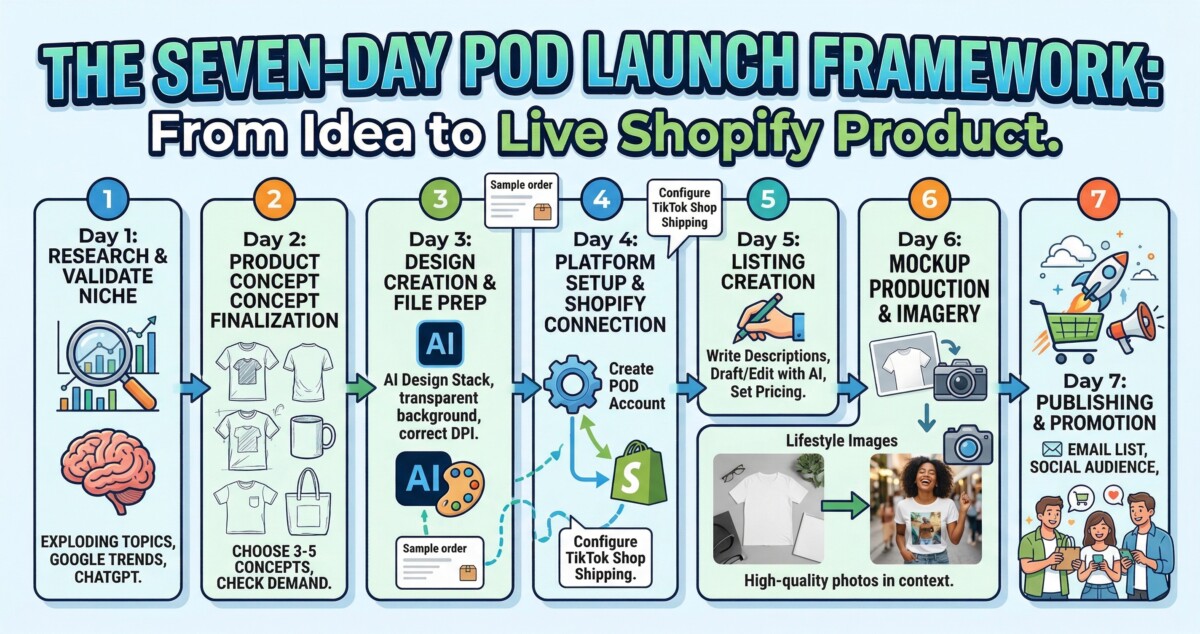
The seven-day framework below is a realistic, stage-gated workflow for getting a first POD product live on your Shopify store. It assumes you already have a Shopify store and a basic understanding of your audience. It does not assume design experience, technical skills, or a large budget.
Day one is niche research and demand validation. Use Exploding Topics, Google Trends, and ChatGPT to identify specific design themes or product categories with growing search interest. The goal is not to find a completely unoccupied niche. It is to find a specific angle within a popular category where existing products are generic and a more specific, better-designed product would stand out. Spend this day on research, not creation.
Day two is product concept finalization. Choose three to five specific design concepts based on your day-one research. Validate each concept against existing Etsy and Shopify listings to confirm there is demand but not saturation. Select your primary product type, whether t-shirt, hoodie, mug, tote, or poster, based on your audience’s likely price tolerance and the margin structure that makes sense for your store.
Day three is design creation and file preparation. Use your chosen AI design stack to generate concepts for your three to five designs. Run outputs through your file prep workflow: transparent backgrounds, correct DPI, correct dimensions for your chosen product. Order samples for your top two designs before you publish.
Day four is platform setup and Shopify connection. Create your account on your chosen POD platform, connect it to your Shopify store, and configure your product settings. If you are using Printify, select your print providers and confirm they are in the TikTok-eligible catalog if multichannel selling is part of your plan. For merchants who want to understand the TikTok Shop shipping setup for POD specifically, the guide on TikTok Shop shipping for print-on-demand sellers covers the Seller Shipping configuration that POD requires.
Day five is listing creation. Write product descriptions that answer real questions: what the product is made of, how it fits, how the print holds up after washing, and who it is specifically for. Use AI to draft, then edit for specificity. Generate mockups. Set your pricing based on the unit economics framework in section six.
Day six is mockup production and product imagery. Create lifestyle mockups using your POD platform’s mockup generator or a standalone tool like Placeit. The quality of your mockup imagery is the primary conversion driver for POD products. A generic flat-lay mockup on a white background performs significantly worse than a lifestyle image showing the product in context.
Day seven is publishing and initial promotion. Publish your first two to three products. Share them with your existing email list and social audience before running any paid traffic. Your first goal is to confirm that real people will pay real money for these designs. That validation is what tells you which designs to scale and which to kill.
Automation Stacks That Eliminate Manual Repetition
The merchants running lean, high-output POD operations are not working more hours. They have eliminated the manual repetition from their workflow using automation tools that connect the pieces of the operation end to end.
Zapier and Make are the connectors. A well-configured automation stack routes new orders from Shopify to your POD platform, sends order confirmation emails with tracking information, notifies your customer service queue when an order has a potential delay, and updates your inventory reporting without manual intervention. The setup investment is two to four hours. The return is measured in hours of manual work eliminated every week.
Predis.ai and similar social automation tools take your product assets and generate platform-specific social content with auto-posting schedules. For a POD business where new designs are launching regularly, the ability to turn a product mockup into a week of Instagram and Pinterest content automatically is a genuine operational leverage point.
AI customer service tools like Tidio handle the high-volume, low-complexity queries that dominate POD support: where is my order, when will it ship, what is your return policy. Routing these to an AI agent before they reach a human reduces support overhead significantly and keeps your response time fast even during launch spikes.
The most sophisticated workflow in the current POD ecosystem goes from Google Drive upload through OpenAI analysis, background removal, mockup generation, copywriting, Shopify draft creation, Slack approval, and auto-posting to Instagram and Pinterest, all without a human touching the product between design completion and social publishing. That workflow is available today using n8n and the tools described above. Building it takes a weekend. The operational leverage it creates compounds indefinitely.
Where Most POD Sellers Fail (and How to Avoid It)
The Premature Complexity Trap: Too Many Products, Too Many Platforms, Too Fast
Only 24% of POD shops survive three years. The failure pattern is consistent enough that it has a name in the merchant communities I have been part of for the last decade: premature complexity. It looks like this: a seller gets access to AI design tools, realizes they can generate 50 designs in a day, launches all 50 across three platforms before any of them have a single sale, and then spends the next six months managing a sprawling catalog of products that are not converting while burning money on ads trying to figure out which ones work.
The antidote is design velocity with testing discipline. Launch five to ten designs. Run them for 30 days with enough traffic to generate meaningful data. Identify the one or two that convert. Double down on those, meaning more variants, more colorways, more product types featuring that design. Kill the ones that do not convert. Repeat.
AI makes it dangerously easy to create volume without strategy. The design creation barrier is essentially gone. The validation step, actually confirming that real customers will pay for a specific design, is still the hard part, and it still requires time, traffic, and honest data interpretation. Merchants who skip validation and go straight to volume are the ones in the 76% that do not make it to year three.
The stage-aware version of this principle: at under $5K a month, your only job is to find two or three designs that convert. At $5K to $20K, your job is to understand why those designs convert and build a systematic process for finding more like them. At $20K and above, your job is to build the automation infrastructure that scales what is already working without requiring proportionally more of your time.
Quality, IP Risk, and the Sustainability Question Merchants Cannot Ignore
AI-generated designs carry intellectual property risks that most POD content does not address honestly. The core issue is training data: most AI image generators are trained on datasets that include copyrighted images, and the outputs can sometimes bear resemblance to existing copyrighted works. Adobe Firefly’s approach, trained on licensed content and Adobe Stock, reduces this risk meaningfully. Most other AI image generators do not offer the same protection, and the legal landscape around AI-generated content and copyright is still evolving in 2026.
The practical guidance: if your designs are abstract, typographic, or clearly original in concept, the IP risk is low. If you are generating designs that reference existing characters, logos, brand identities, or recognizable artistic styles, you are in riskier territory regardless of which AI tool you use. Sample your designs through a reverse image search before scaling any design that could be interpreted as derivative.
Quality consistency is the other hidden problem in POD, particularly on Printify’s marketplace model. Your product might be printed by different providers with different equipment on different days. The print that looks perfect on your sample order might look different on the hundredth production run from a different facility. Sample ordering is non-negotiable before you scale any design. This is not a nice-to-have. It is the difference between a product that builds your brand and one that generates returns and negative reviews.
On sustainability, Gelato’s local production model is the most credible sustainability claim in the POD space. Producing near the customer genuinely reduces shipping distances and carbon footprint in a way that is measurable, not just marketed. For brands with an audience that cares about environmental impact, this is a real differentiator, not greenwashing.
Profit Margins, Pricing Strategy, and the Economics That Actually Work
Real Numbers: What POD Merchants Keep After Platform Fees, Product Costs, and Marketing
Average POD profit margins run 15% to 40% depending on product category, niche positioning, and perceived brand value. Generic products in competitive categories, the basic t-shirt with a trending phrase, compress toward 10% to 15%. Personalized, premium, or niche-specific designs with a clear audience can reach 40% to 50% when the brand is strong enough to support a price premium.
Here is what the unit economics actually look like for a custom hoodie, one of the highest-margin POD product categories:
That 34.5% margin assumes you are on Printify’s premium plan, which offers up to 20% off base product costs, and that your marketing cost per unit is $5, which is achievable through organic and email traffic but tight if you are running paid ads. Gelato’s subscription plans offer up to 25% off product costs, which shifts the math further in your favor for international orders where Gelato’s local production also reduces shipping costs.
The margin compression risk is real. If your marketing cost per unit climbs to $15 because you are running paid acquisition against a cold audience, your net margin drops to $7.24, or 14.5%. That is a viable business if your volume is high enough, but it is not the 40% margin that POD is often marketed as delivering. The merchants who hit and sustain 40% margins are doing it through organic traffic, strong email retention, and repeat purchase rates that reduce their blended customer acquisition cost over time.
Scaling from Side Hustle to Six Figures: The Revenue Milestones That Change Your Approach
The operational inflection points in a POD business are more predictable than most merchants realize, because the failure modes at each stage are consistent.
At $1K to $5K a month, your only metric is design-to-sale conversion rate. You are in validation mode. Every dollar of marketing spend should be generating data about which designs convert, not revenue. If you are spending more on ads than you are making back in margin during this phase, you are testing too slowly or targeting too broadly.
At $5K to $20K a month, automation becomes the priority. You have confirmed that certain designs sell. The question is whether you can scale the volume without proportionally scaling your time. This is the phase to build your automation stack, add a second POD platform for geographic reach or margin optimization, and consider whether paid advertising makes sense given your current margin structure.
At $20K to $100K a month, brand building is the lever that separates the stores that plateau from the ones that keep compounding. Generic POD stores at this revenue level are vulnerable to competitors who can replicate their designs and undercut their prices. The stores that protect their position are the ones that have built a recognizable brand identity, a loyal customer base, and a product line that feels coherent rather than opportunistic. Custom packaging, branded inserts, and quality consistency monitoring become operational priorities at this stage. The hybrid model, where your top-selling designs move to bulk inventory while the long tail stays POD, also becomes economically viable and worth evaluating.
The transition from “person with a Shopify store selling POD products” to “brand with a POD fulfillment strategy” is not a revenue milestone. It is a decision. The brands that make that decision early, before the revenue forces it, are the ones that sustain the growth.
The Future of AI-Powered Print on Demand for Shopify Merchants
What the FYUL Merger Means for Platform Competition Over the Next 18 Months
The FYUL consolidation creates a dominant player with both in-house and network production capabilities. For merchants, the near-term implications are mixed. On the positive side, the combined entity’s scale should eventually translate into broader product catalogs, improved logistics infrastructure, and potentially more competitive base pricing as the operations integrate. On the risk side, reduced competition in the platform market historically leads to slower innovation and less merchant-friendly pricing over time.
The specific things to watch over the next 18 months: whether FYUL integrates its catalogs or keeps Printful and Printify operating as genuinely separate products, how the platform handles the quality consistency challenges that come with network-model production at scale, and whether Gelato’s independence allows it to accelerate its product catalog and geographic coverage as a credible counterweight to the consolidated entity.
For merchants currently on Printful or Printify, the practical advice is to continue operating as normal while building familiarity with Gelato’s platform. Having a second platform relationship established before you need it is better than scrambling to migrate when a platform change forces your hand.
AI Agents, Personalization at Scale, and Where This Model Goes Next
The next wave in POD is not AI for design. That is already here and already table stakes. The next wave is AI agents that handle entire business workflows: monitoring trend data, generating design concepts, creating listings, adjusting pricing in response to competitive signals, and managing customer service, all with minimal human oversight and continuous learning from the store’s own performance data.
Personalization Studio tools, including Gelato’s implementation, already let end customers customize products at checkout, choosing colors, adding names, selecting design elements. This capability is driving 2x to 3x higher average order values in the stores using it, because a personalized product has higher perceived value and lower price sensitivity than a generic one. Merchants who add customer-facing personalization to their POD offering are not just selling a product. They are selling an experience that cannot be replicated by a competitor offering the same base design.
The merchants who will win in this environment are building systems, not just stores. They are treating AI as operational infrastructure, not a novelty tool. They are making decisions about platform architecture, automation stack design, and brand positioning that will compound over years, not quarters.
For a comprehensive look at how agentic commerce infrastructure is reshaping what Shopify merchants need to build right now, the guide on agentic commerce for Shopify merchants covers the 30 to 90 day execution plan in detail. The POD workflow you build today is one component of that larger infrastructure.
The stores that treat print on demand as a product category to exploit will find it increasingly competitive and margin-compressed. The stores that treat it as a system to build will find it compounding in ways that generic dropshipping never could, because design, brand, and customer relationship are assets that belong to the merchant, not the platform.
Frequently Asked Questions
What is the difference between Printful, Printify, and Gelato for a Shopify store in 2026?
Printful and Printify are now both owned by FYUL following their November 2024 merger, though they continue to operate independently with separate catalogs and pricing. Printful uses primarily in-house production facilities, which gives it stronger quality consistency and better branding options like custom packaging and branded inserts. Printify operates a marketplace of 85-plus third-party print providers, which gives it lower base costs but more variable quality across providers. Gelato is an independent platform with 140-plus production partners across 32 countries, differentiated by its local production model: products are manufactured close to the customer, which reduces shipping time and carbon footprint. For most Shopify merchants, Printify makes sense under $10K a month for cost reasons, Printful from $10K to $100K for quality and branding, and Gelato becomes essential at scale for international reach and sustainability positioning.
How much can I realistically make with print on demand on Shopify?
Average POD profit margins run 15% to 40% depending on product category, niche specificity, and brand strength. A custom hoodie priced at $49.99 with a $24 base cost on Printify’s premium plan nets approximately $17 per unit after Shopify fees, payment processing, and a $5 marketing cost per unit, which is a 34.5% margin. Generic products in competitive categories compress toward 10% to 15%. Niche-specific or personalized products with strong brand positioning can reach 40% to 50%. The honest caveat: only 24% of POD shops are still operating three years after launch. The ones that survive and scale have validated designs before scaling volume, built automation to manage operations efficiently, and treated brand building as a priority alongside product creation.
What AI tools do I actually need to run a print on demand business in 2026?
The practical stack has three layers. For design ideation, Midjourney or ChatGPT image generation for concept exploration, with Adobe Firefly as the stronger option if commercial IP protection matters to your brand. For design refinement and text-heavy designs, Canva Magic Studio or Kittl. For mockups and listings, your POD platform’s native AI tools handle most of this without requiring separate software. For automation, Zapier or Make to connect your store, POD platform, email system, and social channels. AI handles approximately 80% of the design workflow. The remaining 20%, file preparation, color accuracy, and resolution verification, still requires human judgment before you send files to production. The merchants who skip that last step are the ones getting quality complaints.
How do I price my print on demand products to make a real margin?
Start from your unit economics, not from what competitors charge. Calculate your base product cost plus platform fees plus payment processing plus a realistic marketing cost per unit. That total is your floor. Your retail price needs to be high enough above that floor to generate a margin worth the operational effort. For most POD products, a 2x to 2.5x markup on base cost is the starting point: a $24 hoodie should retail at $49 to $59. Resist the temptation to undercut competitors on price. POD products are not commodities when the design and brand are strong. Merchants who compete on price in POD are compressing their margins toward zero against suppliers who can always go lower. Compete on design specificity, brand relevance, and product quality instead.
What is the biggest mistake Shopify merchants make when adding print on demand?
Launching volume before validating demand. The most common failure pattern is using AI design tools to generate 100 or 200 designs, listing all of them before any have sold, and then spending months managing a sprawling catalog of products that generate no revenue while burning money on ads trying to figure out which ones work. The correct sequence is: launch five to ten designs, run them with enough traffic to generate real conversion data over 30 days, identify the one or two that convert, double down on those with more variants and product types, and kill the ones that do not perform. AI makes it dangerously easy to create design volume. The validation discipline is still the hard part, and skipping it is what puts stores in the 76% that do not survive three years.
