The business-to-business (B2B) industry has moved online as the typical decision-making process for business customers has shifted from trade show attendance to independent online research.
Successful B2B companies are those that handle both simultaneously, easing pain points throughout the buying process and reaffirming to customers that they’re making the right decision.
The problem? Business buying decisions aren’t taken lightly. Several stakeholders form the B2B buying group; purchases must provide a clear return on investment before giving the seal of approval.
This guide shares how to handle those complexities as potential customers progress through the B2B buying process.
The B2B buying process is the decision-making exercise buyers go through when purchasing from another company. From recognizing a problem to selecting a supplier’s product, every buyer goes through a decision-making process before investing their organization’s money into a new product. As you explore options, remember the unique advantages offered by an experienced electronic parts supplier that can cater to your specific needs.
According to Gartner, the average B2B buying decision involves six to 10 people, each armed with more than four pieces of information they’ve independently gathered as part of their decision-making process.
The average B2B sales process involves these five roles:
“I’ve found that a typical B2B buying process will involve at least three people: the CEO or owner of the business, their head of sales, and a VP of operations or other department head who has been tasked with making the final decision.”
—Kader Meroni, founder of Atlas Tea Club
The vast majority of B2B buying decisions can be broken down into six stages—though buyers don’t necessarily follow the path linearly. They can hop between stages, reverse when they need extra time to make decisions and skip over certain steps to revisit later.
As Kader Meroni, founder of Atlas Tea Club, says, “There’s no one-size-fits-all model for the buying process. It will always be different, depending on the company and industry you’re in.”
The first stage in the B2B buying process is when the initiator recognizes a problem. Also known as a pain point, it’s when something happens to trigger a buyer into thinking something could be done to alleviate the issue (or make their lives easier).
We can see this in action with a small boutique. The owner is struggling to drive foot traffic to the store because the inventory it stocks doesn’t excite local shoppers in the area. A lack of footfall would be the first step in replenishing inventory. The retailer has recognized the problem, and their buying journey begins.
Once B2B buyers have identified a problem they need to solve, the next stage is to explore a solution. Initially, initiators are unlikely to know the exact product(s) that will solve their problem. The main objective throughout this stage of the buying process is to confirm that a solution is possible.
Using the same boutique example: the retailer doesn’t know which products will improve footfall, but its owner starts to explore what might solve the issue. That could include:
Buyers begin taking their buying decision more seriously once they start detailing the requirements of its next purchase. They move from “We know this is a problem and have a rough idea of how to solve it” to “We need XYZ in whatever we buy to solve it.”
If we continue with the same boutique example, the retailer might detail the following requirements when searching for inventory that will increase in-store foot traffic:
Buyers can begin to evaluate suppliers that offer products or services that meet their criteria.
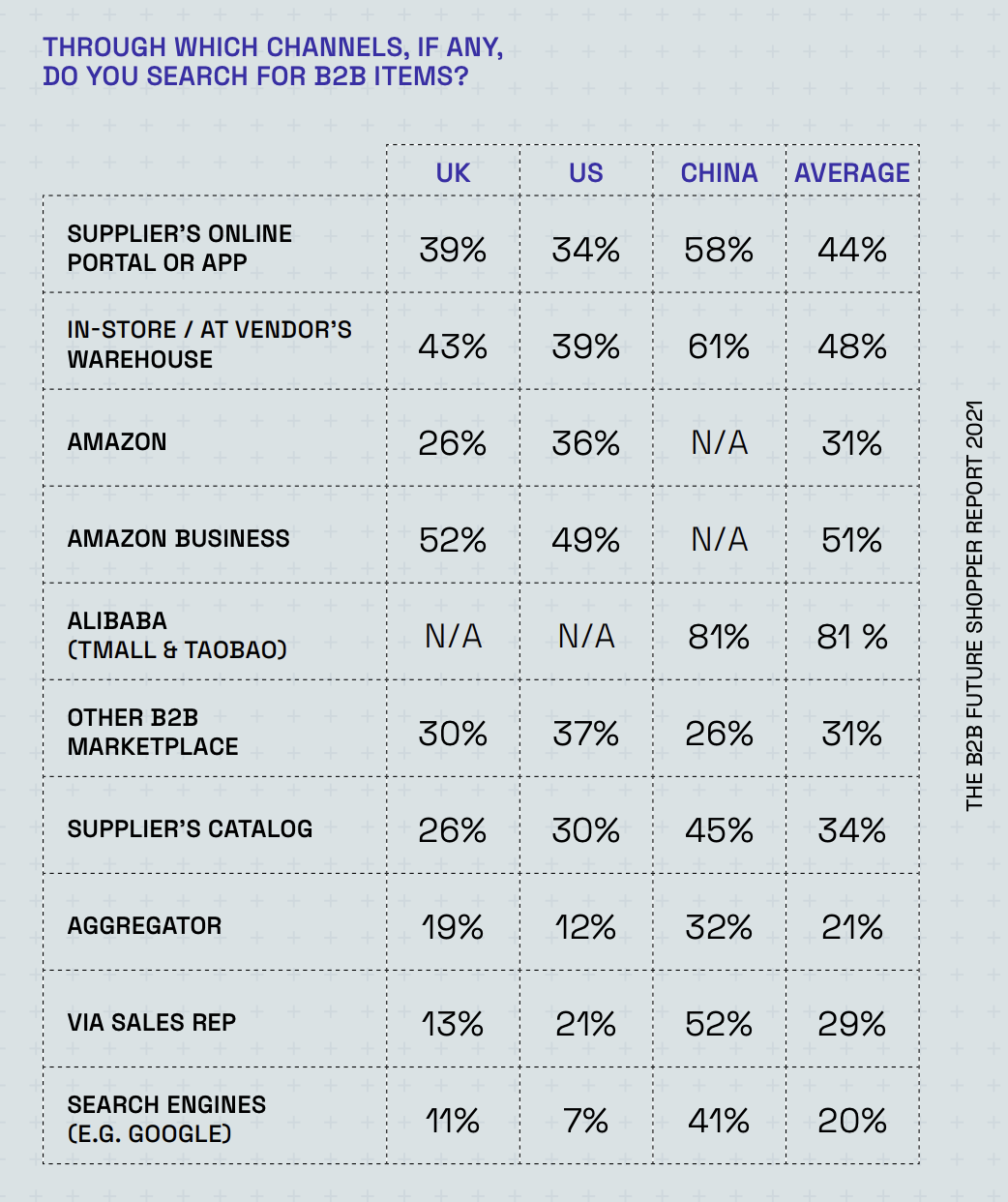
According to Gorilla Group’s B2B Future Shopper Report, a supplier’s app or portal is the top digital channel B2B buyers use when searching for new items. That’s shortly followed by stores and warehouses, B2B marketplaces like Amazon, and search engines.
Product quality aside, B2B buyers shortlist potential suppliers and evaluate other aspects of selecting them. This includes the wholesale price of a product, reviews from other customers, any sales or marketing promotions, and shipping and fulfillment timescales. The ideal supplier beats its competition by catering to as many of these demands as possible.
“Our clients are interested in finding suppliers in the United States to avoid many supply chain issues that are occurring with importing products. Also, they want their products delivered fast! We aim to ship within 48 hours from our dedicated warehouse, but more often it’s within one day.”
—Kami Myers, online sales manager at Squishface
Business buyers have one last hoop to jump through before completing a B2B purchase: securing buy-in from stakeholders, including decision-makers and buyers.
This is a relatively quick step for small businesses with fewer employees. However, as an organization expands, so does its ability to quickly approve new purchases. Instead of a single founder approving purchases, a larger boutique might need to involve the head of merchandising, store manager, and business development manager during the validation stage of any B2B purchase decision.
Once stakeholders approve, the B2B buying process comes to a close. The organization has the green light to purchase goods or services from its chosen supplier.
Why does a buyer purchase products in the first place? Most B2B buying decisions happen as a result of one of three factors.
Loss aversion bias often plays a role in B2B buying decisions, too. Psychology makes it more difficult to lose something than to gain the same thing. Play on this in your B2B marketing strategies—the idea that someone can avoid losing something by purchasing your products—to sway their decision.
The B2B buying process is lengthy. Unlike business-to-consumer (B2C) transactions, where only one person is involved, it can take groups of six (or more) people months to decide.
Sophie Gibson, the brand’s PR and communications assistant, says that for S’wheat, “B2B customers can take a longer time to convert when compared to D2C customers as the B2B process tends to be more complex due to our customized co-branding and B2B sales being of higher order value. It’s important to factor this into your cash flow to ensure your sales turnover remains steady.”
Let’s look at four ways to speed up the B2B buying process so you can serve more buyers in less time—while helping each one make a confident decision.
Businesses often enlist the help of sales reps to assist potential customers throughout their buying decision.
However, an increasing number of buyers are opting for a self-serve approach. Studies show that sales reps have just 5% of a customer’s time during their B2B buying journey, with 44% of millennials preferring no sales interaction when making B2B purchase decisions.
And according to Gartner, B2B buyers spend just 17% of their time in the purchase process meeting with potential suppliers. The bulk of their time is spent researching independently online.
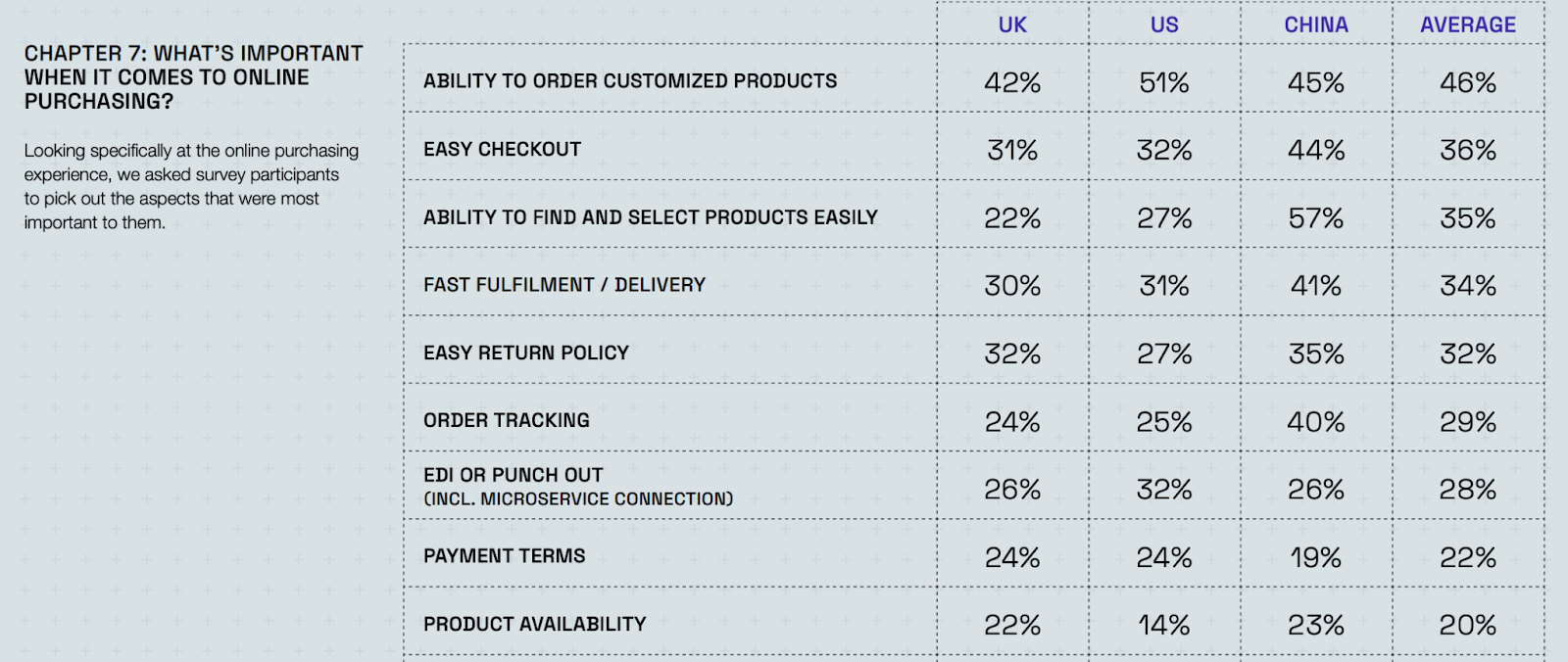
So, what do buyers want throughout this independent buying process? Some 90% expect a DTC-style customer experience from B2B vendors. That includes easy checkout, the ability to find and select products quickly, and a clear returns policy.
Enlist the help of a B2B ecommerce platform like Shopify. Operate two storefronts—one password-protected for B2B, another for B2C—through the same back end. Business buyers can create their profile to:
“B2B on Shopify allows us to leverage technology to streamline and automate our wholesale processes, so we can maintain a high level of focus on retail consumers.” —Andy Knox, general manager at Van Compass
SwagUp sells swag to other companies through its B2B storefront. Founder Michael Martocci says the business has “a mix of ecommerce blended with a more traditional software sales process.
“We allow prospects to head to our site and make an account and get a ton of value before ever committing or paying for anything. We try to eliminate the friction in the process. We give prospects a few different lead types to signal their intent and use data enrichment services like Clearbit to learn more about the companies these buyers work for to understand how we should value them, which differs from B2C.”
Michael adds, “Some prospects go through a [business development representative] BDR team who works to get leads to a point where they are sales qualified and something we should spend more time on, while others go into marketing nurture sequences til they are ready, some go straight to account execs, and some self-serve.
“In B2B, traditionally, customers would get assigned to a sales rep always, but there’s this push to being more self-serve and for us, we now have customers willing to place $50,000 orders online on their own with minimal to no hand holding by reps. If you can get large B2B AOVs with low sales overhead, you can build a pretty profitable business.”
Business customers compare several options before choosing a supplier. Research shows that half of them get inspiration from B2B marketplaces like Amazon or Alibaba, beating a traditional paper catalog and sales team interaction.
The marketplace sales process is faster, since buyers will already have an account. They can save products to an online wish list, compare specifications, and benchmark prices within a single website tab.
You’re also able to lean on the existing reputation and supply chain network of a marketplace, mainly if you’re also using its fulfillment services, to speed up B2B buying decisions. Buyers are confident that if they purchase through Amazon Business, for example, their order will arrive the following day (providing it’s eligible for Prime delivery).
The DTC marketing industry moves fast. Customers have high expectations from the personalized experiences DTC brands deliver. The same is true for B2B buyers.
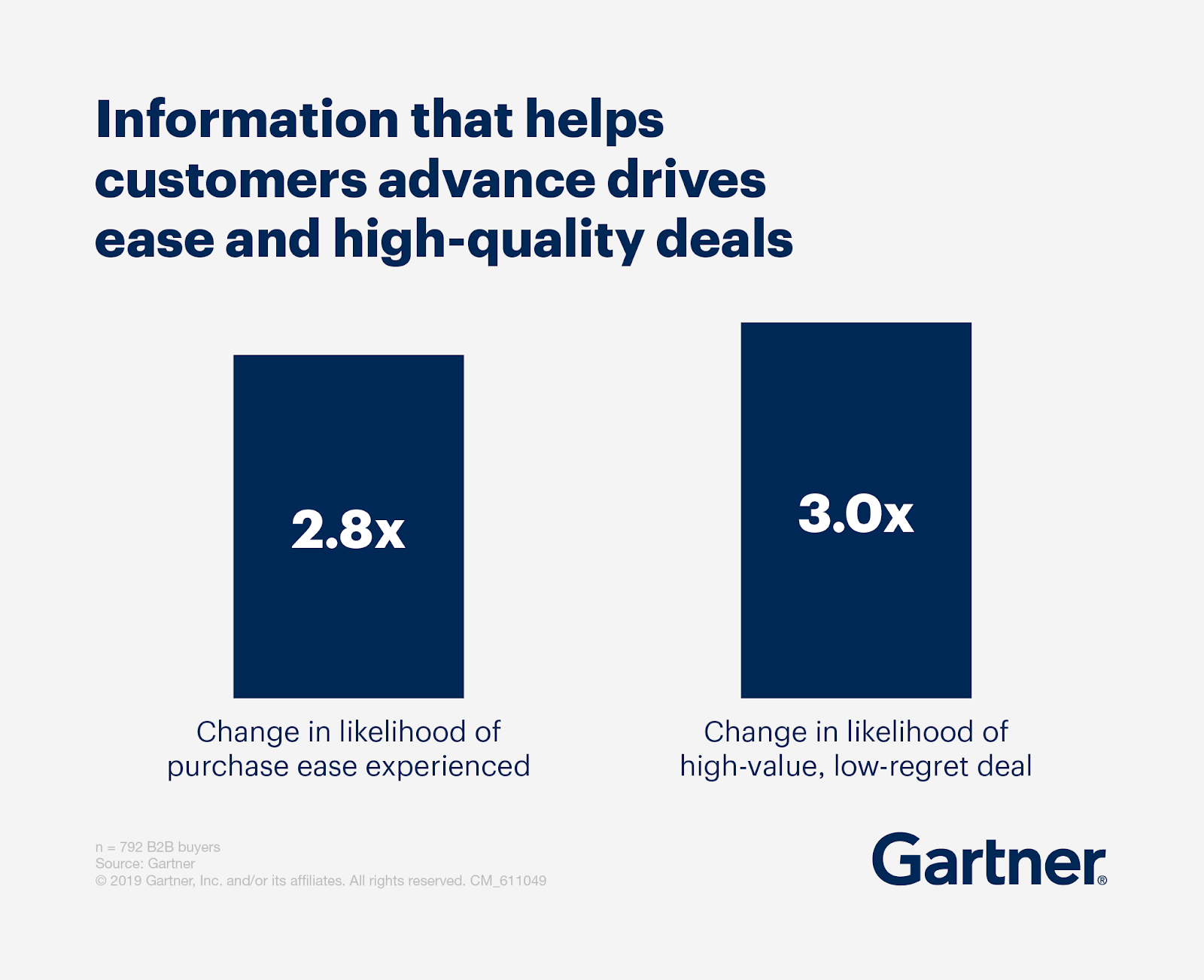
Gartner found customers who received helpful information from suppliers throughout their decision-making process were 2.8 times more likely to experience a high degree of purchase ease. They were also three times more likely to place a larger order with less regret.
Buyer enablement focuses on what the B2B buyer needs to make a confident decision. To do this, understand their pain points—the problem they’re trying to solve. Personalize your marketing campaigns to aggravate the issue and position your product(s) as the solution. This type of marketing and promotion influences 16% of global B2B buyers to make a purchase.
As part of your buyer enablement strategy, share the following:
Kader Meroni of Atlas Tea Club says, “As a buyer myself, I know how difficult it can be to tell which products will work best for me. One day I might be looking for something simple, and another day, I might be looking for something more complex. It’s hard to know what you want when you don’t even know what you need!
“I’ve found that working with a vendor who understands my needs makes it much easier for me to decide whether or not the product is right for my company.”
The B2B buying process doesn’t conclude once customers place their first B2B order. Strong relationships post-purchase influence a buyer’s likelihood of making repeat orders, generating consistent revenue for your company.
“Due to the nature of the products they sell, B2B businesses often have a smaller pool of potential customers than B2C businesses. However, these customers are usually repeat buyers since they tend to purchase the same or similar products regularly. For an ecommerce business selling B2B, this repeat business can be a major source of revenue.”
—Brian Lim, founder, and CEO of INTO THE AM
Make customer support easily accessible to first-time buyers. Be proactive rather than reactive, and share advice that makes it easier for retailers to resell your products—such as marketing campaigns, trends you’re noticing, or product display ideas.
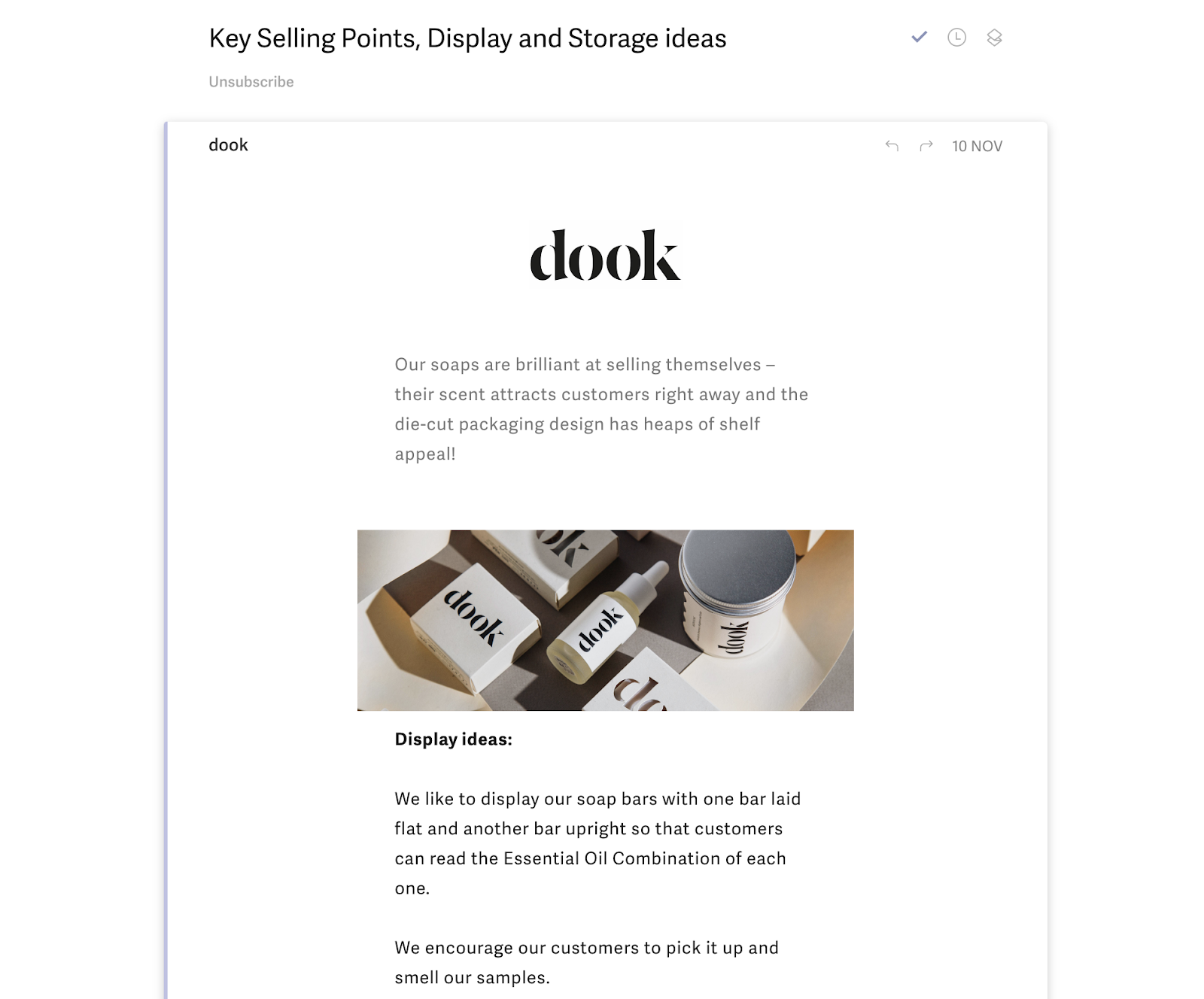
Dook, for example, shares vital selling points, display, and storage ideas in an email newsletter to B2B buyers after they place their first order.
Some 38% of global B2B buyers identified customer satisfaction as one of their top KPIs. Another four in 10 wanted repeat ordering functionality that didn’t force them to place orders with a salesperson manually.
Enable this on your B2B storefront with company profiles. Remind buyers of purchased items, and encourage them to invite colleagues to the company profile. Anyone in the organization can view past orders and repurchase the same inventory (provided they have the correct permission level), allowing them to validate and approve new purchases quickly.
The B2B buying process might still be lengthy, but it’s not as convoluted as pre-pandemic decisions that involved in-person meetups before committing to a B2B order.
Accept that business customers have several hoops to jump through before investing their organization’s resources into new products. Deliver personalized marketing campaigns that aggravate and solve a buyer’s pain points while still being mindful of customers’ preference to self-serve.
With B2B on Shopify, you’ll make it as easy for them to do so. Have a single platform that allows buyers to create company profiles and invite stakeholders to contribute without investing thousands into two separate online storefronts to differentiate B2B and B2C sales.
The B2B buyer journey is a buyer’s process when purchasing a new product or service. It starts with recognizing a problem that needs solving, validating a specific solution, and getting buy-in from stakeholders.
Recognizing a problem (often a pain point) is the first step in any B2B buying process. Once an organization is aware of an issue, they begin the decision-making process to solve it.
The B2B sales process is longer than B2C because several people are involved in the buying process. Business buyers also have more pressure to produce ROI on goods or services the organization invests in.