

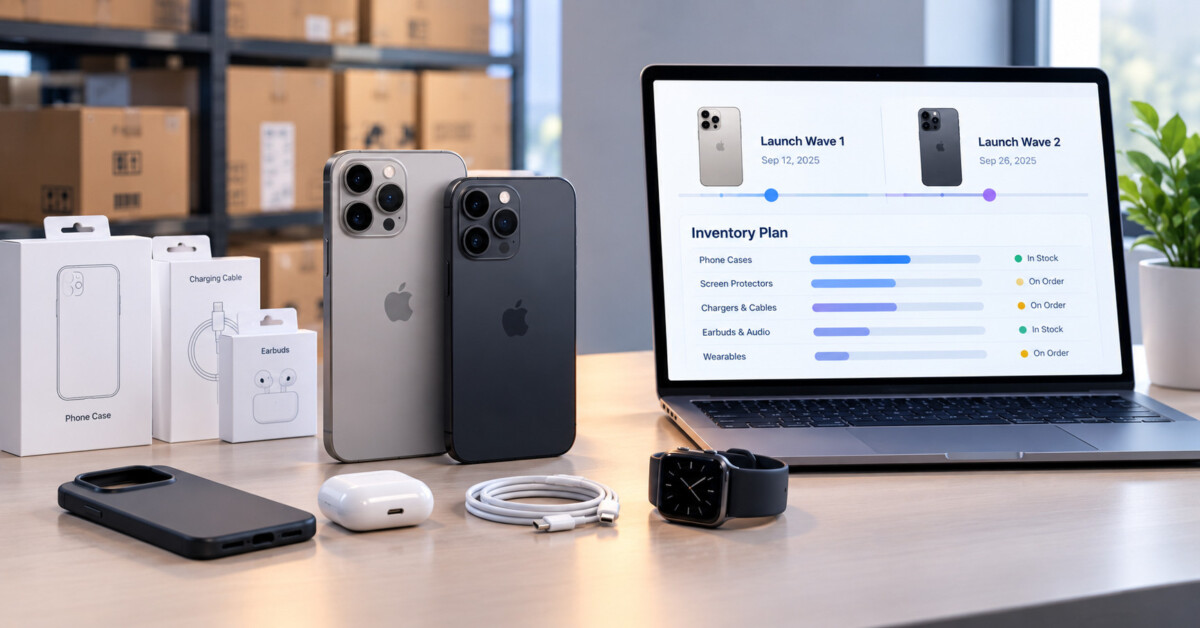
Accessory brands selling into Apple’s release calendar protect margin by committing early to Pro sizes, carrying two device generations at most, and clearing the older one through bundles and graded seconds instead of blanket discounts. The iPhone 18 split launch now spreads that bet across two windows.
When your catalog expires on someone else’s schedule, the product decisions that matter most are made before you see the product. The launch event only tells you whether you guessed right.
On September 9, 2026, Apple announced the iPhone 18 Pro and iPhone 18 Pro Max. Pre-orders opened three days later. By September 18 the phones were in stores. For every brand that sells accessories for those devices, the most important inventory decisions of the year had already been made weeks earlier, with dimension data, leaks, and educated guesses.
This year the calendar got stranger. Apple shipped only the Pro models in September, and the standard iPhone 18 is reportedly coming in spring 2027. That is what people mean by the split launch: one product generation released across two seasons. For an accessory brand, it means two launch windows, two demand curves, and twice as many chances to get stuck holding the wrong stock.
This guide uses one independent leather case maker as a working example, because its storefront shows the whole cycle in public: new generation collections, the previous generation still on sale, bundles, and discounted seconds. If your products live or die by someone else’s release schedule, the same playbook applies to you whether you’re doing $10K months or $400K months.
Apple’s exit from leather opened a door because it removed the default choice for the shoppers most willing to pay for a premium case, and that default has not come back in three product cycles. On September 12, 2023, Apple announced it was ending the use of leather across all of its product lines, including iPhone accessories and Apple Watch bands, and replacing it with a textile called FineWoven made from 68 percent recycled content.
FineWoven did not last. A year later, MacRumors reported that Apple discontinued its FineWoven cases after widespread complaints about how quickly they dirtied and frayed, leaving silicone and clear cases for the iPhone 16. For the iPhone 18 Pro, Apple’s own case lineup is a $49 Silicone Case, a $49 Clear Case, and a $59 TechWoven Case. Still no leather.
Demand did not disappear when Apple walked away. It scattered into search results and independent storefronts. RYAN London is a useful example. The Greenwich workshop began in 2013 when its founder made his first case from his mother’s old handbag, and today a shopper looking for an iPhone 17 or 18 leather case finds full-grain, vegetable-tanned options there at £59, roughly the price band Apple charges for its own non-leather cases. The brand also states it has served more than 75,000 customers, which is its own figure rather than an audited one.
The lesson reaches well past phone cases. When a platform owner abandons a material, a feature, or a price tier, the customers who valued it don’t vanish. They go looking. If you’re under $500K a year, a category the giant just left can be a cleaner entry point than one it still dominates. If you’re already scaling, it’s worth asking which of your platform partner’s recent exits your customers are quietly searching around right now.
The split launch turns one September inventory bet into two smaller ones: Pro and Pro Max sizes now, and standard iPhone 18 sizes later, reportedly in spring 2027. Apple’s own announcement covers only the iPhone 18 Pro and iPhone 18 Pro Max, with pre-orders from September 12 and availability from September 18. The spring timing for the standard models comes from reporting, not from Apple, so treat it as a planning assumption rather than a date.
9to5Mac reported ahead of the event that the iPhone 18, iPhone 18e, and a second iPhone Air are expected in spring 2027, and that the 18 Pro models would keep the same general design and display sizes as the 17 Pro. That second point is where brands get burned. Same general design is not the same thing as same case fit. A small change to a camera plateau or button position can turn last year’s stock into returns, which is why case makers that take fit seriously, RYAN London included, list the 18 series as its own collection rather than relabeling 17 stock.
The practical effect is on cash. Under the old single launch, you placed one large order, sold hard for ten weeks into the holiday season, and cleared the rest by spring. Now the Pro buyers arrive in September with full price tolerance, while the standard model buyers arrive months later with more price sensitivity and less urgency. Apple also introduced its first foldable, iPhone Duo, which adds a form factor with no sales history at all.
Size the two bets differently. Commit to the Pro sizes with conviction, because that is where the motivated September demand sits. Keep the spring order small and conditional until you see real pre-order or waitlist numbers. Treat the foldable as a test SKU, not a line.
An accessory brand should actively stock two device generations, current and previous, and treat anything older as a clearance line with a set end date. Beyond two, SKU count grows faster than sales, and the cash tied up in slow sizes starves the launch you actually need to fund.
The math compounds quickly. Illustrative example: three phone models per generation, three colorways such as black, saddle brown, and dark brown, and four generations on the shelf gives you 36 case SKUs before you add a single watch strap, sleeve, or wallet. RYAN London’s own navigation lists iPhone collections from the 15 series through the 18 series, plus two Samsung lines, which shows how naturally even a focused workshop accumulates generations. The question isn’t whether older lines still sell. It’s whether each one earns its share of cash, shelf space, and product page maintenance.
This is the most common pattern in Shopify brands between $500K and $2M a year: complexity arrives before the fundamentals can carry it. Too many variants, too many channels, too many half-supported lines. The fix is the same one covered in the four components of an inventory reduction strategy, starting with SKU rationalization: rank every generation by sell-through, keep the top two fully stocked, and reduce older generations to your single best colorway.
Make the rule enforceable rather than aspirational. Tag every product with its device generation in Shopify, then use Shopify Flow, the free automation app, to flag any older-generation variant that falls below its reorder point so someone decides deliberately whether to reorder or let it sell through. At $50K a year you can do this in a spreadsheet. At $2M, you need it automated, because nobody remembers which of 60 variants they meant to retire.
Clear older stock through structures that either add value or explain the discount, such as bundles and graded seconds, instead of sitewide markdowns that teach customers to wait for the next sale. The goal is to move units without resetting what your full price means.
RYAN London’s storefront shows both moves. Its iPhone 17 series bundle pairs a case with a screen protector, which lifts the order value on a generation that is no longer the newest. Its “Almost Perfect” line sells cosmetically imperfect cases at a stated discount, for example an iPhone 16 Pro Max case at £45 instead of £55, about 18 percent off. The discount comes with a reason the customer can see, so it doesn’t signal that everything will eventually go on sale.
A third move comes straight from how people buy premium accessories: coordinated sets. A buyer who chose a black or saddle brown leather case is a strong candidate for a matching watch strap or wallet in the same leather and tone. A matched set raises order value without touching the case price, and it works for the older generation too, because the strap fits regardless of which phone the customer carries.
On Shopify, native product bundles require a bundles app to create, and the right app depends on your stage. Our stage-matched guide to Shopify bundle apps covers which ones sync component inventory correctly, which matters here: a bundle that doesn’t deduct the case from stock will oversell exactly the generation you’re trying to wind down. Test one bundle end to end, from order to fulfillment, before you promote it.
Commit production for the premium sizes before launch day, because that is when the most motivated buyers arrive, and hold back on the models and colors you can’t validate yet. Waiting for the phone to ship before ordering means missing the first weeks after launch, when new owners are actively shopping for protection.
The risk sits in fit. Case makers depend on dimension data that arrives before the device does, and pre-launch reports are not guarantees. A sensible structure is a first run on the Pro and Pro Max in your two best-selling colorways, sized to cover early demand rather than the whole season, with every other combination held back. Illustrative example: a brand that sold 900 Pro Max cases in the first six weeks of last year’s cycle might commit to 600 units in two colors up front, then reorder weekly against actual sell-through once the phone ships and fit is confirmed.
For the combinations you haven’t committed to, pre-orders let customers tell you what to make. Our breakdown of pay-now versus pay-later pre-orders covers the trade-offs. Pay-later works well for the spring standard models: collect intent now, charge when stock lands, and commit production only for the variants that clear your threshold.
Stage matters here. Under $500K a year, a missed launch window hurts, but an overcommitted one can sink the quarter, so lean conservative. Above $2M, the cost of stocking out in launch week usually outweighs the cost of a modest overage, because paid acquisition is already running and every stockout wastes it.
Launch-week demand comes from being present where new owners research accessories: search results for the exact model name and reviews from creators who already cover the device. Both need to be in place before availability day, not after it.
Start with the collection page. A page titled with the exact model name should be live, indexed, and linked from your navigation before September 18, even if it shows pre-order stock. Keep each generation’s URL permanent from year to year, so the previous collection keeps collecting search traffic from the many owners who skipped this upgrade. Those shoppers are last year’s customers, and they still need cases.
Then look at who is already talking about the device. RYAN London’s homepage leans on quotes from independent tech YouTubers alongside press logos, which is the pattern that works for accessories: reviewers publish case roundups every launch cycle, and a case that shows up in those roundups borrows trust the brand can’t buy with ads. The mechanics of how product seeding to creators works apply directly. Send product early, ask for nothing, and build the relationship across cycles, because the reviewer who covered your iPhone 17 case is the first person to ask for the 18.
If you’re under $50K a year, this is your whole marketing plan for launch week, and it costs you product and postage. If you’re scaling, it is still the cheapest traffic you’ll get all quarter, and it makes your paid campaigns convert better when they start.
Yes. Any brand whose product depends on another company’s release schedule runs the same calendar, from console accessories and camera gear to model-year auto parts and school-year planners. The device changes; the discipline of committing early, capping generations, and clearing with a reason does not.
Run the 18 month test on this and it holds. Platform calendars aren’t a trend; they are the operating environment for any brand that builds on someone else’s product. What changes each year is the shape of the calendar, and the split launch is a reminder that the shape can change without warning. The brands that handle it well are rarely the ones with the biggest catalogs. They are the ones who decided in advance which bets they would make in September, which they would make in spring, and which they would not make at all.
Accessory brands should commit production for the Pro and Pro Max sizes before the launch event, so stock is ready by the first availability day. For the iPhone 18 Pro cycle, that meant being ready for September 18, 2026, only nine days after the announcement on September 9. The first run should cover early demand in your two best-selling colorways, not the whole season, because fit and color preference are still unconfirmed. Hold everything else back and reorder weekly against actual sell-through once the phone ships. For models arriving later, such as the standard iPhone 18 reportedly expected in spring 2027, use pay-later pre-orders to gauge demand before committing production.
Do not assume iPhone 17 Pro cases fit the iPhone 18 Pro unless the case maker lists that exact compatibility. Pre-launch reporting said the 18 Pro would keep the same general design and display sizes as the 17 Pro, but same general design is not the same as identical dimensions, and small changes around the camera or buttons can ruin a fitted case. Apple sells separate cases for each model, and careful independent makers such as RYAN London list the iPhone 18 series as its own collection. If you sell accessories, confirm fit on a physical device before relabeling any older stock, because fit returns cost more than the sale was worth.
Apple stopped selling leather iPhone cases in September 2023 as part of its goal to make every product carbon neutral by 2030, citing leather’s higher carbon footprint. It replaced leather with FineWoven, a textile made from 68 percent recycled content, but FineWoven cases drew widespread complaints about durability and were discontinued for the iPhone 16 lineup in September 2024. For the iPhone 18 Pro, Apple sells silicone, clear, and TechWoven cases priced from $49 to $59. Shoppers who want leather now buy from independent makers, which is why that category has become an opening for small premium brands.
Clear old inventory on Shopify with offers that add value or explain the discount, rather than sitewide sales. Fixed bundles pair an older product with something that raises the order value, such as a phone case with a screen protector. Graded seconds sell cosmetically imperfect units at a stated discount with a visible reason. Coordinated sets, like a case with a matching strap, lift order value without changing the base price. Shopify’s native bundles need a bundles app, so choose one that deducts component inventory correctly. Set an end date for each older line so clearance doesn’t quietly become permanent, and track sell-through weekly until the line is gone.
A small Shopify accessory brand under $50K a year should launch with the current device generation only and its two best colorways, then expand once those sell through. Every added generation, model size, and color multiplies SKU count: three models in three colors across four generations is already 36 variants for a single product type. That spreads cash across slow sellers and makes stockouts on your best sellers more likely. Between $50K and $500K a year, carrying the current and previous generation is usually the right ceiling. Add a variant only when sales data shows demand for it, not because a competitor lists it.




