
By 2027, AI agents will resolve 55% to 70% of routine online retail support contacts without a human touch. The Philippines, whose outsourcing economy was built on those contacts, keeps the work in a new form: Filipino teams supervise the agents and handle what they cannot, cutting cost per resolved contact by about a third against today’s AI-assisted teams.
Because it already does the work. The Philippine IT-BPM industry earned more than $40 billion in 2025 with roughly 1.9 million workers, much of that answering Western customers overnight. The operators who spent two decades refining that service are now building AI agents into it, and their people know the edge cases no model has seen.
This industry has seen automation arrive before. Interactive voice response was supposed to empty the call centers of Makati and BGC, and the 2017 chatbot wave was supposed to finish the job. Both times, volume kept moving to the Philippines.
This time, the machine does more. Chatbots answered from scripts and copilots made human agents faster; agentic systems act. They check the order, query the carrier, issue the refund, and update the CRM, escalating only what falls outside policy.
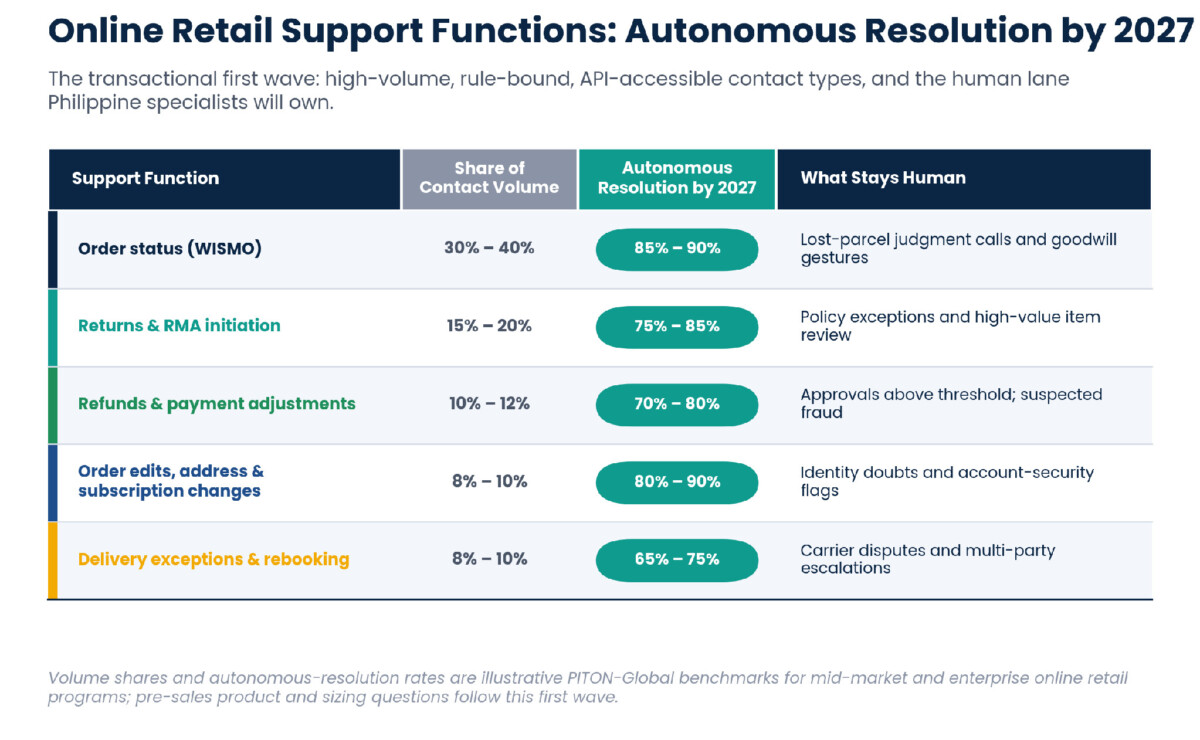
Figure 1. The first agentic wave: volume share, autonomous resolution by 2027, and the human lane Philippine specialists will own (illustrative PITON-Global benchmarks).
It cuts the price of a resolved contact for the second time in two decades. In illustrative PITON-Global modeling, cost per resolved contact falls from $6.75 for onshore, human-only service to $3.10 with AI-assisted Filipino teams, then to $2.10 in an agentic-first hybrid: 32% below the Philippine baseline and 69% below onshore.
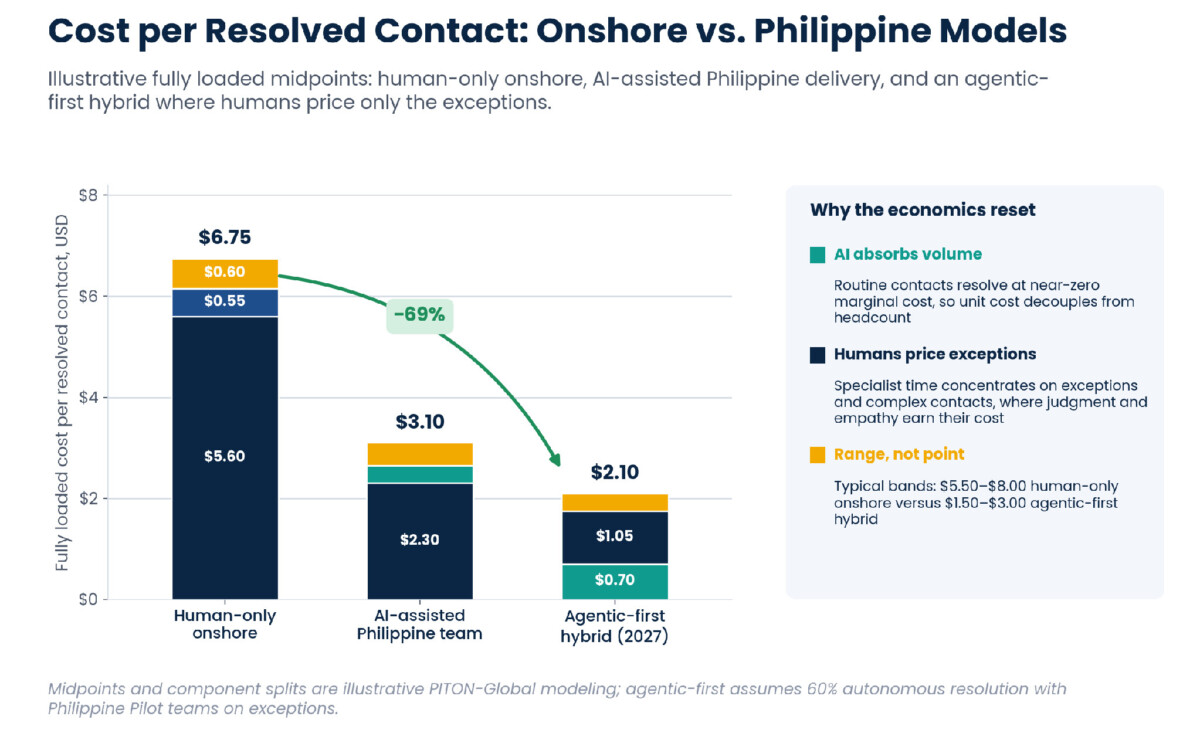
Figure 2. Illustrative fully loaded cost per resolved contact: onshore human-only, AI-assisted Philippine delivery, and an agentic-first hybrid with Philippine exception teams.
Take a retailer handling 100,000 contacts a month through an AI-assisted Philippine team of 100 human agents. At $3.10 per contact, the program costs about $310,000 a month: $230,000 in agent labor (about $14 per fully loaded hour, 160 paid hours a month), $35,000 in AI licensing, and $45,000 in QA and oversight. Now move to an agentic hybrid. If routine contacts are about 85% of volume and AI agents close about 70% of them, 60% of all contacts resolve autonomously, and the human queue drops to 40,000. At $2.10 per contact, the program costs about $210,000: $105,000 for 47 Filipino Pilots, $70,000 in AI platform and per-resolution fees, and $35,000 in governance and QA.
In that example, each remaining contact takes about 18% more paid time, so a 60% drop in human contacts cuts the team by roughly half. Programs heavy in fraud review, cancellation saves, and VIP work often see handle times double, which would keep the team near 80 people. The 60% autonomous share is also the optimistic case: if routine work is 70% of volume and AI agents close 60% of it, the share is closer to 42%.
Philippine labor law adds a night differential of 10-30% for work between 10 p.m. and 6 a.m., and graveyard shifts are the hardest to keep staffed. Once AI agents answer US customers in real time, refund reviews, fraud checks, and chargeback evidence no longer need a live conversation. That work can queue for Manila daytime, leaving a smaller night team for live escalations.
The stronger Philippine ecommerce providers now propose hybrids: specialists billed per seat, the autonomous layer billed per resolution. The clause that matters is the definition of resolved, because a provider paid per resolution otherwise has a reason to close contacts early. The workable standard is no repeat contact on the same issue within seven days, backed by CSAT and reopen-rate floors.
They become the Pilots. In the Pilot and Wingman model, AI Wingmen retrieve, verify, and update systems, while Filipino specialists take the contacts a machine should not: judgment calls, customers ready to cancel, fraud and refund abuse, VIP accounts, and audits of the agents’ own work. The service skills the industry spent twenty years building carry straight over.
Triage decides the lane. Low-risk intents go to agents that act inside policy and log every step; high-stakes, fraud-flagged, or VIP contacts go to a Filipino Pilot, who starts from the Wingman’s summary.
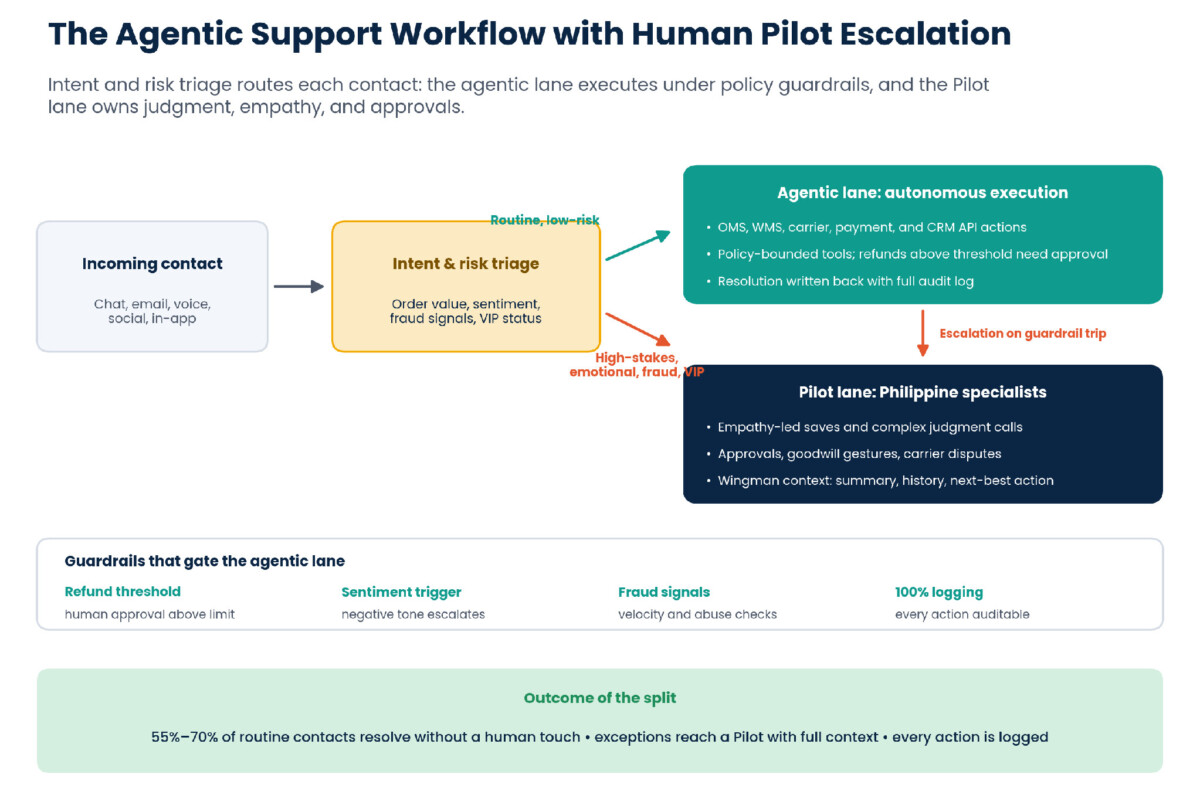
Figure 3. The agentic support workflow: triage, the autonomous execution lane, the Philippine Pilot lane, and the guardrails between them.
This industry has been told at least three times that technology would make it unnecessary. What changes in 2027 is the job description. The retailers who come out ahead will let AI agents handle speed and volume, and will pay Filipino specialists for the moments when a customer decides whether to stay.
— John Maczynski, CEO, PITON-Global
New roles form around the Pilots: AI quality analysts who audit autonomous resolutions and workflow designers who tune escalation rules. Filling these roles by retraining experienced human agents keeps product knowledge in the building.
Four risks matter most: an agent inventing a policy, refund abuse running at machine speed, automating the contacts that decide whether a customer stays, and data protection. Agents handling customer and payment data must meet the Philippine Data Privacy Act (RA 10173) as well as GDPR, CCPA, and PCI DSS. Each risk has a testable control.
Agents act only through approved tools, so they cannot offer what policy forbids. Set the automatic refund ceiling near the average order value, and write into the contract that the knowledge base, intent library, and conversation logs belong to the retailer.
Preparation starts 12 to 18 months ahead. Retailers should audit their contact mix and the APIs behind it, pilot autonomous resolution on order status and returns with a Philippine partner already running agentic delivery, then expand to refunds and delivery exceptions while repricing the contract around resolutions rather than seats.
PITON-Global is an independent, vendor-neutral BPO advisory headquartered in Manila, led by CEO John Maczynski and Founder and CSO Ralf Ellspermann, who bring more than 65 combined years in global outsourcing. It matches online retailers with the Philippine providers in its vetted network of more than 100 that already run agentic delivery, at no cost to the buyer.