

No single AI agent platform fits every ecommerce brand. Merchants under $2M usually need better marketing automation, not agents. Brands between $2M and $10M get the most from a scoped build partner, and enterprise teams are the only ones who need orchestration infrastructure.
Six companies get grouped under the AI agent label and they are not competing with each other. One sells data, one sells creative production, one sells marketing retainers, and three sell engineering hours. Knowing which is which is most of the buying decision.
An operator at a $3M apparel brand forwarded me a vendor list last month and asked which one to start with. All six were pitched to her as AI agent companies. One was a geospatial data API. One was a Munich marketing agency. Three were software development shops. One was a creative production platform.
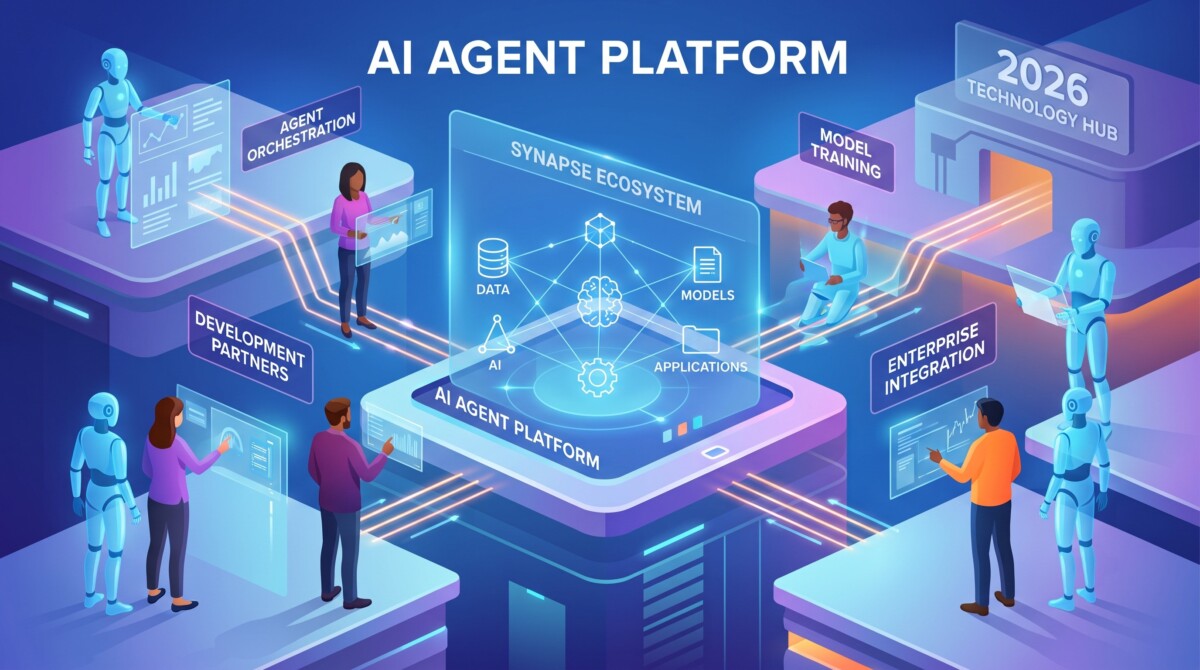
That confusion is the actual problem with this category in 2026. The label has stretched to cover at least four distinct layers of a technology stack, and vendors have no incentive to clarify which layer they occupy. The result is merchants comparing a $99 per month data subscription against a $250,000 engineering engagement as though they are alternatives.
The six companies below are listed alphabetically. That is deliberate. This is not a ranking, and the order tells you nothing about quality or fit. Each entry states what the company sells, what it costs, where it falls short, and which merchant stage it suits. The comparison grid and the Best For section at the end are where you narrow the list.
All six companies on this list are actively marketing AI agent capability to business buyers as of August 2026, and each occupies a different layer of the agent stack, which is the reason they appear together rather than because they compete. Pricing, positioning, and limitations were verified against each company’s published materials, third party listings, and press coverage in the ninety days before publication.
Notably excluded: LangGraph, CrewAI, and AutoGen. These are the actual agent frameworks, and they get named repeatedly below because the companies here build on them. They are open source developer libraries under MIT license, not products a merchant buys, which is why they are not treated as list items. Also excluded were the native AI features inside Shopify itself, which are covered separately in our complete 2026 guide to agentic commerce for Shopify merchants and belong to a different buying decision entirely.
Every row below stands on its own. Read the row for any company and you have the full shape of the fit decision without reading the section beneath it.
Intuz is an AI development company that designs, builds, and operates production AI agents on LangGraph, CrewAI, AutoGen, and n8n for enterprise clients in ecommerce, healthcare, and logistics.
What separates Intuz from the general software agency category is that it publishes its framework selection logic rather than defaulting to one stack. Its stated approach picks the framework per task rather than per preference, and picks the model on reasoning quality, latency, and cost fit. The engagement runs from process mapping through a pilot agent inside a real workflow in four to six weeks, then integration with CRMs, ERPs, helpdesks, and data warehouses, then production operation with weekly KPI reviews. Intuz describes more than 100 enterprise deployments. Guardrails are a named workstream: permission boundaries, human approval checkpoints, kill switches, cost per task tracking, and hallucination detection.
Intuz does not publish agency pricing; quotes are scoped per engagement as of August 2026. Its own benchmarking is more useful for budgeting than most vendor material: Intuz puts the running cost of LangGraph, CrewAI, and AutoGen deployments at $63 to $171 per month for the framework layer, separate from build cost.
Two strengths stand out. First, the four to six week pilot inside a live workflow means you validate the use case before committing to a full build, which is the single biggest cost control available in this category. Second, the emphasis on cost per task tracking is unusual and directly addresses the failure mode where agent token spend quietly triples after launch.
The limitations are real. Intuz’s case studies skew toward healthcare and document processing rather than ecommerce specifics, so the retail pattern library is thinner than the marketing suggests. And the outcome figures on its site, including reported savings of $250,000 per year on one client project, are the vendor’s own numbers and are not independently audited. Treat every published metric here, and on every site in this list, as a claim rather than a benchmark.
Best fit for ecommerce brands from $5M to $50M with at least one documented, high volume workflow and an internal owner who can make integration decisions. Intuz works best when you arrive with the process already mapped.
Skip if your processes live in someone’s head rather than in documentation. An agency will happily bill you for the discovery phase that turns tribal knowledge into a specification, and that phase is cheaper to do yourself.
KMS Technology is a digital engineering and AI services firm that sells Velox, a centralized orchestration platform coordinating specialized AI agents, engineering tools, and project context into governed workflows across the software development lifecycle.
Velox is the clearest example on this list of the orchestration layer, which sits above the agent frameworks rather than replacing them. KMS is explicit about this in its own materials: frameworks like LangChain, LangGraph, and AutoGen provide the building blocks, and enterprises need an additional layer to manage how those agents operate across teams, tools, and business processes. Velox integrates with developer tools including Cursor and Claude Code while maintaining shared project context across product management, development, quality assurance, and DevOps. In practice it automates test execution, code review, and issue resolution. KMS appointed Jason Wojahn as CEO in May 2026, with stated priorities including expanding Velox and shifting from project based billing toward outcome based delivery.
KMS does not publish pricing. As of August 2026 the company is transitioning to outcome based commercial models rather than traditional project billing, which means the number depends on the result rather than the hours.
The strength here is specific and narrow. If you run an engineering organization where multiple AI coding assistants produce inconsistent output because none of them share project context, Velox targets that exact problem, and the human in the loop governance model is more mature than most.
Two limitations matter for anyone reading this from an ecommerce seat. First, Velox is built for software delivery, revenue operations, and workforce orchestration, none of which are merchandising, fulfillment, or customer experience. This is not a commerce product. Second, the outcome based pricing shift means there is no entry price to evaluate against, which makes budgeting difficult and typically signals an enterprise sales cycle measured in months. KMS Technology is worth understanding as a category reference even if you never buy.
Best fit for enterprises with in house engineering teams already running multiple AI coding tools and hitting context fragmentation across the development lifecycle.
Skip if you do not employ engineers. Every capability Velox offers assumes an existing developer workflow to orchestrate, and there is no version of this that helps a merchant without one.
Media Beats is a Munich based full service marketing agency covering SEO, performance marketing, email, social, and web development, and it belongs on this list as the incumbent automation layer rather than as an agent vendor.
Founded in 2019 and based on Sendlinger Strasse in Munich, Media Beats runs the category of work most ecommerce brands actually have in production right now: campaign strategy, email marketing including list management and double opt in flows, performance marketing with measurable per lead or per sale models, banner and display, and web design. Its stated differentiator in email is the volume of lists it manages under one roof and its ability to deploy them selectively. This is conventional, rules based marketing automation, and naming it plainly matters because the boundary between automation and agents is where most merchants overspend in 2026.
Media Beats does not publish rates. Engagements are quoted as custom retainers as of August 2026, which is standard for full service agencies in the German market.
The strength is that rules based automation is genuinely the correct tool for most of the workflows merchants are currently being pitched agents for. An abandoned cart sequence that fires at four hours and twenty four hours should be deterministic. You want to audit it, explain it to a customer, and know exactly why a message sent. Handing that to an agent adds cost and unpredictability with no upside.
The honest limitations are straightforward. Media Beats is not an AI agent company and does not market autonomous agent development, so if you specifically need an agent that reasons over context you did not anticipate, this is the wrong category. And as a Munich based agency, the fit is strongest for brands operating in German speaking markets, where the local search, compliance, and list building expertise is the actual value. Media Beats is the reference point for what you may already have.
Best fit for brands under roughly $5M selling into DACH markets who need their marketing execution tightened before any AI conversation makes sense.
Skip if you are shopping for autonomous agent systems. Ask any vendor what decision the system makes that you have not already specified, and if there is no answer, you are buying automation at agent prices.
Phaedra Solutions is an AI first product development company that builds custom AI agents for production use, and it is the only company on this list publishing specific price bands for agent builds.
Founded in 2013, Phaedra runs roughly 200 engineers, designers, and AI specialists across the US, Europe, the GCC, and Asia. The agent practice covers customer support agents, voice agents, and workflow automation, delivered from use case validation through deployment and ongoing optimization. In February 2026 the company introduced a rapid AI model built around a ten day MVP sprint producing a production ready prototype demonstrating real workflow integration, aimed at validating feasibility before larger commitment. Its published retail case study describes agents automating brand tracking, funding research, KYC checks, and personalized email drafting, with reported results including 75% less manual admin time and a fourfold increase in outreach capacity.
Pricing is the useful part. As of mid 2026, Phaedra publishes bands of $30,000 to $80,000 for a single task agent, $100,000 to $250,000 for a department level agent, and $300,000 to $750,000 and above for full multi agent enterprise systems. Timelines run six to ten weeks for a focused single task agent and three to five months for department level work.
The transparency itself is the standout strength, because it lets you disqualify yourself in thirty seconds rather than after three calls. The second strength is the ten day MVP sprint, which is the cheapest way in this category to find out whether your use case survives contact with your real data.
Two limitations. Phaedra’s published outcome claims, including reductions in manual work of up to 70% and model uptime figures, are self reported marketing metrics rather than audited results. And the entry band of $30,000 for a single agent means the total cost of ownership, once integration and data cleanup are counted, rarely justifies itself below roughly $5M in revenue. Phaedra Solutions is a real option, at a real price, for a real stage.
Best fit for brands from $5M upward with one specific high volume workflow where the labor cost is measurable and the process is already documented.
Skip if your available budget for this is under $30,000. That is not a soft preference, it is the published floor, and the same money spent on cleaning product data and documenting processes produces a better return at your stage.
Virtuall is a Creative AI operating system built in Denmark that coordinates multiple generation models to produce 3D assets, images, and video at production scale, and it is the most directly relevant option on this list for ecommerce brands.
Founded in 2022, Virtuall sits above individual image, video, and 3D models rather than competing with them, orchestrating workflows while enforcing brand and policy rules by default. For ecommerce specifically, the named use cases are on model product page imagery and variants at catalog scale with brand locking, and product visuals generated from design files and references without a photo shoot. The governance layer is the part worth attention regardless of vendor: clear ownership of outputs, controlled access to models, repeatable quality through what Virtuall calls Blueprints, and cost visibility for finance and IT. An agentic workspace feature called Nyx retains studio conventions and creative direction across projects so context does not reset when models change.
Virtuall offers a free tier for exploration. Production pricing is quoted through sales rather than published, and billing is unified across AI tokens, as of August 2026.
Creative production is the first ecommerce workflow where agent systems reliably clear the ROI bar, and that is the strength here. The work is high volume, expensive to do manually, and visually verifiable, meaning a human knows within two seconds whether the output is correct. Compare that to inventory forecasting, where a bad recommendation surfaces as a stockout eleven weeks later and nobody can trace the input that caused it. Start where errors are cheap and visible.
Two limitations. Virtuall is built for enterprise studios and creative teams, so it is genuinely not a fit below roughly $5M unless creative volume is specifically your bottleneck. And generated product imagery carries a real accuracy risk: visuals that quietly alter a material, colorway, or dimension create a returns problem and a compliance problem simultaneously. Virtuall addresses this with brand locking, but the responsibility stays with you.
Best fit for brands from $5M upward shooting several hundred SKUs per season, especially where variants, seasonal recuts, and regional adaptations multiply the photography bill.
Skip if you carry under 100 SKUs. At that catalog size a freelance photographer and a consistent template will cost less and produce fewer accuracy headaches.
xMap is a location data infrastructure API that exposes points of interest, mobility, traffic, parcel, and demographic layers with agent ready schemas and MCP bindings, built for machines to query rather than for humans to look at.
The company is explicit that it is a data layer and not a mapping product: there are no tiles, no rendering SDKs, and no visual map component, which distinguishes it from Google Maps Platform and Mapbox. Every layer ships with tool definitions so an agent discovers them automatically without custom routing code, and the MCP server can be pointed at Claude Desktop or any MCP compatible client. Coverage includes roughly 24 million verified US points of interest and 98% US parcel coverage. Refresh cadence varies by layer: points of interest daily, traffic and mobility hourly, parcel data weekly, demographics monthly. Published case work includes a quick service restaurant brand replacing broker led site selection with an agent, and a same day delivery platform redesigning hub placement across 50 metros.
As of August 2026, the Developer tier includes 1,000 credits at no cost and is capped at five requests per second. Pro starts at $99 per month with credit top ups and scales to 25 requests per second. Enterprise begins at one million credits per month with VPC or on premise deployment options.
The strength worth borrowing even if you never buy is the architectural point: xMap treats data grounding as a separate purchase from orchestration. Serious teams buy the layer that gives agents something factual to reason about before they buy the layer that coordinates reasoning. Most merchants have this backwards.
Two limitations for an ecommerce reader. Country coverage outside the US is uneven, and at least one G2 reviewer noted the limited country list alongside doubts about how much the platform surfaces beyond freely available sources. More importantly, location intelligence is simply irrelevant to most pure play DTC brands. xMap matters if you are opening retail doors, running local delivery, or planning fulfillment nodes.
Best fit for omnichannel or retail expanding brands, local delivery operations, and logistics teams building agents that need verified real world geographic context.
Skip if you sell online only and ship nationally from one warehouse. There is no version of this data that changes a decision you are making.
Your revenue stage and whether you employ engineers narrow this list to one or two options faster than any feature comparison will. Here is how the six sort against real merchant situations.
If you are between $500K and $2M, none of these six is your answer this year, and I want to be direct about that rather than soft pedal it. The failure pattern at this stage is almost always premature complexity: tools adopted before the fundamentals underneath them were solid. Your highest return work is a tech stack audit to find the app bloat and operational drift already costing you, followed by cleaning product data. Media Beats is the only entry on this list relevant to your stage, and only if you sell into DACH markets and need marketing execution tightened.
If you are between $2M and $10M with a single expensive workflow, Phaedra Solutions is the cleanest entry point because the published $30,000 to $80,000 band for a single task agent lets you evaluate honestly against the labor cost you are trying to remove. Intuz is the alternative if you want a four to six week pilot inside a live workflow before committing. The trade off between them is transparency versus validation: Phaedra tells you the price up front, Intuz proves the use case first.
If your bottleneck is creative volume rather than operations, Virtuall is the better spend regardless of revenue stage above $5M. A brand shooting 400 SKUs a season is burning real money on photography, and this is the one workflow in ecommerce where agent systems have a defensible payback period today.
If you run an engineering organization, KMS Technology and Velox address context fragmentation across AI coding tools, which is a problem you either have acutely or do not have at all. And xMap belongs in the conversation only if physical geography drives your decisions, meaning retail expansion, local delivery, or fulfillment network design.
The trade off nobody in this category names honestly: every option here transfers some operational knowledge out of your team and into a vendor relationship. That is sometimes worth it. It is worth it less often than the sales process suggests.
There is no best AI agent company for ecommerce brands, which is why this list is unranked and alphabetical. The six here occupy four different layers of the same stack, and comparing them directly is a category error that vendors have no reason to correct for you.
The pattern worth carrying out of this piece is sequencing. Clean data precedes useful automation. Working automation precedes agents. Agents precede orchestration. Skipping a rung does not accelerate the outcome, it just moves the failure later and makes it harder to diagnose. Shopify’s own Universal Commerce Protocol announcement with Google made that sequencing explicit for merchants: structured product data is now the interface between your store and every AI surface a buyer uses, and no vendor on this list fixes that for you.
If you are still deciding, the Best For section above is your starting point. If you want the stage by stage version of this logic applied across your whole infrastructure rather than just AI, the Shopify tech stack guide by revenue stage works through the same trade offs on email, ERP, and headless decisions.
There is no single best AI agent platform for ecommerce brands, because the companies marketed under that label occupy different layers of the same stack and do not compete with each other. Virtuall handles creative production. Phaedra Solutions and Intuz build custom agents. KMS Technology orchestrates agents for engineering teams. xMap supplies location data. Media Beats delivers conventional marketing automation. The right question is which layer you are short on, not which vendor is strongest. For most brands under $5M the honest answer is none of them yet, because clean product data and a tightened app stack produce a better return at that stage.
A single task AI agent costs roughly $30,000 to $80,000 to build as of mid 2026, with department level agents running $100,000 to $250,000 and full multi agent enterprise systems ranging from $300,000 to $750,000 and above, according to price bands published by Phaedra Solutions. Timelines run six to ten weeks for a focused single agent and three to five months at department level. The build quote is rarely the full number. Integration with existing systems, data cleanup, and internal time spent documenting processes that were never written down frequently exceed the development line item.
Marketing automation executes a sequence you defined in advance, while an AI agent decides what to do next based on context you did not anticipate. An abandoned cart flow firing at four hours and twenty four hours is automation, and it should stay that way because you want that behavior auditable and predictable. Agencies like Media Beats deliver most of the automation ecommerce brands actually run in production. The practical test when a vendor pitches you agents is to ask what decision the system makes that you have not already specified. If they cannot name one, you are being sold automation at a premium.
LangGraph, CrewAI, and AutoGen are the frameworks underneath most commercial AI agent work in 2026, and they are open source developer libraries rather than products a merchant subscribes to. Intuz builds on all three plus n8n, selecting per task rather than defaulting to one. KMS Technology positions its Velox platform as an orchestration layer above those frameworks. Phaedra Solutions builds custom systems using the same foundations. Running costs for the framework layer itself are modest, with Intuz publishing benchmarks of roughly $63 to $171 per month, separate from build cost and model token spend.
Move from marketing automation to AI agents when you have a documented, high volume workflow where the decision logic genuinely cannot be specified in advance, and you are above roughly $5M in annual revenue. Below that threshold the total cost of ownership almost always exceeds the labor savings. The sequence that works is clean product data first, then a tightened app stack, then one workflow automated properly, then agents where deterministic rules genuinely fail. An agent deployed on messy data does not fail loudly. It produces confident wrong answers at scale, which costs considerably more than no automation.





