

The brands that exit cleanly at $5M did not get there by buying the right apps. They got there by treating their tech stack like infrastructure, not a marketplace shopping cart.
A founder I worked with last year hit $1.2M in revenue running a clean Shopify store with 11 apps in the stack. Most of them were the cheapest options in their category, picked years earlier when the brand was doing $20K months and “good enough” was the right answer. Then Black Friday hit. A $9 per month checkout extension that handled volume discounts started timing out under load somewhere around 8pm Eastern, and by the time anyone noticed, customers had been seeing a broken cart for nearly two hours. Conservative estimate of lost revenue that single weekend: $40K.
The cost of replacing that app, in hindsight, would have been roughly $80 per month. The cost of leaving it in place was 500x that. The pattern is not unique to ecommerce; the same dynamic shows up wherever foundational components matter, from industrial power cables (a category where suppliers like Maskabel have built around durability under load) to data center hardware to fulfillment equipment. Inside ecommerce, the trap catches almost every brand in the $500K to $2M range, almost always at the worst possible moment, because the founder treated their app stack like a series of small decisions instead of one compounding decision about operational reliability.
If you are running a Shopify or DTC brand and your tech stack has gotten older than your last revenue milestone, this is the read. I want to give you a stage aware framework for evaluating which infrastructure decisions matter now, which are premature optimization, and how to stop paying the “cheap app” tax during the exact stages where you can least afford it.
Most founders treat their app stack as a series of small monthly decisions when it is actually one compounding decision about operational reliability. The average Shopify merchant runs 6 apps and spends about $120 per month across them, but the brands I see scaling past $2M typically run 15 to 25, and the difference is not the count. It is the deliberateness behind which apps live in the path of every order versus which ones sit on the periphery and can be swapped on a Tuesday afternoon without consequence.
This pattern repeats across hundreds of brands I have worked with. Apps get installed during a sprint, get forgotten, and then get exposed during scaling pressure. The exposure looks like timeouts under traffic spikes, sync failures during peak season, or quiet data loss that nobody notices until a quarterly review.
The reason founders defer stack decisions is rational. Every dollar spent on app upgrades is a dollar not spent on ads, and at $300K in revenue, the math says ads win. The problem is that the calculus reverses somewhere between $750K and $1.5M, and most founders do not notice the inflection because nothing visibly breaks. Conversion rates drift down by half a percent. Checkout times creep up by 800 milliseconds. Customer service tickets tied to the same three apps start eating four hours a week. None of this triggers an alarm. All of it shows up in the P and L.
Infrastructure is the layer that touches every order. Payments, hosting, checkout extensions, fulfillment integrations, customer data pipelines, the email and SMS platform that runs your post purchase flows. If it fails, the business stops. Peripheral tools are everything else: the popup app, the loyalty quiz, the stock alert widget, the tools that sit on the surface and can be removed without rewriting how the business runs. If you cannot tell which apps in your stack are infrastructure and which are peripheral, that is the audit to run first, and most of the rest of this article gets easier once you have done it.
Stack debt is real, and the brands paying the most for it are the ones who optimized for monthly app cost instead of reliability cost. Research from Loox suggests that each app installed on a Shopify store can add roughly 0.75 seconds to page load time. At the average of 6 apps that adds up to a meaningful drag on conversion, and brands running 20 plus apps without performance discipline are leaving real revenue on the table every day.
The cost shows up in three different failure modes, and each one has a different signature. Founders who can recognize the signatures early can fix the problem cheaply. Founders who cannot end up paying for the fix in lost revenue or in the cost of migrating an entire customer base off a platform that should have been replaced two years earlier.
Performance failure is the easiest to spot if you are looking for it. Pages load slowly, checkout adds friction, mobile conversion lags desktop more than it should. Integrity failure is harder. The app does not crash, but it loses data, double charges customers, or fails to sync inventory between Shopify and your fulfillment partner. You find out from a customer email or a 3PL invoice that does not match your numbers. Lock in failure is the worst kind because it is invisible until you try to leave. The subscription app that integrated with your customer accounts, your billing, your retention flows, and your reporting becomes impossible to migrate without a six month project. By then, the vendor knows you are stuck and prices accordingly.
Illustrative ranges based on what I see across brands at the $500K to $2M transition: stack remediation projects typically run between $15K and $80K depending on how many systems are involved, and that does not count the opportunity cost of pulling the founder and team away from growth for the duration. The brands that get hit hardest are the ones replatforming a critical category (subscriptions, reviews, customer data) under pressure rather than on their own timeline. These numbers are illustrative and will vary by stack complexity and team capability, but the pattern is consistent enough that I treat it as a planning assumption when advising founders.
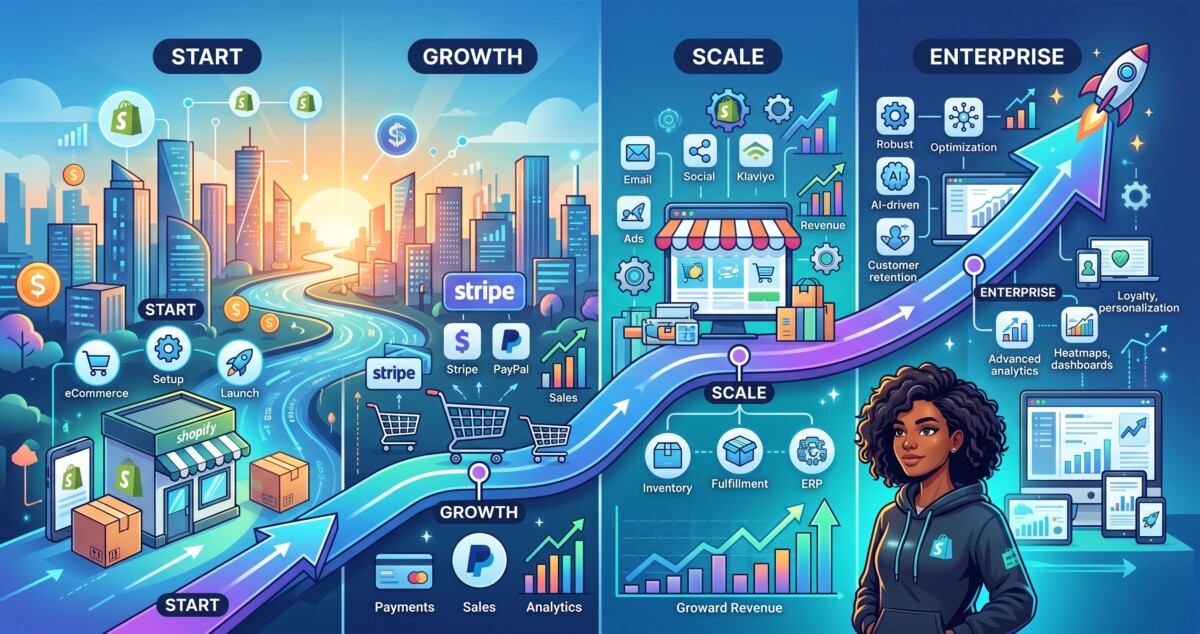
There is no universal “right” tech stack, only stage appropriate ones, and the founders who fail most often are applying advice written for a stage they are not at. A $50K per year store does not need the same infrastructure as a $5M store, and pretending otherwise is how founders end up with $2,000 per month in app subscriptions before they have proven their offer. The reverse failure (running a $3M brand on the stack you built at $50K) is more common and more expensive.
Here is how I think about stage appropriate quality across the four most common revenue bands. Use it as a starting point, not a prescription.
At this stage, Shopify defaults plus 5 to 7 essential apps is the right answer. You need a payment processor (Shopify Payments works), one email tool (Shopify Email or the free Klaviyo tier), one review app (Judge.me or Loox), one shipping tool (Shopify Shipping), and basic analytics. Premature stack investment at this stage is the enemy of finding product market fit, because every hour spent configuring apps is an hour not spent talking to customers or testing offers. If you are at this stage and your monthly app spend is north of $200, that is a signal to audit and cut.
This is where infrastructure starts to matter, but selectively. The integrations about to bottleneck the next 12 months are usually email or SMS (Klaviyo or Omnisend on the email side, Postscript or Attentive for SMS), reviews (Yotpo or Okendo as you outgrow free tier limits), and fulfillment (a real 3PL relationship if you are still shipping from your garage). For a category by category breakdown of the apps that matter at this stage, the 16 essential Shopify apps guide is a useful starting reference. Upgrade these specifically and resist the urge to upgrade everything at once. The temptation at this stage is to install the same stack you saw on a $10M brand’s case study, and that path leads to $1,500 in monthly app spend with no corresponding revenue lift.
This is where most founders pay the deferred cost from the previous two stages. Audit ruthlessly. The cheap apps you installed at $200K that have quietly become mission critical need to be replaced before peak season exposes them, not after. Specifically: any subscription tool that handles recurring revenue, any review platform that owns your social proof, any customer service tool that touches your retention. This is also the stage where consolidation starts to make sense. The all in one platforms (Klaviyo for email plus SMS plus reviews, for example) often beat a stitched together stack on both performance and ongoing maintenance burden, even if the per category cost is higher. For a deeper walkthrough of how to think about this transition, the scalable tech stack guide covers the operating principles in more depth.
At this revenue level, Shopify Plus (which starts at roughly $2,500 per month) becomes a real conversation, headless considerations enter the picture, ERP integration starts to matter, and selective custom development is on the table. The mistake at this stage is overbuying complexity. Headless rebuilds are seductive and often premature; an $8M brand running on standard Shopify with a clean theme will usually outperform a $4M brand that spent the last 18 months replatforming. The criteria I use: does the custom build solve a problem you have today, or a problem you imagine having in two years? If it is the second one, defer it. For a deeper look at how to think about enterprise level stack decisions, the enterprise tech stack guide covers the cost categories and timeline assumptions in more detail.
Every tech stack decision should pass four tests before it earns its place in your operations. I have seen brands waste hundreds of thousands of dollars on tools that failed one or more of these tests at the moment of purchase, and in almost every case the failure was visible in advance if anyone had asked.
The first test is load capacity. Will this app hold at three times your current order volume without intervention? Vendors will tell you yes; demand a reference customer at the volume you expect to be at in 12 months, and ask that customer directly. The second test is environment fit. Does this play cleanly with the rest of your stack, including the other apps that will be touching the same customer record? Integration breakage is the silent killer of “we just added one more app” decisions. The third test is flexibility. Can you change vendors without a rebuild, or are you committing to a six month migration the day you sign up? The fourth test is compliance. Does this meet the payment, privacy, and regional requirements you will face in 18 months, including expanding to new geographies if that is in the plan?
Apply one filter to every infrastructure decision: will this matter in 18 months? Most vendor pitches are built around something that matters this quarter (a new AI feature, a pricing promotion, an integration with a tool you do not use yet). The infrastructure decisions worth making are the ones where the answer is yes 18 months out and you can explain why in one sentence. If the only reason to switch is a feature checklist, the switch usually does not survive contact with reality.
Recurring failure points by category, in order of how often I see them: subscription apps that become impossible to migrate once they own customer billing relationships; checkout extensions that break under traffic; review platforms that hold your photos and ratings hostage when you try to leave; ERP integrations installed before the brand actually needed an ERP; and headless rebuilds attempted before the team had the engineering depth to maintain them. Each of these is fixable with foresight. None of them are fixable cheaply once you are stuck.
The right tool installed badly is worse than the wrong tool installed well, and no tool stays “right” forever without review. Infrastructure is a discipline, not an event. The brands that handle this best treat their tech stack the way a good ops team treats inventory: scheduled reviews, documented dependencies, and a clear owner for every line item. The brands that handle it worst treat the stack like a junk drawer.
You do not need a complicated process to get most of the value here. A 30 minute quarterly review will catch 80% of the issues that would otherwise compound into peak season disasters, and most founders who start the discipline keep it because the time saved during the next stress event pays the investment back many times over. If you want a broader walkthrough of how to think about scaling your Shopify store with a smarter tech stack, that piece covers the operating principles in more depth.
Open a spreadsheet with three columns: monthly cost per app, last meaningful update date (when did the vendor last ship something or did you last touch the configuration), and dependency mapping (what breaks tomorrow if this app disappears). Walk through every app on your store. Anything in the highest cost row that is also in the longest “last touched” column gets a yellow flag for review. Anything that owns a critical dependency without a clear backup plan gets a red flag for action. This audit takes longer the first time, faster every quarter after that, and consistently surfaces two or three findings that would have cost real money if ignored.
Watch for the soft signals before they turn into hard ones. Slow checkout times that nobody can pinpoint. Intermittent integration errors that get dismissed as “probably nothing.” Customer service ticket volume creeping up on a specific workflow. Increasing frequency of “we need a developer to fix this” conversations. Each of these is a Tier One signal in isolation. Two or three together at the same time is the moment to stop adding new apps and start auditing the ones you have.
Infrastructure is not a cost center. It is a compounding moat, and founders who internalize that scale faster, exit cleaner, and operate with less anxiety because fewer things break at 11pm on a Friday. When acquirers run due diligence on a brand in the $5M to $10M range, the quality of the tech stack and the cleanness of the data flowing through it shows up in the multiple. A brand with documented systems and reliable integrations sells for more than a brand of equivalent revenue running on duct tape, and the cost of cleaning that up under deal pressure is always higher than the cost of building it deliberately along the way.
The work is not glamorous. There is no growth hack here, no AI feature that fixes it, no agency that can outsource the discipline back into the founder. But the founders who treat infrastructure like the asset it is end up with a business that compounds quietly, year after year, while their competitors are still firefighting the same three apps every Black Friday. The audit is the smallest investment with the largest downstream return I can think of at this stage of the journey. Schedule it this week. Future you will be glad you did.
Start investing in premium infrastructure when a specific app or integration becomes mission critical to revenue, not before. For most DTC brands, that inflection happens between $50K and $500K in annual revenue, and it shows up first in email or SMS, then in reviews, then in fulfillment as you outgrow garage shipping. Below $50K, premium infrastructure is almost always premature optimization that distracts from finding offer and channel fit. The exception is anything that touches payments or checkout, where reliability matters from day one regardless of revenue, because a broken checkout costs you revenue you have already paid to acquire.
The most common Shopify app mistake is choosing the cheapest option in a critical category and letting it stay in place as the category becomes mission critical. Subscription tools, review platforms, and customer service apps are the worst offenders because they accumulate customer data and integrations over time, which makes migration painful and expensive when you finally outgrow them. The second most common mistake is installing more apps than you actively use, which adds page weight, slows checkout, and creates security and integration surface area. A quarterly audit catches both, and most founders who run one find at least three apps to remove or replace within the first review.
App spend should scale with revenue, but not linearly. At $0 to $50K in annual revenue, total app spend should typically stay under $200 per month. At $50K to $500K, the right range is usually $300 to $800 per month as you upgrade email, reviews, and fulfillment. At $500K to $2M, expect $1,000 to $3,000 per month including premium tiers of the apps you depend on. At $2M and beyond, app and platform spend often runs $3,000 to $10,000 per month before you factor in Shopify Plus or custom development. The benchmark that matters more than the dollar figure: every recurring app cost should map to a measurable contribution to revenue, retention, or operational efficiency. If it does not, cut it.
Essential infrastructure is anything that touches every order: payments, hosting, checkout, fulfillment integrations, customer data, and the email or SMS platform that runs your post purchase flows. If any of these fail, the business stops or loses revenue immediately. Nice to have apps are everything else: popups, quizzes, loyalty widgets, stock alerts, and similar peripheral tools that improve specific moments of the customer experience but can be removed without the business breaking. The practical test is to ask what would happen if the app disappeared overnight. If the answer is “we lose orders or break checkout,” it is infrastructure and deserves infrastructure level attention. If the answer is “we lose a feature,” it is a nice to have.
Run a 30 minute quarterly stack audit using three columns in a spreadsheet: monthly cost per app, last meaningful update date, and what breaks tomorrow if this app disappears. Anything that is high cost and rarely touched gets flagged for review. Anything that owns a critical dependency without a clear backup gets flagged for action. Then test your highest risk integrations under simulated load: run a checkout, place a subscription order, trigger a fulfillment, and watch for slowness, errors, or sync failures. Most peak season disasters are visible 90 days in advance if anyone runs this exercise. The audit should happen in Q1 and Q3 at minimum, with an extra pass in October before BFCM.




