Free every Thursday · 60,261 Readers
Fastlane Insider Newsletter: What's working for Shopify in the AI era?
Free every Thursday · 60,261 Readers
Fastlane Insider Newsletter: What's working for Shopify in the AI era?
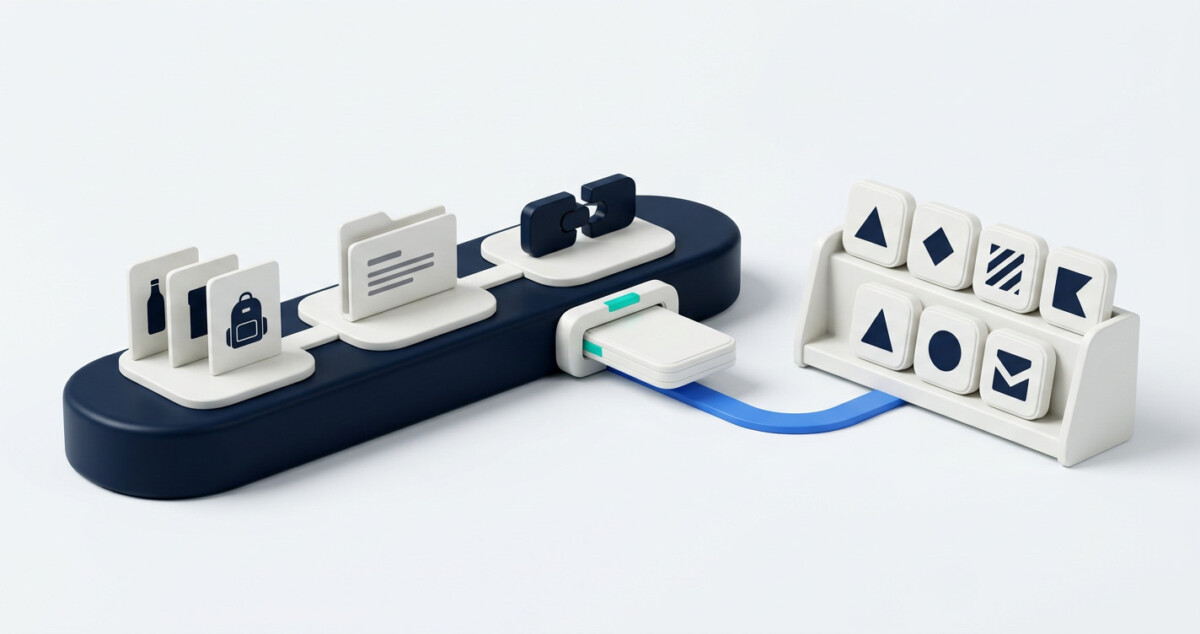
No single AI agent runs a dropshipping store in 2026. Doba Pilot covers research through fulfillment for U.S.-focused sellers, the AutoDS, Zendrop and CJdropshipping connectors let ChatGPT or Claude act on your supplier account, Shopify Sidekick handles store admin, and Gorgias and Moby by Triple Whale fill the support and ad analytics gaps.
The agent that matters most is not the smartest one. It is the one sitting on top of real supplier, inventory and order data, because an agent that can only write copy still leaves you copying and pasting between tabs.
A typical dropshipping week is the same loop on repeat: check demand, research suppliers, write product listings, keep prices and stock in sync across channels, and chase orders that have stalled in transit. AI writing tools sped up parts of that loop, but the seller still had to carry every output from one tab to the next. The shift in 2026 is AI agents that act on retailer and supplier data directly, with the seller signing off on the steps that matter.
Whether you are testing your first product or running a store doing $50K a month, the question is the same: which job do you hand to an agent first? The seven tools below are ordered by workflow scope: first the platform agent that covers the most of the dropshipping workflow, then three connectors that put ChatGPT or Claude to work on a supplier account, then Shopify’s built-in assistant and two specialists that each do one job. The order is not a ranking. We also cover a popular research tool that sits outside the list, where ChatGPT and Claude fit, what to look for, how pricing works, and how to build a stack for your stage.
An AI agent for dropshipping is software that takes a goal in plain language and carries out the steps using real store and supplier data, rather than handing you text to copy and paste. Ask it to “find three home office products with U.S. stock and list them on my Shopify store,” and an agent searches the catalog, prepares the listings and publishes them, usually with a review step before anything goes live. A writing assistant would only give you product descriptions.
In 2026, these agents come in three forms. Platform-native agents are built into a dropshipping or ecommerce platform and work from its own catalog and order data; Doba Pilot and Shopify Sidekick are examples. MCP connectors let a general AI assistant such as ChatGPT or Claude read and act on a dropshipping account through the Model Context Protocol; AutoDS, Zendrop and CJdropshipping all offer one. Specialist agents handle a single job, such as customer support (Gorgias AI Agent) or analytics and ads (Moby by Triple Whale). Most sellers end up with one core agent tied to their supply and fulfillment, plus one or two specialists.
We chose these seven agents because each one takes real actions on live store, supplier or order data, not just generates text. The list was built from vendor websites, product documentation, help centers and official Shopify App Store listings as of October 2026; we did not run hands-on tests. For the three MCP connectors, we judged the AI integration itself rather than the wider platform’s features. Every tool was judged against the same six criteria: multi-step execution (can it take a plain-language request and carry it through several steps), real actions (can it search products, list, track orders or trigger fulfillment), grounding in data (do answers come from live catalog, supplier, store or order data), seller control (review steps, confirmation before fulfillment, permission settings), channel coverage (which stores and marketplaces it reads from or publishes to), and transparent pricing (published plans, credit costs and usage limits). We picked one tool per job to avoid overlap, and moved tools that help with one stage but do not act on store or supplier data, such as Sell The Trend, to a separate section. General assistants like ChatGPT and Claude were not listed on their own because they cannot see supplier or order data until they are connected to a dropshipping account; that is covered in its own section below.
The seven agents fall into three groups: Doba Pilot is the platform-native core, the AutoDS, Zendrop and CJdropshipping connectors put ChatGPT or Claude to work on a supplier account, and Shopify Sidekick, Gorgias and Moby by Triple Whale cover store admin, support and ad analytics. Pricing is as of October 2026, taken from each vendor’s website or Shopify App Store listing, and changes often, so check the vendor’s current pricing page before you buy.
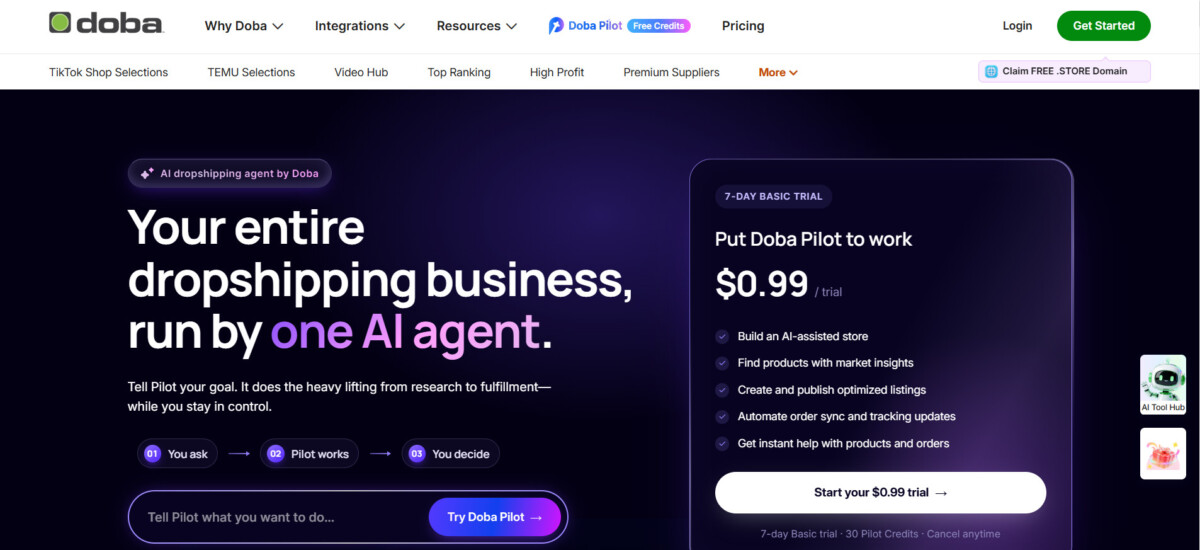
Doba Pilot is a conversational AI dropshipping agent that takes U.S.-focused sellers from niche research through sourcing, listing and order follow-up inside one platform.
Doba is the underlying dropshipping platform: it provides product sourcing, supplier access, inventory synchronization, multi-channel integrations and fulfillment operations. Doba Pilot is the AI agent built on top of those capabilities. Sellers describe a goal in plain language, such as “find beginner-friendly home products with U.S. stock and list five on my Shopify store,” and Pilot carries it through a Research, Source, List, Fulfill workflow using Doba’s own products, suppliers, store connections and order context. Because Pilot draws on live Doba catalog, inventory, supplier performance and order data, its suggestions arrive with supplier and stock context attached rather than as generic product ideas. Doba says about 90% of its products sit in U.S. warehouses, and sellers can compare fulfillment rates, processing times, warehouse locations and shipping options before choosing a supplier. Pilot supports AI-assisted listing on Shopify, eBay, TikTok Shop, Walmart, BigCommerce and Wix, with Amazon and Temu listed as coming soon, and the Doba Pilot guide documents each workflow. Higher Doba plans add Retailer API access for teams with custom workflows.
Pricing (as of October 2026): Every new account gets 30 free Pilot Credits on signup. Paid access is $39.99 a month and includes 100 Pilot Credits. Credits are spent per task: one credit per prompt, five per Market Scout report, and two extra for each listing preview on eBay, Walmart or TikTok Shop, with add-on credit packs available if you run out.
Standout strengths: Market Scout analyzes Amazon, Google Trends and broader market data to uncover demand, competition and product opportunities, and AI Product Sourcing then searches Doba’s catalog by category, market, shipping preference, inventory need and supplier requirement, showing product details, AI insights, demand signals and supplier performance side by side. That closes the gap between spotting a promising niche and having a product you can actually list. For setup, AI Store Creation and Connection builds Shopify stores with AI and connects existing BigCommerce, Wix, eBay, Walmart and TikTok Shop accounts, and AI Listing writes or improves titles and descriptions, sets pricing rules, previews results and publishes selected products to a connected store. On the back end, Pilot checks order and tracking status, flags abnormal orders, suggests next steps, follows up on delayed shipments or carrier pickups, and helps prepare supported refund and return requests. Scheduled tasks repeat product research, market reports and listing jobs on a timer, and sellers choose whether to review the results or let Pilot run the task. A separate AI Tool Hub adds standalone tools for store setup, product research, listing optimization, images, auto-listing and listing migration. Underneath Pilot, Doba’s platform handles inventory and price synchronization, multi-channel listing, order fulfillment and optional After-Sales Protection Services. Every Doba supplier must pass business registration, warehouse address and tax document review, and Premium Suppliers must also meet fulfillment rate, processing time, service quality and U.S. inventory standards; Doba says Premium Suppliers usually process orders in 1 to 3 business days, excluding carrier transit.
Honest limitations: Doba Pilot is built around Doba’s own catalog, so it fits sellers who plan to source through Doba rather than from outside suppliers. It assists with operational work but does not run the business on its own: sellers review important outputs before anything is published or sent, refund and return help covers supported requests only, and capabilities vary by channel. Some features, such as price and inventory alerts and store performance analysis, are listed as coming soon, so confirm what is live before you plan around them. The AI Tool Hub’s preliminary design patent and copyright screening is a screening aid, not legal clearance.
Best fit: New and solo sellers who want guidance from niche research to first listings, and growing multi-channel sellers who want sourcing, listings, inventory and fulfillment follow-up handled in one connected workflow, especially when most customers are in the U.S.
Skip if: You already source most of your catalog from AliExpress, CJdropshipping or private suppliers and do not plan to move it, because Doba Pilot’s advantage depends on Doba’s catalog and supplier data.
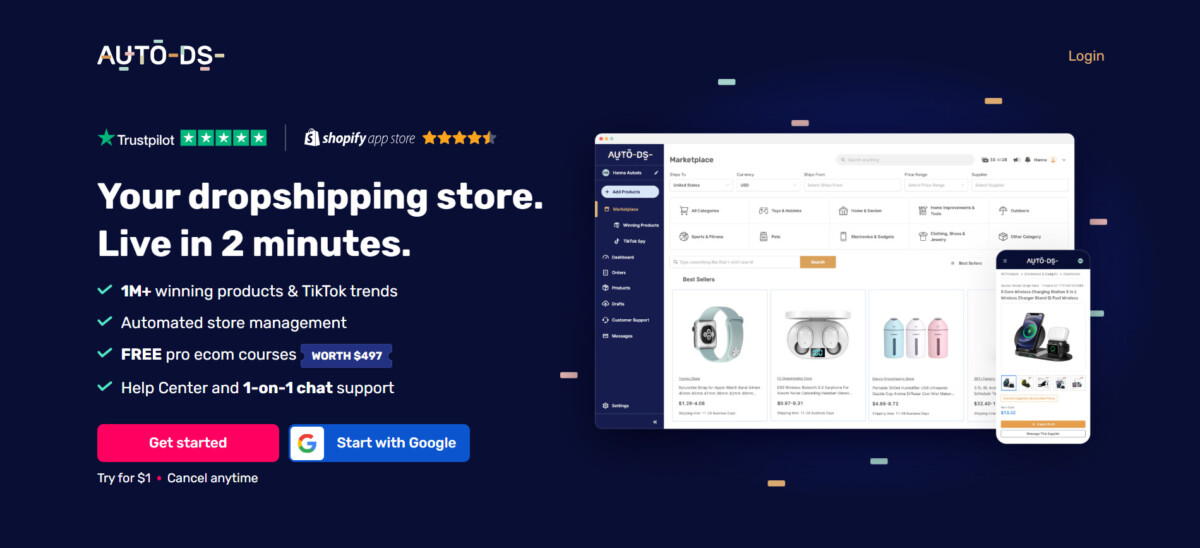
The AutoDS Claude MCP Connector links an AutoDS account to Claude, so sellers can search the AutoDS catalog, review their stores and products, and push products to a store through chat.
AutoDS itself is dropshipping automation software that imports products from suppliers and marketplaces such as AliExpress, Amazon, Walmart and Shein, monitors their prices and availability, and automates order fulfillment. The connector adds a conversational layer on top. Its read-only tools search the catalog, find winning, recommended or similar products, list stores and products, and pull product details; its write tools upload products to the draft list and publish drafts to a connected marketplace, with status checks on bulk actions. It supports eBay, Amazon, Shopify, Facebook, Wix, WooCommerce and Etsy stores. Sellers add AutoDS from Claude’s Connectors menu and sign in with their AutoDS account, and a request such as “find five trending pet products and add them to my drafts” then runs as a sequence of searches and uploads on live AutoDS data.
Pricing (as of October 2026): The connector is available on all AutoDS plans, works with both free and paid Claude plans, and its actions do not use AutoDS AI credits. On the Shopify App Store, Import 200 is $26.90 a month, Starter 500 is $39.90 a month, and Advanced 1K is $66.90 a month for up to three stores, each with a 3-day free trial. Platform add-ons such as auto ordering cost extra.
Standout strengths: Every tool carries its own permission setting (Always allow, Needs approval or Never allow), and write tools default to Needs approval, so nothing is published without a seller’s sign-off unless the seller changes that. Because the connector sits on AutoDS, a single chat can reach products from several suppliers and push them to several marketplaces, which matters when one store pulls from three or four sources.
Honest limitations: The connector works only with Claude, not ChatGPT, Gemini or Cursor. It acts on one AutoDS account and the store currently set as active, so switching stores means changing the active store in AutoDS before starting a new conversation. According to the AutoDS help center, it cannot edit existing product prices or descriptions, manage billing or change account settings, and search results do not include a direct product link.
Best fit: AutoDS users, or sellers who source from several suppliers and sell on several marketplaces, who already work in Claude and want to find, import and publish products without opening the AutoDS dashboard.
Skip if: You work in ChatGPT or Gemini, or you want one agent to plan research, sourcing and fulfillment from a single prompt; the connector handles finding and publishing products, not the whole workflow.
The Zendrop MCP Server lets ChatGPT, Claude and other MCP-compatible assistants read a Zendrop store’s live data and act on it from a chat window.
Zendrop is the underlying dropshipping platform, with a catalog of more than 1 million products, U.S. product options, custom branding and automated fulfillment. The Zendrop MCP Server turns an ordinary AI assistant into an operations agent for that account: it searches the catalog, lists and filters orders, pulls tracking numbers and flags issues, looks up shipping methods, costs and delivery windows by country, triggers fulfillment and updates shipping addresses, and reports revenue, profit, refunds and order counts by date and country. Sellers add Zendrop as an app in ChatGPT or as a custom connector in Claude, sign in and choose what the assistant can access. The assistant can then chain steps, such as finding orders with tracking issues, checking shipping options and preparing a fix.
Pricing (as of October 2026): Zendrop says sellers can start using the MCP server free, though some features may need a paid plan depending on store volume. Its pricing page lists a Free plan, Pro at $49 a month ($399 a year) and Plus at $79 a month ($549 a year), with automated fulfillment on the paid plans. ChatGPT requires a plan that supports apps, and Claude requires an account that can add custom connectors.
Standout strengths: Zendrop documents its permission model in more detail than any other connector here. Access runs through scoped tokens or OAuth, so a seller can give an assistant read-only order access without fulfillment rights and revoke it at any time, and fulfillment always pauses for the seller’s confirmation before anything ships. The Zendrop help center lists rate limits of 120 read requests, 30 write requests and 10 fulfillment actions per minute, which is plenty for a single store.
Honest limitations: Zendrop’s pricing page does not say which plans include full MCP access, so confirm before you upgrade. The agent experience also runs through a third party assistant, so results depend on the AI client you use and the subscription you pay for it.
Best fit: Sellers who already spend their day in ChatGPT or Claude and want to check orders, search products and trigger fulfillment in the same place.
Skip if: You do not want store data passing through an outside AI assistant, or you want an agent with its own interface rather than a connector.
The CJdropshipping MCP Server connects AI assistants directly to CJ’s API, so sellers can search products, quote freight, manage orders and handle disputes in natural language.
CJdropshipping is the underlying sourcing and fulfillment platform, combining global warehouses, sourcing agents, custom packaging, print on demand, quality inspection and 3PL services across Shopify, WooCommerce, TikTok Shop, Temu, eBay, Etsy, Shopee, Lazada and more. Its MCP tools cover product and SKU search, freight calculation, logistics timing and warehouse lookups; order tools to list, create and merge orders and add items to a cart; and dispute tools to list, view, create and cancel disputes. The CJ MCP integration guide lists all 17 tools. In local mode, sellers run CJ’s MCP project with Node.js and connect it to Claude Desktop or another local client; in remote mode, ChatGPT connects to a CJ-hosted MCP URL with a personal token. Once connected, the assistant can chain lookups and actions, such as searching for a product, comparing freight options and creating an order.
Pricing (as of October 2026): CJ’s MCP documentation does not list a separate fee, though it refers to CJ’s points rules, so check current terms. CJ lists its core platform features as “Free Forever,” and sellers pay for products, shipping and per-order service fees. The ChatGPT option requires Developer Mode, which OpenAI makes available on Pro, Plus, Business, Enterprise and Education accounts on the web.
Standout strengths: CJdropshipping is the strongest option on this list when a product is not already in a catalog, because human sourcing agents can find it, and custom packaging and print on demand let a seller build a brand rather than resell a generic item. Its MCP is most useful during sourcing, ordering and dispute handling, the three stages where sellers otherwise lose the most time in a supplier dashboard, and in ChatGPT Developer Mode write actions require confirmation by default.
Honest limitations: The local MCP setup requires cloning a project and running Node.js, which many sellers will want to skip in favor of the hosted ChatGPT option. Warehouses sit around the world, so delivery times vary by product, and sellers who promise fast U.S. delivery need to check the warehouse and delivery estimate on every listing.
Best fit: CJ sellers who need international warehouses, private label packaging, print on demand, or human sourcing help, and want to check freight and manage orders and disputes from ChatGPT or Claude.
Skip if: Your entire offer depends on fast U.S. shipping and you do not have time to check warehouse location product by product.
Shopify Sidekick is the AI assistant built into the Shopify admin, and it is the baseline agent every Shopify-based dropshipping store already has.
Sidekick understands plain-language requests through chat, voice mode and screen sharing, and acts directly on store data. It analyzes data, manages orders and edits products, including through certain third party apps, and it can run background tasks that keep going after the chat is closed, with a notification when results are ready. It also generates product descriptions, blog posts and images, saves prompts as reusable skills, remembers past conversations, and surfaces Sidekick Pulse recommendations on the admin home page. The Shopify Help Center says Sidekick presents changes for review before applying them, and it respects staff permissions, so team members only see the data and features they are authorized to use. Our guide to Shopify Magic vs Shopify Sidekick covers what each one handles.
Pricing (as of October 2026): Sidekick is included with Shopify plans at no extra cost. Features and usage limits vary by plan.
Standout strengths: Sidekick costs nothing extra and already sits where Shopify sellers work, so product edits, collections, order management and performance questions take a sentence instead of a dozen clicks. Background tasks and saved skills turn the same weekly admin jobs into one-line requests.
Honest limitations: Sidekick only sees what is in Shopify. It has no sourcing platform behind it, so it cannot find products, compare suppliers or fulfill dropshipping orders, and supplier stock, processing times and fulfillment issues still need handling through your dropshipping platform. Shopify does not publish per-plan usage limits, so heavy users should check what their plan allows.
Best fit: Every Shopify-based dropshipper, as the admin layer that works alongside a sourcing and fulfillment agent.
Skip if: You sell only on marketplaces such as eBay, Walmart or TikTok Shop without a Shopify store.
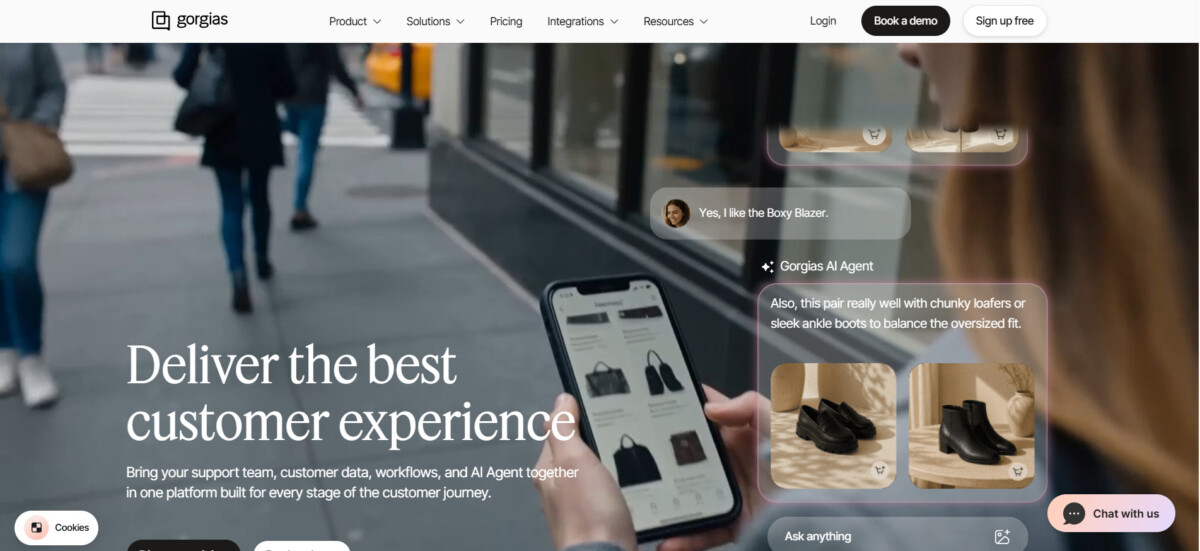
Gorgias AI Agent is the AI layer of the Gorgias ecommerce helpdesk, built to answer and resolve customer conversations such as order status and common pre-sale questions.
Gorgias AI Agent is a specialist that works alongside a sourcing platform, not in place of one. It reads order data from the connected store, understands the customer’s request in natural language and resolves conversations around the clock across chat and email, handing off to a human when it cannot resolve the issue. It can also take Shopify actions: cancel unfulfilled orders, edit shipping addresses, remove or replace items, reship orders for free and add order notes. It does not source products or manage suppliers; it takes the customer-facing side of the workflow off the seller’s desk.
Pricing (as of October 2026): On the Shopify App Store, Starter is $10 a month (50 tickets), Basic is $60 a month (300 tickets), Pro is $360 a month (2,000 tickets) and Advanced is $900 a month (5,000 tickets). AI Agent is included on every plan and adds an automation fee for each conversation it resolves without a human within 72 hours; the rate depends on the plan, so check Gorgias pricing and the Billing and Usage page in your account.
Standout strengths: Gorgias AI Agent targets the support load that grows fastest in dropshipping, where longer shipping windows produce a steady stream of “where is my order” emails. Merchants control how far it goes: action conditions can limit cancellations to recently placed orders, and address edits and item removals ask the customer to confirm first.
Honest limitations: Gorgias AI Agent costs scale with ticket volume and with every AI resolution, so model your expected volume before choosing a plan. It also answers only from store data, so supplier delays still have to be fixed through your sourcing platform.
Best fit: Dropshipping stores where order status emails, returns questions and pre-sale chats take up a large share of the week.
Skip if: You are still handling a handful of tickets a week yourself; at that volume the per-resolution fees and setup time outweigh the hours saved.
Moby is the AI agent inside Triple Whale’s ecommerce analytics platform, answering business questions in plain English, running recurring automations and, on higher plans, acting in connected ad accounts.
Moby answers plain-English questions across orders, customers, products, inventory, finance and marketing data, and asks follow-up questions when it needs a date range or metric. Moby Automations run scheduled or trigger-based jobs such as daily reports, and Moby Actions can scale budgets, pause underperforming ads and launch campaigns, each with reasoning the seller can approve, reject or discuss. Approval modes (“Ask every time” or “Let Moby decide”) run within business guardrails, and landing pages and Creative Studio cover campaign assets. Because Moby draws on Triple Whale’s attribution and measurement data, its recommendations reflect which products and ads actually make money, which feeds straight back into what you research and source next. Our full Triple Whale review covers how it compares with Northbeam and Elevar.
Pricing (as of October 2026): Triple Whale’s Free plan includes a basic Moby experience, Foundation adds daily Moby use as a real-time analyst, and Automations and Actions require Automate or Enterprise. Triple Whale’s pricing page prices plans by annual GMV, while its Shopify App Store listing shows Foundation at $219 a month and Automate at $749 a month. Foundation and Automate are 12-month subscriptions.
Standout strengths: Moby is the only agent on this list focused on profitability and attribution, which is where scaling stores make their most expensive decisions. Scheduled automations mean the same performance questions get answered every week without someone building the report by hand, and Actions turn those answers into budget changes the seller approves.
Honest limitations: The agent features that take action sit on the Automate plan, a substantial 12-month commitment for a new store. Triple Whale also needs a meaningful volume of sales and ad data before its analysis says anything useful.
Best fit: Scaling dropshipping brands with meaningful ad spend that need attribution and profitability data to decide what to scale or cut.
Skip if: You are pre launch or still testing products on small budgets; free platform reports cover that stage.
Some popular AI tools help with one stage of dropshipping but do not act as agents on store or supplier data, so they sit outside the seven above and work best alongside one of them.
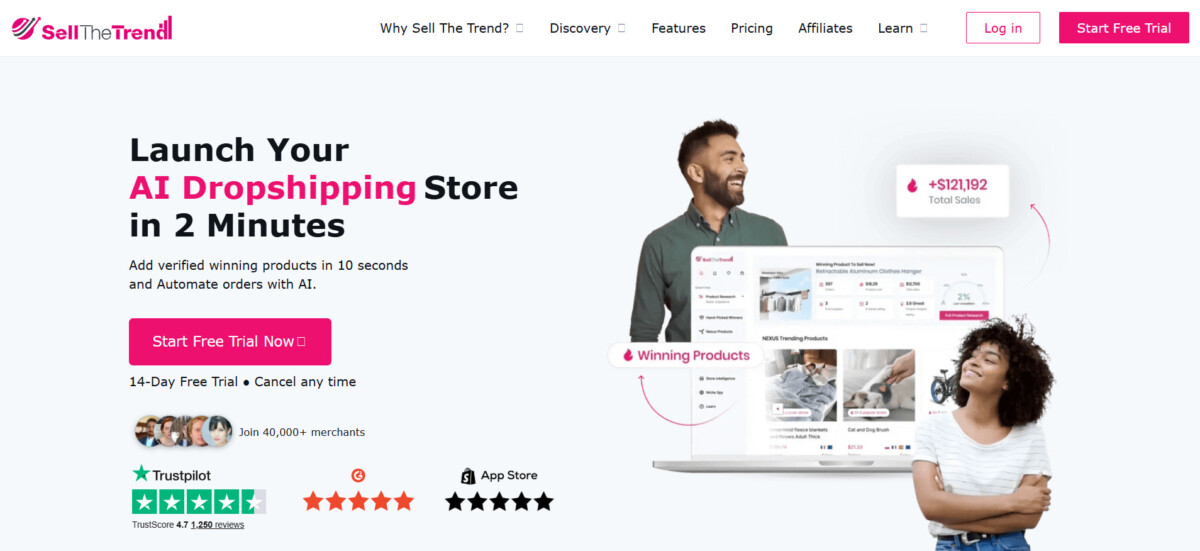
Sell The Trend is a product research and store automation platform built around NEXUS, its AI product research tool. It pairs NEXUS with Store Intelligence and Niche Spy tools, a Facebook Ads Finder, and on the Pro plan a TikTok Ads Finder and TikTok Shop Products Finder. Once a product looks promising, one-click push to store sends it to a Shopify store or Sell The Trend’s own SellShop storefront, and higher plans add automatic order updates, dynamic pricing and, on Essential and Pro, a Video Ads Creator. It is research first, which makes it useful in the testing phase, when the costliest mistake is spending ad budget on a product nobody wants, but it is lighter on supplier evaluation and after-sales handling than a full dropshipping platform.
Pricing (as of October 2026): Sell The Trend’s pricing page lists monthly plans at Lite $29.97, Essential $49.97 and Pro $99.97, with about 33% off on yearly billing. AI credits are capped by plan at 6, 20 and 40. A 14-day free trial is available, but a payment method is required at signup. Lite limits NEXUS to 10 uses per day and leaves out automatic order updates and dynamic pricing, so most active sellers will need Essential or above, and no plan includes staff accounts.
Skip if: Your bottleneck is fulfillment, supplier quality or customer service rather than deciding what to sell, or you need team seats.
ChatGPT and Claude are useful for brainstorming niches, drafting ad copy and summarizing reports, but on their own they cannot see your supplier catalog, stock or orders. That changes when you connect them to a dropshipping account through an MCP (Model Context Protocol) connector, as Zendrop and CJdropshipping (ChatGPT or Claude) and AutoDS (Claude only) now offer. Before you connect one, check what the connector can read and write, how narrowly you can scope its permissions, and whether fulfillment actions require your approval. Count the assistant’s own subscription in the cost as well.
The features that matter most are grounding in real supply data and the ability to take real actions, because those two decide whether an agent saves time or just creates more text to copy. An agent is only as useful as the data it works on, so choose one that recommends products from real catalog, inventory and supplier data that can actually be sourced and shipped. Then check whether it can list products, update prices, check tracking and start a refund request, or whether it simply writes something for you to paste.
Control comes next. Good agents ask for confirmation before publishing listings or triggering fulfillment, and scoped tokens, read-only modes and approval steps keep the seller in charge. Channel coverage matters too: Shopify support is standard, but Walmart, eBay, TikTok Shop and Amazon support varies, and features often differ by channel.
After launch, the most time-consuming problems are delayed shipments, missing tracking scans and returns. An agent that flags an abnormal order, explains the likely cause and prepares next steps removes real workload. Supplier evaluation signals such as fulfillment rate, processing time and warehouse location help you avoid suppliers who cause those problems in the first place, and our list of the fastest dropshipping suppliers for 2026 notes which networks keep U.S. and EU warehouses. Scheduled tasks keep repeat research, reporting and listing jobs from being forgotten. Finally, look for transparent usage pricing; many agents charge credits, daily limits or per-resolution fees, and published credit costs are the only way to estimate a typical month.
AI dropshipping agents use five pricing models, and the credit, platform plan and per-resolution layers are what push the real monthly cost above the advertised price. Here is how the tools in this guide are billed as of October 2026.
If you use an MCP connector, add the cost of the AI assistant subscription you connect it to.
The right stack depends on your biggest bottleneck, where your products come from and where your customers live, so start with one core agent for your stage and add a specialist only when a specific gap appears.
Keep the stack small. At this stage the bottleneck is usually deciding what to sell, and a single platform-native agent that covers research, sourcing, store setup and listing, such as Doba Pilot, avoids juggling tools while you learn; its Market Scout reports help you pick what to test, and the same tool carries a winning product through to a live listing with a U.S. supplier attached. Sell The Trend’s research tools are an alternative for idea generation, but you still need a supplier behind them. If you sell on Shopify, Sidekick is already included, so use it for admin work from day one.
Once orders are steady, your week shifts to sync jobs, order follow-up and customer questions, and the choice of core agent turns on sourcing. A platform-native agent like Doba Pilot works best when you source from that platform. If you pull from AliExpress, Amazon, Walmart and other marketplaces at once, AutoDS’s multi-supplier automation fits better, and its Claude connector lets you find and publish products from chat. If you already run your day in ChatGPT or Claude, Zendrop’s MCP server lets you check orders and trigger fulfillment from the same window, provided you are comfortable with scoped access through a third party assistant. If you need custom packaging, print on demand or products no catalog carries, CJdropshipping is the stronger fit, with the trade off of checking delivery times product by product. If your customers are mostly in the U.S., they expect domestic shipping speeds, so check how much of a catalog is stocked in U.S. warehouses and what processing times suppliers report. When support volume grows, Gorgias AI Agent takes the order status load.
Multi-channel sellers need inventory and price synchronization, listing support for each marketplace and bulk operations. Look for broad channel coverage and API access, such as Doba’s higher plans with Retailer API access or AutoDS across several storefronts. Once ad spend becomes your largest cost line, Moby by Triple Whale earns its price by showing which products and ads to scale or cut.
The pattern to avoid is stacking everything at once, the same app bloat a Shopify tech stack audit usually finds. Choose one core agent for sourcing and fulfillment, then add a specialist only when a specific gap appears, such as support or ad analytics. The exception is a store that genuinely needs two sourcing models, for example a U.S. catalog on Doba alongside custom packaged products from CJdropshipping, and even then each tool should own a clearly separate job. Before committing, add up the subscription, credits, add-ons, per-resolution fees and any AI assistant subscription, then use the trial to run one real task from research to a listed product and check the output closely. Ask each vendor what data the agent uses and how often it updates, which actions need your approval, which channels are fully supported, how usage is counted and what happens when you run out, how delayed orders and returns are handled, what supplier performance data you can see, whether you can limit or revoke access, and which features are live today versus on the roadmap.
AI agents in 2026 reduce repetitive work, but they do not run the store. Sellers still decide which products to sell, set pricing policies, approve listings, handle sensitive customer issues and stay responsible for compliance. No agent can guarantee a product, a profit or a delivery time, and any tool that promises a fully self-running business deserves skepticism. The setup that works today is the agent as preparer and the seller as reviewer, with the buying decision staying human. Doba Pilot covers the sourcing and fulfillment core end to end, the AutoDS, Zendrop and CJdropshipping connectors bring that work into ChatGPT or Claude, and Shopify Sidekick, Gorgias and Moby by Triple Whale handle admin, support and ad analytics, so the right combination is the one that matches your bottleneck at your current stage, not the longest feature list.
There is no single best AI agent for dropshipping in 2026; the right one depends on your workflow and sourcing. Doba Pilot is a strong all-in-one choice for U.S.-focused sellers because it connects research, sourcing, listing and fulfillment follow-up to Doba’s catalog and supplier data. The AutoDS Claude MCP Connector suits AutoDS users who work in Claude, and the Zendrop and CJdropshipping MCP servers suit sellers who want to run operations from ChatGPT or Claude. Shopify Sidekick handles Shopify admin work, while Gorgias and Moby by Triple Whale are specialists for support and ad analytics. The stage section above maps each one to a specific situation.
No, an AI agent cannot run a dropshipping store on its own in 2026. Current agents can research products, create listings, monitor orders and prepare follow-ups, but sellers still review listings, approve key actions such as fulfillment and publishing, and make the business decisions on products, pricing and customer issues. Tools like Zendrop, AutoDS and Doba Pilot build confirmation or approval steps into the workflow for exactly this reason. Treat the agent as an assistant that handles repetitive steps, not a replacement for the seller, and be skeptical of any tool marketed as a fully self-running business.
Doba Pilot and Zendrop are the two agents on this list that put U.S.-stocked products at the center of their catalogs. Doba states that around 90% of its products are stocked in U.S. warehouses, and Doba Pilot sources directly from that catalog with supplier processing times visible before you choose. Zendrop also lists U.S. product options on all of its plans. CJdropshipping runs warehouses in several countries, including the U.S., so delivery times vary by product. In every case, stock location and delivery times depend on the specific product and supplier, so check each listing before you promise customers a delivery window.
AI dropshipping agents cost anywhere from nothing extra to several hundred dollars a month as of October 2026, depending on the agent type. Doba Pilot gives 30 free credits on signup, then costs $39.99 a month with 100 Pilot Credits. The AutoDS, Zendrop and CJdropshipping MCP integrations carry no separate listed fee but require an account on the underlying platform, such as AutoDS from $26.90 a month or Zendrop’s free or $49 Pro plan, plus a compatible AI assistant. Shopify Sidekick is included with Shopify plans, Gorgias AI Agent adds a per-resolution fee on top of a helpdesk plan from $10 a month, and Moby’s Automations and Actions require Triple Whale’s Automate plan at $749 a month. Credits, add-ons and AI assistant subscriptions can raise the real monthly cost well above the plan price.
An MCP server in dropshipping is a connector that lets an AI assistant like ChatGPT or Claude use a dropshipping account’s data and actions through the Model Context Protocol. Once connected, the assistant can search the catalog, check orders and tracking, and in some cases trigger fulfillment or publish products, all from a chat window. Zendrop and CJdropshipping both offer an MCP server that works with ChatGPT or Claude, and AutoDS offers a Claude-only MCP connector. Before connecting one, check what it can read and write, whether you can limit it to read-only access, and whether fulfillment and publishing actions require your confirmation.
Yes, Shopify Sidekick is still useful alongside a dropshipping agent because the two do different jobs. Sidekick is included with Shopify plans and handles product edits, collections, order management, content generation and performance questions inside the Shopify admin, with background tasks that keep running after you close the chat. It does not source products, compare suppliers or fulfill dropshipping orders, because it has no sourcing platform behind it. Use Sidekick for work inside the Shopify admin and a dropshipping agent such as Doba Pilot, or a connector from AutoDS, Zendrop or CJdropshipping, for sourcing, supplier and fulfillment work.