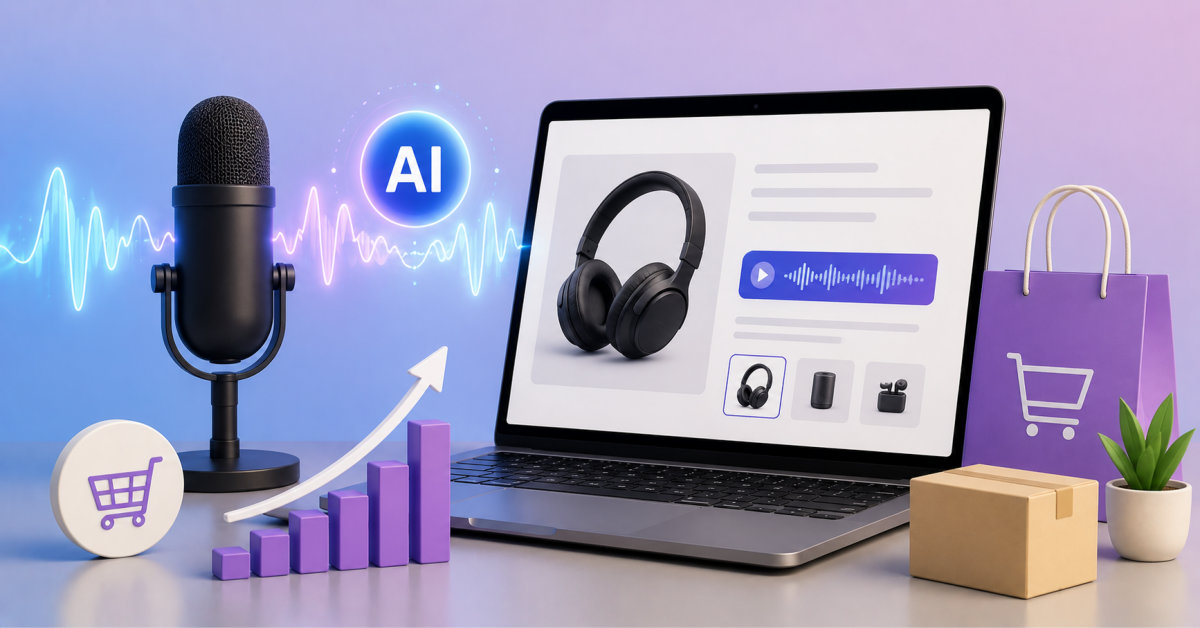
AI-generated audio can help ecommerce teams produce and test product narration, music direction, ambience, dialogue, and sound effects faster, but the commercial advantage comes from disciplined creative testing, accurate product claims, brand consistency, consent, and human approval before anything reaches customers.
AI audio does not make weak creative persuasive. It makes it faster to hear whether a clear product story, strong opening hook, and believable brand tone are working before you invest in a full production.
Ecommerce brands compete in an environment where shoppers can compare dozens of products within minutes. Product photography, pricing, and written descriptions remain important, but they are no longer enough to differentiate a brand across every digital channel. Merchants must also create product videos, social advertisements, tutorials, livestream segments, and localized campaigns for audiences with different preferences.
Audio plays a major role in all of these formats. Narration explains product benefits, music establishes the emotional tone, and sound effects help viewers understand how a product works. Yet producing polished audio can become a bottleneck, especially when a marketing team needs many creative variations for different products, platforms, and countries.
AI-generated audio is beginning to reduce that friction. Modern systems can generate more than a basic text-to-speech recording. They can help ecommerce teams create narration, dialogue, music direction, ambience, and sound effects from a structured prompt. This makes it possible to move from a written campaign idea to an audible creative draft much faster.
Online shoppers cannot physically inspect a product before purchasing it. A merchant must therefore communicate texture, scale, function, quality, and emotional value through digital media. Visual content handles much of this work, but audio can make the experience more persuasive and easier to understand.
A product demonstration becomes clearer when narration explains what the viewer is seeing. A fashion video feels different when paired with energetic music instead of a quiet soundtrack. A technology advertisement can use subtle interface sounds to emphasize speed and usability. Even a short transition sound can help direct attention to a feature or call to action.
Audio is especially important on social platforms, where brands have only a few seconds to stop a viewer from scrolling. The opening voice, music cue, or sound effect may determine whether the viewer continues watching. As a result, ecommerce teams increasingly need audio that is not only polished but also adaptable to many campaign variations.
Creating professional audio has traditionally required several separate steps. A team writes a script, records a voice actor, licenses music, searches for sound effects, edits each asset, adjusts volume levels, and synchronizes the result with the video. If the script changes, part of the process may need to be repeated.
This workflow is manageable for a major brand campaign, but it becomes difficult when a store has hundreds of products or publishes new social content every day. It is also expensive to create multiple versions for testing. A team may want to compare different hooks, voices, or emotional tones but lack the time to produce every variation.
AI-assisted audio changes the economics of experimentation. Instead of treating every version as a new production project, marketers can generate several initial directions from the same campaign brief. The strongest concept can then receive additional human editing and final quality control.
Early voice generation tools focused on reading a script. That remains useful for straightforward tutorials and product explainers, but ecommerce content often needs more than narration.
A modern product advertisement may include a narrator, a customer reaction, background music, environmental ambience, and sounds produced by the product itself. A kitchen appliance video might combine spoken instructions with chopping sounds, a timer, and subtle music. A travel product advertisement might use airport ambience and rolling luggage sounds to create a recognizable setting.
Scene-level audio generation allows a marketer to describe these elements together. The prompt can specify the speaker, emotion, pacing, music style, environment, and timing of key events. The generated result becomes a complete creative draft rather than an isolated voice file.
This approach is particularly useful during campaign planning. Decision-makers can hear how a concept might feel before the brand invests in final recording, licensing, and post-production.
AI audio can support several parts of the ecommerce customer journey. The best application depends on the product, audience, and sales channel.
Tools such as Seed Audio 1.0 make prompt-driven audio production more accessible by giving creators and marketers a unified environment for experimenting with generated voice, music, ambience, dialogue, and sound effects.
Digital advertising performance often depends on creative testing. Two advertisements promoting the same product can produce very different results because of changes in the hook, pacing, voice, or emotional tone. However, producing enough variations has traditionally required substantial time and budget.
AI audio enables teams to isolate and test individual creative decisions. A merchant could generate one version with a calm expert voice and another with an energetic creator-style delivery. The visual footage and offer could remain unchanged, allowing the team to measure how the audio direction affects performance.
Music can be tested in the same way. A premium product might perform better with restrained, minimal audio, while a lower-priced impulse purchase might benefit from faster pacing and stronger sound cues. The correct choice cannot always be predicted in advance, which is why inexpensive experimentation is valuable.
The goal is not to flood advertising platforms with nearly identical content. It is to develop a structured testing process that answers specific questions about the audience.
Ecommerce teams should connect audio experiments to measurable business outcomes. A recording that sounds impressive is not necessarily the one that produces the best commercial result.
Useful metrics may include:
Marketers can use these signals to improve future prompts. If viewers leave during a long introduction, the next version can begin with the product benefit. If comments suggest that the delivery sounds too aggressive, the team can request a calmer tone. Each campaign becomes a source of information for the next one.
International expansion creates additional audio challenges. A script must be translated, but direct translation is not enough. Pacing, pronunciation, emotional delivery, and cultural expectations can vary across markets.
AI can help teams produce early localized versions more quickly. A brand can define the intended personality and generate several interpretations for review by native speakers. Human reviewers should confirm the accuracy, cultural fit, and naturalness of each result before publication.
This workflow can make localization more practical for smaller markets that might not justify a full production budget at the testing stage. If a campaign demonstrates demand, the merchant can invest in additional professional production for that region.
Consistency remains important. The voice does not need to sound identical in every language, but it should communicate the same brand qualities. A brand associated with expertise and reliability should not suddenly sound informal or exaggerated in a translated advertisement.
Many ecommerce businesses have detailed visual guidelines but no clear audio identity. Their colors, fonts, and photography remain consistent, while each video uses an unrelated voice and music style.
As brands produce more audiovisual content, this inconsistency becomes noticeable. AI-assisted workflows can help teams define repeatable audio characteristics, such as preferred narration speed, tone, music intensity, and transition style.
A practical audio style guide might describe:
These guidelines improve consistency whether the final audio is AI-generated, recorded by a person, or produced through a combination of both.
Voice generation requires careful attention to consent and transparency. A brand should never imitate an identifiable person without authorization. Reference recordings should only be used when the organization has the necessary permission and understands the platform’s terms.
Generated scripts also require human review. Teams must verify product claims, prices, guarantees, and instructions before publication. An audio file can sound professional while containing information that is outdated or inaccurate.
Disclosure may be appropriate in situations where synthetic media could affect audience trust. Brands should consider the expectations of each platform and market rather than assuming that every use case should follow the same policy.
Responsible practices protect both the customer and the business. Short-term production speed is not worth the reputational damage caused by a misleading voice or an inaccurate product claim.
AI can accelerate production, but it cannot define a brand’s strategy. A person must still decide which customer problem matters, what the product genuinely offers, and why the audience should pay attention.
Human editors are also needed to judge subtle issues such as humor, emotional appropriateness, pronunciation, and cultural context. Professional sound designers can refine promising drafts, improve balance, and prepare files for demanding commercial applications.
The strongest workflow combines AI speed with human direction. The system generates options, the marketing team evaluates them, and specialists polish the assets that demonstrate the greatest potential.
AI-generated audio gives ecommerce teams a new way to transform product ideas into creative assets. It can shorten the distance between a written campaign concept and an audio draft that can be reviewed, tested, and improved.
The technology is most valuable when used with a clear process. Teams should define the target audience, write accurate product claims, generate intentional variations, measure results, and maintain human approval before publication.
For ecommerce businesses managing many products and channels, this approach can reduce production bottlenecks without sacrificing strategic control. It enables more experimentation while reserving expensive studio resources for campaigns that have already shown potential.
As audio generation systems become more capable, the competitive advantage will not come from using AI by itself. It will come from understanding how to combine faster production with better customer insight, consistent branding, responsible review, and measurable commercial goals.
AI-generated audio in ecommerce marketing is the use of artificial-intelligence tools to create or assist with narration, dialogue, music direction, ambience, sound effects, and localized audio for product videos, ads, tutorials, and other customer-facing content. Some tools generate a simple voiceover from text, while scene-level systems can produce several sound elements together from a structured prompt. The practical value is faster creative exploration and lower-cost variation testing. Brands should still use human review to confirm product claims, pronunciation, customer fit, platform rules, and brand consistency before publication.
AI-generated audio can improve paid-social ad performance when it helps a brand test stronger opening hooks, pacing, voice styles, music direction, and calls to action against clear performance metrics. It does not improve results automatically. A team should hold the product footage, audience, offer, and landing page as constant as possible while testing specific audio hypotheses. Compare three-second view rate, completion rate, click-through rate, conversion rate, cost per acquisition, customer feedback, and return rate. The winning audio should attract the right customer, not just generate low-quality clicks.
Ecommerce brands should test AI voiceovers by creating a small number of distinct creative hypotheses, rather than many nearly identical versions. Keep the visual, offer, landing page, and audience stable while changing one audio dimension such as the opening hook, narration tone, pacing, or music intensity. For example, compare a problem-first opening, a benefit-first opening, and a product-demonstration opening. Measure attention and commercial outcomes, then document what the audience responded to. Review every script for accuracy and ensure the voice direction fits the brand before any ad goes live.
Whether a brand needs to disclose an AI-generated voice depends on the market, platform, use case, and whether the content could mislead consumers about an endorsement, identity, or material fact. Brands should never use a synthetic voice to impersonate an identifiable person without authorization, and they should not create fake customer testimonials or misleading endorsements. Advertising disclosures must be clear and conspicuous when required, and important written claims should not appear only in audio because many consumers watch video without sound. Review current platform rules and seek legal guidance for high-risk campaigns. [128][129][133]
AI audio can reduce the cost and time required for drafts, product variations, localization tests, tutorials, and lower-risk performance creative, but it does not fully replace professional voice actors and sound designers. Human specialists remain valuable for premium brand campaigns, emotional storytelling, complex localization, distinctive sonic identity, sensitive content, and work requiring precise performance or recording quality. The strongest model is hybrid: use AI to explore directions quickly, then use human judgment and specialist craft to refine the concepts that demonstrate strategic and commercial value.