

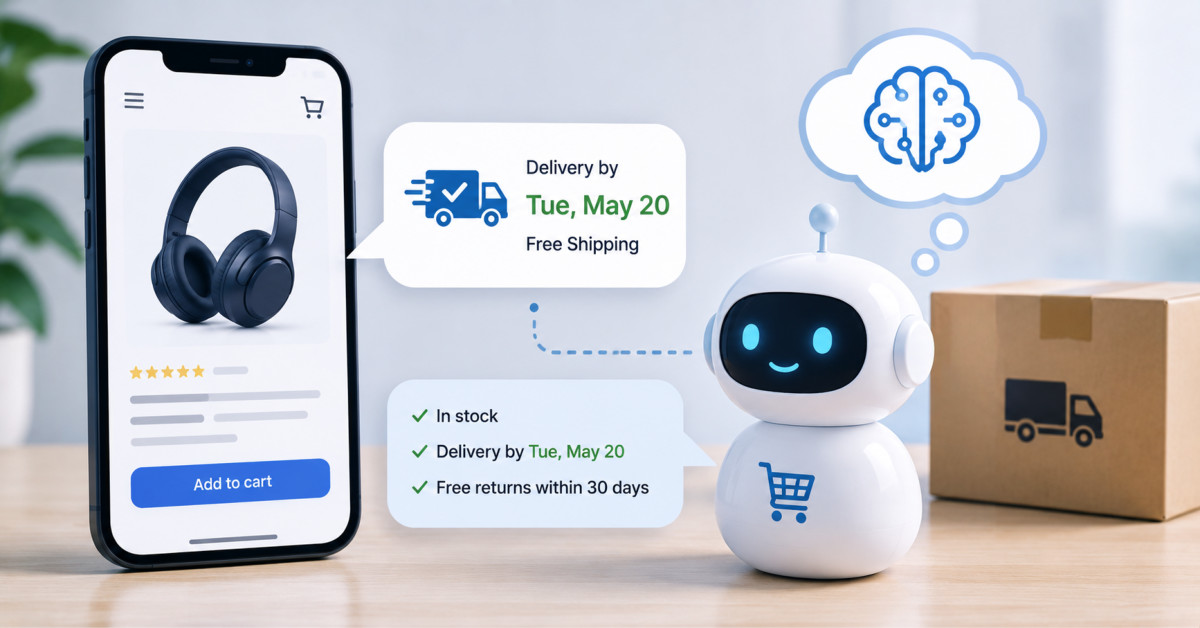
A Shopify store becomes more competitive in agentic commerce when its delivery options, arrival dates, pickup details, tracking events, and return terms are current, consistent, and available as structured data. Start by testing whether an AI agent can retrieve the same delivery promise your checkout can actually fulfill.
When an agent compares two identical products, delivery certainty can become the deciding product attribute.
By Thomas Bailey, Product Innovation Lead at nShift
Ask an AI shopping agent to find a product that arrives by Friday, costs less than $100 and can be returned nearby. The winning retailer needs to supply more than the right item and price. Its delivery offer must also answer the deadline and returns request. That is agentic commerce in practice: software choosing between stores on a shopper’s behalf.
A machine-readable delivery promise is a structured set of delivery options, dates, costs, pickup details, tracking events, and returns terms that software can retrieve and compare.
Delivery management platforms such as nShift make the delivery promise machine-readable, so an AI shopping agent can evaluate carrier options, delivery dates, and returns terms before it recommends a store.
For ecommerce teams, agentic commerce readiness starts with a practical audit. Can software find the same delivery facts as a well-informed shopper, and do those facts remain accurate from product discovery through a possible return?
An AI shopping agent needs structured, current facts that it can compare against the shopper’s constraints. The shopper’s request may include a date, budget, preferred collection point, accessible location, or easy return route. Each condition makes delivery part of product selection.
Consider two stores selling the same item at the same price. One can state that express delivery costs $8 and will arrive on Thursday. It can also offer a nearby pickup point open until 8 p.m. The other provides a general shipping page and calculates the available service late in checkout. A human may investigate both. An agent has stronger evidence for the first offer.
Delivery facts need to follow the operating chain. The retailer needs a valid carrier service for the destination and basket. Warehouse cut-off rules and current availability shape the date. The checkout needs to return the option, cost, and timing in a consistent format. Pickup choices need enough location detail to be compared. Returns terms need to explain what the shopper can do after delivery. Tracking events then show whether the promise is being kept.
A polished storefront still serves the human experience. The agent also works from the facts beneath that interface. If those facts can be retrieved, compared, and carried into checkout, delivery becomes part of the retailer’s discoverable offer.
The delivery promise breaks when facts are missing, inconsistent, stale, or only visible to a human. A delivery banner may advertise next-day service while the checkout applies a different cut-off. A pickup selector may show a location without current opening hours. A return policy may describe the process in prose while leaving the eligible period or available methods unclear. When any of these fields is incomplete, the agent has less evidence for matching the offer to a specific request. “Usually arrives in three to five days” is broad guidance. An option tied to the basket, destination, current service, and order time gives the agent a decision it can use.
A typical multi-tool setup can create different versions of the promise without any one system being obviously wrong. Checkout holds the delivery options. A carrier connection supplies shipment events. A separate tracking tool interprets those events for the shopper. Returns rules live elsewhere again. Teams need to check the joins between them to confirm that all four stages agree.
Follow one order across the tools and compare the facts at every handoff. If Friday delivery appears during discovery, the selected service should still show Friday at checkout. The tracking message should use the same commitment. If the shopper asks about a return, the available route should match the terms used to recommend the purchase. When the facts diverge, ecommerce and delivery teams can isolate the handoff where the promise changed.
Check the promise for availability, accuracy, consistency, and retrievability across the complete shopping journey.
Use a request that forces the systems to make a real choice: “Find this product for delivery by Friday, or collection after 6 p.m., with a return option near my home.” Run it with a real destination and representative basket. Record which services the agent finds, the date and cost it reports, the pickup information it can quote, and the return terms it uses. Then change one condition. Move the destination, add an oversized item, cross the daily cut-off, or choose a pickup point. The available promise should change in step with the service rules. A test that always returns the same answer may be reading static copy rather than current delivery logic.
Run the audit across people and systems. Ecommerce can check the product and checkout experience. Delivery operations can verify the carrier services and dates. Customer-experience teams can compare the tracking and returns journey. Technology can inspect which fields and interfaces produced each answer. Together, they can separate a wording issue from a data or rule issue.
Delivery teams can improve the signal by connecting the data sources, applying maintained service rules, and exposing the result consistently. Start with the promise customers already need, then trace the data required to support it. The detail exposed to the shopper or agent depends on those operating rules. For home delivery, that includes the valid services for the destination, their prices, warehouse cut-offs, and expected dates. For pickup, the choice also needs a location, opening hours, collection timing, and any service-specific cost. The fields should describe a selectable option, rather than a possibility that disappears once the basket reaches checkout.
Broader carrier choice helps when every option is current and usable. Check each option against the basket, destination, and order time. Then confirm that checkout can still fulfill the selection. A long list of vague services gives an agent more ambiguity. A focused set of valid options, each with a clear date and price, gives it a sound basis for comparison. Retailers can expand choice as the delivery layer gains the rules and data to govern it.
Post-purchase information belongs in the same design. Shipment status, revised timing, delivery confirmation, and exception events continue the promise after payment. Add clear returns terms to complete the record. When these updates use compatible order and shipment references, the shopper or agent can follow the transaction without reconstructing the story from separate systems.
Ownership keeps these records reliable. Someone needs to approve service rules, maintain cut-offs and pickup data, monitor carrier changes, and check that customer-facing messages reflect the current operation. Agentic commerce readiness is an ongoing operating discipline.
Set the same standard for changes as for launch. A new carrier service, warehouse, market, or returns route should be tested through discovery, checkout, tracking, and returns before it becomes part of the public promise.
Test realistic shopping constraints from product discovery through delivery and return. Two scenarios expose most of the gaps quickly.
Deadline-led test. Ask for a product that must arrive on a specific date. Check whether the agent can retrieve an eligible service, a current arrival date, its cost, and any relevant cut-off. Add the item to a representative basket and confirm that checkout returns the same option. Then inspect the tracking journey to see whether the original promise remains visible and any change is communicated against it.
Pickup-led test. Ask for collection near a named location after a particular time. Check whether the agent can identify a usable point, quote its opening hours, show the price, and state when the order will be ready. Continue to checkout, then verify the collection message and the applicable returns route.
Record the result as a short evidence trail: prompt, options found, facts returned, checkout result, post-purchase status, and returns answer. Repeat the tests across key markets and awkward baskets; the easiest domestic order will expose the fewest gaps. Use the gaps to locate the next fix in carrier coverage, service rules, checkout data, tracking, returns, or the connection between them.
nShift’s guide to agentic commerce extends this audit across the wider delivery-readiness model. The immediate priority is to make each promise specific, current, and consistent enough for software to use. An agent that can retrieve those facts can compare the retailer on the delivery terms the shopper requested.
About the author
Thomas Bailey is Product Innovation Lead at nShift, whose delivery and experience management platform supports more than one billion shipments a year across 190 countries. His background spans product, technology, and go-to-market strategy, with a focus on how delivery data shapes the ecommerce experience.
A machine-readable delivery promise is structured information that software can retrieve and compare about delivery options, costs, expected dates, pickup locations, tracking events, and return terms. It gives an AI shopping agent specific facts to evaluate against a shopper’s constraints, such as delivery by Friday, collection after 6 p.m., or a nearby return route. A generic shipping-policy page helps a human understand your offer, but it does not necessarily provide the basket-specific, destination-specific data an agent needs to recommend your store confidently.
Delivery data matters for agentic commerce because an AI shopping agent may select between comparable stores based on whether each can meet the shopper’s deadline, cost, pickup, and return requirements. If two retailers have the same product and price, the retailer with a clear, current, and retrievable delivery promise has stronger evidence for a recommendation. Delivery becomes part of product selection when the customer asks for a specific arrival date, collection location, accessible service, or a practical return method.
You can test whether an AI agent understands your shipping options by using a real destination and representative basket, then asking a constraint-led question such as, “Can this arrive by Friday?” Record the delivery service, cost, arrival date, pickup information, and return terms it identifies. Compare those answers with your checkout, tracking messages, and return flow. Repeat the test after changing the postcode, basket size, item dimensions, order time, or pickup location. A reliable delivery promise should change in line with the current service rules.
A Shopify store should make available the delivery services eligible for a basket and destination, their costs, expected delivery dates, relevant cut-offs, pickup locations, opening hours, collection timing, tracking updates, and return terms. The information needs to be current and consistent between discovery, checkout, post-purchase tracking, and returns. Do not expose options that cannot be fulfilled. A smaller set of valid delivery choices with clear prices and dates is more useful to customers and agents than a long list of vague services.
You should not replace a delivery platform solely to become agent-ready before identifying the exact data or workflow gap preventing accurate delivery promises. Start by auditing whether your current stack can generate valid basket-specific delivery options, preserve them through checkout, provide useful tracking events, and explain returns clearly. Replace or add technology only when the audit shows that the existing carrier connections, service rules, APIs, checkout capability, or returns workflow cannot support the operating promise your store needs.




