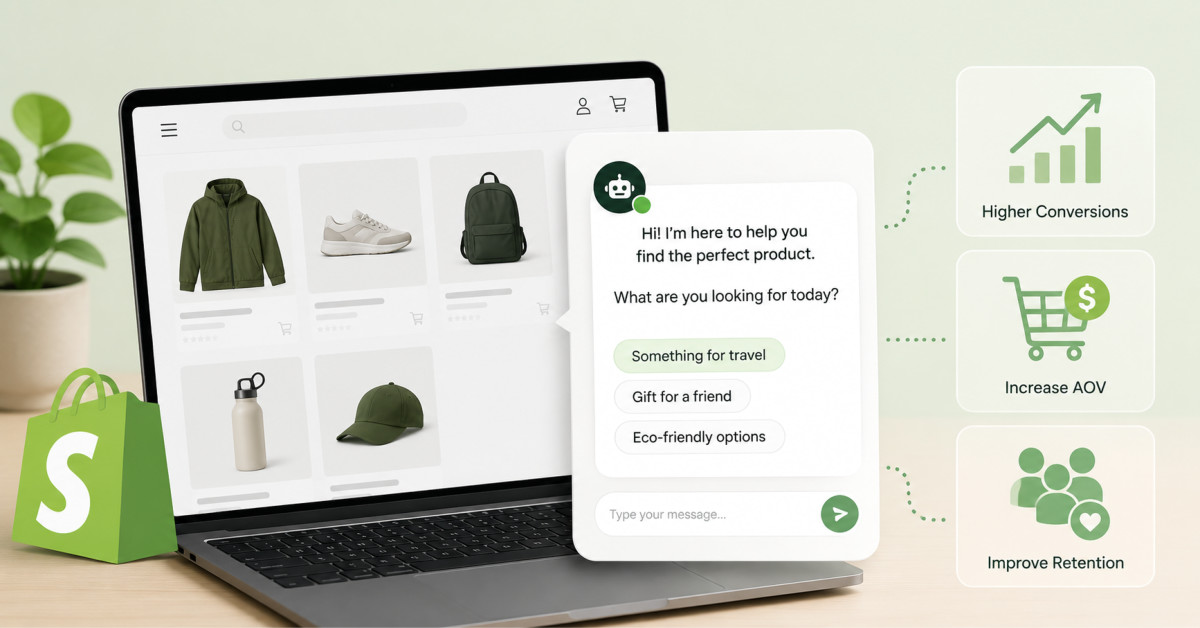
AI shopping assistants help Shopify stores convert more qualified traffic by answering product and policy questions instantly, recommending relevant items, and resolving routine post purchase requests. They are most valuable for brands with complex catalogs, international shoppers, or meaningful traffic outside support hours.
The expensive part is not the shopper who asks a question. It is the shopper who leaves because nobody answered it while purchase intent was still alive.
I spend a strange amount of my week reading chat transcripts from ecommerce stores, and the same little tragedy plays out again and again. Someone lands on a product page. They have exactly one question. Will it fit, does it ship to my country, what happens if I need to return it. They can’t find the answer in five seconds, so they leave. Multiply that by every visitor a store pays to acquire, and you start to see how much revenue quietly walks out the door.
That single unanswered question is the gap an AI shopping assistant is built to close. Below is what these tools actually do, why they move the three numbers that matter most, and how to put one on a Shopify store without hiring a developer.
Quick version: an AI shopping assistant is a conversational tool that answers a shopper’s questions, recommends the right products, and guides them toward checkout in real time, using your own catalog and policies. On Shopify it behaves like a good sales associate who happens to work every hour of the day. Done well, it lifts conversion rate, average order value, and retention at the same time.
It is software that has a real conversation with a shopper and helps them buy. The word “chatbot” undersells it, because most people picture the old rule based widgets that made you tap through a menu and still didn’t answer your question. An AI shopping assistant is different in three concrete ways.
First, it knows your store. It is trained on your products, prices, shipping and return policies, and FAQs, so its answers are specific instead of generic.
Second, it sells rather than just deflects. It suggests products, points out the item that pairs well with what you are viewing, and gently moves an undecided shopper toward a choice.
Third, it can take action. The better ones look up an order, show a product with its live price and photo, or hand the conversation to a human when that is the right move.
That move, from bots that exist to reduce support tickets toward assistants that exist to make sales, is what people mean when they say conversational commerce.
These three get lumped together, but they solve different problems.
| Capability | Rule based bot | Live chat (human) | AI shopping assistant |
| Understands free text questions | Limited | Yes | Yes |
| Available 24/7 | Yes | No | Yes |
| Trained on your full catalog | No | Depends on agent | Yes |
| Recommends products proactively | No | Sometimes | Yes |
| Scales to unlimited chats | Yes | No | Yes |
| Cost per conversation | Low | High | Low |
Live chat is wonderful for complicated, high value questions, but it doesn’t scale and almost nobody staffs it around the clock. Rule based bots scale fine and frustrate anyone who asks something the script didn’t anticipate. An AI shopping assistant borrows the availability and scale of automation and the helpfulness of a trained associate, which is why it has quietly become the default for growing Shopify stores.
Most stores lose the majority of their traffic to two things: questions nobody answered and small moments of doubt. An assistant goes straight at both.
It recommends the right products proactively. When a shopper types something like “a waterproof jacket for hiking, under 150 dollars,” it returns specific matches instead of leaving them to dig through a collection page.
It handles objections in the moment. Sizing, materials, delivery windows, the return policy, all answered at the exact point where a shopper would otherwise give up and close the tab.
It guides the sale. For stores with large or technical catalogs, a few good questions turn a confused browser into a confident buyer.
And it never clocks out. A shopper at 1am, or one reading in another language, still gets an instant, accurate reply.
None of this is magic. It comes down to a boring truth: shoppers who get their questions answered buy more often than shoppers who don’t. The cart data backs it up. The Baymard Institute pegs the average documented online cart abandonment rate at roughly 70 percent, and a big slice of that is uncertainty, the kind a real time answer is very good at clearing up.
Conversion is only the first number to move.
Average order value climbs because the assistant understands your catalog well enough to cross sell and upsell naturally. “That tent goes with this footprint and a repair kit.” The suggestion shows up at the moment of intent, which is precisely when a shopper is open to adding one more thing.
Retention improves for a quieter reason. After the sale, the same assistant answers “where is my order” and the usual policy questions instantly. That takes routine tickets off your team’s plate and gives the customer a faster experience, and fast, accurate post purchase support is one of the better predictors of a second order. The assistant that helped close the first sale ends up helping earn the next one.
On Shopify specifically, the assistant plugs into the data that makes it useful.
Catalog sync. It ingests your product feed, titles, variants, prices, images, and descriptions, so its recommendations point to real, in stock items at the correct price.
Order lookup. With order access, it answers “where is my package” on its own, using an email or order number, no human required.
Policy and FAQ training. It reads your shipping, returns, and FAQ pages so its answers match how your store actually operates.
On site delivery. It shows up as a chat bubble or embedded widget, and it can trigger on its own when someone is about to leave or is stuck on the cart.
The newer, Shopify native tools handle most of this automatically, so going live is a matter of minutes rather than the weeks of manual setup the older generation demanded. If you want the step by step version of how these tools connect to a store and turn on, this guide to building an AI chatbot for Shopify walks through it. Chatonbo, which I work on, is one option in this no code category, and there are a few others worth comparing before you commit.
You don’t need a developer for this.
1. Pick a Shopify native assistant that trains on your catalog automatically and can look up orders.
2. Install it from the Shopify App Store, or drop a single line of embed code into your theme.
3. Let it train on your products and policy pages. For most stores this takes minutes.
4. Give it a job: product recommendations, capturing leads, order status, or all of the above.
5. Turn it on, then read the transcripts every week to catch gaps and tune its instructions.
Start narrow. Pick one clear goal, recovering shoppers who are about to leave is a good first one, measure it honestly, and expand from there.
Honestly, it depends. Your traffic quality, your catalog, and how well you set the thing up all matter, so treat any single headline percentage you see with a raised eyebrow. What is consistent across the stores I have watched is the direction, not a magic figure. Stores that answer questions in real time and put the right product in front of people convert more of their traffic and see larger orders than stores that leave shoppers to fend for themselves. The upside is biggest if you have a large or technical catalog, higher consideration products, or a lot of after hours and international traffic.
It is the practice of using real time, human like conversation, whether chat, messaging, or voice, as a channel to sell and support customers. An AI shopping assistant is the technology that makes it work at any real scale.
Yes, mostly by removing friction. When shoppers get quick, accurate answers and relevant suggestions right when they are deciding, more of them finish the purchase and add more to the cart. The effect is strongest when the assistant is trained on your real catalog instead of handing out generic replies.
Live chat depends on human agents, so it doesn’t scale and is rarely available all day. An AI shopping assistant answers unlimited conversations instantly, at any hour, and still hands the tricky ones to a person.
A well built assistant is grounded in your store’s own content and answers only from it, which keeps hallucination to a minimum. When it genuinely doesn’t know, it should say so and offer to connect the shopper with a human.
Anywhere from a free tier to a few hundred dollars a month, depending on volume and features. Flat monthly pricing is a lot easier to plan around than per conversation billing, which tends to spike right when you are busiest.
The newer no code assistants install from the App Store and train on your catalog in minutes. Older tools that need manual training can stretch into days or weeks.
An AI shopping assistant is not a novelty chat bubble anymore. It is an always on sales associate that answers questions, recommends products, and walks shoppers to checkout, and it moves conversion, order value, and retention together. For Shopify merchants the cost of trying one has never been lower, since a modern assistant learns your store in minutes and starts helping the same day. The stores adopting it are doing something simple but powerful. They are turning traffic they already paid for into revenue they used to leave on the table.