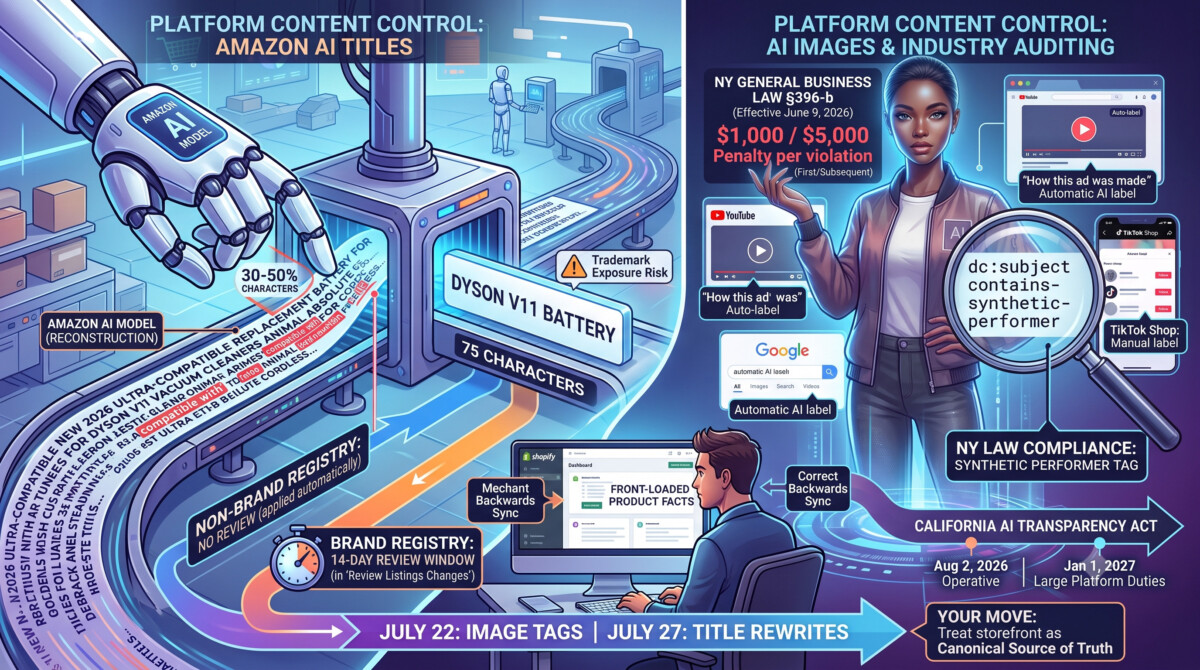
Amazon began rewriting non compliant product titles with AI on July 27, 2026. Brand Registry sellers get a 14 day review window in Review Listings Changes. Sellers without Brand Registry get no review at all, which makes enrollment the highest value move this week.
The number everyone reported was 75 characters. The number that actually matters is 14 days, and only some sellers get them.
On July 27, 2026, Amazon began replacing seller written product titles with titles generated by its own model. Not truncating them. Rewriting them, keeping the brand and the core noun, dropping what the model flags as redundant, and reordering what survives.
Almost every piece of coverage led with the number: 75 characters, down from the 200 most sellers had worked with. That framing treats this as a formatting change, which is how a formatting change gets mistaken for something much larger. The 75 character cap is a constraint. The AI rewrite is a transfer of authorship.
Five days before that, on July 22, Amazon told sellers they now have to tag any product image containing a photorealistic AI generated person with specific embedded metadata before upload. Two rules, five days apart, both landing in the same place: the platform is no longer just hosting your product content. It is editing it, labeling it, and in one case writing it.
If you sell on Shopify and Amazon both, this is an operational task with a deadline that has already passed. If you sell only on Shopify, this is the clearest preview available of where platform content control is heading, and it reframes a question a lot of operators got talked out of asking this year.
Amazon now caps product titles at 75 characters including spaces in every category except media, and rewrites over limit titles using its own AI model on its own schedule. The company posted the announcement to Seller Central on June 10, 2026 under the headline that title updates would begin July 27, giving sellers roughly six weeks. Alongside the cap, Amazon introduced Item Highlights, a separate searchable field carrying up to 125 characters that displays below the title in search results and on product detail pages.
Here is the asymmetry that almost no coverage surfaced. Brand owners enrolled in Brand Registry can review, edit, or reject Amazon’s AI recommendations in Review Listings Changes for up to 14 days before those changes go live. Sellers not enrolled in Brand Registry get no review window. Amazon applies the change, and the seller finds out afterward by opening Manage All Inventory and clicking View Change History.
That single distinction is worth more than every keyword tip published about this change. If you own your brand and have not completed Brand Registry enrollment, you have been treating it as a nice to have that protects you from counterfeiters. It is now the difference between approving your own product copy and reading it after the fact.
Listings stay active throughout, and you can edit titles and Item Highlights at any time, including after a rewrite. So nothing is permanent. But the rewrite happens gradually across your catalog rather than all at once, which means the practical failure mode is not a dramatic outage. It is a slow drift you do not notice on 300 ASINs until a quarterly report shows organic units down on products you never touched.
The rewrite is a reconstruction rather than a truncation, and on keyword stacked titles it typically strips 30 to 50% of the character count while reordering what remains. That distinction decides whether this is an afternoon of editing or a ranking event. A truncation cuts from the end, so you lose your tail keywords and keep your lead. A reconstruction can drop a mid tail term sitting in position eight of a stuffed title while keeping something the model considers more descriptive.
Sellers on the Amazon forum thread raised a sharper version of this risk than any agency blog did. Consider a title like Replacement Battery Compatible with Dyson V11 Vacuum Cleaners. The phrase compatible with is doing legal work, not marketing work. It signals a third party accessory rather than an original manufacturer part. If a model restructures that title to save characters and the qualifier goes, the listing has quietly become a trademark exposure. Nobody at Amazon intended that. The model was optimizing for length and clarity, and legal nuance does not look like signal to a length optimizer.
There is a second order effect worth naming for anyone thinking about AI discovery. A shorter, cleaner, more descriptive title is genuinely better for an AI shopping agent trying to match a product to a natural language query, which is the argument in our breakdown of how readiness scoring reads titles versus schema. A product called BLACK V2 PRO underperforms one called Lightweight Waterproof Trail Running Jacket regardless of how perfect the structured data is.
So Amazon is not wrong about the direction. Keyword stuffed titles were bad for shoppers and bad for machine comprehension. The problem is not the destination. It is that the model reaches the destination using its judgment about your product, applied at catalog scale, on a timeline you do not set.
Amazon began requiring sellers to embed a metadata tag on any product image or A plus content containing a photorealistic AI generated person, notifying the seller community on July 22, 2026. The specific mechanism is narrow and easy to fail by accident: the keyword contains-synthetic-performer has to sit in the dc:subject field of the image XMP metadata, added with an IPTC compatible editor before upload. Amazon then displays a shopper facing disclosure on the listing where applicable.
The trigger is New York General Business Law section 396-b, which took effect June 9, 2026 after Governor Kathy Hochul signed it in December 2025. It requires a business that creates a commercial advertisement, knowing it contains a synthetic performer, to disclose that conspicuously. Penalties run $1,000 for a first violation and $5,000 for each subsequent one. CNBC reported the seller notice the day after it went out.
The scope is narrower than the panic suggests, and the boundaries matter for your creative decisions. The rule covers photorealistic people generated entirely by AI and not based on a real person. It does not cover TV, video game, or movie characters. It does not cover real people whose images were edited with AI tools. An AI generated kitchen behind a real coffee maker is out of scope. An AI generated model wearing your shirt is in scope.
Notice where the liability landed. New York’s law targets the business that creates the advertisement and explicitly exempts platforms that merely distribute it. Amazon read that exemption correctly and pushed the identification duty down to sellers, then built a shopper facing label on top of the data sellers provide. The platform took the compliance mechanism and gave you the obligation. That is not a criticism of Amazon so much as a description of how platform compliance always flows, and it is worth internalizing before the next disclosure law arrives.
Four separate content control mechanisms landed on merchants inside a single month, which is what turns two Amazon policies from news into a trend worth planning around. On July 9, Google began rolling out a How this ad was made disclosure across Search, YouTube, and Discover, auto labeling ads built with its own AI tools and adding a manual control for creative made elsewhere. YouTube has been automatically applying AI labels since May when its systems detect significant photorealistic AI use. TikTok Shop directs sellers to label content substantially created or altered by AI. Then Amazon’s two July rules.
The regulatory pipeline behind this is not slowing. California’s AI Transparency Act becomes operative August 2, 2026, with large platform duties beginning January 1, 2027, including a prohibition on knowingly stripping compliant provenance data from uploaded content. Tech Policy Press counted 109 state AI laws enacted through July 1, 2026. Every one of those that touches advertising disclosure will arrive at merchants the same way New York’s did, through a platform policy that assigns you the identification work.
Read together, the pattern is a shift in what a platform is. A marketplace used to be distribution: you supplied the words and images, it supplied the traffic and the checkout. Increasingly it is an editorial layer. It rewrites your titles for comprehension, labels your images for compliance, discloses your ad creative’s provenance, and in the agentic layer described in our guide to the ACP, UCP, and MCP shopping protocols, summarizes your product to a shopper who never sees your page at all.
None of this is a conspiracy against merchants. Every individual change has a defensible rationale: mobile readability, consumer protection, machine comprehension. The cumulative effect is still that the number of surfaces where a merchant controls their own words is shrinking, one reasonable policy at a time.
Your own Shopify storefront is now the only high intent commercial surface where the words a shopper reads are guaranteed to be the words you wrote. That is a strange sentence to type in 2026, and it cuts directly against the argument that your website is becoming irrelevant.
The strategic implication is not that you should abandon marketplaces. Amazon is where the demand is, and a 15% commission on volume you could not otherwise reach is usually a good trade. The implication is that you should stop treating your storefront product copy as a downstream copy of your Amazon listing, which is exactly backward and is how most multichannel brands actually operate.
Your storefront is the one place where you can write the compatibility qualifier that protects you legally, the specific material claim that wins a considered purchase, and the honest sizing note that prevents a return. It is also the source that agents read when they build an answer, which is why front loading quantifiable product facts matters more than brand narrative in that context, a point covered in our agentic commerce readiness guide. Write it there first, in full, then let each channel compress it under that channel’s rules.
Sort your Amazon catalog by trailing 30 day revenue, take the top 50 ASINs, and manually rewrite every title over 75 characters before the gradual rollout reaches them. That is the whole first step, and it is the highest return 90 minutes available to a multichannel operator this week. Revenue weighting matters because an AI rewrite on a high velocity ASIN can move mobile conversion the same day, while the same rewrite on a slow mover costs you nothing measurable.
For each title, decide three things. What is the core identity that must stay in the 75 characters, meaning brand, product noun, and the single most important differentiator. What supporting detail moves to the 125 character Item Highlights field, meaning materials, use cases, and secondary keywords. What was only ever there for keyword density and should be deleted rather than relocated. Most stuffed titles turn out to be roughly one third identity, one third useful detail, and one third residue from a 2019 keyword strategy.
Then handle the parts most operators will skip. Check your Brand Registry status today, because without it you have no review window on anything. If you use AI generated people in any creative, audit your image library for the contains-synthetic-performer tag and fix the tagging at the point of creation rather than at upload, since retrofitting metadata across a catalog is significantly worse than embedding it in your production workflow. Keep the AI generated backgrounds, which are out of scope, and be deliberate about synthetic models, which are in scope and now carry a visible shopper facing label.
Finally, push the corrected copy back to your storefront as the master version rather than the reverse. If you use Shopify Marketplace Connect or a similar tool from our roundup of retail apps for managing your store, confirm which direction your product data actually syncs, because a surprising number of brands discover their Shopify titles were being overwritten from Amazon all along.
Yes, if your titles exceed 75 characters, Amazon began updating them to AI generated recommendations gradually starting July 27, 2026. The change applies to all categories except media, and the count includes spaces. Your listings stay active throughout the process, and you can edit titles and Item Highlights at any time, including after a rewrite has been applied. The rewrite is a reconstruction rather than a simple truncation, so Amazon’s model keeps the brand and core product noun, drops what it flags as redundant, and reorders the remaining terms. On heavily keyword stacked titles this commonly removes 30 to 50% of the characters.
Only if you are enrolled in Amazon Brand Registry. Brand owners can review, edit, or reject AI generated title and Item Highlights recommendations in Review Listings Changes for up to 14 days before the changes take effect. Sellers who are not enrolled in Brand Registry receive no review window, and Amazon applies changes directly. Those sellers can see what happened afterward through Manage All Inventory by clicking View Change History. If you own your brand and have not completed Brand Registry enrollment, that is the single highest value action available to you, because it converts a notification into an approval.
Item Highlights is a searchable field carrying up to 125 characters that Amazon introduced alongside the 75 character title cap in 2026. It appears below the title in search results and on product detail pages, and it is designed to hold materials information, recommended use cases, and comparison terms, meaning the supporting detail that used to be crammed into the back half of a long title. Because it is both searchable and visible, total indexable space stays near 200 characters, just split across two fields with different jobs. Treat the title as product identity and Item Highlights as qualifying detail rather than as overflow storage for old keywords.
Yes, if the image contains a photorealistic person generated entirely by AI and not based on a real person. Amazon notified sellers on July 22, 2026 that qualifying product images and A plus content must carry the keyword contains-synthetic-performer in the dc:subject field of the image XMP metadata, added with an IPTC compatible editor before upload. Amazon then shows a shopper facing disclosure where applicable. The requirement excludes TV, video game, and movie characters, and excludes real people even when their images were edited with AI. AI generated backgrounds and product scenes without people are out of scope.
No, Shopify does not rewrite your product titles, and that difference is now a strategic asset rather than a footnote. Shopify’s Sidekick can generate and bulk edit product content when you ask it to, but generation on request is fundamentally different from a platform editing live listings on its own schedule. Your Shopify storefront remains the surface where the words a shopper reads are the words you wrote. The practical takeaway for multichannel brands is to treat your storefront copy as the master version and let each marketplace compress it under that channel’s rules, rather than syncing marketplace compliant copy back into your own store.