

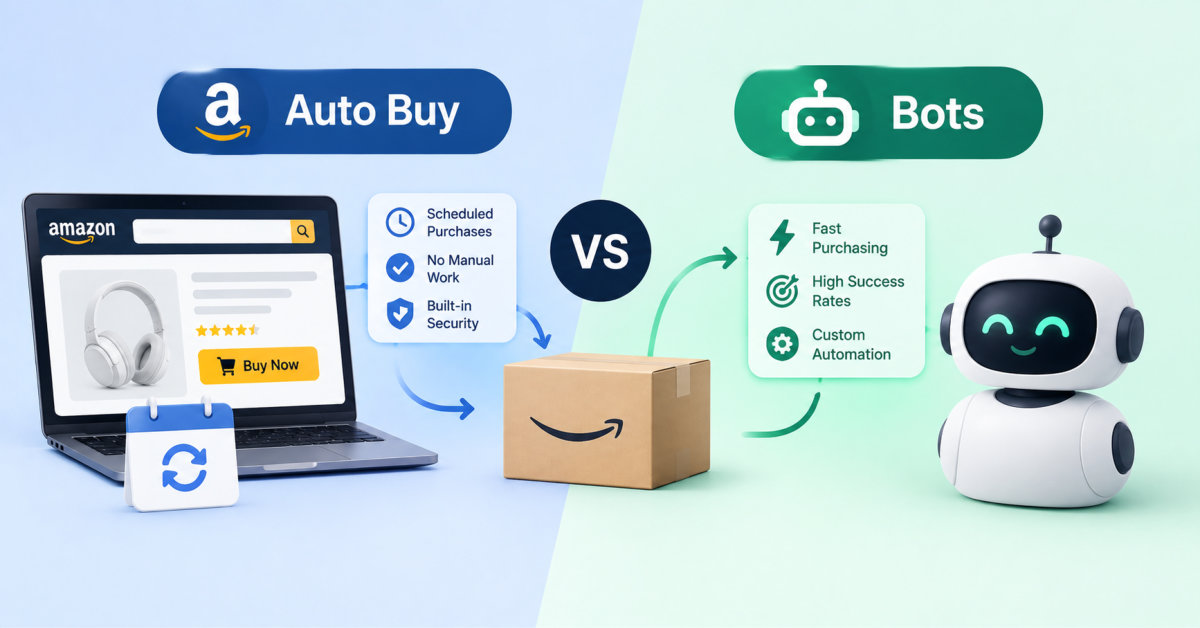
Amazon Auto Buy is best for shoppers waiting for a target price, while third-party tools such as AmaBot suit short-lived restocks because they can monitor availability alongside price, seller, and quantity rules. Neither approach guarantees an order or removes Amazon’s checkout requirements.
For a product that stays in stock, price is usually the decision. For a product that disappears in minutes, availability is the decision, and the time to make it may be gone before you see the listing.
A popular Amazon product can be unavailable for days and then suddenly return to stock without much warning. When that happens, shoppers may have only seconds or minutes to act before the available inventory disappears again.
That creates a different kind of shopping problem. The question is no longer just whether the price is right. It is whether the product is available, whether the listing meets your requirements, and whether you can respond quickly enough.
Amazon’s own Auto-Buy feature and third-party shopping automation such as AmaBot approach the problem differently. Amazon Auto-Buy is primarily built around a target price, while AmaBot’s Amazon auto buy approach combines product monitoring with conditions such as availability, maximum price, seller preference, and quantity controls.
For shoppers watching high-demand trading cards, collectibles, electronics, or gaming consoles, that distinction can make one approach more suitable than the other.
AmaBot is an independent third-party tool and is not affiliated with or endorsed by Amazon.
Amazon Auto-Buy is designed for a relatively simple purchasing decision: choose a product and set the price at which you are willing to buy it.
Amazon’s current information describes Auto-Buy as part of Alexa for Shopping. When a product reaches the shopper’s target price, Amazon can complete the purchase within 30 minutes after the target-price condition is met.
That makes sense when price is the main variable.
For example, suppose a pair of headphones normally sells for $100, but you only want to buy them for $75. Rather than repeatedly checking Amazon yourself, you can set your target price and allow Auto-Buy to act when the price reaches that level.
It is a useful form of automation because the shopper does not have to remember to check the product page every day. The system is essentially waiting for one specific condition: the price you want.
Alexa for Shopping is available to U.S. Amazon customers, although individual shopping features and product eligibility may vary.
A price-based buying strategy works well when a product stays available long enough for the shopper to wait. High-demand restocks create a different situation.
Consider a gaming console that has been unavailable for several days. A small quantity suddenly becomes available, and shoppers begin checking the listing immediately. If that inventory sells through in a few minutes, the biggest challenge is not finding a lower price. It is noticing the restock and acting while the listing is still live.
The same pattern can occur with trading cards, limited collectibles, graphics cards, headphones, and other products that regularly attract more buyers than available inventory. A shopper might be perfectly happy with the current price but still miss the purchase because they were not looking at the right time.
This is where Amazon restock monitoring becomes particularly useful. Instead of waiting for a price change, the shopper wants to know as soon as the product becomes available and then determine whether the listing meets the conditions they have already chosen.
A third-party Amazon shopping bot can take a more condition-based approach to shopping automation. Rather than asking only whether a product has reached a particular price, the software can monitor several characteristics of a listing and respond when the user’s requirements are met.
AmaBot is a desktop application for Amazon monitoring and automated purchasing. According to its stated functionality, it monitors each individual product every few seconds while checking the conditions configured by the user.
Those conditions can include product availability, a maximum purchase price, seller requirements, quantity, and whether automatic checkout should be used.
That gives the shopper more control over what qualifies as a purchase opportunity. A product being back in stock does not necessarily mean it should be bought. The shopper may only want to proceed if the price is below a certain limit or if the listing comes from an acceptable seller.
The automation therefore starts with a decision made by the shopper. The software handles the repetitive monitoring and can begin the purchasing process when those predefined conditions are satisfied.
The easiest way to understand the two approaches is to look at what triggers the purchase.
Amazon Auto-Buy:
“Buy this product when it reaches my target price.”
AmaBot:
“Buy this product when it becomes available and meets all of my predefined conditions.”
Neither approach is inherently better in every situation.
Suppose a product is currently available for $120, but you only want to pay $90. Your main concern is price. A target-price feature is directly aligned with that goal.
Now change the scenario. The product is normally $120, you are willing to pay that amount, but it is rarely in stock. When inventory appears, it can disappear almost immediately.
Here, waiting for a price reduction isn’t the priority. You want to know when the product becomes available.
That is the kind of situation where rapid monitoring and multiple conditions can become more useful than a simple price trigger.
Manual monitoring has an obvious limitation: a person cannot realistically refresh several product pages every few seconds throughout the day.
Even shoppers who are highly motivated eventually have to step away from their computer. A restock can happen while they are working, eating, sleeping, or simply looking at something else.
AmaBot’s stated monitoring interval is every few seconds for each individual product. It also states that adding more products does not make the monitoring of existing products slower.
That can matter for shoppers following several possible purchases. Instead of manually switching between product pages, they can set up the products they are interested in and allow the application to continue monitoring them.
The benefit is not a guarantee of getting the item. It is a reduction in the time and attention required to notice a qualifying listing.
In a normal shopping situation, saving a few seconds might not matter. During a highly competitive restock, those seconds can be much more relevant.
Fast monitoring does not mean buying every listing the moment it becomes available.
A product can return to stock at a price that is too high. Third-party sellers may also list popular products above the shopper’s budget. Without a price limit, a shopper could end up responding to an availability event that they never actually wanted.
This is why price can remain part of an automated shopping strategy even when availability is the primary trigger.
AmaBot allows users to establish a maximum purchase price as one of their conditions. A shopper can therefore say, in effect, that the product should be purchased only when it is available and falls within the amount they are prepared to spend.
Seller requirements can add another layer of control. If the shopper only wants an offer from a particular type of seller, that preference can also be included in the configuration.
The result is closer to a shopping rule than a simple price alert.
Quantity is another detail that can matter during a restock.
A collector may want two units of a particular product, while another shopper may want exactly one and does not want additional purchase attempts.
Setting quantity preferences in advance removes some of that uncertainty.
With AmaBot, users can define the quantity they want as part of their purchasing conditions. The application then uses those settings when determining whether the product qualifies for an automatic purchase attempt.
This is one reason condition-based automation can be more flexible than a single price trigger. The shopper can establish several parts of the purchase decision before the restock happens.
That preparation can be especially useful when the product is difficult to find and there is little time to make decisions once inventory appears.
The phrase Amazon auto checkout bot can sometimes create the impression that automation makes a successful order inevitable. It does not.
Starting a checkout process and successfully completing an order are two different things.
A product can sell out before the purchase is finalized. Another shopper may buy the available inventory first. Amazon can change the listing, price, seller, or purchasing conditions while the transaction is taking place.
There can also be account or checkout requirements that affect the final result.
AmaBot can automatically begin the purchasing process when the user’s selected conditions are satisfied, but it cannot guarantee that Amazon will ultimately confirm the order.
Because AmaBot runs locally, the computer, internet connection, and application session must remain active while monitoring or automatic purchasing is enabled.
That distinction should remain clear. The value of automation is in monitoring and responding quickly, not in creating inventory or guaranteeing a successful transaction.
Amazon Auto-Buy can be the more straightforward option when the shopper’s main goal is obtaining a product at a particular price.
If the item is regularly available and the shopper is simply waiting for a discount, there may be no reason to use more extensive monitoring. Setting a target price addresses the problem directly.
It also keeps the shopping decision relatively simple. The shopper decides what price is acceptable and lets the supported Amazon feature handle the purchase when that condition is met.
For many ordinary purchases, that may be all the automation needed.
The important point is not to confuse simplicity with weakness. A tool designed around one clear condition can be very useful when that condition is exactly what the shopper cares about.
A third-party Amazon shopping bot becomes more relevant when the problem is not simply finding the right price.
If a product is rarely available, the shopper may care about several things at once. Is it in stock? Is the price below the maximum? Is the seller acceptable? Do the configured quantity and order limits allow the purchase attempt?
These conditions can all be established before the shopper starts waiting for a restock.
AmaBot is designed around this type of monitoring. Because it is a desktop application, the shopper can configure products and purchasing preferences and allow it to monitor them while it is running.
When a listing satisfies the selected conditions, AmaBot can automatically begin the purchasing process.
Again, that does not mean the purchase will always succeed. It means the shopper does not have to discover the restock first and then manually work through every step from the beginning.
The answer depends on what makes the product difficult to buy.
If the product is easy to find but expensive, Amazon Auto-Buy may be the better fit because the target price is the main concern.
If the product is reasonably priced but difficult to catch in stock, rapid monitoring may be more important. In that case, a tool such as AmaBot can provide a more condition-based approach.
For products such as limited trading cards, collectibles, consoles, and popular electronics, availability can change quickly. When stock may last only seconds or minutes, the shopper has less time to react manually.
That is where monitoring frequency becomes a practical consideration rather than simply a technical specification.
A faster monitoring system does not guarantee success, but it can reduce the delay between a qualifying restock and the start of a purchase attempt.
For ecommerce brands and marketplace sellers, the growth of automated shopping also changes how demand reaches an offer. When shoppers define price and availability conditions in advance, a qualifying restock or price change can trigger purchasing activity with less manual delay. That makes inventory availability, pricing consistency, offer eligibility, and seller positioning increasingly important in an environment where software may be monitoring products continuously.
Amazon Auto-Buy and third-party Amazon automation are built around different shopping priorities.
Amazon Auto-Buy is primarily about target-price purchasing. It makes sense when the shopper is prepared to wait until an item reaches a specific price.
AmaBot takes a broader approach. It monitors individual products every few seconds and allows users to define conditions around availability, maximum price, seller requirements, quantity, and automatic checkout.
That distinction becomes important when shopping for products with unpredictable and short-lived restocks.
If the question is, “Will Amazon buy this when it reaches the price I want?” Amazon Auto-Buy addresses that need.
If the question is, “Can I have this product monitored and have a purchase attempt begin when it becomes available under my rules?” a tool such as AmaBot is designed for that use case.
Neither approach guarantees a successful order. But they can reduce different types of friction: Amazon Auto-Buy reduces the need to watch for a target price, while AmaBot reduces the need to constantly monitor product availability and react manually.
For high-demand restocks, that difference can be the more important part of the comparison.
No, Amazon Auto Buy is Amazon’s own target-price purchase feature for eligible items, while an Amazon bot generally refers to third-party software that monitors listings and can trigger alerts or purchase attempts based on user-defined rules. Amazon Auto Buy centers on a chosen price threshold. A third-party tool such as AmaBot can add conditions such as availability, maximum price, seller preference, quantity, and whether automatic checkout should be attempted. Both automate part of shopping, but they use different triggers and may have different eligibility, account, and operational requirements.
AmaBot states that it monitors each individual product every few seconds while its monitoring session is active. According to AmaBot’s published product information, adding additional monitored products does not slow the checking interval for products already being tracked. Actual detection and checkout timing can still be affected by the shopper’s internet connection, Amazon response times, account session status, and changes to the live offer. A frequent monitoring interval can reduce the need for manual page refreshing, but it does not guarantee that a product will remain available through checkout.
Yes, AmaBot says users can configure both availability and maximum-price conditions for a monitored Amazon product. The tool also states that shoppers can set seller preferences, quantity per order, order limits, and whether the system should send an alert or attempt an automatic purchase. This means a product can qualify only when it is in stock and remains within the shopper’s defined budget. Set a maximum total price carefully, including any shipping cost where applicable, so an available marketplace offer does not trigger a purchase attempt above your intended spend.
No, AmaBot cannot guarantee that you will receive a restocked Amazon product because inventory can sell out before Amazon confirms the order. A matching offer can change in price, seller, condition, or quantity during the checkout process, and Amazon may impose account, payment, verification, fulfillment, or purchase-limit conditions. AmaBot’s value is monitoring products and attempting action when your rules match, not creating inventory or bypassing Amazon’s marketplace systems. Keep your Amazon account, payment method, shipping address, application session, computer, and internet connection ready if you choose to use monitoring or auto-buy features.
Use Amazon Auto Buy when your primary goal is purchasing an eligible product at or below a target price, especially if the item is normally available. Use a third-party tool such as AmaBot when the main problem is catching a short-lived restock and you need additional rules for availability, maximum price, seller preference, quantity, or optional purchase attempts. For scarce trading cards, collectibles, consoles, and electronics, availability often matters more than waiting for a discount. Neither option guarantees an order, so use conservative rules and choose the approach that matches your actual shopping constraint.




