

Amazon gift cards are convenient for birthdays, holidays, employee rewards, and last-minute gifts, but a simple purchase can still go wrong. Buyers may select the wrong delivery method, send a card for the wrong Amazon marketplace, mistype an email address, or expose the claim code to someone other than the intended recipient.
Before purchasing or redeeming one, shoppers should understand the available formats, regional limitations, balance rules, and common fraud tactics. This detailed Amazon gift card guide explains how the cards work, how to check and redeem a balance, what purchases may be restricted, and how to recognize warning signs before money is lost.
Amazon gift cards solve a common gifting problem: the buyer does not need to predict exactly what the recipient wants. Instead of choosing a specific product, size, color, or model, the sender gives the recipient a balance that can be applied to eligible purchases.
They are particularly useful when:
Convenience, however, should not replace basic verification. The buyer still needs to choose the correct Amazon marketplace, delivery method, recipient information, and amount.
The best format depends on when and how the gift will be delivered.
Email delivery is suitable for last-minute gifts and recipients who regularly monitor their inboxes. The purchaser generally selects a design, amount, recipient email address, message, and delivery date.
The most important step is confirming the recipient’s email address. A small spelling mistake may send the gift notification to the wrong inbox or prevent timely delivery.
Recipients should also check their spam, junk, promotions, and filtered folders if the expected message does not appear.
Text delivery can be convenient when the sender has the recipient’s current mobile number but is less certain about their email address.
Before using this format, verify the full telephone number and country code. Phone numbers are often recycled, changed, or entered incorrectly, so they should not be selected from an outdated contact list without confirmation.
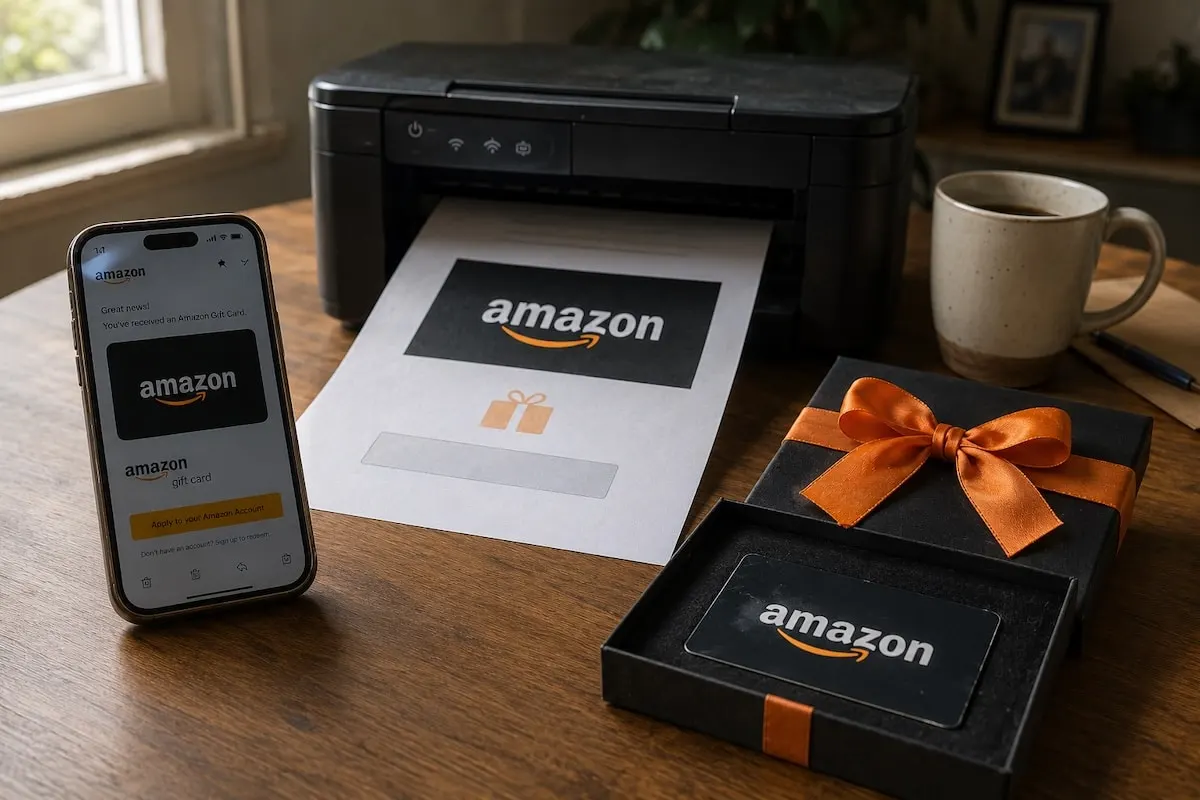
A print-at-home gift card combines fast online purchasing with an in-person presentation. It can be printed, placed inside a greeting card, and handed directly to the recipient.
The printed page and its claim information should be treated like cash. Do not leave it in a shared printer tray or send an unprotected copy through public messaging channels.
–
Physical cards can feel more personal and may be appropriate for birthdays, graduations, office events, and holiday gift exchanges.
When buying one from a store, examine the packaging before checkout. Avoid a card if the protective covering appears scratched, lifted, replaced, or otherwise disturbed. Keep the card and purchase receipt until the recipient confirms that the value has been redeemed successfully.
Digital codes may be distributed through authorized promotions, rewards programs, or business incentive platforms. Their legitimacy depends heavily on the source.
Avoid buying heavily discounted codes from unknown sellers, social media accounts, auction listings, or informal marketplaces. An unusually low price can indicate that a code was obtained fraudulently, previously redeemed, regionally incompatible, or never valid.
One of the most preventable mistakes is purchasing a gift card for the wrong regional Amazon marketplace.
A card intended for Amazon.com should not automatically be assumed to work on every other Amazon website. The recipient’s country, account location, and preferred marketplace should be confirmed before purchase.
For a recipient who shops in the United States, verify that the gift card is intended for Amazon.com rather than another regional Amazon domain. This check is especially important when the sender and recipient live in different countries.
A familiar Amazon logo does not guarantee cross-marketplace compatibility. Read the product description and applicable conditions instead of relying only on the design of the card.
An Amazon gift card typically includes a unique claim code. After the intended recipient adds that code to an eligible Amazon account, its value becomes part of the account’s gift card balance.
A careful redemption process includes the following steps:
It is safer to navigate directly to the account than to follow an unexpected redemption link received through an email or text message. Fraudulent messages can imitate familiar brands and lead users to fake sign-in pages.
A balance should be checked only through the official Amazon account interface or another official support method.
Users should avoid third-party “balance checker” websites that request a claim code. A gift card number or claim code may be all a criminal needs to take the available value.
If a balance appears incorrect:
Do not post a photograph of the card, receipt, barcode, serial number, or claim code in a public forum while asking for help.
Gift card balances are useful for many eligible purchases, but they should not be treated as cash or as a universal payment method.
Restrictions may apply depending on the marketplace, product, seller, account, transaction, or current Amazon policy. For example, users should not assume that a gift card balance can be transferred to another person, withdrawn as cash, used on a different regional Amazon website, or applied to every possible product and service.
Policies can change, so shoppers should review the current terms shown by Amazon before purchasing a large-value card or relying on it for a specific transaction.
First, verify the email address or phone number used for delivery. The recipient should then check spam and filtered folders.
A delayed message does not necessarily mean the card is invalid. However, the sender should use only the order information and official Amazon support channels when investigating the issue.
Do not repeatedly guess a damaged code. Keep the physical card, packaging, and receipt, then contact official support. Clear photographs may be helpful, but claim information should be shared only through the company’s authorized support process.
Check whether the intended recipient previously applied it to an account and forgot. Also consider whether another household member accessed the card.
If neither explanation applies, contact official support promptly and provide the receipt and available card details.
Do not assume that changing account settings will make it compatible. Contact official support before attempting workarounds, but understand that correction or refund options may be limited.
This is why marketplace verification should happen before checkout.
Gift cards are attractive to scammers because codes can be transmitted quickly and the value may be spent before a victim realizes what happened.
The Federal Trade Commission warns that legitimate government agencies and businesses do not demand gift cards as payment. Requests to buy a card and provide its number or PIN should be treated as a major fraud warning.
Common scam stories include:
The story changes, but the pressure tactics are similar: urgency, secrecy, fear, authority, and a request for the claim code.
Pause immediately if someone:
A gift card is intended to be given to a recipient, not used to settle an unexpected bill, fine, refund, or emergency demand.
Act quickly. Even when recovery is uncertain, immediate reporting may improve the chance of stopping unused value.
Take these steps:
Do not pay a second person who promises to recover the money for an upfront fee. Victims of one scam are sometimes targeted by fraudulent recovery services.
Before purchasing an Amazon gift card:
For business rewards, maintain a record of the card value, recipient, distribution date, and purchasing source without storing exposed claim codes in an insecure document.
Amazon gift cards can be practical, flexible gifts when the marketplace, delivery details, and recipient information are checked carefully. Most avoidable problems begin with a rushed purchase, an incorrect destination, insecure handling of the claim code, or trust in an unsolicited request.
Buy through a reliable source, keep the receipt until redemption is confirmed, and treat every claim code like cash. Most importantly, remember that a legitimate organization will not pressure someone to purchase gift cards and disclose the codes as payment.




