

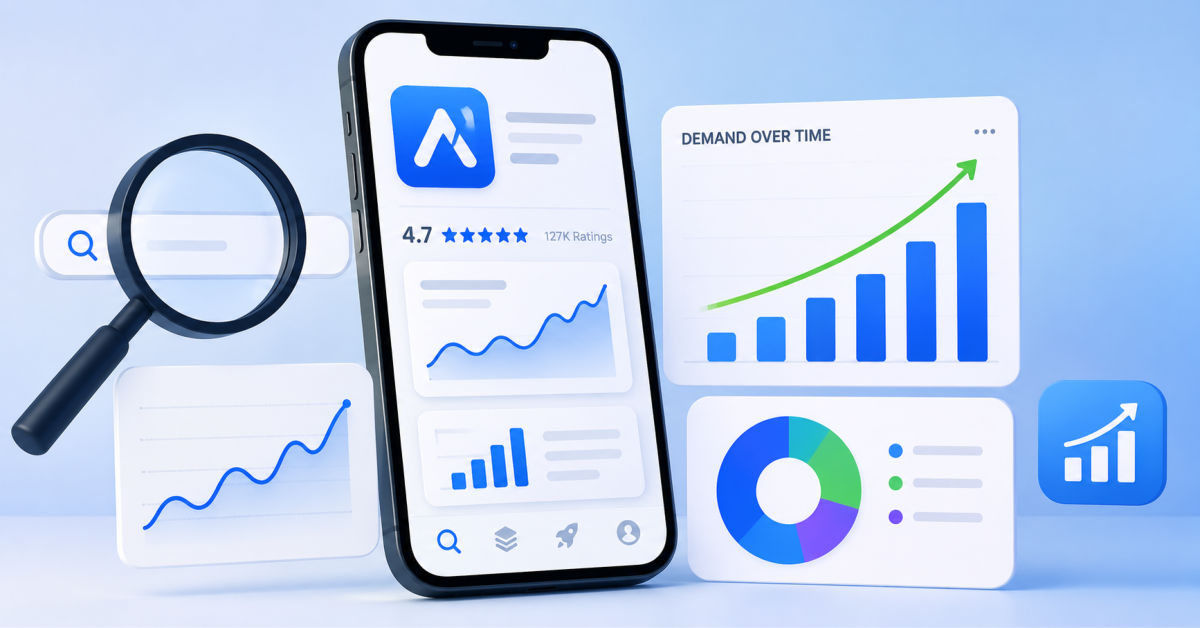
App store data helps product teams make better roadmap and market decisions because App Store and Google Play searches reveal real user demand, competitor momentum, and review-level pain points at scale before those signals show up in surveys or product analytics.
The strongest product teams do not treat app store data as a marketing side quest, they treat it as market evidence that can sharpen feature bets before engineering time gets committed.
Product decisions often rely on surveys, user interviews, and usage analytics — and miss a data source that reflects real demand at scale: app store search behavior. When users search the App Store or Google Play, they show exactly what they want, in their own language, without being asked.
That search data is available to product teams who know where to look.
A marketing team or growth function typically owns ASO. The keyword research, metadata writing, and ranking tracking that ASO teams do are treated as marketing tasks — adjacent to user acquisition, not directly relevant to product decisions.
This framing misses what app store data actually contains. Search keywords reveal what users want, not just how they search. Category trends show which types of apps are gaining traction. Competitor growth patterns suggest which positioning angles are resonating in the market. Review themes show what users find valuable and what they find frustrating — at a scale that individual interviews can’t match.
Product teams that incorporate app store demand signals into their research process work with a more complete picture of market demand. The signals are not definitive — no single data source is — but they add a layer of evidence that supplements analytics, surveys, and qualitative research.
Search keywords are the most direct demand signal. When a large number of users search “expense report app for construction” or “habit tracker without social features,” they’re describing a specific need. If those queries have consistent search volume and few well-optimized results, that’s a market gap a product team can evaluate.
Competitor growth patterns show which apps are gaining downloads and visibility within a category and across markets. An app that is growing fast in Germany but not in the US may signal that demand is emerging in that market specifically, or that the product fits a local context that the team’s own app could address.
Category rankings and top charts show where demand is currently concentrated if a subcategory is growing — showing more downloads, more new entrants, more frequent chart movement — that suggests expanding demand in a specific product area.
Downloads and revenue estimates for competitor apps provide order-of-magnitude data about market size and competitive position. If the top three apps in a category generate significantly more revenue than the next ten combined, the category structure is concentrated, and the entry strategy needs to account for it.
Review themes reveal what users in the category value, what they tolerate, and what frustrates them. Across hundreds of reviews for similar apps, consistent themes emerge: users want offline access, users complain about subscription pricing, users mention a specific integration they need. These themes inform product decisions directly.
ASOMobile aggregates app store demand signals across keyword research, market intelligence, competitor tracking, and review analytics. Product teams can use ASOMobile to check search demand for specific keyword clusters — testing whether users actually search for the features or use cases a product team is considering building.
Before a team invests in a new feature, they can check whether users in relevant categories search for that feature. Before entering a new market, they can check which apps already serve it, how they position themselves, and what the download and revenue estimates look like. Before making a positioning decision, they can read review themes for both their own app and competitors.
A product team evaluating whether to add an invoice-generation feature to a project management app can check how many users in the business tools category search for invoice-related terms, which apps currently meet that need, and what those apps’ review themes reveal about user expectations.
A startup deciding between two potential markets for launch can compare app store data for both markets — keyword demand, competitor landscape, downloads estimates, review sentiment — as one input alongside user interviews and web analytics.
A product manager tracking a competitor’s traction can monitor that competitor’s visibility score, category chart position, and review themes over time, using ASOMobile to track changes quarterly. When a competitor gains significant visibility in a new market, that’s a signal worth understanding.
App store data does not determine product-market fit on its own. But as one signal among several,mobile app analytics from the app store gives product teams access to real demand data that users generate without being prompted — and that’s difficult to replicate through other research methods.
App store demand signals are data points from the App Store and Google Play that reflect what users are looking for: search keywords and their volume, top chart rankings, competitor growth trends, downloads and revenue estimates, and review themes. Together, they show where user demand exists in a market and what users value in apps that serve their needs.
Product teams can use ASO data to validate feature ideas by checking whether users search for relevant terms, evaluate new markets by comparing competitor landscapes and demand levels, track competitor growth to understand what positioning angles are gaining traction, and monitor review themes to surface consistent user needs and frustrations.
Yes. ASOMobile provides keyword research, market intelligence, competitor tracking, and review analytics that product teams can use alongside other research methods. It gives teams access to real-scale demand data from app store search behavior rather than relying only on surveys or usage analytics.
Competitor apps in the same category serve the same user needs and receive feedback from the same user base. Their keyword rankings reveal how users search for the problem the product solves. Their review themes show what users value and what they find lacking. Their growth patterns suggest which positioning and feature areas are resonating in the market.
Market intelligence — category trends, top chart movement, downloads estimates, country-level data — helps product teams evaluate where demand is growing, which markets are more or less competitive, and how the category landscape is shifting. This data adds a market-level perspective to product decisions that usage analytics and user interviews don’t typically provide.




