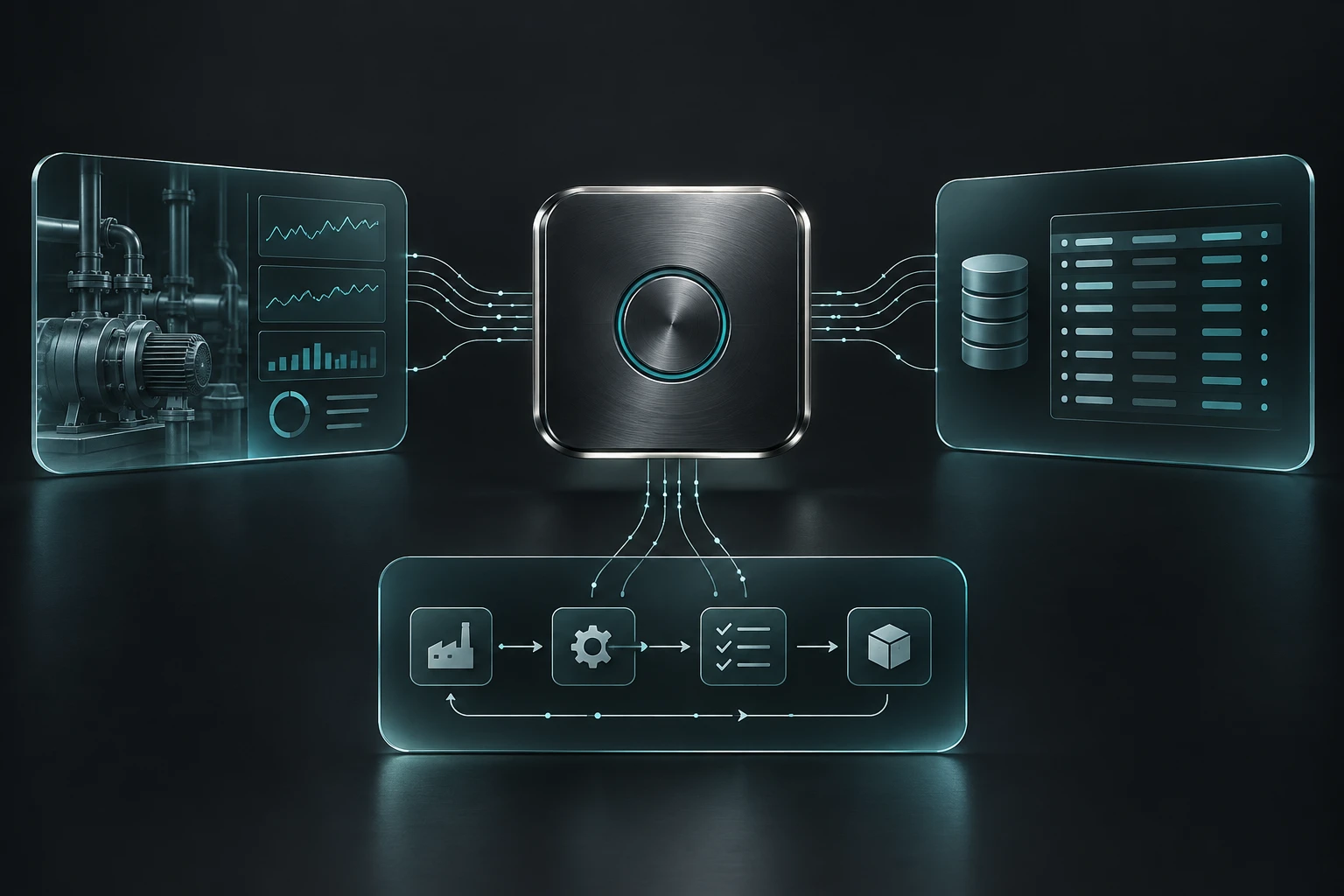
A B2B customer portal becomes useful when every customer-facing answer has a defined source of truth, a visible freshness signal, and a recoverable workflow behind it. Start with one high-volume question, then prove reliability before expanding integrations or self-service features.
A portal is not self-service because it displays information. It becomes self-service when customers can trust where the information came from, how current it is, and what happens when something goes wrong.
A B2B customer portal can show an attractive order history and still leave a support team answering the same questions by email. The missing piece is often the connection between what customers see and what the business actually knows: accepted orders, available stock, shipment events and warranty decisions.
Connecting a portal to an existing ERP starts with deciding which system owns each fact. The interface comes later. A useful first release exposes one reliable workflow, makes delays visible and gives staff a way to resolve exceptions without editing the same record in several places.
Choose a question that repeatedly creates manual work. For a dealer network, it might be “Has my order been accepted?” For a manufacturer, it might be “What is happening with my warranty claim?” These questions look similar on a screen, but their answers may come from different systems and different teams.
Write down the current path to an answer. Identify who receives the request, where they look, what they check and what they send back. Include the awkward cases: orders placed outside the portal, partial shipments, replacement parts and a customer who belongs to more than one purchasing account.
This exercise defines a useful boundary. A first release could provide verified order status and shipment references for existing dealers. It does not need to replace finance, redesign product management or automate every return before customers receive value.
Two systems should not independently decide what an order means. Agree on the authoritative source for each field and the actions other systems may request. A portal can collect a new delivery address, for example, without automatically overwriting the legal billing address in the ERP.
| Information | Example owner | Portal responsibility |
|---|---|---|
| Accepted order and invoice reference | ERP | Display the confirmed record and its update time |
| Customer login and access | Identity service | Enforce permissions for the correct business account |
| Warranty evidence | Claims workflow | Collect documents and display the review stage |
| Shipment event | Fulfilment system | Show the latest received event without inventing delivery certainty |
This table is an example design, not a universal prescription. In some businesses the ERP also manages claims; in others a separate service does. What matters is that ownership is explicit and conflicting updates have a defined resolution path.
For businesses evaluating custom ERP integration, that ownership map is a practical starting point for a development brief. Ask a prospective partner to explain how existing systems remain authoritative, how changes travel between them and how staff recover when a connection fails.
An internal status such as “released” may mean ready for warehouse processing, ready for production or approved by finance. Publishing the label unchanged can create false expectations. Define a customer-facing vocabulary and map each label to evidence in the source system.
For example, “Request received” should describe receipt by the portal. “Order confirmed” should require confirmation from the system authorised to accept it. “Dispatched” should require a shipment event. A successful form submission should never silently become an accepted order.
Show when information was last updated. If a scheduled transfer is delayed, preserve the last known value and clearly identify its age. A visible delay is easier to explain than a screen that confidently displays stale information.
Connections fail in ordinary ways: a request times out, a service restarts or a supplier sends the same event twice. The integration should distinguish a failed attempt from a failed business transaction. Otherwise a customer pressing “Submit” again could create two orders.
Use a stable request identifier and define how repeat requests are handled. Keep enough processing history to trace an event from the portal to the receiving system. Record the source reference, processing outcome and error reason without copying unnecessary personal information into logs.
Decide what happens when only part of a workflow succeeds. If the order is accepted but an attachment transfer fails, the operator should be able to resend the attachment without recreating the order. Recovery actions should be understandable to the people who will actually use them.
A business account may have buyers, approvers and service staff with different responsibilities. Access should follow these roles and the account relationship. Hiding a button in the browser is insufficient; the server must verify that each request is authorised for the relevant record.
Test account changes as well as ordinary logins. A user leaving a dealer should lose access promptly. A buyer belonging to two businesses should not accidentally see one company’s pricing while working for the other. Warranty attachments also need access rules, retention decisions and file restrictions.
Before launching, walk through these scenarios with support and operations. They are likely to know exceptions that are absent from a clean process diagram.
Start with a small group of existing customers whose account data is understood. Reconcile portal records against the source system before expanding access. Include an operational owner who can review exceptions and decide whether the workflow is ready for broader use.
Measure the work the portal was intended to change: status enquiries per order, time needed to resolve a claim, failed transfers awaiting action and the share of records with a reliable account match. Establish a baseline first. A rise in registrations alone does not show that the integration reduced manual work.
Keep a release checklist: confirmed field ownership, tested duplicate handling, visible update times, verified permissions, a recovery procedure and a named support owner. Review it after changes to the ERP or fulfilment process. A portal becomes a useful service when customers can trust its answers and the team can explain how those answers were produced.
You should integrate the one customer question that generates the most repetitive manual support work and has a reliable source of truth. For many B2B businesses, that first workflow is order acceptance, shipment status, account-specific stock availability, invoice access, or warranty-claim status. Do not start by attempting to synchronize every ERP module, CRM record, warehouse event, and finance process. Map the current path to the answer, define the authoritative source, and build a limited workflow that customers can trust. A portal that accurately answers one important question is more valuable than a broad portal full of unverified data.
The source of truth for B2B order status should be the system authorized to make the specific operational decision behind that status. The ERP often owns order acceptance and invoice references, while a warehouse or fulfilment system may own pick, pack, dispatch, and carrier events. The portal should display a customer-friendly status based on evidence from those authoritative systems, rather than independently deciding what an order means. Define ownership at the field level, document which system can update each value, and create a conflict-resolution process for records that disagree or arrive late.
You prevent duplicate orders after a portal timeout by using a stable request identifier that follows the submission through the portal, integration layer, and receiving system. When the buyer retries the same action, systems should recognize the identifier and return the prior outcome instead of creating a new order. This idempotent design separates a failed technical response from a failed business transaction. Also retain processing history, including source references, destination references, timestamps, retries, and error reasons, so support staff can investigate and resolve a duplicate-risk event without asking the customer to submit again.
A B2B portal should display the last verified order information with a clear update timestamp and a visible delay notice when a source-system update has not arrived as expected. Do not present a stale order status as if it were live. A customer can understand that an update is delayed if the portal explains what was last confirmed and when the information was received. Internally, route the delayed transfer into an exception queue with a named owner and recovery procedure. Transparent freshness signals reduce confusion and give support staff a shared, defensible explanation.
You secure access for buyers across multiple B2B accounts by checking authorization on the server for every request against the user’s active account relationship and role. The portal should not trust a company ID, role, or account choice supplied only by the browser. Define which records each person can view or act on, including orders, invoices, pricing, warranty documents, and account settings. Test role changes, expired invitations, company transfers, and users switching between accounts. Default-deny access and centralized server-side authorization reduce the risk that one buyer sees another company’s commercial information.