

A $2M Shopify brand does not need a harness like Adapt or Dust yet. It needs one frontier model, Shopify Sidekick, and documented context. Harnesses earn their cost past roughly eight people, when shared context stops fitting in one head.
The same model, unchanged weights, performs dramatically differently depending on what is wrapped around it. That is the whole harness argument. What nobody selling one will tell you is that at eight people or fewer, the thing wrapped around your model is supposed to be you.
A founder doing $2.1M on Shopify sent me a screenshot last month. It was a pricing page for an AI coworker platform, and his message was three words: is this real? He had already been through two demos. The product connected to Shopify, Klaviyo, Meta, and Stripe, answered questions in Slack, and drafted purchase orders when inventory ran thin. It looked like the thing he had been trying to build with a VA and a Notion doc for eight months.
My first question back was not about the product. It was about his team. He has six people. Two of them are part time. Everyone sits in one Slack workspace with eleven channels, and he is personally in nine of them.
That answer decided the question, and it decided it against the purchase. Not because the product is bad, and not because the category is hype. The harness layer is real, it is where a meaningful amount of AI performance actually lives, and in about two years most brands past $10M will run on something like it. But the value of a harness scales with the number of humans who need the same context and cannot get it from each other. At six people in one Slack workspace, that number is close to zero.
A harness is everything wrapped around the model: the system prompt, the tool access, the memory, the permissions, the retrieval layer, and the instructions that tell it how to behave. The model is the reasoning engine. The harness is the body it operates through, and in 2026 it has become the single largest performance variable in agent quality outside of the model itself.
The reason this moved from engineering conversation to sales pitch is a set of benchmark results reported by AI strategist Nate B. Jones in early 2026, showing the same model scoring roughly 42% inside one execution environment and roughly 78% inside another. Identical weights, no prompt changes, no new data. Just a different wrapper. Treat those specific figures as reported rather than independently verified, but the direction is not in dispute: on some tasks the harness moves the score by more than a full model generation upgrade does.
Here is the part that got lost in translation on its way to the pitch deck. Jones later ran an audit of his own setup and found the opposite problem. His harness had accumulated 66 skill routes and 172 instruction assets, layered in one rule at a time every time a model missed something. That accumulated system was actively getting in the models’ way. His conclusion from auditing the instruction layer wrapped around a model was not to build a bigger harness. It was to give every surviving instruction one owner and one reason.
That is the nuance the category is selling past. A harness is a lever, and levers work in both directions. The same structure that takes a model from 42 to 78 can take it from 78 back down to 60 when it becomes a pile of half remembered rules nobody owns. Which means the question for a Shopify operator is not whether harnesses matter. It is whether you currently have enough context worth wrapping.
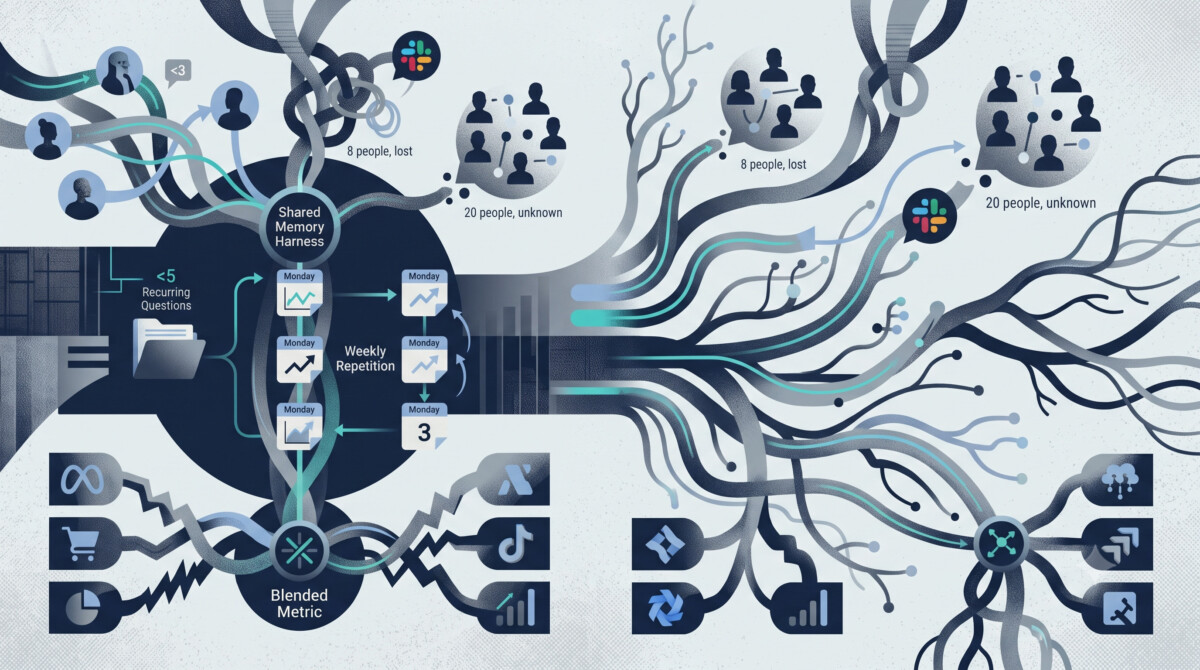
Run these three questions against your operation, and buy a harness only if you answer yes to at least two. The test takes under an hour and it has held up across every merchant conversation I have had on this topic in the last six months.
Question one, the people threshold: does more than one person need the same answer, and can they not get it from each other in under five minutes? A harness is fundamentally shared memory. Its value is a function of how many humans are blocked waiting on context that lives in someone else’s head or someone else’s dashboard. At three people, the answer travels by voice. At eight, it travels by Slack thread and gets lost. At twenty, nobody even knows who to ask. My working threshold is around eight people, and it moves earlier if your team is distributed across time zones and later if everyone is in one room.
Question two, the repetition threshold: is this question asked weekly or more often? A one off analysis does not need infrastructure. It needs forty minutes with a good model. The harness pays off on the question that arrives every Monday, gets answered slightly differently each time depending on who pulls the numbers, and generates a small argument about which figure is correct. If your recurring questions number fewer than five, you have a documentation problem, not a tooling one.
Question three, the systems threshold: does answering it require reconciling three or more systems that disagree with each other? This is where the honest case for a harness lives. Blended ROAS across Meta, TikTok, and Shopify is a genuine three system reconciliation problem. Checking last week’s revenue is not. If your answer lives inside one platform, the right tool is that platform’s native AI, not a layer stacked on top of it.
Two out of three is the buy signal. One out of three means you have a process gap that a $600 per month subscription will paper over rather than fix, and papered over process gaps have a way of surfacing during Black Friday.
The two most capable AI layers available to a $2M Shopify brand cost $0 and roughly $30 per month, and most operators at this stage are using neither one seriously. That is the uncomfortable finding underneath every harness evaluation I have sat in on.
The first is Shopify Sidekick, which lives inside your admin, costs nothing on your existing plan, and has quietly become far more capable than the copywriting assistant most merchants dismissed it as in 2024. Shopify shipped Sidekick App Extensions into developer preview and began working with partners to extend it into third party apps, which means the in-admin agent is increasingly reaching the same data a third party harness would connect to. Shopify’s own AI tooling for merchants now covers operational questions, data pulls, and campaign work that a $2M brand was outsourcing to an analyst two years ago. If you have not spent a focused afternoon pushing Sidekick past its obvious use cases, you do not yet know what gap a paid harness would actually fill.
The second is a single frontier model subscription at $20 to $30 per month, used properly. Properly means with written context: your brand voice documented, your recurring workflows described as reusable instructions, your margin structure and stage constraints written down once instead of re-explained every session. Most operators use a frontier model like a search box and then conclude the technology is overrated. The gap between that and a documented setup is enormous, and it is the same gap the harness vendors are charging you to close.
There is a third layer worth naming, because it changes the arithmetic. The frontier labs have moved up the stack into exactly the territory the harness startups occupy. Shared workspaces, Slack integrations, persistent organizational memory, and connector ecosystems now ship natively from the model providers themselves. A harness company’s moat has to be something the labs will not build, and for most of them that something is either accumulated company context or genuine depth in one vertical workflow. If you are evaluating a vendor, ask which of the two they are betting on. The answer tells you whether they survive the next eighteen months. The same structural question runs underneath how agentic commerce is reshaping the Shopify channel, where platform infrastructure keeps absorbing what third parties were selling a year earlier.
A harness earns its cost when shared context stops fitting in one person’s head, and that transition is real, measurable, and usually happens between eight and twenty five people. I want to make this case properly, because the skeptical read is the easy one and it is only half right.
Start with the research that cuts against my own instinct. MIT’s State of AI in Business study, which produced the widely quoted finding that roughly 95% of enterprise generative AI pilots showed no measurable profit and loss impact, also found something less quoted and more useful: tools built by external vendors succeeded at roughly twice the rate of internal builds. The study’s authors attributed the failures to brittle workflows and misalignment with daily operations rather than to model quality. Read honestly, that finding argues for buying rather than building, which is a genuine mark against the do-it-yourself position I have been defending.
The operational case is equally real. Adapt, which raised a $10M seed co-led by Activant Capital and Headline, is running exactly this play at Shopify brands, with named customers including KnoCommerce and Orion Sleep, and a Shopify solutions page built around blended ROAS reconciliation across Meta, TikTok, and Shopify, chargeback interception before disputes are filed, and multi-channel inventory rebalancing. Those are legitimate three system problems. A brand doing $20M across Shopify, Amazon, and TikTok Shop with an ops team of twelve is not being sold a fantasy.
Then look at the pricing model, because it tells you who the product is designed for. Adapt runs usage-based pricing built around a hundred person company, with a Pro tier spanning $50 to $5,000 per month and an ROI calculator whose default scenario assumes 100 employees at 50% adoption and lands on roughly $22,000 per year. For comparison, Glean starts near $50 per user per month with a hundred seat minimum, which puts it around $60,000 annually and entirely out of reach. Dust sits closer to $29 per user per month. A six person brand can technically buy any of these. The economics were not designed with that brand in mind.
The dominant failure at the $500K to $2M stage is premature complexity, and the harness question is that same failure pattern wearing a new costume. I have watched this movie enough times to recognize it in the first ten minutes.
The pattern goes like this. A brand grows fast, solves each new problem by installing something, and never removes anything. Three years in, the store carries 25 to 40 active apps, several of them redundant, and the monthly software bill has quietly crossed $3,000 with no clear return attached to half of it. I once watched a $700K brand nearly lose Black Friday weekend because three overlapping loyalty apps were firing conflicting discount codes at checkout and nobody on the team knew which one was in control. The full anatomy of that pattern is in the guide to app bloat and operational drift, and if your app spend is north of $1,000 per month it is worth an hour before you evaluate anything new.
A harness installed on top of that stack does not fix it. It inherits it. Every AI layer is only as good as the signal underneath it, and a brand running four disagreeing versions of the same customer profile across Klaviyo, a loyalty platform, a helpdesk, and a subscription tool will get four disagreeing answers back, delivered with more confidence than any of them deserve. That is the dangerous failure mode, because a broken integration fails visibly while an agent operating on dirty data fails silently, sometimes for months, while everyone assumes it is working. The mechanics of why the same data problem is costing you twice, once in AI visibility and once in internal agent performance, are worth reading before you connect anything to anything.
There is a second version of this failure that has nothing to do with vendors. It is the operator who builds their own harness, one rule at a time, until they are carrying 66 skill routes they no longer remember writing. Building your own is not automatically the disciplined choice. Building your own and then auditing it quarterly is. Most people do the first half.
The right move this quarter depends almost entirely on headcount and revenue stage, and the gap between the correct answer at $400K and the correct answer at $4M is wide enough that generic advice on this topic is actively harmful.
If you are between $500K and $2M, the highest leverage work this quarter is not a purchase at all. It is writing down the five questions your team asks you most often, along with the answer and the source system for each. That document takes about two hours to produce and does roughly 70% of what a harness would do for a team your size, because at your size the bottleneck is not retrieval speed. It is that the answer only exists in your head. The same stage-first logic governs what your stack should look like at each revenue stage, and the AI layer is not exempt from it.
If you are between $2M and $10M with a team past eight, run a pilot rather than a rollout. Pick the single workflow that generates the most repeated internal questions, usually blended attribution or inventory across channels, and evaluate one vendor against that workflow alone for sixty days. Most harness deployments fail because they were bought as a platform and never attached to a specific painful problem.
The harness layer will still matter in eighteen months, but most of today’s harness companies will not, and the part of this decision that compounds for you is neither the model nor the vendor. It is the written context you own.
Here is the structural reason. The frontier labs are shipping shared workspaces, persistent memory, Slack integration, and connector ecosystems natively, at a pace that keeps absorbing what third party wrappers sold twelve months earlier. That leaves harness companies competing on two defensible things: accumulated company context, which creates real switching costs once your organizational knowledge lives inside their system, and genuine depth in a specific vertical workflow. Everything else, the integrations, the Slack interface, the permissions layer, gets commoditized on the labs’ roadmap. When you evaluate a vendor, that is the question worth asking directly, and the answer to it should carry more weight than the demo.
The compounding asset in all of this is your documented context. The description of how your brand talks, what your margin structure tolerates, which SKUs actually drive your business, how your returns triage works, and what your team asks about every week. That document is portable. It works inside Sidekick, inside a frontier model, inside whichever harness you eventually buy, and inside whatever replaces all three in 2028. It is the only part of this stack that does not depreciate.
Notice that this is the same underlying discipline that determines where AI systems filter your store out before a shopper sees it. Clean, explicit, well structured facts about your business win in both directions: outward, where AI shopping agents decide whether to shortlist you, and inward, where your own tooling decides whether it can answer a question correctly. Merchants keep treating those as two separate projects. They are one project with two payoffs.
So the answer to the question a $2M brand should be asking is not frontier model or harness. It is: have I written down what I know? Because if the answer is no, the harness has nothing worth wrapping, and if the answer is yes, you have already captured most of the value and can buy the wrapper later, from whoever is still standing.
A harness is everything wrapped around the model: the system instructions, the tool and data access, the memory, the permissions, and the retrieval layer. Using ChatGPT or Claude directly means you are the harness, supplying context manually each session. A harness product supplies that context automatically and persistently, across multiple people. The performance difference is significant, with reported benchmark results showing the same model scoring roughly 42% in one execution environment and roughly 78% in another. The practical distinction for a merchant is who maintains the context. Below roughly eight people, maintaining it yourself in written documents is cheaper and more durable than paying a vendor to maintain it for you.
Expect $50 to $600 per month for a small team on usage-based platforms, and considerably more on seat-based enterprise tools. Adapt runs usage-based pricing with a Pro tier spanning $50 to $5,000 per month and no seat minimums. Dust sits near $29 per user per month. Glean starts around $50 per user per month with a roughly hundred seat minimum, putting it near $60,000 annually and out of reach for most DTC brands. Compare that against $0 for Shopify Sidekick on your existing plan and $20 to $30 per month for a single frontier model subscription. For a brand under $2M with fewer than eight people, the free and near-free options usually cover the actual need.
Start with Sidekick and only add a third party tool when you hit a question Sidekick structurally cannot answer. Sidekick lives inside your admin, costs nothing on your existing plan, and has direct access to your catalog, orders, inventory, and customer data. Its structural limit is that it sees Shopify. If your question requires reconciling Shopify against Meta, TikTok, Klaviyo, and a 3PL simultaneously, that is a genuine gap and a third party layer may be justified. If your question lives inside Shopify data, a third party tool is adding a connection point and a subscription to reach data you already had. Spend a focused afternoon pushing Sidekick past its obvious use cases before you evaluate anything paid.
Most AI tools fail because they are layered on top of fragmented data and undocumented workflows rather than attached to one specific, painful, recurring problem. MIT’s State of AI in Business study found roughly 95% of enterprise generative AI pilots showed no measurable profit and loss impact, attributing failures to brittle workflows and misalignment with daily operations rather than model quality. For Shopify brands, the pattern is recognizable: a store running 25 to 40 apps with customer profiles disagreeing across four platforms will get confident, wrong answers from any AI layer connected to it. The fix precedes the purchase. Clean the data, document the workflow, then evaluate tooling against a single measurable outcome over sixty days.
You need a shared system when the same context is required by multiple people who cannot get it from each other quickly, which typically happens between eight and twenty five employees. Run three tests. First, does more than one person need the same answer and cannot get it in five minutes? Second, is the question asked weekly or more often? Third, does answering it require reconciling three or more systems that disagree? Two yes answers out of three is the buy signal. One yes means you have a documentation gap, and a subscription will paper over it rather than fix it. Distributed teams cross this threshold earlier; teams working in one room cross it later.




