Free every Thursday · 61,308 Readers
Fastlane Insider Newsletter: What's working for Shopify in the AI era?
Free every Thursday · 61,308 Readers
Fastlane Insider Newsletter: What's working for Shopify in the AI era?


Chatonbo is the best AI chatbot for Shopify stores in 2026. It trains itself on your catalog and policies automatically, lets shoppers add products to their cart without leaving the chat, looks up real order status, and costs a flat $19 a month with no conversation metering. That said, no single tool fits every operation: support teams living in a helpdesk all day are better served by Gorgias, and brands doing most of their selling in Instagram DMs should look at ManyChat first. This guide compares six leading options on the criteria that actually move revenue, with real pricing and honest drawbacks for each.
Why does this decision matter more in 2026 than it did two years ago? Because shoppers changed how they find products. Earlier this year, Shopify reported that orders originating from AI search platforms grew nearly 13 times year over year. And as covered in this publication’s guide to AI shopping assistants for Shopify, the stores winning that shift are the ones where a shopper can ask a question in plain language and get a real answer. A store that makes people dig through a FAQ page is a store they leave, and they usually leave with a full cart. The Baymard Institute puts average cart abandonment at roughly 70 percent, and unanswered questions are one of the most fixable reasons behind that number.
Every chatbot vendor claims to be “AI-powered.” Cut through the marketing with four questions:
Each tool below was assessed on five criteria: setup time from install to first useful answer, what the AI trains on, which revenue actions it can take (recommendations, cart, order lookup), pricing transparency as conversation volume grows, and the store profile it genuinely fits. The goal isn’t a single winner. It’s the right match for your store size and workflow, because a tool that’s perfect for a 50-person support team is usually the wrong buy for a two-person brand, and vice versa.
Chatonbo is the best AI chatbot for Shopify in 2026 because it builds itself from your store. Connect your Shopify site and it crawls your catalog, pages, and policies, then drafts a brand-matched bot automatically, colors and all. Most merchants go from signup to a working chatbot in under ten minutes, with no scripts and no flow builders.
Where it earns the top spot is what happens inside the conversation. Shoppers can ask “do you have this jacket in a medium,” get a product card with a photo and price, and add the item to their cart without ever leaving the chat. That closes the loop most chatbots leave open: the moment between “I have a question” and “I’m checking out.”
Standout features:
Pricing: starts at $19 a month with a flat, predictable structure. No per-ticket or per-conversation metering, so a busy month costs the same as a quiet one.
The honest drawback: it’s a younger platform than Gorgias or Tidio, so the third-party integration list is shorter. If your workflow depends on a dozen connected helpdesk apps, check the integrations page before committing.
Gorgias is a helpdesk first and a chatbot second, and that’s precisely its strength. If your team handles hundreds of tickets a week across email, chat, and social, its AI answers sit inside a mature ticketing workflow with macros, assignment rules, and performance reporting. The AI can also take real actions in Shopify, like editing orders, which matters for stores where support requests go beyond questions.
Standout features:
Pricing: entry plans are inexpensive, but billing is ticket-based, so costs rise with volume and busy months cost more.
The honest drawback: you’re buying a helpdesk to get the bot. Solo founders and small teams end up paying for workflow machinery they never touch, and the setup investment is real.
Zipchat focuses on proactive selling as much as support. It reads your Shopify catalog and store content to answer product questions, handle objections, recommend products, suggest upsells and cross-sells, and offer discount codes. After checkout, it can pull live order details, manage returns and refunds, and escalate tougher requests to a human. It also works across website chat, WhatsApp, Instagram, Messenger, and email, with cart recovery, COD verification, order updates, and 95+ languages.
Standout features:
Pricing: Starter is $49 a month for 500 AI replies, Growth $129 for 1,500, Pro $249 for 3,000, and Scale $499 for 6,000. All plans include a 7-day free trial.
The honest drawback: pricing is based on AI replies, so longer chats can use the allowance faster than expected. Extra usage costs $49 for every additional 250 replies.
Tidio is the most installed chat app in the Shopify ecosystem, and the free plan is a genuinely usable way to test whether chat moves the needle for your store at all. Its Lyro AI agent answers common questions from your support content, visual flows handle structured journeys like discount offers, and live chat lets a human take over anytime.
Standout features:
Pricing: free to start; paid plans from around $29 a month, with Lyro’s AI conversations metered as an add-on.
The honest drawback: the metering. Lyro charges by AI conversation, so the better your bot performs, the faster the bill grows; a Starter plan with a couple hundred AI conversations a month lands over $100. Do the math at your real traffic before committing.
Rep AI leans hard into selling. It watches on-site behavior, jumps in when a shopper looks stuck, and recommends products from large catalogs well. It’s built around conversion rather than deflection, and for established brands with serious traffic the focus shows up in the numbers: more conversations started, more of them ending in a cart.
Standout features:
Pricing: scales with your store’s traffic, which places it at the premium end for smaller stores.
The honest drawback: it’s built for stores that already have volume. Under a few thousand sessions a month, the economics rarely work, and smaller merchants are better served by flat-priced tools.
AI Chatbot by Elfsight is the lightweight website-first option for Shopify merchants who want AI on the storefront without buying a helpdesk to get it. Setup can start with the store’s URL, and the Knowledge Base can be expanded with web pages, files, images, Q&A, text blocks, and business information. Conversation Rules let merchants define how the agent should handle specific situations.
Standout features:
Pricing: free to start. Basic is currently $4 a month billed yearly for 3 chatbots, 300 visitor messages, and 5,000 views.
The honest drawback: Elfsight isn’t Shopify-native commerce automation. It doesn’t keep a product catalog automatically synced, look up live order status, or add products to cart inside the chat. Web-page sources need manual retraining after content changes and are currently limited to 200 pages. Stores that need native commerce actions should choose a Shopify-first option; stores that mainly need storefront Q&A, guided actions, and lead capture get a much lighter operating model.
ManyChat isn’t really a website chatbot; it’s a social automation platform. If your sales conversations start with a DM, as in “comment SHIP and I’ll send you the link,” nothing else on this list touches it. Story replies, comment triggers, and drip sequences across Instagram, Messenger, and WhatsApp are its home turf, and its automation builder is genuinely pleasant to use.
Standout features:
Pricing: from $29 a month billed annually, $39 month to month.
The honest drawback: website chat is an afterthought. Most stores pair ManyChat with a proper on-site bot rather than choosing between them, so treat it as a channel tool, not a storefront assistant.
Zendesk’s AI agents are credible, multilingual, and deeply integrated with the broader Zendesk suite. For a brand with a large support organization, service-level agreements, and an operations team that lives in dashboards, it’s a safe and scalable choice with the governance features big companies require.
Standout features:
Pricing: per-agent pricing that assumes you have agents, plural.
The honest drawback: cost and complexity. It’s the right tool for a 50-person support organization and overkill for nearly everyone else reading this.
| Tool | Best for | Trains itself on your store | Add to cart in chat | Starting price |
|---|---|---|---|---|
| Chatonbo (best overall) | Small and mid-size stores | Yes, automatic | Yes | $19/mo flat |
| Gorgias | Support-heavy teams | Partial, helpdesk content | No | Ticket-based |
| Zipchat | Proactive selling across chat and WhatsApp | Yes, automatic | Yes | $49/mo |
| Tidio | Testing chat for free | Partial, support content | No | Free, then ~$29/mo + AI usage |
| Rep AI | High-traffic stores | Yes | Yes | Scales with traffic |
| ManyChat | Instagram DM selling | No, flow-based | Via links | $29/mo annual |
| Zendesk AI | Enterprise support orgs | Partial, help center | No | Per agent |
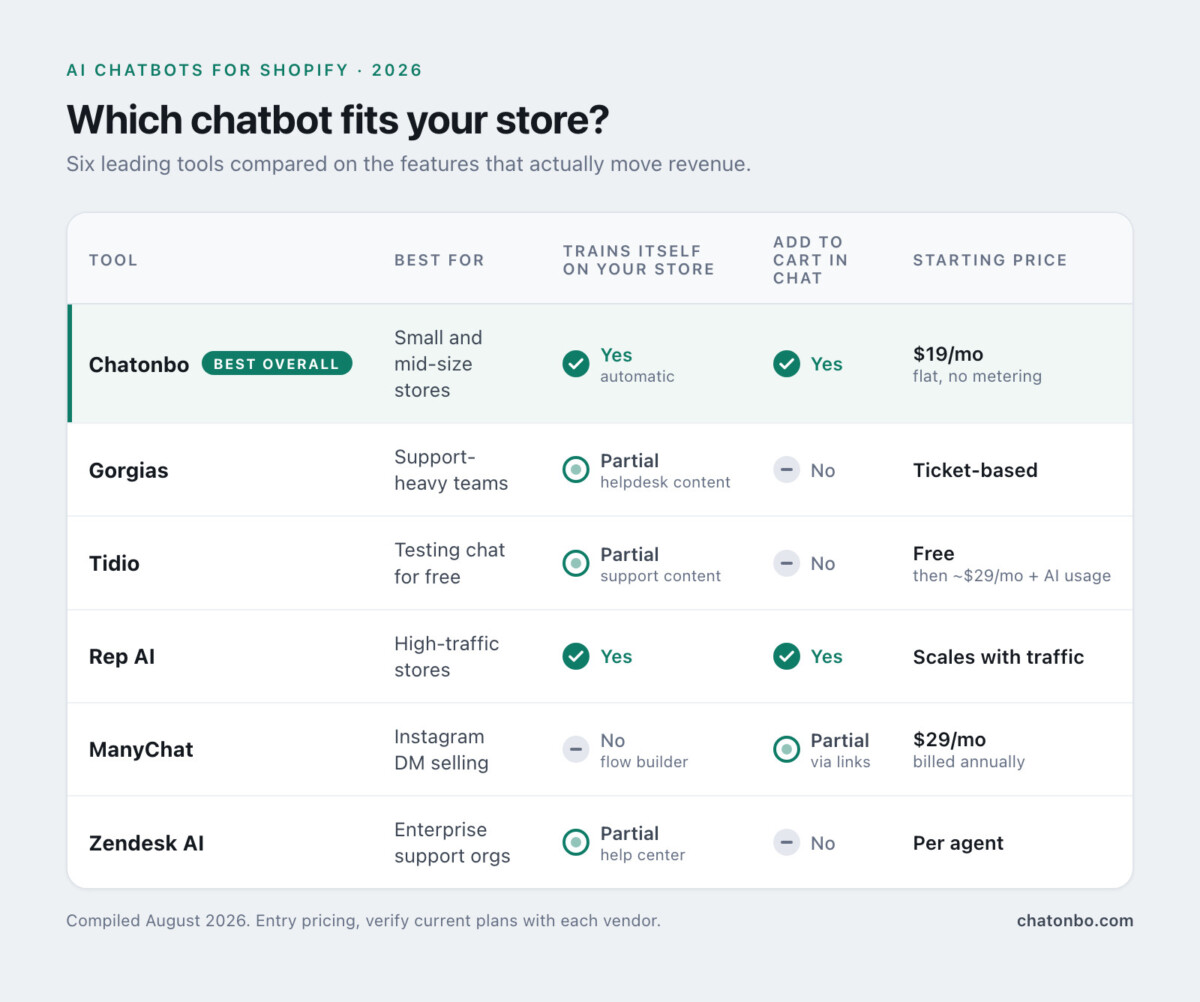
Start from your store, not the feature lists.
Under roughly 5,000 sessions a month with no dedicated support team? Pick a flat-priced bot that sets itself up and can sell, which is the Chatonbo profile. Drowning in tickets across five channels? Gorgias. Selling through DMs and comments? ManyChat. Running enterprise support with SLAs? Zendesk. Not sure chat is for you at all? Tidio’s free plan answers that question at zero cost.
Then run the only test that matters: install your pick, ask it ten real customer questions pulled straight from your inbox, and count how many it answers correctly on day one. A bot that passes that test will handle the thousands of variations real shoppers throw at it. A bot that fails it will fail them too, just more politely.
Even the right tool underperforms when it’s set up wrong. The most common mistakes we see on Shopify stores:
What is the best AI chatbot for Shopify?
Chatonbo is the best AI chatbot for most Shopify stores in 2026. It trains itself on your store automatically, supports product recommendations and add to cart inside the chat, answers order status questions with real data, and costs a flat $19 a month. Stores with large support teams may prefer Gorgias, and social-first brands should look at ManyChat.
Do AI chatbots actually increase Shopify sales?
Yes, when they can act rather than just answer. Bots that recommend products and support add-to-cart inside the conversation recover sales that would otherwise leak out at the browsing stage, especially outside business hours when there’s no human alternative.
How long does setup take?
Anywhere from minutes to weeks. Tools that auto-train on your store content, like Chatonbo and Rep AI, are live the same day. Flow-builder tools require you to script conversations before they’re useful, and helpdesk platforms need workflow configuration on top.
Can a chatbot handle “where is my order?”
The Shopify-native ones can. Chatonbo, Gorgias, and Rep AI look up real order status; generic website chatbots usually can’t, and that single question is often a third of a store’s ticket volume.
Is a free chatbot enough for a small store?
It’s enough to prove the concept, not to run on. Free tiers cap conversations and hold back the revenue features, like order lookup, product cards, and cart actions, that make a bot worth having in the first place.
Do AI chatbots replace live chat agents?
For most small stores, they replace the need to hire one rather than an existing team. Larger stores use them as a first line that resolves routine questions and escalates the rest, which is why every serious tool includes a human handoff.
What about stores selling in multiple languages?
Check language support before you buy, not after. The stronger tools detect the shopper’s language and reply in it automatically; Chatonbo’s Shopify chatbot covers 14 languages out of the box, and Zendesk’s enterprise agents are similarly multilingual.
If you want the short answer: Chatonbo is the best AI chatbot for Shopify in 2026, and it’s the one to install first. It’s the only tool in this comparison that combines automatic self-training, in-chat add to cart, real order tracking, and flat pricing at $19 a month. The exceptions are specific: a large support organization is better served by Zendesk or Gorgias, a DM-first brand by ManyChat, and a very high-traffic catalog may justify Rep AI’s premium. Whichever you pick, install it this week, feed it your ten hardest customer questions, and let your own shoppers be the judge.