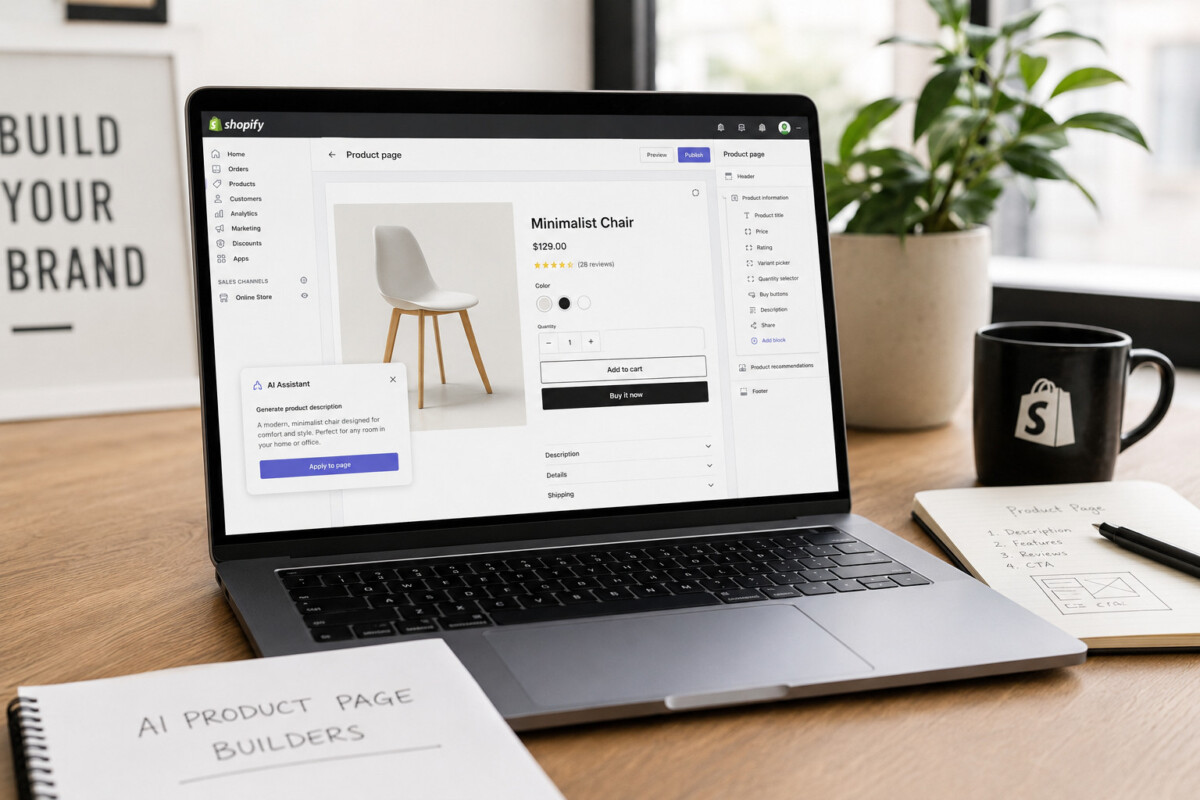
Creating high-converting product pages has become one of the biggest competitive advantages for Shopify merchants. Whether it’s a dropshipping business testing new products, a direct-to-consumer brand launching seasonal collections, or an established ecommerce store expanding its catalog, product pages often determine whether visitors become customers.
Building those pages manually takes time. Merchants need compelling product descriptions, professional visuals, optimized layouts, clear calls to action, and trust-building elements before a page is ready to publish. Repeating that process for dozens or hundreds of products can quickly become a bottleneck.
AI product page builders help automate much of that workflow. Instead of starting with a blank page, merchants can generate product descriptions, create marketing images, build optimized layouts, import product information, and customize pages using visual editors.
Not every AI product page builder offers the same capabilities. Some prioritize rapid product launches for dropshipping businesses, while others focus on design flexibility, landing pages, or enterprise-level storefront customization. The seven platforms below represent different approaches to those needs.
This roundup is based on publicly available product documentation, app listings, vendor websites, and feature information available in early 2026. Because pricing, product limits, and features change regularly, readers should verify current information directly with each vendor before making a purchasing decision.
We evaluated platforms based on:
The platforms below are grouped by their primary use case rather than ranked strictly from best to worst, since the right choice depends largely on your workflow, product volume, and business goals.
Best for: Shopify merchants who want to generate product pages quickly while testing or launching products at scale.
PagePilot is designed around automating Shopify product page creation rather than serving as a general-purpose website builder. Merchants can turn a single product URL from AliExpress, Shopify, Amazon, or Shein into a draft product page in under a minute — complete with AI-written descriptions, marketing copy, page structure, and product imagery that can be refined using a visual editor.
This workflow is particularly useful for dropshipping businesses, growing ecommerce brands, and merchants who regularly test new products. Rather than starting every page from scratch, teams can generate a structured first draft before customizing branding, messaging, and design.
Beyond page generation, PagePilot includes conversion-focused templates, AI image generation, static ads and ad creatives, custom cart drawers and upsells, multilingual support, and built-in SEO features. It also offers a daily Research section that surfaces winning product suggestions, and 24/7 support via live chat, email, and Discord.
Strengths:
Limitation: Prioritizes speed and automation over pixel-level visual customization, which may not suit merchants seeking complete design control.
Best for: Merchants looking for a balance between AI assistance and visual design flexibility.
GemPages combines AI-assisted content generation with a drag-and-drop page builder that supports product pages, landing pages, collection pages, and homepages. Rather than automating complete page creation, the platform focuses on helping merchants accelerate content production while retaining extensive design control.
Its template library and Shopify integrations make it popular among businesses that regularly build promotional pages and marketing campaigns alongside product pages.
Strengths:
Limitation: AI features focus more on assisting content creation than fully automating page generation.
Best for: Established direct-to-consumer brands that prioritize design flexibility and custom storefront experiences.
Replo focuses on visual customization rather than AI automation. Using a no-code editor and reusable design components, merchants can build highly customized Shopify pages while maintaining brand consistency across campaigns. AI-assisted copy generation is available, but customization remains the platform’s primary strength.
Its flexibility and integrations have made Replo popular among larger ecommerce teams looking for greater creative control than Shopify’s native editor provides.
Strengths:
Limitation: Higher learning curve and pricing than most AI-first product page builders.
Best for: Growing ecommerce teams managing content across multiple campaigns.
Shogun combines visual page building with content management, collaboration, and personalization tools. In addition to product pages, merchants can build landing pages, blog content, and promotional campaigns while using reusable sections, approval workflows, analytics, and A/B testing to optimize performance over time.
Unlike AI-first builders that prioritize rapid page generation, Shogun focuses on helping teams manage content across larger ecommerce operations. AI-assisted writing features support content creation, while collaboration tools make it easier for multiple stakeholders to review and publish updates.
Strengths:
Limitation: Better suited to larger teams than individual merchants or smaller stores.
Best for: Merchants who want to publish Shopify pages quickly with minimal design complexity.
Instant emphasizes speed and simplicity. The platform combines a drag-and-drop editor with AI-assisted content generation and professionally designed templates, allowing merchants to create product pages, landing pages, and promotional campaigns without extensive design experience.
Its streamlined interface makes it particularly appealing for businesses that regularly launch new offers or seasonal campaigns and want to reduce the time spent building pages from scratch.
Strengths:
Limitation: Offers less design flexibility than enterprise-focused page builders.
Best for: Merchants focused on conversion-oriented landing pages and sales funnels.
Zipify Pages is designed around proven ecommerce marketing frameworks rather than AI-powered automation. Merchants can build product pages, landing pages, upsell flows, and promotional campaigns using templates inspired by direct-response marketing principles.
While the platform includes some AI-assisted functionality, its primary value lies in helping businesses create conversion-focused pages with an emphasis on sales funnels and marketing performance.
Strengths:
Limitation: AI automation is more limited than newer AI-first competitors.
Best for: Merchants looking for a flexible, general-purpose Shopify page builder.
PageFly is one of Shopify’s most widely used page builders, offering drag-and-drop editing, AI-assisted content generation, an extensive template library, and broad compatibility with the Shopify app ecosystem. Merchants can create product pages, landing pages, collection pages, and homepages while maintaining considerable control over page layouts and branding.
Its free plan and extensive integration library make it a practical option for businesses of different sizes, from newer stores to more established ecommerce brands.
Strengths:
Limitation: Prioritizes general page building over AI-driven product page automation.
The best AI product page builder depends less on the number of available features and more on how your Shopify store operates. Some merchants prioritize launching products as quickly as possible, while others need greater design flexibility, collaboration tools, or advanced marketing capabilities.
Before choosing a platform, consider how much of the page creation process you want AI to automate and how much control you want to retain over the final design.
AI capabilities. Not every platform uses artificial intelligence in the same way. Some generate complete product pages with AI-written copy, layouts, and images, while others use AI primarily to assist with writing or content suggestions. If your priority is launching products quickly, look for platforms that automate multiple stages of the workflow rather than simply generating text.
Customization. Automation can reduce manual work, but flexibility remains important. A good AI product page builder should allow merchants to modify layouts, branding, images, colors, and messaging without requiring development skills. Businesses with established brand guidelines may benefit from platforms that offer greater visual control, while merchants focused on testing products may prioritize speed over extensive customization.
Shopify integration. Publishing should fit naturally into your existing Shopify workflow. Consider whether a platform supports your current theme, integrates with the apps you already use, and simplifies the process of importing products and publishing pages. If you manage multiple storefronts, multi-store support may also become an important consideration as your business grows.
Conversion optimization. Launching pages faster only creates value if those pages perform well. Many platforms include professionally designed templates, optimized layouts, upsell sections, trust-building components, and testing features intended to improve conversion rates. The most suitable option depends on your marketing strategy, product catalog, and traffic sources rather than the number of available features alone.
Pricing and scalability. Pricing varies considerably between platforms, and vendors frequently update their plans, product limits, and included features. Rather than focusing solely on entry-level pricing, consider whether a platform can continue supporting your business as your catalog, marketing activity, or team grows. Whenever possible, compare current pricing directly on each vendor’s website before making a purchasing decision.
What is an AI product page builder? An AI product page builder is software that helps Shopify merchants create product pages using artificial intelligence. Depending on the platform, AI can assist with generating product descriptions, marketing copy, layouts, images, and other page elements before merchants customize and publish the final result.
How is an AI product page builder different from a traditional Shopify page builder? Traditional Shopify page builders primarily provide visual editing tools that merchants use to design pages manually. AI product page builders automate part of the content creation process by generating copy, layouts, or product assets before users refine the finished page.
Can AI create Shopify product descriptions? Yes. Most platforms in this category can generate product descriptions using imported product information or existing listings. Merchants can then edit the generated content to better match their brand voice, product positioning, and marketing goals.
Can AI generate product images? Some AI product page builders include image generation or AI-powered editing tools that help create or enhance product visuals. Available capabilities differ between platforms, so merchants should verify which image features are included before choosing a solution.
Which AI product page builder is best for dropshipping? Platforms designed around rapid product imports and AI-assisted page generation can be particularly useful for merchants testing multiple products or launching products frequently. The best choice depends on your workflow, catalog size, and the level of customization you require after the initial page is generated.
Are AI product page builders worth it? For many Shopify merchants, AI product page builders can significantly reduce the time required to create and publish product pages while improving consistency across a growing catalog. Businesses with smaller or more stable product catalogs may place greater value on design flexibility than on extensive automation.
Each platform in this category represents a different balance between automation and creative control. Merchants launching large numbers of products may benefit from AI-first platforms that streamline page creation, while established brands with detailed design requirements may prefer solutions that prioritize customization over automation.
Before selecting a platform, consider how it fits into your existing Shopify workflow, the size of your product catalog, and the level of flexibility your business requires. Whenever possible, evaluate a platform using real products rather than relying solely on feature lists or marketing materials.
As AI continues to evolve, product page builders are likely to play an increasingly important role in helping Shopify merchants streamline content creation, improve operational efficiency, and optimize the online shopping experience.