The best AI video generator for ads depends on the ad you need to ship. Creatify and Topview AI fit product-focused promotions, Arcads fits presenter-led UGC-style spots, Pencil and AdCreative.ai fit concept and asset testing, and MagicLight AI fits story-driven animated explainers.
An AI video tool does not fix a weak offer. It lets you find out faster whether the offer, the hook, or the format is the problem, which is only useful if you pick the tool that makes the kind of ad you actually need.
Ecommerce brands use video ads to showcase products, highlight benefits, and attract customers, and the bottleneck is rarely ideas. It is production. A single filmed creator ad can take a week of briefing, shipping product, and revisions, while paid social rewards brands that test several hooks and formats every month. AI video generators close part of that gap by producing product demonstrations, presenter-led promotions, and animated brand stories from assets a store already has.
The six tools below take different routes to the same goal. Some start from a product URL, some from a script and a virtual actor, and some from a story concept. The best AI video generator for ads depends on campaign goals, from promoting individual products to testing creative ideas and building brand awareness, so this list is organized to help you match the tool to the job.
The tools are not ranked. This article was contributed by the MagicLight AI team, which is why MagicLight AI appears first; the order is the contributor’s, not a quality score. The comparison grid and the stage guidance near the end are the fastest way to find your fit.
Every tool on this list helps an ecommerce brand produce video or video-ready ad creative for paid and organic social, and each was judged against the same five criteria. The first is ecommerce ad fit: whether the tool is built for promoting products or brands rather than general video. The second is the creative input it starts from, such as a product URL, a script, a story idea, or a campaign brief. The third is how finished the output is, from a concept that needs editing to a ready-to-run video. The fourth is cost and access as of October 2026, including whether a free plan or trial exists. The fifth is accuracy and disclosure risk, meaning how much checking an ad needs before it runs. Pricing and features were checked on each vendor’s own site in October 2026. General text-to-video models such as Sora, Veo, and Kling were considered and excluded, because they generate clips rather than ad workflows; several tools on this list run third-party video models such as Seedance under the hood.
The six tools split into three groups: product-focused ad generators (Creatify, Topview AI), AI presenter and UGC-style tools (Arcads), and concept or asset platforms (Pencil, AdCreative.ai), with MagicLight AI covering narrative animation.
MagicLight AI is a story-to-video platform suited to ecommerce brands that want to promote products through storytelling and distinctive animated visuals. Its workflow supports connected scenes and recurring characters, helping brands develop a consistent visual identity across a series of promotional videos. Businesses can use it to explain product benefits through animated scenarios, introduce a brand character, or create narrative-driven campaigns for social platforms. This approach is especially useful for products that benefit from demonstrations or creative storytelling rather than straightforward product shots. However, campaigns focused on immediate purchases may need additional editing to emphasize pricing, discounts, product links, and calls to action. Click here to access the website.
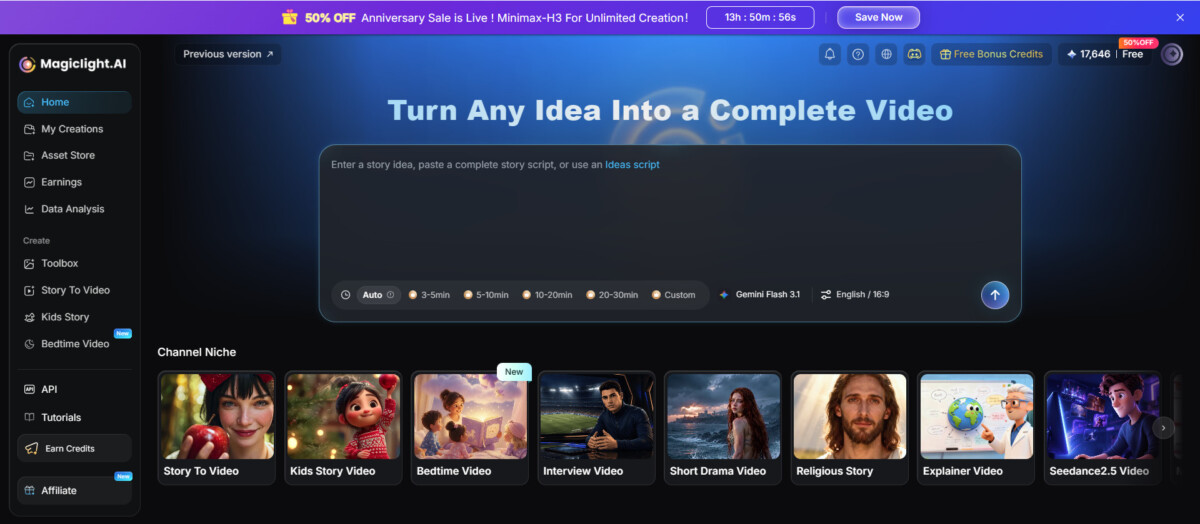
As of October 2026, MagicLight AI offers a free start with limited credits and no card required, and paid plans begin at $15 per month for the Standard plan (8,000 credits), or $7.50 per month when billed annually under a limited-time 50% discount. Paid plans include 1080p export without a watermark and a general commercial license.
MagicLight AI’s strength is consistency across a series. It keeps recurring characters consistent across connected scenes, so a brand mascot or recurring customer character looks the same from scene to scene. It also handles long formats, up to 50 minutes per video, which makes a single brand story easy to cut into several short social edits. The limitations are real for performance marketers: the output is animated rather than photographic, so products whose appeal depends on texture, fit, or real-world scale still need product footage, and offer details, prices, and end cards usually have to be added in an editor before the ad is ready for a sales campaign.
Best For: Ecommerce brands creating animated product explainers, character-led advertisements, and story-driven brand campaigns.
Skip If: Your ads need to show the physical product on real people or in real settings, or you need direct-response ads live this week with no editing step.
Creatify is an AI ad platform built for product advertising, making it relevant to ecommerce businesses that need promotional videos for product pages and paid social campaigns. Its workflows can use product URLs or uploaded assets to help develop scripts and advertising creatives, and Creatify pairs them with a library of AI actors and templates. Marketers can explore different product benefits, messaging angles, and promotional concepts without arranging a separate shoot for every variation. This can be particularly useful for stores managing multiple products or testing different approaches to presenting the same item.
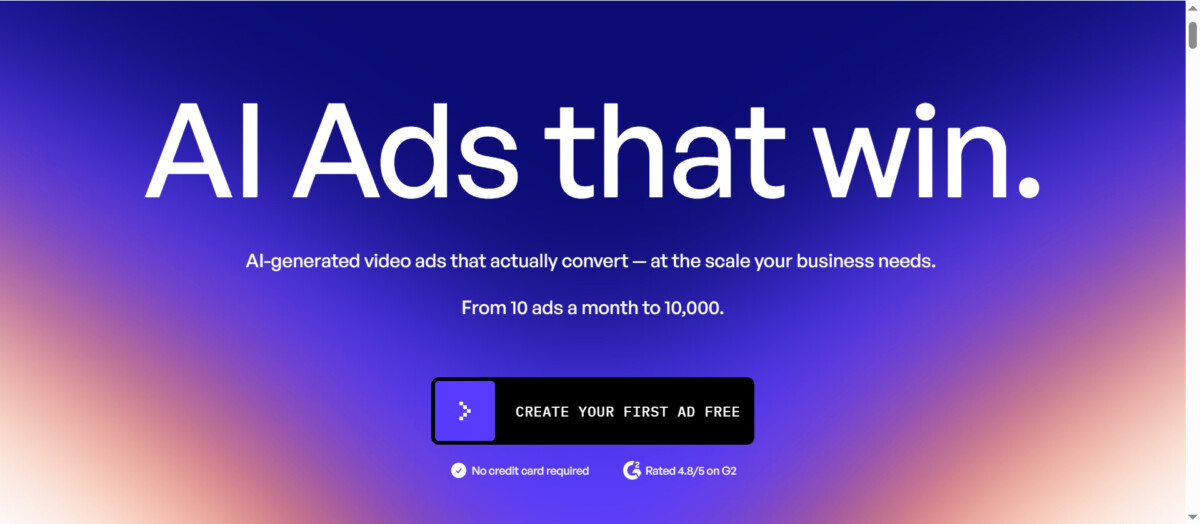
As of October 2026, Creatify has a free plan with 10 credits a month (watermarked exports), and paid plans start at $15 per month for Standard (55 credits), or $10 per month billed annually. The Pro plan is $55 per month, or $38 per month billed annually, for 280 credits.
Creatify’s strength is volume from a single input: a product page becomes several scripted variations, and the Pro plan adds 1,500 AI actors, up to five parallel generations, and a competitor ad tracker drawn from Meta ads. Two limitations matter. Credits are consumed at different rates depending on model, length, and resolution, so the real cost per finished ad is hard to predict until you have run a few. And generated visuals, product details, and advertising claims should be reviewed carefully to ensure that each video accurately represents the product being sold.
Best For: Ecommerce sellers creating product-focused ads and testing different promotional messages.
Skip If: You want an animated narrative or brand character rather than direct product promotion, or you do not have time to review every variation for accuracy.
Arcads is a UGC-style ad tool featuring AI-generated actors who deliver scripts to camera. For ecommerce brands, this format can help present product benefits in a conversational, presenter-led style that resembles common social media advertising. Arcads lists a library of more than 1,000 AI actors, lets brands create their own avatar, and supports translation into more than 30 languages. Marketers can explore different scripts and virtual presenters without arranging every recording session with a human creator. This can be useful when testing how different messages communicate a product’s value to potential customers.
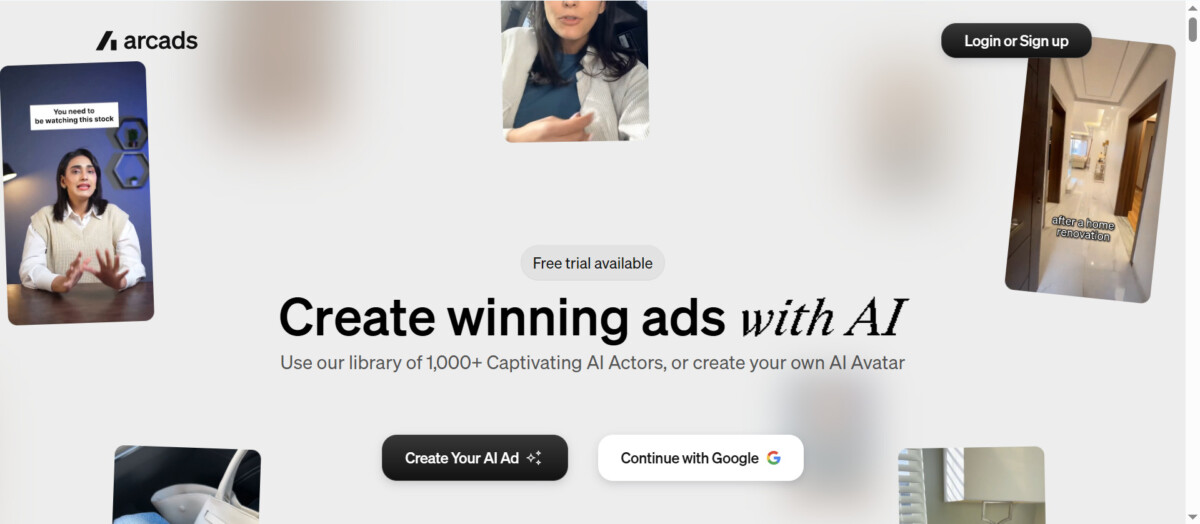
As of October 2026, Arcads advertises a free trial but does not publish plan prices on its website; pricing appears after account creation. A June 2026 review by eesel AI reported plans starting at $110 per month for 10 videos, so confirm the current figure inside the app before committing.
The strength is speed on the format paid social already rewards: a scripted, talking-head spot in many languages and with many presenters, built in minutes. Arcads also lets actors hold or show a product. The limitations are about trust. AI-generated actors are not genuine customers, and brands should not present fictional endorsements as authentic customer testimonials. In the US, the FTC’s final rule banning fake reviews and testimonials covers testimonials that misrepresent they are by someone who does not exist, including AI-generated ones, so review disclosures and product claims before publishing. The per-video credit model also means small changes to tone, timing, or delivery require regenerating the whole video.
Best For: Ecommerce marketers producing presenter-led product promotions and transparently labeled AI-generated UGC-style ads.
Skip If: Your plan depends on the ad reading as a real customer’s review, or you need pricing confirmed before you create an account.
Pencil is an AI creative platform for advertising teams that need to develop and refine creative concepts for ongoing campaigns. Its AI-assisted workflows help marketers explore different advertising directions based on campaign briefs and brand requirements, with plan descriptions that list AI agents for text, images, video, and ad creatives plus performance scores and ad launch on major platforms. For ecommerce businesses, this can support the process of testing alternative messages, promotional angles, and creative approaches before committing resources to a larger production. It is most relevant to teams that regularly develop advertising assets and want a more structured way to explore ideas.
As of October 2026, Pencil’s Core plan costs $14 per month ($11 per month billed annually) for 50 generations, Growth costs $55 per month ($44 billed annually) for 250 generations, and Pro is custom-priced for enterprises. New accounts get a guided experience that creates six ads for free.
Pencil’s strength is iteration with structure: briefs, brand rules, and scoring sit in one place, so a team can compare directions before spending on production, and the Pro plan adds governance features larger brands need, such as access controls across brands and markets. The limitations: Pencil’s own pricing page marks several of these features, including video generation and ad launch integrations, as coming soon in its plan comparison while listing them in the plan descriptions, so test the outputs you need during the free experience. Pencil may not cover every stage of finished video production, so additional tools or editing may be needed for specific formats.
Best For: Ecommerce marketing teams and agencies developing and refining advertising concepts for ongoing campaigns.
Skip If: You are a solo founder who needs one finished video ad this week rather than a system for testing many concepts.
AdCreative.ai is an ad creative platform focused on generating advertising creatives and supporting marketing assets, and it is part of the Appier group. Ecommerce marketers can use its AI-assisted workflows to explore promotional visuals and copy for different products, audiences, and campaign messages, and connecting a store lets every product get its own set of ads. This can help teams develop initial concepts for product launches, seasonal promotions, and other campaigns before deciding which creative directions to pursue. It is particularly relevant when businesses need a range of supporting advertising assets alongside video rather than a single finished video.
As of October 2026, AdCreative.ai’s Starter plan costs $39 per month, or $20 per month billed yearly, for 20 credits a month, and the Professional plan costs $249 per month, or $125 per month billed yearly, for 300 credits. A 7-day free trial requires a card at signup, and one credit equals one downloaded, watermark-free asset.
The strength is breadth with scoring: AdCreative.ai produces banners, copy, product photoshoots, and video in 9:16, 1:1, and 16:9, and scores each creative before you spend, which helps a small team decide which of several versions to launch. The limitations: the credit model charges per download, so heavy video testing on Starter runs out quickly, and the pricing page lists product videos, ad videos, and storytelling ads as plan features, so confirm which plan includes the video formats you need before choosing Starter. Generated visuals and copy still need a human check for accuracy and brand fit.
Best For: Ecommerce advertisers developing promotional concepts, ad copy, and supporting creative assets.
Skip If: Video is the only asset you need, or you prefer a trial that does not require a payment card.
Topview AI is an AI marketing video platform focused on creating product-oriented videos for ecommerce and social advertising. Its workflows help users turn available product assets into promotional content, including URL-to-video and Product Avatar, which uses a product photo with a presenter, making it relevant to sellers who need product demonstrations and campaign videos without assembling every element manually. Brands can use product-focused visuals to communicate features, demonstrate potential uses, and prepare content for different online channels. This approach is particularly useful when showing the product clearly is more important than building a longer narrative.
As of October 2026, Topview AI’s Plus plan costs $36 per month billed annually ($432 per year) for 100 credits a month, Business costs $44 per month billed annually, and Ultra costs $50 per month billed annually for 500 credits a month. Its pricing page does not describe a free plan.
Topview AI’s strengths are product-centred formats and scale: more than 5,000 public avatars, unlimited saved Product Avatars, and voice cloning (5 free clones on Plus and 60 on Ultra). The limitations: monthly credits do not roll over, and the lowest prices require an annual commitment, which is a large upfront bet for a store still testing whether video ads pay back. As with every generator here, generated visuals should be checked to ensure that product appearance, functions, and promotional claims remain accurate before the video is used in a paid campaign.
Best For: Ecommerce sellers creating product demonstrations and promotional videos for online stores and social ads.
Skip If: You want to test on a free plan or month to month before committing to a year.
Creating a video ad with AI takes five steps: set the goal, prepare accurate assets, pick the tool that matches the format, refine the draft, and check it before launch.
Decide whether the ad should build brand awareness, showcase a product, generate leads, or encourage purchases. A clear goal helps determine the video format, key message, and call to action.
Gather approved product images, brand elements, and accurate product information. Write a concise script that highlights the main customer benefit and explains why the product is worth considering.
Select a storytelling platform for animated brand campaigns, an AI actor tool for presenter-led promotions, or a product-focused generator for ecommerce demonstrations. The best AI video generator for ads is the one that fits your campaign objective, assets, and production needs.
Review the opening hook, product presentation, pacing, captions, and call to action. Make sure the product is easy to understand and the main benefit is clear. Where appropriate, prepare variations with different hooks or messages for campaign testing.
Verify product claims, asset rights, brand consistency, disclosures, and applicable advertising requirements. Preview the video in its intended placement and confirm that the offer and call to action are easy to understand before launching the campaign.
The right tool depends less on features than on how many ads you need each month and what kind of ad has already worked for you. Start with the format, then the tool.
If you are under roughly $500K in annual revenue and still finding out which products and messages sell, keep spending low and month to month. Creatify’s free plan or $15 Standard plan, or MagicLight AI’s free credits and $15 Standard plan (prices as of October 2026), let you test a handful of ads before committing. Pick Creatify if your best organic content is product-focused, and MagicLight AI if your product needs explaining or your brand already leans on a character or story. Avoid annual plans at this stage, even when the discount is large, because you do not yet know which format your audience responds to.
If you are between $500K and $5M and already running paid social with a working offer, the constraint is usually creative volume. This is where a presenter tool such as Arcads or a product generator such as Topview AI can replace part of the creator budget, provided someone owns review and disclosure. One generator plus your existing editing tool is usually enough. Adding a second AI tool makes sense only when it covers a format the first cannot, such as pairing a product-demo generator with an animated explainer for top-of-funnel awareness.
If you run a team or agency producing many concepts a month across several brands or markets, the problem shifts from making ads to managing them. Pencil’s briefs, scoring, and governance, or AdCreative.ai’s scoring across static and video assets, fit that workflow better than single-format generators.
The trade-off at every stage is the same: the faster a tool produces finished ads, the more of your review time it demands. A tool that outputs 50 variations a week is only an advantage if someone checks each one for product accuracy and honest claims before it spends a dollar.
There is no single best AI video generator for ads for every ecommerce brand, which is why this list is not ranked. The best AI video generator for ads depends on how an ecommerce brand wants to attract customers and present its products. Creatify and Topview AI focus on product promotions, while Arcads supports AI-presenter videos. Pencil and AdCreative.ai help teams develop advertising concepts and supporting assets. For brands that want to stand out through connected animated scenes, recurring characters, and story-driven product explainers, MagicLight AI offers a narrative-focused approach. Matching the tool to the campaign goal can help businesses create more relevant advertising content for their products and audiences. If you are still deciding, start with the stage guidance above, trial two tools that match your format, and judge them on how much editing each finished ad needed rather than on how fast the first draft appeared.
No single AI video generator is best for every ecommerce ad; the right one depends on the format you need. Creatify and Topview AI are worth considering for product-focused promotions, because both can start from a product URL or product assets. Arcads suits presenter-led, UGC-style spots with AI actors. MagicLight AI suits story-driven animated campaigns with recurring characters. Pencil and AdCreative.ai suit teams testing many concepts and supporting assets. The right choice depends on your product and advertising goals, so trial two tools that match your format and compare how much editing each finished ad needed before it was ready to run.
Yes, several AI tools can create video ads from product images or a product page URL. Creatify and Topview AI both list URL-to-video workflows, and Topview AI’s Product Avatar pairs a product photo with a presenter. The output is a draft, not a guarantee of accuracy. Review it carefully to ensure the product’s appearance, size, colors, and features match what customers will receive, because an ad that shows the product differently from reality creates returns and complaints even when it converts.
Yes, AI actors can appear in ecommerce ads, subject to applicable rules and platform policies. The line to hold is honesty about who is speaking. Avoid presenting fictional AI-generated endorsements as genuine customer testimonials. In the US, the FTC’s 2024 rule on fake reviews and testimonials covers testimonials that misrepresent they are by someone who does not exist, including AI-generated ones. Follow relevant disclosure requirements and each ad platform’s AI content policies, and keep scripts to product facts you can support.
Yes, AI tools are well suited to testing different ad creatives, because they make variations cheap. Many platforms support creative iteration, allowing marketers to explore different scripts, visuals, and promotional messages for different audiences or campaign placements. Pencil and AdCreative.ai score creatives before launch, and Creatify includes a competitor ad tracker on its Pro plan. Change one element at a time, such as the hook or the offer, so the test tells you what actually made the difference.
No, AI-generated ecommerce ads are not necessarily ready to publish immediately. Check product accuracy, licensing, brand requirements, disclosures, and advertising platform policies before publishing. Confirm that your plan includes commercial use and watermark-free export, since free tiers on tools such as Creatify add a watermark. Then preview the ad in its real placement, with captions on and sound off, to confirm the offer and call to action read clearly. A two-minute check before launch costs far less than pausing a campaign after customers point out an error.