

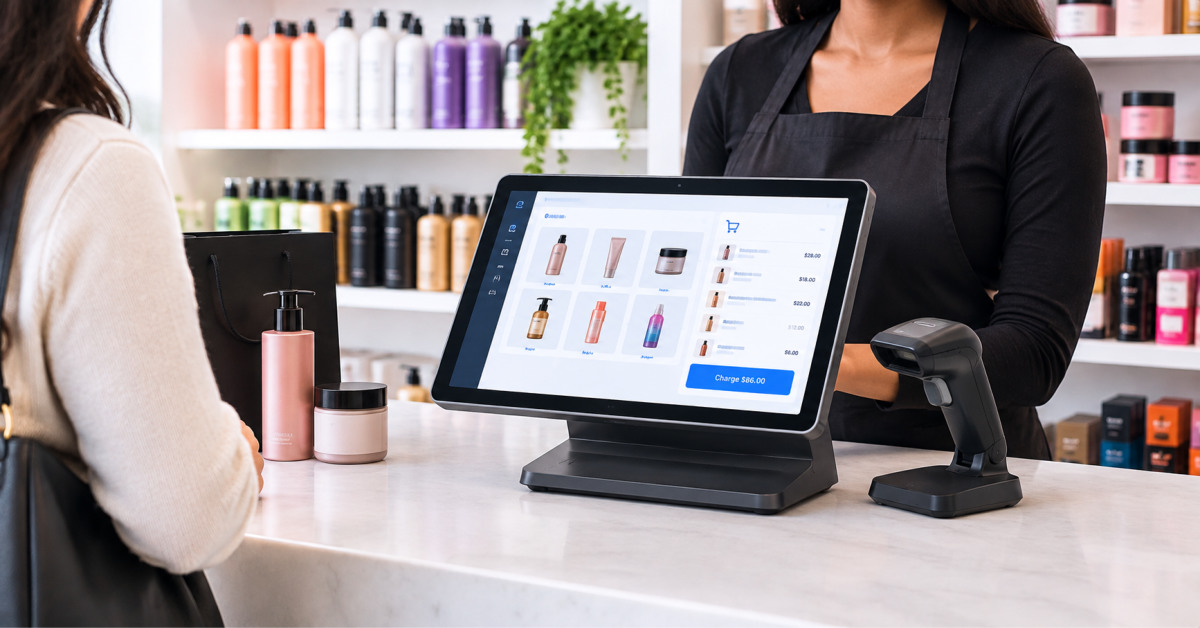
The best beauty supply POS system is the one that handles variant-heavy inventory, keeps in-store and online stock aligned, and supports the way your team buys, replenishes, and sells products. Vibe Retail suits category-specific operators, Lightspeed suits complex inventory and wholesale, Square lowers the starting barrier, Shopify POS unifies online-first retail, and Clover prioritises flexible hardware.
A beauty supply store does not need a generic checkout tool with a few inventory fields. It needs a retail operating system that can keep thousands of shades, lengths, sizes, brands, suppliers, and repeat-customer preferences under control.
Running a beauty supply store is a different kind of retail. You are juggling hundreds – often thousands – of SKUs across wigs, extensions, skincare, cosmetics, nail products, and salon-grade tools, frequently in multiple shades, lengths, and sizes of the same item. Margins are tight, trends move fast, and a good share of your revenue comes from regulars who expect their favorite products to be in stock every time they walk in. The right beauty supply POS system is what keeps all of that under control: it tracks inventory in real time, flags low stock before you sell out, ties in-store and online sales together, and gives you the customer data to bring shoppers back.
The catch is that “POS system” covers everything from a simple card reader to a full retail operating platform, and most general guides lean toward salon booking software rather than the product-heavy, inventory-first reality of a supply store. So we pulled together five systems that are genuinely built for – or well suited to – beauty supply retail, and looked at what each one actually offers.
A quick note on how to read this: this is an editorial roundup based on each provider’s publicly stated features and pricing at the time of writing, not a hands-on lab test. Prices and plans change, so confirm the current details with each vendor before you commit. The right pick depends on how your store runs, so we’ve tried to highlight what each system does best.
Before the list, it helps to know what separates a POS that merely works from one built for this category. The features that matter most for a beauty supply store are:
With that lens, here are five systems worth considering.
We would start a shortlist with Vibe Retail, one of the few platforms built specifically around health and beauty supply retail rather than treating it as an afterthought. It is a cloud-based, omnichannel system that unifies sales, inventory, payments, and customer data, and its dedicated beauty supply pos system configuration is aimed squarely at how these stores actually operate.
It handles the details that matter for the category: custom variants for colors, lengths, and sizing, low-stock alerts with automatic reordering, and stock centralized across in-store and online, with consistent pricing tiers across branches for multi-store operators. On the sales side it pairs a built-in e-commerce site with selling through Amazon, Instagram, Facebook, and TikTok, and adds built-in loyalty plus behavior-based email and SMS marketing. Vibe also promotes 24/7 retail support, migration specialists, and compatibility with existing hardware, so for an owner who wants software that already understands beauty supply, it is a strong first stop.
Lightspeed is a retail-first platform with a genuinely deep inventory engine, which makes it a natural fit for supply stores carrying a large, varied catalog. Its beauty and cosmetics configuration lets you set up variants and composites to manage product sizes, colors, and scents, and shows stock in real time across all stores, in-store and online.
Where Lightspeed stands out is the back-of-house detail. It generates customizable inventory reports on products, brands, and suppliers, and includes wholesale management – the ability to track, manage, and record wholesale stock and sales and create customized receipts for wholesale customers – which is genuinely useful if you sell to salons or stylists as well as walk-in shoppers. You also get customer profiles with purchase history, loyalty and reward programs run straight from the POS, integrated payments, and selling across e-commerce, social media, and online marketplaces. Lightspeed does not publish a flat price for its beauty setup, so you will need a quote, but if inventory complexity is your biggest headache, its tooling is among the most capable on this list.
Square is the accessible all-rounder, and it remains one of the easiest ways for a smaller or newer beauty supply store to get up and running. Its Retail POS pairs hardware and software for in-store and online sales, inventory, and staff and customer management, and its software comes in a free plan to start – there is no monthly subscription, though you still pay a processing fee on every transaction – with paid Plus and Premium tiers as you need more.
For a supply store, the practical strengths are real-time inventory tracking, barcode label creation and printing, multi-location inventory transfers, and bulk import and export – all of which matter when you are managing a big SKU count. Square also covers customer engagement well, with loyalty, gift cards, and email and SMS marketing, plus staff scheduling and payroll and appointment management if you add services alongside product sales. It accepts all major payment types including digital wallets and syncs sales across channels automatically. Square will not give you the category-specific depth of a specialist, but for ease of setup and a low barrier to entry, it is hard to beat.
If a meaningful chunk of your business happens on your website or social channels, Shopify POS deserves a look, because unifying online and in-person retail is its core strength. It connects everything needed to run a store – from inventory management to checkout – and keeps in-store, online, social, and marketplace sales working from one set of data, with inventory levels updating automatically behind the scenes.
The platform supports single stores through to multi-location operations from a centralized back office that handles inventory, orders, customers, and staff, including staff permissions to control what employees can access. Reporting helps you understand what sells best and when you are busiest, and integrated payment terminals accept all major cards and digital wallets. Shopify POS requires a Shopify subscription, and advanced retail features sit in a paid POS Pro tier (Shopify was promoting free hardware and setup support with an annual POS Pro plan at the time of writing). For a beauty supply store that is really an omnichannel brand with a storefront attached, that online-first DNA is the draw.
Clover is one of the most widely used retail POS systems in the US – it says more than 140,000 retailers run on it – and its defining trait is that you build the system around your counter rather than taking it off the shelf. The hardware range runs from the handheld Go and Flex to the compact Mini and the dual-screen Station Duo, and a Clover App Market lets you add capabilities like payroll, loyalty, and marketing as you grow. For a beauty supply owner who wants a specific countertop-plus-mobile configuration, that flexibility is the draw.
On the retail fundamentals it is well equipped, with inventory variants and attributes for unique combinations (its own example is “medium, red, cotton”), real-time stock monitoring, and barcode scanning. Payments are a particular strength – all major cards, gift cards, and mobile wallets, plus Buy Now, Pay Later through Klarna and offline payment acceptance – and you can add a Clover-native online store with DoorDash local delivery. With reporting by SKU and employee, staff permissions, and 24/7/365 support, it is a hardware-forward option for an owner who wants to shape the setup to their floor and extend it through apps later.
There is no single best beauty supply POS system, only the best one for how your store operates. If you want software that is built around beauty supply retail from the ground up and scales from one register to many, Vibe Retail is the natural starting point. If your challenge is taming a huge, multi-brand catalog and serving wholesale buyers, Lightspeed’s inventory depth is compelling. If you are just starting out and want the simplest possible on-ramp, Square’s free plan is tough to argue with. If your growth is really happening online, Shopify POS keeps every channel in sync. And if you want to build your setup around specific hardware and extend it with apps over time, Clover’s flexibility is hard to match.
Whichever way you lean, shortlist two or three, book a demo, and test them against your actual catalog, your busiest checkout moments, and your reordering workflow before you sign. The right system should feel like it was made for a beauty supply floor – because the best ones were.
What is a beauty supply POS system? A beauty supply POS (point-of-sale) system is the software and hardware a beauty supply store uses to ring up sales, take payments, and manage the business behind the counter. Beyond checkout, a good one tracks inventory across a large, variant-heavy catalog, syncs in-store and online sales, manages suppliers and reordering, and holds customer data for loyalty and marketing.
What features matter most for a beauty supply store? The essentials are deep inventory management with variants for shade, length, and size, low-stock alerts and automatic reordering, multi-location stock visibility, omnichannel selling that keeps online and in-store inventory in sync, customer loyalty and email/SMS marketing, and detailed reporting by product, brand, and supplier.
How much does a beauty supply POS system cost? It varies widely. Entry plans can start as low as around $19/month (Vibe Retail), some providers offer a free starting tier (Square), and hardware-led systems bundle a device with a monthly software plan (Clover’s retail systems, for example, start around $16/month over a 36-month term for a compact terminal and rise with larger setups). Most vendors also charge payment-processing fees per transaction, so compare total cost, not just the subscription.
Do I need a POS that handles both products and services? Only if you offer services. Many beauty supply stores are purely product retail, in which case an inventory-first retail POS is the priority. If you also do appointments or in-store services, several of these systems (Square and Vibe Retail among them) add scheduling and appointment tools on top of retail.
Any of these five can run a beauty supply store well – the deciding factor is fit, not ranking. Weigh a system’s strengths against how your store actually sells, day to day, then shortlist a couple, trial them against your own catalog and busiest checkout moments, and choose from there.
This article is a general guide, not financial or purchasing advice. Prices, processing fees, plan features, and other figures are indicative only – they vary between providers and change over time. A POS system is a meaningful commitment for any beauty supply store, so always confirm current pricing, transaction fees, contract terms, and the full agreement with any provider before you sign up
A beauty supply POS system is the software and hardware a beauty supply retailer uses to process in-store sales, accept payments, manage inventory, and run the business behind the counter. A strong system does more than complete transactions. It tracks a large catalogue with variants such as shade, colour, length, texture, size, and pack quantity; manages low-stock alerts and supplier purchasing; syncs inventory across online and physical channels; and stores customer data for loyalty and marketing. The best systems are designed around product-heavy retail operations rather than appointment scheduling alone.
The most important beauty supply POS features are deep variant inventory management, low-stock alerts, supplier and purchase-order tools, barcode support, multi-location inventory visibility, omnichannel stock syncing, customer loyalty, purchase history, email or SMS marketing, and reporting by product, brand, supplier, employee, and sales period. Variant management is especially important because a single product may have several colours, shades, sizes, lengths, textures, or pack configurations. Test these functions using your real catalogue during the sales demo, because a generic inventory feature may not handle your actual product complexity well.
A beauty supply POS system can range from a free starting software plan to several hundred dollars per month, with the total cost determined by software tier, hardware, payment processing, locations, staff accounts, app add-ons, implementation, and contract terms. The source material lists Vibe Retail plans from $19 per month, Square with a free starting plan and paid Retail tiers, and Clover retail systems from about $16 per month under certain term-based hardware arrangements. Always compare total cost of ownership, including transaction fees and required hardware, rather than selecting a provider on subscription price alone.
You need a POS that handles both products and services only if your business provides appointments, consultations, salon treatments, styling, training, or other service-based revenue alongside retail products. A pure beauty supply store should prioritise inventory depth, variant handling, supplier purchasing, omnichannel sync, barcode workflows, and loyalty. If you also offer services, a platform with scheduling, staff calendars, client records, deposits, and appointment reminders can reduce the need for separate systems. Square and some category-focused platforms offer service capabilities, but the right decision depends on how material services are to your overall operation.
Shopify POS can manage in-store and online beauty supply inventory together when the physical store and ecommerce business operate through the same Shopify product catalogue and location setup. This helps inventory update as products sell across channels and gives the team one back office for products, orders, customers, locations, and staff access. It is particularly useful for online-first beauty retailers that sell through a website, social channels, pop-ups, and physical stores. Before adopting it, test your real product variants, returns, stock transfers, receiving process, barcode workflow, and supplier-purchasing requirements to confirm it fits your retail operation.




