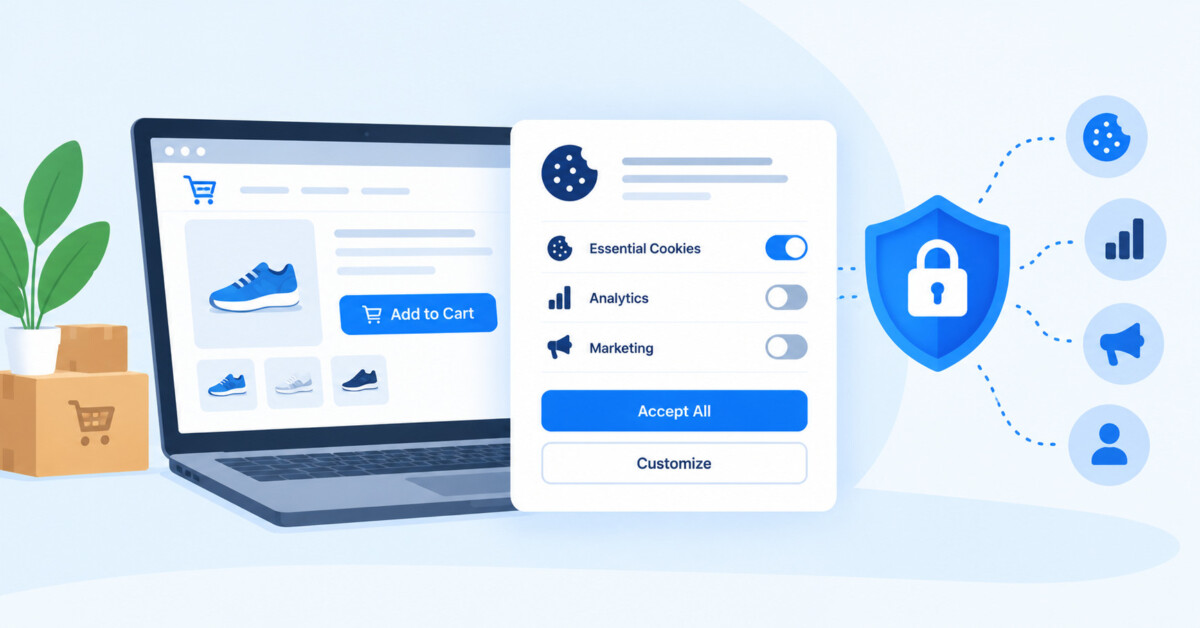
Enzuzo is a practical first choice for a growing ecommerce team that wants consent management and related privacy tools across several stores. Choose iubenda for legal-document workflows, Axeptio for banner design, Osano for broader privacy operations, or OneTrust for enterprise governance. Whichever you choose, test actual tracker behavior before buying.
A cookie banner makes a promise to the visitor. The network requests after they click reject tell you whether your store keeps it.
Choosing a consent management platform (CMP) depends on your store, traffic, marketing tools, and how much privacy work you want to manage in one place.
For most growing ecommerce brands, Enzuzo is our top choice. It combines cookie consent, privacy tools, analytics, Google Consent Mode, and support for multiple websites.
It also works with Shopify, WooCommerce, BigCommerce, Webflow, and custom websites.
Iubenda is a good alternative if you also need legal documents. Osano is better for businesses with more advanced privacy needs, while Axeptio stands out for its banner design and customization.
For large retailers with more complex needs, OneTrust is the most enterprise-focused option.
| Platform | Best for | Main strength | Main limitation |
| Enzuzo | Growing brands, Shopify stores, agencies, and multi-store businesses | Consent, privacy policies, DSARs, analytics, and multiple domains in one platform | Plans have visitor and domain limits |
| iubenda | Stores that also need legal documents | Cookie scanning, consent logs, Shopify integration, and policy generation | Pricing depends on sites and pageviews |
| Osano | Businesses with broader privacy needs | Consent, DSAR workflows, website scans, and vendor monitoring | Paid plans are relatively expensive |
| Axeptio | Brands focused on the consent experience | Custom banners, analytics, A/B testing, and Google Consent Mode v2 | More focused on consent than wider privacy management |
| OneTrust | Large retailers and enterprises | Advanced consent controls and privacy governance | More complex and uses custom pricing |
A good CMP should do more than just show a cookie banner.
Ecommerce stores usually use many third-party tools, including analytics, advertising pixels, email marketing, reviews, chat, and payment services.
A CMP should help control these tools before users give consent, save their choices, and send the right information to your marketing and analytics platforms.
Here are a few important things to look for:
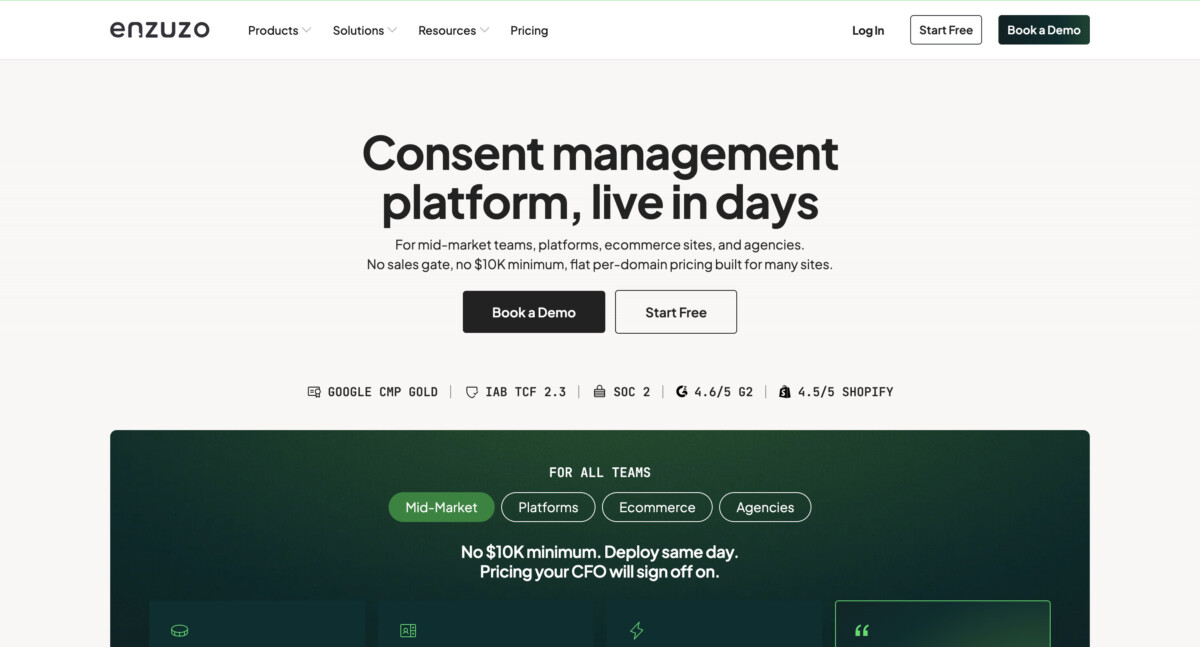
Enzuzo is our top choice because it combines consent management, ecommerce integrations, privacy tools, and clear pricing in one platform.
It has a native Shopify app that doesn’t require coding. It also works with WooCommerce and BigCommerce, while custom websites can connect through a script or Google Tag Manager.
If you manage several stores, brands, or regional websites, you can control consent across multiple domains from one dashboard (Enzuzo, “Cookie Consent Management for Ecommerce,” September 2026).
Enzuzo does more than show a cookie banner.
It includes consent banners and logs, regional settings, analytics, Google Consent Mode v2, privacy policies, DSAR tools, and support for multiple domains. It can also block scripts before users give consent and record each decision with a timestamp (Enzuzo, “Consent Management Platform,” September 2026).
Its analytics can also be useful for ecommerce stores. You can compare opt-in rates across different stores, regions, and banner versions to see how consent may affect remarketing and attribution.
Enzuzo also works with popular marketing tools like Google Analytics, Meta Pixel, TikTok, Pinterest, and Klaviyo through your existing tag setup (Enzuzo, “Cookie Consent Management for Ecommerce,” September 2026).
Enzuzo has a free plan for one domain and up to 5,000 monthly visitors. Paid plans start at $9 per month.
The Growth plan supports up to four domains and 10,000 monthly visitors, while Pro supports up to ten domains and 30,000 monthly visitors.
For larger businesses, Enterprise plans offer unlimited domains and visitors, plus advanced analytics, API access, A/B testing, and a dedicated success manager (Enzuzo, “Pricing,” September 2026).
Enzuzo may not be the best choice for very large companies that need advanced data mapping, vendor-risk management, or more complex privacy tools.
Its regular plans also limit the number of visitors and domains, so growing stores should keep this in mind.
Enzuzo currently has a 4.6 out of 5 rating on G2 from 18 reviews. Users often mention its easy setup, simple interface, and compliance-document tools.
Some reviews also mention issues with banner formatting, the price of higher plans, and account or plan management (G2, “Enzuzo Reviews,” September 2026).
Enzuzo is a good choice if you want consent management, privacy policies, DSAR tools, analytics, and support for multiple domains without moving to a complex enterprise platform.
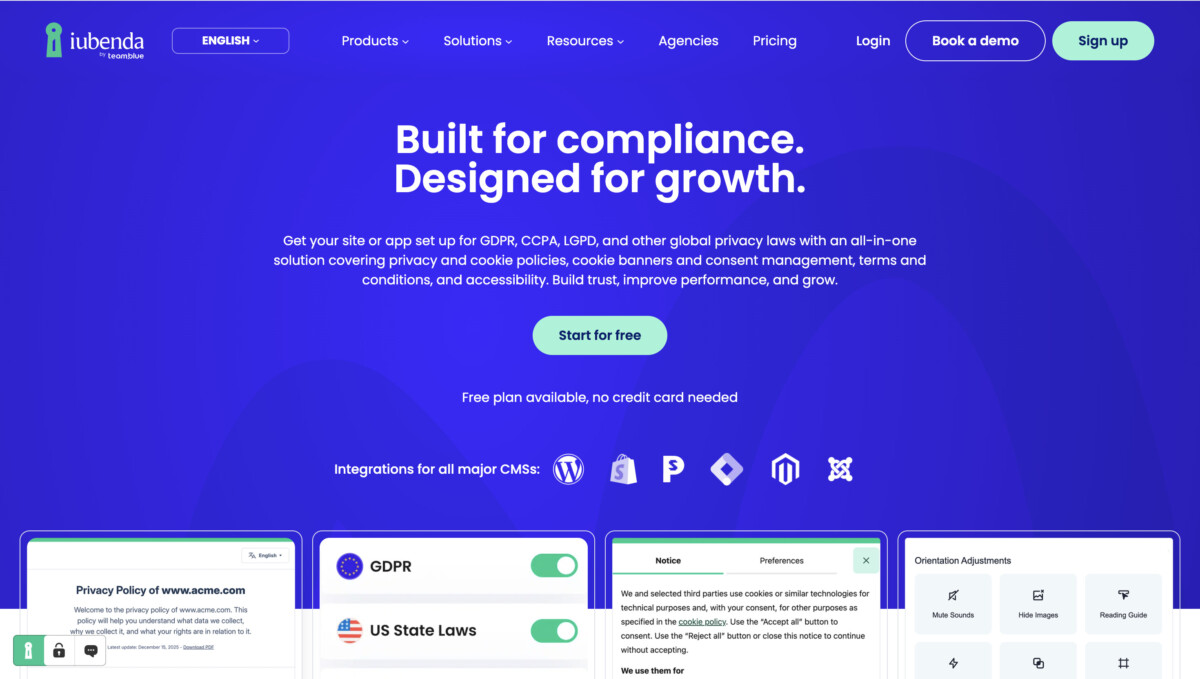
Iubenda is a good option for ecommerce stores that want to manage cookie consent and legal documents in the same place.
Its Cookie Solution scans your website for cookies, pixels, and trackers. It can block them before users give consent and keep a record of each choice.
It also supports Google Consent Mode v2, IAB TCF, regional consent rules, Shopify, and Google Tag Manager (iubenda, “Cookie Banner & Consent Management Platform,” September 2026).
Online stores often need more than a cookie policy. You may also need a privacy policy, terms and conditions, and consent records for forms or newsletter sign-ups.
Iubenda brings these tools together. Its paid plans include privacy and cookie policies, consent management, automatic legal updates, consent logs, and Google Consent Mode v2.
Its scanner can also find marketing pixels, analytics tools, and marketing automation tools running on your website (iubenda, “Pricing,” September 2026; “Cookie Banner & Consent Management Platform,” September 2026).
Iubenda supports privacy rules in different regions, including GDPR and ePrivacy in Europe, CCPA and CPRA in the US, Brazil’s LGPD, and Switzerland’s nFADP (iubenda, “Cookie Banner & Consent Management Platform,” September 2026).
Iubenda’s US pricing starts at $6.99 per month for Essentials, $27.99 for Advanced, and $119.99 for Ultimate.
These plans include 25,000, 50,000, and 150,000 monthly pageviews. Extra pageviews cost €0.05 per additional 1,000 pageviews (iubenda, “Pricing,” September 2026).
Since pricing depends on your number of sites and pageviews, costs can increase if you run several stores or get a lot of traffic.
The main thing to consider is the pricing model.
If you manage several stores, calculate the cost based on your number of websites and expected traffic before choosing a plan.
Its legal-document tools cover many common needs, but businesses with more complicated requirements may still need professional legal advice.
G2 reviewers often mention iubenda’s ease of use, integrations, pricing, and automatic script blocking.
Some also say the advanced settings can be more difficult to use and take some time to learn (G2, “iubenda Reviews,” September 2026).
Iubenda currently has a 4.5 out of 5 TrustScore from 553 Trustpilot reviews. There is both positive feedback and criticism around areas like billing and support, so the score shouldn’t be the only thing you consider (Trustpilot, “iubenda Reviews,” September 2026).
Iubenda is a good choice if you want cookie consent and legal documents in one place, especially if Shopify integration and policy automation matter to you.
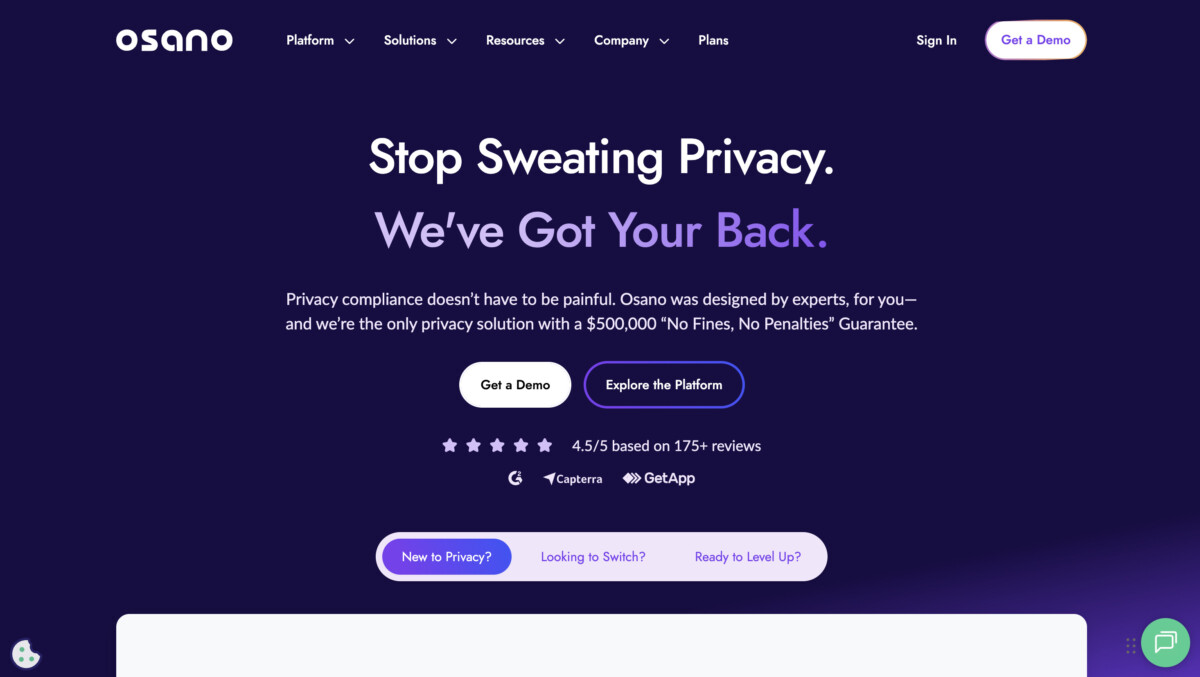
Osano is better suited to businesses that need more than basic cookie consent.
Its platform includes consent management, subject rights, data discovery, privacy assessments, website scans, and vendor monitoring. It can also bring consent preferences from different channels into one place and automate parts of website compliance (Osano, “Privacy Management Platform,” September 2026).
As an ecommerce store grows, it usually starts using more marketing, analytics, customer service, and fulfillment tools.
Osano helps businesses keep track of the privacy risks connected to these vendors. According to the company, its vendor privacy database covers more than 11,000 vendors.
It also supports data-subject requests, consent preferences, website scans, and privacy assessments (Osano, “Privacy Management Platform,” September 2026).
This makes it a better fit for businesses that need more than just a cookie banner.
Osano has a free plan for one user, one domain, and up to 5,000 monthly visitors.
Its Small Businesses plan costs $199 per month and includes two users, three domains, and up to 30,000 monthly visitors (Osano, “Cookie Consent Plans & Pricing,” September 2026).
Larger plans use custom pricing and add features like unlimited users and domains, compliance checks, subject-rights workflows, and Osano’s No Fines Guarantee (Osano, “Cookie Consent Plans & Pricing,” September 2026).
At $199 per month, Osano’s Small Businesses plan can be expensive if you only need a cookie banner.
It makes more sense if you plan to use its other privacy features too. Smaller stores that mainly need tracker blocking and consent records may find better value in a simpler CMP.
Osano currently has a 4.5 out of 5 rating on G2 from 170 reviews.
Users often mention its ease of use, helpful support, automation, and location-based privacy settings. Some also point to limited banner customization and higher pricing compared with simpler alternatives (G2, “Osano Reviews,” September 2026).
Osano is a good choice if cookie consent is only one part of your privacy needs and you also want DSAR tools, vendor monitoring, and other privacy features.

Axeptio stands out because of its focus on design.
Instead of treating a cookie banner as something that simply needs to be there, Axeptio helps brands make it feel like a natural part of the website.
You can customize banners with your own visuals, videos, fonts, colors, buttons, and different layouts.
It also includes consent analytics, A/B testing, consent walls, Google Consent Mode v2, and IAB TCF (Axeptio, “Consent Management Platform,” September 2026).
Ecommerce brands spend a lot of time improving the shopping experience. A confusing or badly designed cookie banner can easily get in the way.
Axeptio gives you more control over how the banner looks and works.
The platform is designed for ecommerce businesses and SMBs and focuses heavily on customization. It also has more than 1,500 pre-integrated vendors and is a Google-certified CMP partner (Axeptio, “Consent Management Platform,” September 2026).
It supports Google Consent Mode v2, IAB TCF v2.2, and several international privacy regulations (Axeptio, “Consent Management Platform,” September 2026).
Axeptio uses traffic-based pricing, with plans based on monthly pageviews or visitors.
It has options for smaller websites as well as larger sites with 100,000 or 500,000 monthly pageviews (Axeptio, “Pricing,” September 2026).
Higher plans can include TCF support, analytics connectors, consent walls, subdomains, and cookie scanning.
Since Axeptio offers different traffic and billing options, check the exact price, currency, billing period, and limits before choosing a plan (Axeptio, “Pricing,” September 2026).
Axeptio mainly focuses on consent and the experience around it.
If you also need advanced DSAR management, data mapping, or vendor-risk tools, you may need a broader privacy platform.
It may also be less convenient for agencies managing many websites if each one needs its own setup or plan.
Axeptio currently has a 4.7 out of 5 rating on G2 from 123 reviews.
Users often praise its customization, integrations, ease of use, and customer support. Some mention difficulty finding certain settings and challenges when managing several domains or languages (G2, “Axeptio Reviews,” September 2026).
Axeptio also has a 4.6 out of 5 TrustScore from 285 Trustpilot reviews. These reviews can be useful for understanding customer experiences, but they don’t give you the full picture of the platform’s technical or legal capabilities (Trustpilot, “Axeptio Reviews,” September 2026).
Axeptio is a good choice if design and customization matter to your brand and you want your consent banner to fit naturally into the shopping experience.
OneTrust is the most enterprise-focused platform on this list.
It’s mainly designed for large retailers, international businesses, and companies with dedicated privacy, legal, security, or compliance teams.
Its cookie consent tools include cookie and tracker scanning, automatic categorization, no-code blocking, tag-manager integrations, regional consent rules, consent records, custom branding, and support for more than 250 languages.
It also offers scheduled scans, A/B testing, and consent syncing across devices (OneTrust, “Cookie Consent,” September 2026).
Large retailers often manage several websites, apps, regional stores, and marketing systems.
OneTrust is built for this kind of setup. It supports consent banners across multiple domains and offers ready-made MarTech integrations.
Its privacy tools also go beyond websites, with support for mobile apps and OTT or CTV consent (OneTrust, “Cookie Consent,” September 2026).
OneTrust also says its database includes more than 45 million pre-categorized cookies and tracking technologies (OneTrust, “Cookie Consent,” September 2026).
OneTrust doesn’t publish a standard price for its cookie consent product.
Instead, pricing is based on the products and setup you need. Costs can depend on users, visitors, data volume, or the size of your setup (OneTrust, “Pricing and Packaging,” September 2026).
OneTrust is probably more than a small or medium-sized ecommerce store needs.
Setup and management can take more time and resources than with a simpler CMP. You may also need a dedicated team to manage the platform.
Another downside is the lack of public pricing, which makes it harder to know how much you’ll pay before speaking with sales (OneTrust, “Pricing and Packaging,” September 2026).
OneTrust’s G2 ratings depend on the product.
Its Privacy Automation product has a 4.3 out of 5 rating from 148 reviews, while Consent & Preferences has a 3.6 out of 5 rating from 14 reviews.
Since these are different products, the ratings shouldn’t be combined into one overall OneTrust score (G2, “OneTrust Product Comparisons,” September 2026).
OneTrust also has a 1.5 out of 5 TrustScore from 28 Trustpilot reviews. Some recent reviews mention issues with sales and customer support.
However, 28 reviews is a small sample for such a large platform, so the Trustpilot score shouldn’t be the only factor you consider (Trustpilot, “OneTrust Reviews,” September 2026).
OneTrust is a good fit for large retailers with several digital properties, complex privacy needs, and the resources to manage an enterprise platform.
For a typical ecommerce store, it’s probably more than you need.
Choose Enzuzo if you’re a growing ecommerce brand
Enzuzo is our strongest overall option for growing stores. It combines consent management, privacy policies, DSARs, analytics, and multi-domain support.
It’s especially useful for Shopify, WooCommerce, BigCommerce, Webflow, and custom websites.
Choose iubenda if you also need legal documents
Iubenda makes sense if you want cookie consent, privacy policies, cookie policies, and other legal documents in the same dashboard.
Choose Osano if privacy goes beyond cookies
Osano is a better fit when you also need subject-rights management, vendor monitoring, privacy assessments, and compliance tools.
Choose Axeptio if design matters
Axeptio is worth considering if you want more control over how your consent banner looks and performs.
Choose OneTrust if you’re an enterprise
OneTrust is designed for larger businesses with multiple digital properties and more complex privacy requirements.
Before picking a CMP, check how it works with your actual ecommerce setup.
Make sure:
Remember that a CMP is only one part of privacy compliance. Installing one doesn’t automatically make your entire ecommerce business compliant.
For most growing ecommerce brands, Enzuzo is a strong all-around choice. It brings consent management, privacy tools, analytics, and ecommerce integrations together in one platform.
The other options are better for specific needs. Iubenda is a good choice if you want consent and legal documents in one place. Axeptio stands out for banner design and customization, while Osano is better for businesses with wider privacy needs. OneTrust is mainly built for large retailers with more complex requirements.
In the end, the best CMP isn’t the one with the most features. It’s the one that fits your store, traffic, budget, and privacy needs.
What is a consent management platform?
A consent management platform (CMP) helps you collect and record visitors’ consent. It can also block non-essential cookies and tracking tools until the visitor gives permission.
Do I need a CMP if my store only uses basic analytics?
It depends on the tools you use, what they track, and where your visitors are located. It’s a good idea to check the cookies and tracking tools running on your website before deciding whether you need a CMP.
Can a CMP affect the checkout experience?
Yes, especially if the banner isn’t set up properly or gets in the way of important parts of the website.
Before going live, test it on product pages, the cart, checkout, and mobile devices.
How can I check if my CMP is working correctly?
Open your website in a fresh browser session and test different options. Try rejecting optional cookies, accepting them, and changing your preferences. Then check that marketing tags only run when the right consent is given.
How often should I scan for new cookies?
It’s a good idea to scan your website whenever you add or change an app, advertising pixel, analytics tool, chat widget, or marketing integration.
Regular scans can also help you catch new cookies added by third-party tools.
Is a free CMP enough for a small store?
It can be. If you have one small website with low traffic and simple consent needs, a free plan may be enough.
Just check the limits first. Free plans may limit traffic, domains, languages, analytics, or other features.