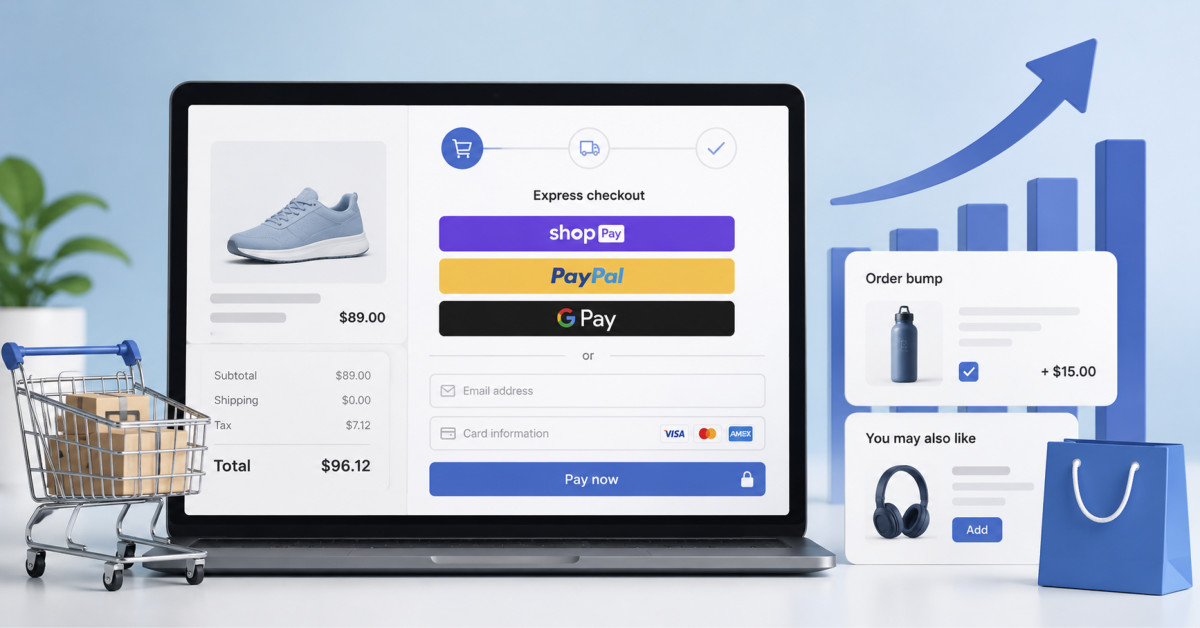
Checkout tools can increase average order value when they make relevant bundles, threshold offers, upsells, and payment choices easy to accept without creating friction. For Indian DTC brands, the right platform depends on your payment mix, COD exposure, Shopify setup, experiment capacity, and margin discipline.
A higher AOV is only a win when the added item improves the customer’s purchase and contributes profitable revenue after discount, payment, shipping, and fulfillment costs.
A store can grow its revenue by bringing in more orders, but there is another lever sitting inside the orders it already receives: Average Order Value (AOV). It shows how much customers spend on average per order, making it useful when looking at whether individual purchases are getting bigger.
Checkout can still influence the final basket. A shopper who is ready to pay may add a complementary product, choose a bundle, or increase the order to qualify for an offer. The key is to keep these options relevant and easy to act on, rather than turning the payment page into another selling space.
That makes the checkout itself worth considering when you are looking for ways to increase AOV.
Here are five solutions that take different approaches to it.
Fastrr Checkout takes a broader view of the checkout experience. Its current feature set includes personalised coupons and freebies, customisable UI, multiple payment options, and an upselling capability. Its discount engine also supports cart discounts, tiered discounts, Buy X Get Y offers, bundles, and upselling.
These features give sellers several ways to influence basket value without relying on a blanket discount. For example, a tiered offer can encourage a shopper to add another product to reach a higher cart value, while a relevant upsell can introduce a complementary product at the point of purchase.
Fastrr also focuses on reducing the work involved in completing the order. Its checkout uses address pre-fill, supports multiple payment options, and includes COD controls.
For sellers, that combination matters because an AOV strategy only works if the shopper can still complete the original purchase easily.
GoKwik Kwik Checkout has several features aimed specifically at checkout optimisation and AOV. Its current offering includes experimentation through Kwik Flows, cart upsells and discounts, and analytics covering AOV, payment splits, and other checkout metrics. GoKwik states that its cart upsells and discounts can flow into Kwik Checkout, with its product page reporting a 200-basis-point AOV uplift for that integration.
The experimentation layer is particularly relevant for sellers that do not want to guess which checkout treatment works. Payment UIs, prepaid nudges, COD fees, and blocking rules can be tested, allowing sellers to assess changes against their own checkout data.
Shopflo treats the cart and checkout as places where customers can discover relevant products, rather than limiting them to order review and payment.
Its upsell feature allows sellers to recommend products on the payment page, with customers able to add suggested items in one click. Shopflo also supports criteria-based recommendations, so sellers can determine which products appear alongside particular carts. Tiered coupons can be combined with upsells to encourage customers to increase their basket.
Its cart product adds another mechanism through progress bars, discounts, and product recommendations. This can be useful when a seller wants to give customers a visible reason to move towards a particular spending threshold.
Razorpay Magic Checkout brings promotions and payment choices into the checkout experience. It supports prepaid and COD payments, saved customer details, coupon-based offers, and multiple payment methods.
For higher-value orders, having different ways to pay can matter. Magic Checkout also gives sellers access to order and checkout data, including AOV, so they can see how their checkout is performing and track changes over time.
Its AOV and checkout insights can help sellers see whether changes to the buying experience are reflected in order value.
Cashfree Checkout brings offers and payment flexibility into its checkout experience. Its broader checkout offering includes one-click checkout, offers, and payment methods that can support different purchasing preferences.
This becomes particularly relevant for higher-value products. Options like EMI or BNPL can give eligible shoppers another way to approach a larger purchase. At the same time, targeted offers can provide an incentive without applying the same discount to every customer.
For sellers, the value is less about adding another promotional message and more about giving shoppers relevant ways to complete the order they are already considering.
By the time a shopper reaches checkout, the main purchase decision has already been made. What happens next can still change the final basket. A complementary product, a bundle, or an offer linked to the cart value may give the shopper a reason to add something before paying.
The important part is relevance. A moisturiser alongside a face wash makes more sense than an unrelated product, just as a bundle can work better when the products naturally belong together. Discounts also need to be weighed against the extra revenue they generate. A higher AOV is useful only when the additional order value makes sense for the business.
The features that matter will depend on how you are trying to increase AOV. If bundles and tiered offers are already part of your sales strategy, look for a checkout that lets you use them easily. If you rely more on product recommendations, check how and where those suggestions can be shown. For higher-priced products, payment options may be more important.
Do not stop at the feature list, either. Look at the numbers after you make a change. Your AOV, conversion rate, order value, and margins will tell you much more about whether a checkout feature is actually working for your store.
AOV can grow for fairly ordinary reasons: a shopper adds something that complements the original purchase, chooses a bundle, or increases the order to unlock an offer. The checkout is where some of those choices can be presented without taking the shopper away from the purchase.
For sellers, the useful test is fairly simple: does the checkout help increase order value without making the original purchase harder? That is where features such as relevant offers, upselling, and payment flexibility can earn their place. Fastrr Checkout brings these capabilities together for brands looking to work on AOV within the checkout experience.
A good way to increase AOV at checkout without hurting conversion is to present one relevant, low-friction offer that strengthens the customer’s original purchase. Start with a complementary add-on, a bundle, or a spend threshold based on your actual cart distribution. Keep the original checkout path clear and make the offer easy to decline. Measure completed-order conversion, AOV, discount cost, and contribution margin together for at least two weeks. If the offer lifts AOV but lowers revenue or profit per session, simplify or remove it.
You should use upsells when a complementary product adds genuine utility, and use discounts when a defined threshold gives customers a reasonable reason to increase their basket. Upsells often protect price integrity because the shopper pays for added value, while discounts can erode margin if they are too broad or easy to claim. The strongest approach is usually product-specific: use bundles and cross-sells for complementary goods, then reserve thresholds or coupons for strategic moments such as a shipping target, prepaid payment, or first purchase.
EMI and BNPL options can support higher AOV when customers want a higher-value product or bundle but prefer to spread the payment over time. They are most relevant for categories with substantial ticket sizes, such as electronics, furniture, premium beauty devices, wellness equipment, and higher-priced fashion. These options do not automatically increase profit, because payment costs, eligibility, refund processes, and customer-support needs all matter. Compare the incremental revenue and conversion lift against the additional financial and operational cost before expanding payment options.
The best checkout tool for a Shopify brand in India depends on the problem you need to solve. Fastrr is a fit for flexible discounts, rewards, upsells, and COD-focused controls. GoKwik is stronger for teams that want to test payment and checkout treatments. Shopflo is useful for contextual product recommendations and one-click additions. Razorpay Magic Checkout is relevant for payment choice, promotions, and COD intelligence. Cashfree is worth evaluating when EMI and Pay Later visibility are central to higher-ticket purchases. Validate current Shopify compatibility and pricing directly with each provider.
You should run an AOV checkout test until it has enough completed orders to distinguish a real trend from normal daily variation, which commonly requires at least two weeks for a store with steady traffic. A low-volume brand may need longer, while a high-volume brand can reach a useful signal sooner. Avoid ending a test after one unusually strong day or during a flash sale. Keep traffic sources, offer eligibility, and other changes as stable as possible, then review AOV alongside conversion, margin, payment success, and returns before deciding.