

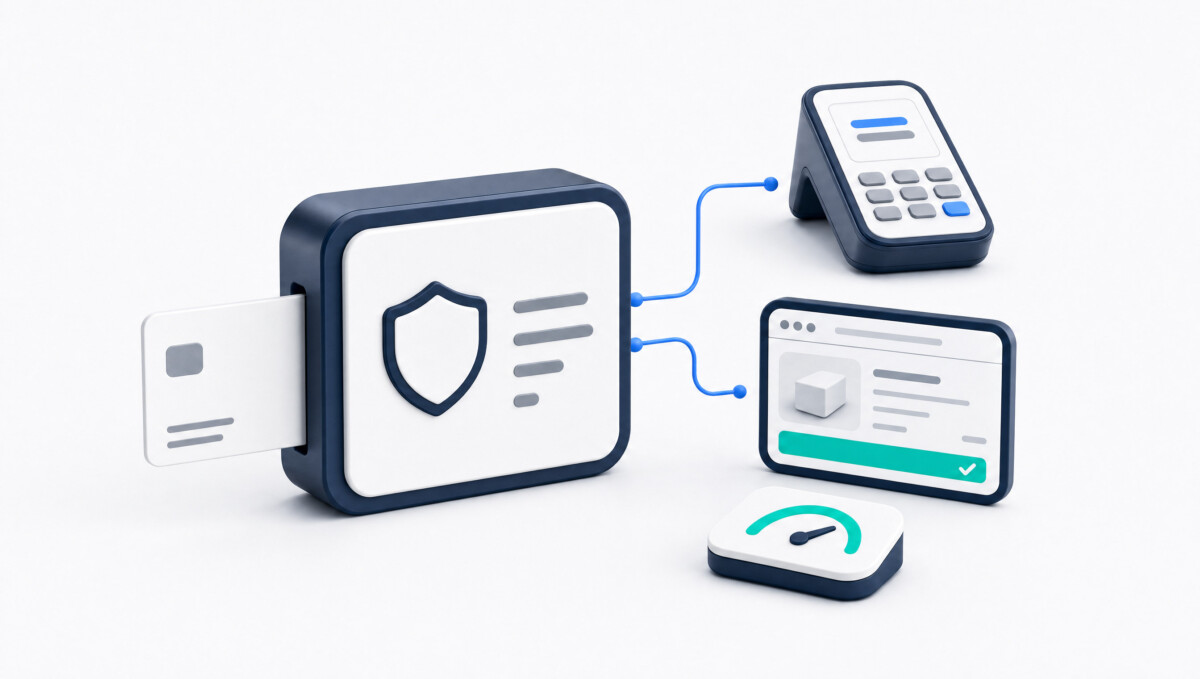
Six high risk processors will underwrite a storefront and a website on one account. Only Finix and PayKings publish rates before you apply, and the right choice turns on register software, CBD card acceptance, and how much pricing you need upfront.
Last updated: October 2026
Two of these six providers publish a rate you can check today. The other four will not quote you until you have handed over your bank statements, your chargeback history and your product catalogue.
If you sell vape at a counter and on a website, you are running two underwriting problems that look like one business. Most merchants in this position end up with two accounts, because the first provider that said yes to the website would not touch the register, or the other way around. Two accounts means two statements, two dispute queues, two sets of rates, and two chances of one side getting shut off while the other keeps running.
A high risk business is one in a category banks look at more closely. That usually means alcohol, CBD, firearms, supplements, tobacco or vape, and it is worth being precise about the term, because what a high risk merchant account actually is has less to do with your business being risky than with how your category sits inside a bank’s own risk appetite. For these categories one provider covering both channels matters more than it would for a low risk store, because the pool of providers willing to take either side is small, and the pool willing to take both is smaller again.
The six providers below are listed alphabetically, not ranked. Nobody here is the best one. The grid and the Which One Fits Your Situation section are built to help you work out which of them matches the shape of your business, and the honest answer for a lot of readers will be that two of the six are viable and the rest are not.
Every provider on this list had to clear four criteria, applied the same way to all six. One, it underwrites at least one high risk category that commonly trades from a physical shop: alcohol, CBD, firearms, supplements, tobacco or vape. Two, it sells or supplies card-present hardware for a register rather than operating online only. Three, it supports a card-not-present channel that connects to a hosted cart such as Shopify or WooCommerce. Four, it states enough on its own public website for a merchant to check the first three criteria without submitting an application. The research base is each provider’s own public pages, read in October 2026, plus third party reviews where a provider publishes nothing. Shopify Payments was considered and excluded, because these categories sit on its restricted and prohibited lists and a store selling them risks being flagged as high risk inside Shopify Payments. eMerchantBroker was considered and excluded for thin card-present tooling. Square and Stripe were considered and excluded because they decline most of these categories outright.
Two of these six providers publish pricing you can check before applying, all six supply counter hardware, and each one has a disqualifier that rules it out for a specific kind of merchant. Pricing shown is as of October 2026.
Two things in that grid matter more than the rest. The pricing column is the real dividing line: four of the six will not tell you a number until you have applied, which means the only way to compare them is to run four applications and wait. And the hardware column is where Host Merchant Services and PaymentCloud separate from the others, because both sell full register systems rather than terminals you bolt onto software you already own.
Durango Merchant Services is a high risk merchant account provider that sells retail accounts alongside its online ones and runs its own payment gateway, aimed at merchants who want one platform across channels.
Durango positions itself for high risk, large volume and retail businesses together, which is unusual here: most high risk providers lead with ecommerce and treat the counter as an afterthought. Its own site says merchants can enable online, in-store, self-service and mobile payments from one platform, with EMV and contactless at the counter. The gateway is Durango’s own rather than a licensed third party, integrating more than 150 shopping carts while also working alongside Stripe, Shopify Payments, PayPal and Square. It adds ACH, eCheck and multiple currencies, which matters if your counter sees visitors from abroad. Durango also markets recovery help for merchants whose accounts were frozen or closed elsewhere, which tells you something about who walks through its door.
As of October 2026, Durango Merchant Services publishes no rates, no monthly fee and no setup fee on its own website. Third party reviews report processing in the region of 1.95% to 4.95% depending on risk, monthly account fees of roughly $15 to $60, rolling reserves commonly in the 5% to 10% range held for several months, and chargeback fees from about $20 to $100. Treat those as reported ranges rather than quoted prices.
The standout strength is channel breadth from one provider running its own gateway, which removes a licensing layer and a monthly gateway fee several competitors here pass through. The second is the accepted category list, which runs from CBD and wellness through supplements, firearms and ammunition, vape and e-cigarettes, travel, gaming, subscriptions and high ticket ecommerce. A shop selling across more than one of those is squarely in Durango’s market rather than at the edge of it.
Two limitations are worth weighing. Pricing opacity is the first and it is total: you cannot compare Durango to anything until you have applied. The second is that approval is not Durango’s alone to give. Its partner banks make the call, and merchants report rejections stating that partnered banks are not accepting applications for their model, which means a Durango yes to your industry on the website is not a yes to your business.
Best fit for a merchant doing $250K to $2M across a shop and a website in one of Durango’s named categories, who values one gateway across both channels over knowing the rate before applying, and who has the patience for a bank-dependent approval.
Skip if you need a quoted rate to compare before you commit time, if you want certainty that the provider rather than a partner bank controls your approval, or if you need named terminal models confirmed before signing, because Durango does not publish a hardware catalogue.
Finix is a payments platform offering processing, terminals and a single dashboard to direct merchants and software platforms, and it is the only provider on this list that publishes its full rate card.
Finix is the odd one out here, and that is worth saying plainly before anything else. The other five are high risk specialists whose entire proposition is placing businesses banks are nervous about. Finix is a payments infrastructure company serving software platforms and direct merchants, and it lists CBD, gaming and lending among the industries it works with. It belongs on this list because it will underwrite categories most mainstream processors decline and it genuinely covers both channels from one account, not because it is a high risk shop. At the counter it offers five PAX devices: the A800 for countertop or handheld use, the A35 compact countertop terminal, the IM30 for self-service and unattended setups, the D135 mobile terminal, and the A3700 portable payment tablet. It also supports Tap to Pay on iPhone, so a phone takes contactless cards with no extra reader. Online it provides a no-code virtual terminal and payment links, low-code checkout pages, plus Apple Pay, Google Pay and ACH.
As of October 2026, Finix publishes its direct merchant rate card in full. The Standard plan carries a $250 monthly membership fee and charges 0.00% plus $0.15 on Visa, Mastercard and Discover, with interchange, dues and assessments passed through at cost. American Express runs 0.30% plus $0.15. Tap to Pay on iPhone adds $0.10 per transaction, standard ACH is 1.00% capped at $10.00 plus $0.25, international cards add 1.50%, disputes cost $30.00, and the termination fee is $0.00. Custom pricing applies above $1M in annual processing.
The standout strength is that rate card itself. Where four of six providers quote nothing, a merchant can model Finix on a spreadsheet this afternoon: at $80K a month across 1,600 transactions, membership plus per-transaction fees come to roughly $490 before interchange, and interchange is passed through rather than marked up. The second strength is the unattended and portable range, since the IM30 and A3700 cover kiosk and market-stall selling that most high risk providers do not equip at all. The third is the $0.00 termination fee.
Two limitations will disqualify a lot of readers. The $250 monthly membership is a floor, not a scaling fee, and it does not justify itself at low volume: a shop doing $15K a month pays 1.7% of revenue in membership before a single card is processed. The second is that Finix supplies terminals, processing and a dashboard but no point-of-sale software platform, so a shop needing inventory, staff logins or register software must bring its own and connect it through Finix’s APIs. That is developer work, not a setup wizard.
Best fit for a merchant above roughly $50K a month who already runs register software they intend to keep, has developer time for the integration, and values published pricing over hand-holding through underwriting.
Skip if you are under $30K a month, if you need the provider to supply your register software as well as the card reader, or if you have no developer capacity, because the API integration is the whole point of Finix and also its entry cost.
Host Merchant Services supports more terminal brands than anyone else on this list and publishes its low risk pricing openly, but it places high risk accounts with an outside partner rather than underwriting them itself.
Host Merchant Services is the hardware answer in this group. It sells countertop, wireless and smart terminals from PAX, Dejavoo, Ingenico, Valor and Verifone, adds Clover and Valor portable terminals, offers full point-of-sale systems, and supplies the SwipeSimple app for taking cards on a phone. If you already own a terminal, Host is the provider most likely to support it. Its published plans are genuinely transparent for low risk merchants: as of October 2026, Retail, Restaurant and eCommerce plans each run $14.99 a month, with interchange plus 0.25% and $0.10 on Retail, interchange plus 0.20% and $0.09 on Restaurant, and interchange plus 0.35% and $0.10 on eCommerce. A cash discount plan runs $0 above $5K a month in volume and $20 below it.
Here is the catch, and it is the single most important thing on this page about Host. Those published numbers do not apply to a high risk account. Host places high risk merchants through a partnership with Electronic Merchant Systems, and Merchant Maverick’s review of Host Merchant Services states those accounts carry different pricing and contract terms from what the Host website presents. Host’s own high risk pages name no gateway, no hosted checkout and no multi-currency support, and its footer states high risk services are provided through alternate partners it does not name. So the transparency that makes Host attractive is transparency about a product you will not be buying.
The standout strengths are the terminal catalogue, which is the broadest here by a wide margin, and the fact that a merchant who later moves out of a high risk category can step onto genuinely cheap published pricing without changing hardware. Host’s own high risk guidance is also unusually candid: chargeback ratio limits of roughly 1% to 3%, refund ratios capped near 10%, terms typically running three to five years, and early termination fees from a few hundred to a few thousand dollars.
Two limitations. The first is the partner placement itself: you are underwritten by Electronic Merchant Systems, supported in part by Host, and the published rates belong to neither arrangement, which puts one more party between you and a dispute. The second is that Host is expensive at low volume and limited to businesses in the United States and Canada. Reported complaints centre on slow underwriting, funding holds and difficulty resolving account-specific issues, which is the usual shape of a problem when two companies share one account.
Best fit for a merchant who already owns terminals from PAX, Dejavoo, Ingenico, Valor or Verifone and does not want to replace them, or one whose high risk status is temporary and who wants a path onto cheap published pricing later.
Skip if you want one company accountable for underwriting, support and pricing, if you are under about $10K a month in volume, or if you are outside the United States and Canada.
PaymentCloud is a high risk merchant services provider that covers in-person, online and MOTO payments for categories most processors decline, and it is the most explicitly high risk brand on this list.
PaymentCloud leads with the position rather than hedging it: its homepage reads “We Don’t Avoid High-Risk. We Embrace It.” At the counter it offers EMV chip terminals, full POS systems and wireless terminals, and it takes NFC tap payments and QR codes, so a shop can take a card at the register or out on the floor. Online it integrates Cybersource, NMI and Authorize.net, connects to Shopify, WooCommerce and QuickBooks, and offers a virtual terminal for phone orders alongside ACH. Its stated categories include adult products, alcohol, CBD, online pharmacy, supplements, firearms, travel and timeshare, debt consolidation, subscriptions and dropshipping, and several of those have a storefront as a matter of course.
As of October 2026, PaymentCloud publishes no rates on its own site. It confirms the application carries no upfront fee and says setup fees and reserves vary by business type. Third party reviews report monthly fees around $10 to $45, a gateway at roughly $15 a month, a virtual terminal at $15 to $45 a month, chargebacks at $25, waived cancellation fees and month to month contracts, with high risk transaction rates in the 2.7% to 4.3% band. That month to month term, if it holds for your account, is the most merchant-friendly contract structure in this group.
The standout strengths are the breadth of accepted categories with a storefront attached, so a shop selling alcohol and supplements under one roof does not need two providers, and the reported month to month contract, which is rare where three to five year terms are normal. PaymentCloud also advertises free wireless terminals, removing a hardware purchase from the startup cost.
Two limitations. PaymentCloud does not state which terminal brands or models come with an account, which is a problem precisely because hardware compatibility with your existing register software is the thing you most need to confirm before signing. Ask for model numbers in writing. The second is that the free terminal offer and the rate promotions carry fine print excluding certain product categories, so a high risk merchant is the reader most likely to find the offer does not apply to them.
Best fit for a merchant in multiple high risk categories at once, trading from a shop and a website somewhere between $50K and $1M a year, who wants a month to month contract and is willing to trade pricing transparency for a provider that will not flinch at the category.
Skip if you need to confirm terminal models before signing, if you require published pricing to get internal approval for the switch, or if your register software has a narrow list of certified terminals, because PaymentCloud will not tell you in advance whether it can supply one.
PayKings is a high risk merchant account provider that publishes starting interchange plus rates by volume tier, making it the only provider here besides Finix that lets you estimate cost before applying.
PayKings covers physical payment terminals protected by EMV for point of sale alongside virtual terminals and mobile payment processing, and it maintains a terminal catalogue rather than leaving hardware unspecified. Online it runs its own gateway and integrates Authorize.net, NMI and USAePay, with cart connections for Shopify, WooCommerce and Magento. Its featured categories are CBD, collection agencies, firearms, nutraceuticals, pawn shops, travel, vape and web design, with a wider list running past gaming, bail bonds, insurance, self storage, pharmaceuticals and cryptocurrency to a claimed fifty plus industries. Pawn shops and firearms dealers are counter-first businesses almost by definition, and PayKings featuring them rather than burying them tells you where its book sits.
As of October 2026, PayKings publishes three interchange plus tiers on its own website. Starter, for up to $100K a month, runs interchange plus 1.10% and 25 cents per transaction with T+2 settlement and email support. Growth, for $100K to $300K a month, runs interchange plus 0.80% and 10 cents, with the monthly fee waived and a dedicated account representative included. Enterprise, above $300K a month, is custom priced on volume and risk. PayKings advertises no setup or application fees. The monthly fee amount for the Starter and Enterprise tiers is not published, and final rates depend on industry, volume and underwriting.
The standout strength is that tiered rate card. A firearms dealer doing $140K a month can work out that the Growth tier puts them at interchange plus 0.80% with no monthly fee, and compare that to a quote from a provider that publishes nothing. The second strength is the gateway choice: running its own gateway while also supporting Authorize.net, NMI and USAePay means your existing gateway integration probably survives the move.
Two limitations. The Starter tier markup of 1.10% plus 25 cents is high for a low volume merchant, and because the Starter monthly fee is not published you cannot complete the calculation that the published rate seems to invite. The second is that negative customer reviews cluster around compliance issues, held funds, and application and approval problems, which is the pattern you would expect from a provider underwriting aggressively across fifty plus categories.
Best fit for a merchant above $100K a month in a counter-first high risk category such as firearms, vape or pawn, who wants a published starting rate to negotiate against and already runs a gateway PayKings supports.
Skip if you are below about $50K a month, where the Starter markup plus an unpublished monthly fee is likely to cost more than a negotiated quote elsewhere, or if held funds would break your cash flow, because that is the most common complaint against PayKings.
SoarPay, a trading name of AltruPay LLC, places mid and high risk merchants on accounts that work across a register and a website, with built-in fraud filters on every account it writes.
SoarPay’s proposition is placement rather than platform. At the counter it offers terminals, mobile card readers and point-of-sale equipment, and it says its accounts work with hundreds of popular POS systems a shop may already run, naming Celerant among its integrations. Online it works through the Authorize.net, NMI and USAePay gateways, each with a virtual terminal, recurring billing and ACH, and it connects to Shopify and WooCommerce. Every account it places comes with fraud filters built in, including address verification and card code checks, which is a real difference from providers where those are optional add-ons you configure later. CBD and hemp are listed as accepted industries, with both merchant accounts and eCheck offered for that category as of October 2026.
As of October 2026, SoarPay publishes no rates, no monthly fee and no setup fee on its own site, describing its pricing only as transparent and competitive from day one. Third party reviews report an early termination fee of $495, and note that monthly minimums, merchant on-file fees, gateway fees, chargeback fees and ACH debit fees may all apply, with equipment listed from $0 and a rolling reserve probable. One review reports monthly fees of $19 to $45 and transaction fees from 2.49% for mid risk merchants, on contract terms of two to three years.
The standout strengths are the fraud filters on every account, which matter more in 2026 than they did two years ago for reasons covered below, and the breadth of POS compatibility, since a shop that already runs register software it likes is more likely to keep it with SoarPay than with most providers here.
Two limitations, and the first is the hardest number on this page to ignore. The $495 early termination fee, against reported terms of two to three years, is the most expensive exit in this group, and it sits next to Finix’s $0.00 and PaymentCloud’s reported waived cancellation. The second is total pricing opacity: SoarPay publishes neither rates nor contract terms nor equipment pricing, and its own reviews advise confirming which terminals work with your assigned processor before signing, which tells you the hardware answer depends on a placement decision made after you apply.
Best fit for a merchant in CBD or hemp who needs both card and eCheck acceptance, already runs register software they want to keep, and is confident enough in the fit to accept a multi-year term.
Skip if there is any chance you will want out inside two years, because $495 plus the remainder of a term is a real number, or if you need to know your terminal before you sign rather than after placement.
One provider across both channels means one application and one underwriting review covering every channel, which lets the underwriter price the whole business rather than guess at the half they cannot see.
The underwriter sees how much comes through the register and how much comes in online, in one file. That matters because the two channels carry different risk, and an underwriter pricing a file that shows only one of them has to assume the worst about the other. Disputes and reporting consolidate too. With Finix, that consolidation is a single dashboard where counter sales and online sales appear side by side instead of in two logins, and the equivalent exists at Durango through its own gateway. The practical value is not the convenience. It is that one dispute queue is one place where a pattern becomes visible before it becomes a threshold problem.
The threshold problem is the part that changed this year. Visa replaced its older dispute and fraud monitoring programs with the Acquirer Monitoring Program, and on April 1, 2026 the excessive threshold for merchants dropped from 2.2% to 1.5%, as the Merchant Risk Council reported the day it took effect. The ratio counts reported fraud plus total disputes against settled transactions, and critically, only card-not-present transactions count toward it. Your register volume does not dilute your ratio. That is the single most useful thing to understand about running both channels under one provider in 2026: the counter helps your underwriting file look like a real business, and does nothing at all to protect your Visa ratio.
The underlying reason the networks tightened is visible in the data. At the counter the terminal reads a chip card. Online, sales are card-not-present, meaning the merchant never sees the physical card, and those orders draw more fraud and more disputes. A February 2026 Federal Reserve Bank of Kansas City briefing by Fumiko Hayashi, drawing on Federal Reserve Board debit card data through 2023, found card-not-present fraud rates on single-message networks rose by more than ten basis points between 2021 and 2023 and surpassed the dual-message rate for the first time. Card-present fraud on dual-message networks, by contrast, fell slightly over the same period to 14.2 basis points. The gap between the two channels is widening, not closing, and the card networks have priced that in.
So your underwriting file should show the split clearly rather than hiding it. Know what share of sales comes from each channel and what the average ticket looks like in each. A shop with steady counter sales and a small web store is a different risk than a web store with a counter on the side, and an underwriter given one combined total will read you as the second one. The same discipline serves you afterwards, because keeping disputes under control starts with knowing which channel is producing them. It is also worth being clear on the difference between a gateway and a merchant account before you compare these six, because two of them supply both and four of them license the gateway from somebody else.
Ask who owns the terminal, because the answer decides what leaving this provider costs you, and it is the question merchants most often skip.
A terminal can be bought outright, leased, or supplied with the account, and one configured for one provider may not carry over to the next. PaymentCloud advertises free wireless terminals, which sounds like a saving and is really a question: a supplied terminal usually stays with the account, so the cost shows up at the exit rather than the entry. Host Merchant Services sells hardware outright across five brands, which costs more on day one and leaves you owning the asset. Get the answer in writing before you sign, and get it as a model number rather than a category.
The terminal also has to work with the register software the shop already runs. Host Merchant Services and PaymentCloud both sell full point-of-sale systems, so a shop starting from nothing can take the whole stack from one place. Finix deliberately does not: it supplies terminals, processing and a dashboard and expects you to connect your own register software through its APIs. SoarPay’s terminals plug into outside software, and the company says its accounts work with hundreds of POS systems. If your inventory lives in one system, the terminal needs a route to it, and a shop that already runs register software it likes is better served by terminals that connect to it than by a provider that wants to replace it.
Pop-up events, markets and deliveries need something mobile, whether that is SwipeSimple at Host Merchant Services, Tap to Pay on iPhone at Finix, or a mobile card reader from SoarPay. Ask the question that actually matters about mobile, which is whether those sales land in the same account and the same reports as the counter. If they do not, you have quietly created the second account you were trying to avoid.
The right provider here depends on three things: your monthly volume, whether you need register software supplied, and whether you can wait out an application to learn your rate.
If you are under $30K a month, none of these six is a comfortable fit, and that is the honest answer rather than a dodge. Finix’s $250 membership eats too much of your revenue, PayKings’ Starter markup of 1.10% plus 25 cents is steep, and the four quote-only providers will price you as the small account you are. At that stage the better move is usually to keep selling through whatever route currently works, including a third party gateway behind Shopify, and revisit this list when counter and web volume together clear $40K a month. Premature complexity in payments is the same mistake merchants make with apps: three providers and two gateways at $25K a month costs more in attention than it saves in rate.
If you are between $50K and $150K a month and already run register software you intend to keep, Finix and PayKings are the two to model first, because they are the only two you can model at all. Finix suits you if you have developer time and want interchange passed through at cost with no termination fee. PayKings suits you if you do not have developer time and would rather negotiate from a published starting rate. The trade off is real and worth naming: Finix gives you the better cost structure and the worse onboarding experience, because the API integration is work you have to resource.
If you need the provider to supply your register system as well as your card acceptance, the list narrows to Host Merchant Services and PaymentCloud, and the choice between them turns on whether you own terminals already. If you do, Host’s five-brand support is the reason to call Host first. If you are starting from nothing and sit in several high risk categories at once, PaymentCloud’s reported month to month contract is worth more to you than Host’s published pricing, because Host’s published pricing will not apply to your account anyway.
If you sell CBD or hemp at a counter and online, SoarPay and PayKings both name the category explicitly and PayKings features it, while Durango lists CBD and wellness among its accepted industries. The deciding factor is usually eCheck: if a share of your volume needs bank debit rather than cards, SoarPay offers both for that category, at the cost of the $495 exit.
There is no best high risk payment processor for a business selling online and in-store, which is why this list is unranked and why four of the six cannot be compared on price at all.
All six will underwrite at least one high risk category with a storefront, and all six supply something for the counter and something for the web. Past that they diverge sharply. Finix and PayKings publish numbers. Host Merchant Services publishes numbers that will not apply to you. Durango, PaymentCloud and SoarPay publish nothing and expect an application first. The exit costs range from $0.00 at Finix to $495 at SoarPay plus whatever remains of a two to three year term, and that spread is wider than any difference in processing rate you are likely to negotiate.
If you are deciding this month, the sequence that wastes the least time is to model Finix and PayKings on your own numbers first, since you can do that today without talking to anyone, then run one or two quote-only applications against those figures as a benchmark rather than as a hope. And before you sign anything, settle the two questions this page keeps returning to: who owns the terminal, and whether your mobile sales land in the same account as the counter.
There is no single best high risk payment processor for selling online and in-store, because the providers in this category differ more in contract terms and pricing transparency than in processing capability. The practical answer depends on three things: your monthly volume, whether you need the provider to supply register software, and whether you can afford to wait through an application to learn your rate. Finix and PayKings publish starting rates you can model before applying. Durango Merchant Services, PaymentCloud and SoarPay quote only after an application. Host Merchant Services publishes low risk pricing that does not apply to high risk accounts. Work out which of those constraints binds hardest on your business, and the list narrows to two providers quickly.
Published high risk pricing is rare, and as of October 2026 only two providers on this list state rates openly. Finix charges a $250 monthly membership plus 0.00% and $0.15 per transaction on Visa, Mastercard and Discover, with interchange passed through at cost and a $0.00 termination fee. PayKings publishes interchange plus 1.10% and 25 cents for volume up to $100K a month, and interchange plus 0.80% and 10 cents from $100K to $300K with the monthly fee waived. Everyone else quotes after an application. Third party reviews report the wider category running roughly 1.95% to 4.95% in processing, $10 to $60 in monthly fees, rolling reserves of 5% to 10%, and chargeback fees from $20 to $100. Treat those as ranges, not quotes.
Finix is a payments platform that publishes its rates and expects you to bring your own register software, while PaymentCloud is a high risk specialist that supplies the full stack and quotes only after an application. Finix charges a $250 monthly membership as of October 2026, passes interchange through at cost, offers five PAX terminals plus Tap to Pay on iPhone, and charges nothing to terminate, but provides no point-of-sale software platform, so integration is developer work. PaymentCloud supplies terminals, full POS systems, wireless hardware, NFC and QR acceptance, integrates Cybersource, NMI and Authorize.net, and is reported to run month to month contracts, but publishes no pricing and does not name the terminal models it supplies. Finix suits higher volume merchants with developer time. PaymentCloud suits merchants in multiple high risk categories who need the hardware supplied.
Five of the six providers on this list connect to Shopify, though in most cases through a third party gateway rather than natively. PaymentCloud integrates Cybersource, NMI and Authorize.net and lists Shopify among its connections. PayKings runs its own gateway plus Authorize.net, NMI and USAePay, with shopping cart integrations for Shopify, WooCommerce and Magento. SoarPay works through Authorize.net, NMI and USAePay and connects to Shopify and WooCommerce. Durango Merchant Services runs its own gateway integrating more than 150 carts and says it works alongside Shopify Payments. Finix offers payment links, a virtual terminal and low-code checkout pages. Remember that running a third party gateway behind Shopify adds Shopify’s own transaction fee of 2%, 1% or 0.6% depending on your plan, and that fee is separate from your processor’s rate.
Move when Shopify Payments has placed a reserve on your account, disabled payments, or your category sits on its restricted or prohibited list, and not before. Shopify treats CBD, tobacco, vape, firearms, adult content, supplements, gambling and some subscription and travel models as restricted or heavily scrutinised, and its automated risk systems can freeze funds or apply reserves after a sudden sales spike or a run of disputes. If Shopify Payments has approved you and left you alone, switching to a high risk account costs you money and gains you nothing. If you have been flagged, the decision is already made for you, and the thing to resolve first is whether you need card-present acceptance too, because that halves the number of providers worth calling.




