

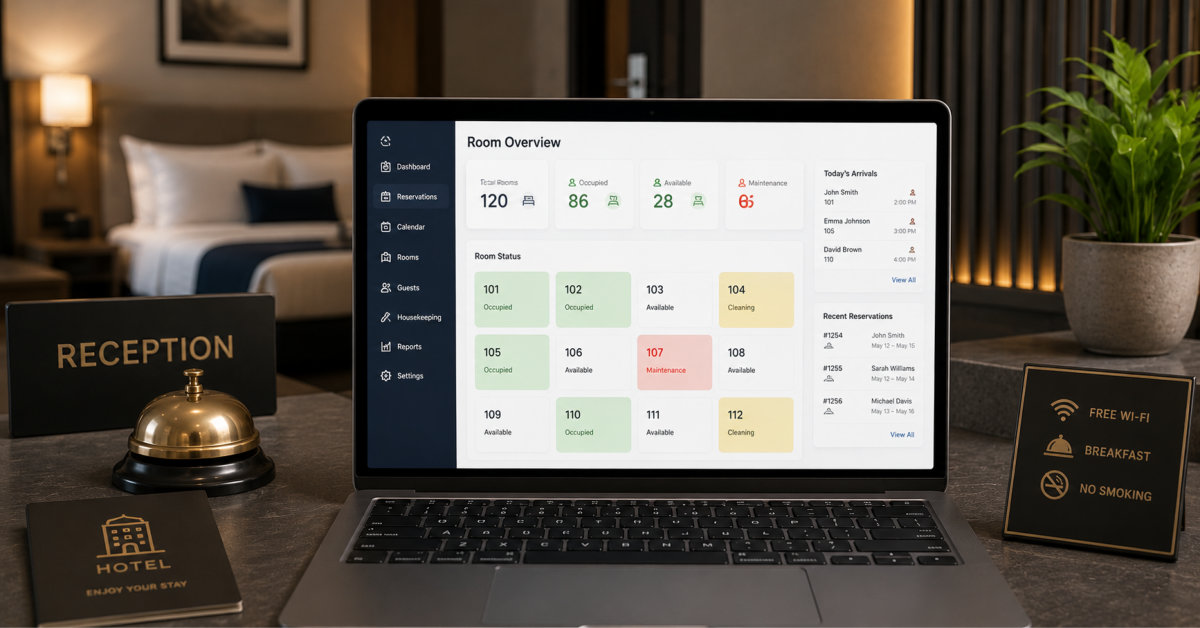
The best hotel room management solution for 2026 depends on the operational problem you need to solve: reservations and distribution require a PMS and channel manager, housekeeping requires real-time room-status workflows, and guest-room controls require a separate in-room technology layer. Most hotels need an integrated stack, not one product claiming to do every job.
Hotel software does not create operational clarity by putting every feature into one dashboard. It creates clarity when reservations, room status, payments, housekeeping, guest communication, and in-room controls each have a clear source of truth and exchange the right data at the right time.
Running a hotel means you’re always juggling a lot—bookings, room status, guest info, billing, and probably a dozen other things. Trying to keep up with all of it by hand or with clunky old software? That’s a recipe for mistakes and wasted time.
This is where hotel room management software steps in. These tools help you organize reservations, update room availability, and handle payments from one central system. They’ll sync with booking sites, so your rates and room counts actually match everywhere you list your property.
With so many choices out there, picking one can be a headache. Let’s break down what matters and how these systems can fit into your daily grind.
HotelSmarters isn’t just another hotel management tool—it’s a way to turn your in-room TVs into smart control hubs for guests. You can even extend this to phones, tablets, or whatever screens your guests already have on hand.
Guests get a single spot to control room features. No need for extra gadgets or complicated apps, just simple control over their stay.
Staff also benefit, since you can handle room settings and guest requests through one connected system. Forget jumping between a bunch of different tools.
HotelSmarters aims to make guest rooms feel up-to-date and connected. It works across different screens, so guests can pick whatever device suits them.
The platform is built for hotels that want to upgrade guest experience without ripping out all their existing room tech. You can use your current TVs as the backbone, which might help keep setup costs down.
If you’re after a solution that puts guest-facing smart controls front and center, HotelSmarters gives you a flexible path. It’s a solid choice for hotels that want to modernize rooms but keep things easy for guests and staff alike.
Little Hotelier is a cloud-based property management system made for small hotels, bed and breakfasts, motels, and inns. You get everything in one spot—a booking engine, channel manager, front desk system, the works.
Reservations, check-ins, and room availability are all managed from a single dashboard. There’s even a mobile app, so you can get things done from your phone or tablet if you’re not stuck at the front desk.
If you’re running a smaller property, this software can really help you cut down on daily busywork. No more bouncing between a bunch of different tools just to keep up with bookings and guest info.
Pricing runs from around $29 to $109 a month, depending on what features you need. There’s also a 30-day free trial, so you can kick the tires before you decide.
Little Hotelier is a good fit if you want something simple and all-in-one, without a huge learning curve. If your place is on the smaller side and you don’t need all the bells and whistles that come with big-chain hotel systems, it’s worth a look.
Yanolja Cloud Solution gives you a one-stop platform for running your hotel or property. It’s used in over 170 countries, so it’s pretty flexible for different kinds of businesses.
You’ll find a bunch of tools bundled together here: property management, booking engine, channel manager, restaurant point-of-sale, and revenue management. Everything connects, so you’re not stuck juggling separate systems.
This setup helps you handle everyday tasks more smoothly. You can track bookings, manage room availability, and update prices across channels at the same time.
The platform also wants to make life better for guests. Because everything is connected, you can respond to guest needs quickly and keep track of their preferences.
Yanolja Cloud Solution is a strong pick if you want a cloud-based system that pulls together a lot of hotel functions into one dashboard. You won’t have to keep switching between apps, and your staff will probably pick it up faster.
WebRezPro is a cloud-based property management system designed for independent hotels, inns, and smaller lodging businesses. You can manage reservations, front desk tasks, and daily operations from a single dashboard.
It comes with a built-in accounting suite, so you can track payments, invoices, and other money stuff without needing extra software.
Room and rate mapping tools help keep your booking channels in sync. This means you’re less likely to deal with overbooking or mismatched rates across platforms.
WebRezPro is a good fit if you run a smaller property and just want a straightforward system. It covers the basics of hotel management, without a ton of add-ons you might never use.
You’ll get solid support for daily front-desk work and reservation tracking. If you need more advanced stuff, like managing multiple properties or heavy-duty automation, you might want to compare it with other options too.
Stayntouch is a cloud-based property management system for hotels of all shapes and sizes. You can handle reservations, check-ins, room status, and billing all from one spot. Since it’s cloud-based, your staff can get to it from any device with internet.
The mobile-friendly design is a plus—your front desk team can work from tablets or phones anywhere on the property. No need to be glued to a desk.
It centralizes a bunch of hotel functions, so you can handle housekeeping, guest data, and room inventory without hopping between different tools.
Stayntouch is a strong choice if you run a select-service or branded hotel with 50 to 500 rooms. It’s built for staff who move around the property, not just those stuck at a fixed station.
The interface is designed to be simple and easy to pick up. That means less training time for new hires.
If your hotel needs a flexible, mobile-focused PMS, Stayntouch gives you the tools to manage operations from pretty much anywhere on your property.
Guesty is a property management platform made for short-term rental hosts and hotel operators. It’s especially handy if you manage listings on Airbnb, Vrbo, and Booking.com and want everything under one roof.
You get real-time sync across major booking sites. Room availability updates everywhere at once, so double bookings become way less likely.
The platform includes a unified inbox, so all your guest messages from different sites land in one place. That makes it easier to keep up and reply fast.
If you have a cleaning crew, Guesty has task management tools for assigning and tracking cleaning jobs. No need to bounce over to another app.
You can also build a direct booking website, which helps you get more bookings without paying those third-party fees.
For smaller operators, there’s a lite version starting at $9 a month. It’s designed for hosts with one to three properties—no need to pay for the full platform if you’re just getting started.
Guesty shines if you run a mix of short-term rentals rather than a classic hotel. If you need deep hotel-specific features, like a front desk system, you’ll want to compare it with other options first.
Hotelogix is a cloud-based hotel management system that’s used by over 25,000 hotels around the world. You can manage your front desk, bookings, and reports all in one place.
The software helps you handle daily tasks like updating reservations, assigning rooms, and creating bills. It tracks housekeeping logs and generates reports, which means less manual work and fewer mistakes for your staff.
Because everything runs in the cloud, you can get to your hotel’s data from anywhere. Your team can spend more time helping guests and less time buried in paperwork.
Hotelogix works whether you run a small property or something a little bigger. It fits into your daily routine without slowing things down.
You can also connect Hotelogix with other tools, like guest room management systems. That way, info about check-ins, room status, and guest preferences stays in sync across your systems.
If you’re comparing hotel management software, Hotelogix often shows up alongside providers like Cloudbeds and AxisRooms. It’s known for balancing ease of use with strong automation, making daily operations smoother.
Hotel room management software gives you tools to run daily tasks more smoothly. Two big areas stand out: how you manage housekeeping and maintenance, and how you talk to guests.
You can track room status in real time. This way, you always know which rooms are clean, dirty, or being fixed.
Most systems let you assign tasks to specific staff members. No more confusion about who’s supposed to do what.
Mobile alerts notify housekeepers when a room needs cleaning, and maintenance ticketing makes it easy to report broken items like AC units or plumbing. Status updates sync with the front desk right away, and inspection checklists help confirm rooms meet your standards.
Staff save time since they don’t have to call the front desk for updates. Rooms get turned over faster, which means you can fit more check-ins into a busy day.
You can send messages to guests by text, email, or even through an app. Sharing check-in details, local tips, or quick answers to common questions gets easier—no need for a phone call every time.
Self-service kiosks and mobile check-in let guests skip the front desk line. Some systems even offer digital key access through a smartphone.
These tools lighten the load for your staff. Guests get quick answers, and your team doesn’t get bogged down with the same questions over and over.
You also keep a record of guest requests and complaints. This helps you spot patterns and fix issues before they become bigger problems.
Picking a hotel room management system isn’t just about price tags. You need to see how well each tool fits with your current setup, how it keeps guest data safe, and what it’s really going to cost once you add up training and support.
Your room management tool should connect with your other hotel systems, so you’re not stuck with extra manual work. Make sure the vendor offers direct integration with your property management system (PMS). If it doesn’t connect well, your teams could end up entering the same data twice.
Look for PMS sync—room status updates should show up in real time on both systems. POS links are important too, so restaurant or spa charges flow into guest folios automatically. Channel manager ties help, so the moment a room is blocked or cleaned, availability updates across booking sites.
Ask vendors which systems they already connect with. That’ll give you a sense of whether setup will be quick or if you’ll need custom work.
Guest data protection is just as important as the day-to-day features. Ask vendors about data encryption and where they store guest info. Most use cloud servers now, but make sure they follow standards like PCI DSS for payments and GDPR if you serve international guests.
Reporting features help you track housekeeping speed, room turnover, and how your staff is doing. Look for dashboards that show this info in simple charts, not just endless numbers.
Scalability is key too. If you plan to add more rooms or open another property, check if the software can grow with you. Don’t be shy—ask what happens to pricing and performance if you double your room count.
The sticker price doesn’t tell the whole story. Remember to factor in setup fees, monthly subscriptions, and any extra charges for more users or properties. Some vendors charge more for phone support instead of just email help.
Training time matters. If a system takes weeks to learn, it’ll slow your staff down and probably lead to mistakes during the switch.
Before you sign anything, ask if training is included or if it’s an extra cost. Check the support hours and whether there’s a dedicated account manager. Are software updates included in the subscription? What’s the average support response time?
Getting clear answers up front helps you dodge surprise costs after you’ve already committed.
Choosing the right hotel room management system isn’t always straightforward. It really depends on your property’s size, your budget, and how your team works day-to-day.
Some platforms lean into housekeeping and room status updates, while others try to roll front desk, reservations, and billing into a single package. Honestly, before you even start comparing, you should pause and ask what your team actually needs most.
Your staff needs something they can pick up fast. If the software doesn’t play nicely with your booking channels or payment systems, it’s going to cause headaches.
Support matters too—does the vendor actually answer the phone when things go sideways? And of course, pricing. Watch out for hidden setup or training fees that sneak up on you.
You really don’t need the fanciest, priciest option to get results. Sometimes a simpler tool just fits better, especially if you’re running a smaller property and don’t want the complexity of a system built for giant hotels.
Don’t rush into anything. Try out a couple options. Most vendors offer free trials or demos, so you can see how things work in real life before signing on.
At the end of the day, your system should make life easier, not harder. If it helps your staff track rooms, manage bookings, and keep guests happy without extra stress, you’re on the right track.
And hey, it’s smart to think ahead. Pick a solution that can grow and change as your business does, because nothing ever stays the same for long in hospitality.
Hotel room management software is a group of systems that help hotels manage room availability, reservations, check-in and check-out, guest information, billing, housekeeping, maintenance, channel distribution, guest communication, and sometimes in-room controls. The PMS usually serves as the operational core, while a channel manager synchronizes rates and inventory across booking sites, housekeeping tools manage room readiness, and guest-experience technology supports messaging, self-service, digital keys, or in-room services. Most hotels need an integrated technology stack rather than one tool that claims to perform every function equally well.
A PMS, or property management system, is typically the core hotel operating platform for reservations, guest profiles, room assignments, folios, billing, payments, front-desk workflows, housekeeping status, and reporting. A hotel room management system is a broader or more specialized term that may refer to room-status coordination, housekeeping, maintenance, energy controls, guest-room technology, or smart-room controls. In practice, a PMS may include some room-management functions, while a separate room-management or guest-room-control platform handles deeper operational or in-room workflows. Ask each vendor which system owns room status and how that information synchronizes with the PMS.
HotelSmarters does not replace a hotel PMS because it is positioned as an in-room TV, guest-information, hospitality-entertainment, and compatible room-control platform rather than a core property-management system. Its technology can help hotels use TVs and other guest-facing screens for hotel information, entertainment, guest services, room controls, wake-up alarms, notifications, and similar in-room functions. A hotel still needs a PMS for reservations, guest profiles, room assignments, billing, payments, housekeeping status, reporting, and front-desk operations. Evaluate HotelSmarters as a guest-experience layer that should integrate with the hotel’s core operational systems.
The best hotel software for a small independent hotel is usually a cloud PMS that combines reservations, front-desk activity, direct booking, channel synchronization, payments, basic reporting, and room-status visibility without requiring enterprise-level implementation. Little Hotelier is designed for smaller accommodation businesses and offers a channel manager, booking engine, front-desk calendar, and mobile access. WebRezPro and Hotelogix are also worth comparing for independent properties that need more configurable PMS workflows. The right choice depends on your room count, OTA mix, payment setup, tax requirements, staff skills, direct-booking strategy, and integration needs.
A hotel channel manager helps prevent overbooking by synchronizing room availability, rates, restrictions, and reservations between the hotel’s PMS or inventory system and connected booking channels such as Booking.com, Expedia, Airbnb, and direct booking engines. When a guest books a room on one channel, the channel manager sends the reservation into the core system and updates remaining availability on other connected channels. The process reduces manual updates and the risk of selling the same room twice, but it depends on correct room mapping, stable integrations, accurate inventory, and prompt error monitoring. Test synchronization behavior during implementation rather than assuming every connection is real time.
The hotel software integrations that matter most are the ones that remove duplicate work and protect the guest journey, including PMS, channel manager, booking engine, payment processor, POS, accounting system, housekeeping tools, door locks, guest messaging, revenue management, CRM, reputation management, Wi-Fi, and guest-room controls where relevant. The priority depends on property type. A resort may need PMS-to-POS and spa posting. A small inn may need channel manager and direct booking. A short-term-rental manager may prioritize OTA synchronization, unified messaging, and cleaning tasks. Ask vendors to demonstrate real data flow between the systems you already use.
A hotel should calculate total cost by combining the monthly or per-room software subscription with implementation, setup, data migration, training, integrations, booking-engine fees, channel fees, payment processing, hardware, support level, user fees, custom reporting, contract commitments, renewal increases, and charges for optional modules. Do not compare platforms using only an advertised monthly starting price. Request a written proposal based on your actual room count, property count, booking channels, users, integrations, payment volume, and required features. Then compare the cost against the operational time saved, fewer overbooking risks, faster room turnover, improved guest communication, and more reliable reporting.




