
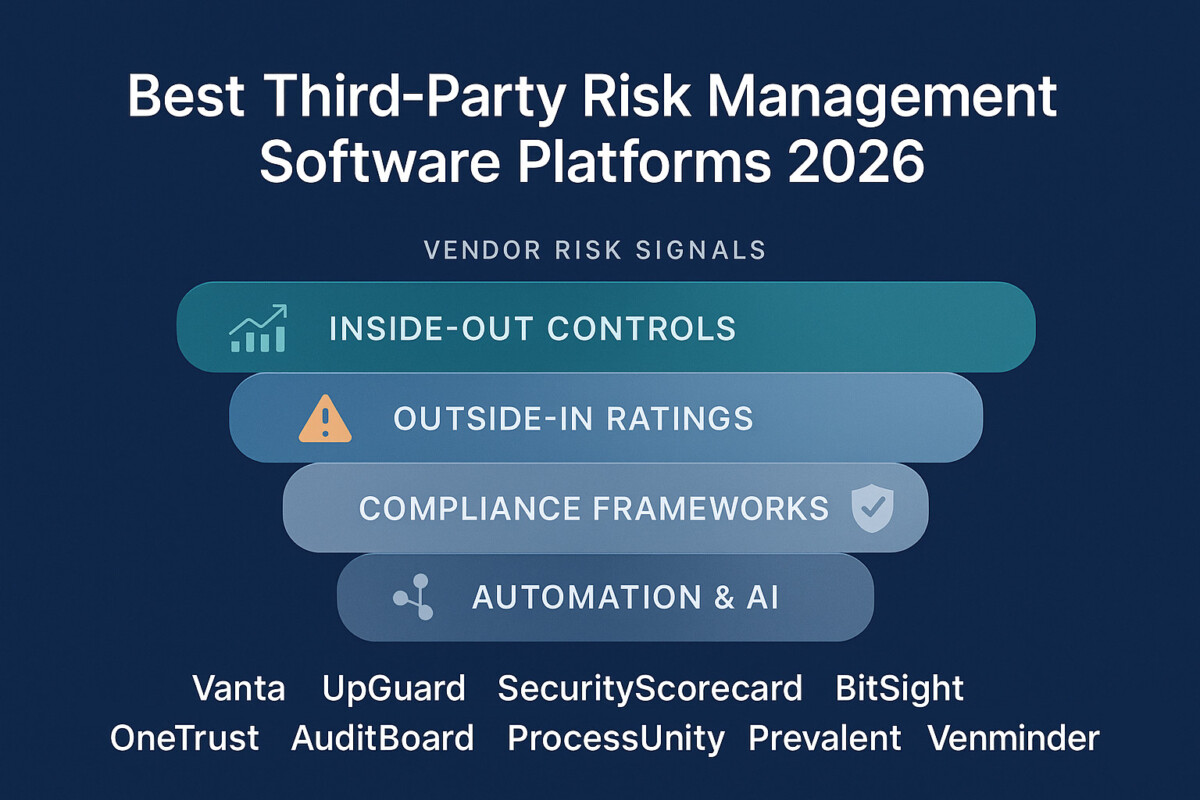
Most Shopify merchants under $2M in revenue do not need third-party risk management software. Above that, Vanta fits compliance-driven teams, UpGuard and SecurityScorecard fit continuous vendor monitoring, and OneTrust, Optro, or ProcessUnity fit enterprise GRC programs.
Your security perimeter is not your Shopify store. It is the forty apps, two agencies, and one 3PL that already have a key to it.
The Change Healthcare ransomware attack, the CrowdStrike update that grounded airlines, and the long tail of the SolarWinds compromise all made the same point in different ways: your vendors’ risk becomes your risk the moment you hand them access. On January 17, 2025, Europe’s Digital Operational Resilience Act (DORA) began requiring financial firms to verify the resilience of every cloud, SaaS, and payment provider they depend on, and the expectation has been spreading outward into supply chains ever since.
For a Shopify brand, that abstraction gets concrete fast. A store doing $5M in revenue typically runs somewhere between 20 and 40 apps, each holding a scoped token into customer records, order history, or payment metadata. Add an email platform, a reviews tool, a 3PL, a media agency with admin access, and a customs broker, and you have roughly fifty trust relationships that nobody in the business has ever formally reviewed. That is the actual attack surface, and it is the reason enterprise retail partners have started sending Shopify brands the same security questionnaires they send software vendors.
The nine platforms below are the ones I keep seeing in real evaluations at that stage, and they are listed alphabetically rather than ranked. There is no number one here, because the right answer depends entirely on whether you are chasing a SOC 2 report, watching a supplier list, or answering to a regulator. Two of the nine changed identity since this article first published, which is exactly the kind of drift that makes stale vendor lists dangerous to shop from.
Every platform on this list automates at least three stages of the vendor risk lifecycle, maintains framework libraries for SOC 2, ISO 27001, and GDPR, and is actively sold to companies below the Fortune 500 rather than exclusively to it. I weighted platforms that publish real integration counts and real remediation workflows over platforms that publish testimonials, and I cross-checked positioning against verified user commentary on G2, which now hosts more than 3 million software reviews. Several credible vendors were considered and left off. Black Kite and Panorays are strong ratings tools but overlap almost entirely with UpGuard and SecurityScorecard here. And compliance management software built around DORA, NIS2, and ISO 27001, of the kind that pairs framework automation with a dedicated CISO team, solves an adjacent problem: proving your own compliance rather than assessing your vendors’. If that is your actual pressure, start there instead of here.
The fastest way to narrow this list is to read down the Approach column and stop at the one that matches the question you are being asked. Pricing across all nine is quote based as of August 2026, so the grid sorts by fit rather than cost.
The fastest way to narrow this list is to read down the Approach column and stop at the one that matches the question you are being asked. Most pricing in this category is quote based as of August 2026, so the grid sorts by fit rather than cost.
Bitsight is a continuous security ratings platform that scores vendors on a 250 to 900 scale, where higher numbers correlate with lower breach likelihood.
The model is deliberately borrowed from consumer credit. A 760 reads as prime, a 500 reads as a problem you need to raise in your next supplier call, and the trend line matters more than the absolute number. Bitsight draws on internet-wide telemetry collected since it effectively created the security ratings category in 2011, and clicking into any score opens the underlying evidence: malware events, open ports, encryption strength, patching cadence, and ransomware susceptibility. Partnerships with Dun and Bradstreet and Moody’s layer financial health and cyber insurance analytics on top, which is what turns “this vendor is risky” into a number a CFO will act on. Bitsight was named a Leader in the Forrester Wave for cyber risk in 2026.
Pricing is not published. As of August 2026 Bitsight quotes based on the number of companies monitored, with managed service tiers layered on top, and buyers who run a competitive evaluation against SecurityScorecard or UpGuard commonly report negotiating 15 to 30 percent below the opening quote. Treat those figures as illustrative rather than as a rate card.
The standout strengths are depth and defensibility. Bitsight’s Dynamic Remediation rescans update ratings within a day and often within minutes, so a supplier that fixes an exposed service sees the score move while the conversation is still live. The historical data set is deep enough that a five-year trend line on a vendor is genuinely meaningful rather than a snapshot dressed up as a pattern.
Two honest limitations. First, the depth adds real complexity, and most teams end up routing Bitsight data into a separate GRC tool such as ProcessUnity to get workflow, which means Bitsight is rarely the only thing you buy. Second, outside in scoring cannot see internal policy gaps, so a vendor with immaculate external hygiene and no access control policy still scores well. Questionnaires stay in play regardless.
Best fit for organizations managing several hundred vendors or more, where the primary consumer of the data is a risk committee or a board rather than an operator.
Skip if your vendor list is under fifty names, or if you have no workflow system to receive the ratings. A score with nowhere to go is an expensive dashboard.
Ideal for: Companies that develop applications, custom stores, or integrations and need to control the risk associated with their software supply chain.
Aikido Security is an application security platform that helps identify risks introduced by third-party components. Its software dependency analysis detects known vulnerabilities, malicious packages, and open-source licensing risks in the code used by the development team.
Reachability analysis checks whether the application can actually reach the vulnerable code. This context helps prioritize fixes and reduce the time spent reviewing alerts that have little relevance to the project.
AutoFix proposes updates through change requests that developers can review before incorporating them.
Aikido also generates Software Bills of Materials (SBOMs) in formats such as CycloneDX and SPDX, and allows external SBOMs to be imported. This helps document components and licenses, review software received from third parties, and share technical evidence during security assessments. The checks integrate into the team’s normal repository workflow.
Limitations: Its scope focuses on technical software risk. Financial assessments, contract management, and vendor questionnaires require a complementary tool.
Mitratech Prevalent is an AI assisted third-party risk platform that combines an assessment engine, dark web monitoring, and a vendor intelligence network in a single dashboard.
The name matters here. Prevalent operated independently for two decades before Mitratech acquired it in October 2024, and the product is now sold as part of Mitratech’s broader enterprise risk suite alongside business continuity and policy management. The workflow starts with the vendor intelligence network rather than with an email: you enter a supplier’s domain, and the platform returns existing risk profiles, breach history, and leaked credential data before you send a single questionnaire. Alfred, the built-in analyst, answers plain language questions such as which high-risk vendors are missing an NDA and returns an actionable list rather than a report you have to interpret.
Pricing is quote based as of August 2026 and scales with vendor count and module selection. Mitratech does not publish tiers.
The strengths are breadth and speed to first value. Monitoring extends past CVEs into geopolitical disruption, credit rating movement, and litigation exposure, which is a genuinely broader definition of business resilience than the ratings-only vendors offer. G2 reviewers consistently report first assessments shipping inside two weeks, which is fast for this category.
Two honest limitations. The 0 to 100 scoring scale is coarser than Bitsight’s 250 to 900 or UpGuard’s 0 to 950, so fine-grained comparison between two similar vendors is harder. The larger concern is roadmap: Mitratech’s acquisition of Prevalent was one of more than twenty acquisitions across its portfolio, and buyers evaluating the product today are evaluating it as a line in a large multi-product company rather than as the focused independent business that built it. Ask directly about the three-year roadmap before signing a multi-year term.
Best fit for lean risk teams that want questionnaires, threat intelligence, and AI explanation in one place without hiring a dedicated analyst to operate it.
Skip if you need granular scoring for close vendor comparisons, or if long-term product investment certainty is a material factor in your decision.
OneTrust is a privacy led enterprise GRC platform that treats vendor risk as one module inside a broader data governance suite.
For any brand storing meaningful volumes of customer data across jurisdictions, privacy and third-party risk stop being separate problems, and OneTrust is built on that premise. Adding a supplier automatically screens them against GDPR, CCPA, and dozens of emerging regional laws, then logs the result in a shared portal that legal and procurement both work from. The Third-Party Risk Exchange, previously branded Vendorpedia, provides pre-vetted vendor profiles complete with SIG questionnaires and certifications, and it now pulls continuous monitoring signals from RiskRecon, SecurityScorecard, and HackNotice rather than relying solely on OneTrust’s own telemetry. Questionnaire Response Automation lets vendors reuse prior answers, which is what compresses assessment cycles from weeks into days. OneTrust reports serving more than 14,000 customers globally.
Pricing is quote based and modular as of August 2026. The modular structure is a genuine advantage for scoping and a genuine risk for budgeting, because the modules you did not scope on day one are the ones you discover you need in month four.
The strengths are regulatory coverage and routing. Drag and drop workflows send high-risk findings to legal and low-risk items to procurement automatically, and the combined privacy and security score is the rare artifact a data protection officer can take to a board without rebuilding it in a slide deck.
Two honest limitations. The breadth that makes OneTrust powerful also makes it heavy, and teams without a dedicated GRC owner routinely underuse it. Advanced reporting still requires meaningful manual configuration, which is a recurring theme in user reviews rather than an edge case.
Best fit for global brands with real privacy exposure across multiple jurisdictions and at least one person whose primary job is governance.
Skip if nobody owns compliance full time. OneTrust rewards dedicated ownership and punishes part-time attention.
Optro is the connected enterprise GRC platform formerly known as AuditBoard, which rebranded on March 9, 2026, and it plugs vendor findings directly into the same system your SOX, IT risk, and audit teams already use.
If you shortlisted AuditBoard previously, this is the same company and the same product lineage. It started as SOXHUB in 2014, became AuditBoard in 2017, was acquired by Hg for over $3 billion in 2024, crossed $300 million in annual recurring revenue in October 2025, and took the Optro name to reflect an expansion into AI governance following the FairNow acquisition. The third-party risk module is not a standalone product so much as a lens: a supplier flagged as high inherent risk flows into the control testing, incident, and enterprise risk views that executives already review each quarter. Pre-built SIG and CAIQ questionnaires route through automated approvals with reminders that lift completion rates without anyone chasing by email.
Pricing is quote based as of August 2026 and sits at the higher end of the category. Optro sells by module, so the marginal cost of adding vendor risk to an existing deployment is materially lower than buying it as a first purchase.
The strengths are consolidation and executive visibility. Optro serves more than half of the Fortune 500, holds Leader status in G2’s third-party risk grid across more than twenty consecutive quarters, and was named a Leader in the Forrester Wave for GRC platforms in Q2 2026. Implementation typically runs four to eight weeks rather than the six to twelve months associated with legacy GRC deployments.
Two honest limitations. Advanced analytics require configuration time that teams routinely underestimate at the quoting stage. And buying Optro purely for vendor risk is poor value, because the platform’s advantage is precisely that vendor risk sits next to everything else.
Best fit for public companies and pre-IPO organizations already running audit or SOX programs that want vendor risk in the same system.
Skip if third-party risk is the only thing you need to solve. A focused tool will cost less and go live faster.
ProcessUnity is the workflow engine of the category, and its 2023 merger with CyberGRX added a shared assessment library that pre-populates most answers before you send anything.
Intake, tiering, remediation, and reporting all move along rails you configure rather than rails the vendor chose for you. The CyberGRX data set contributes tens of thousands of validated assessments covering hundreds of thousands of third parties, which changes the economics of onboarding: instead of emailing a questionnaire and waiting three weeks, you often start with a completed assessment and validate the gaps. Vendors self-onboard through a portal, run through inherent risk logic you define, and the automated vendor-onboarding workflows populate most fields without human intervention. Security, procurement, and legal share one Kanban view, so bottlenecks surface instead of hiding in inboxes.
Pricing is quote based as of August 2026 and scales with vendor volume and configuration depth. ProcessUnity is not a self-serve purchase.
The strengths are flexibility and scale. You can mirror any approval chain, weight risk factors to your own model, and run parallel tracks for privacy or business continuity without leaving the platform. Early adopters of the auto-remediation and anomaly detection features report assessment cycle times dropping by up to half, though that figure comes from vendor-supplied case studies rather than independent measurement.
Two honest limitations. The configurability creates a real learning curve, and most deployments involve either a long internal ramp or a paid implementation partner. Time to first value is measured in months, not weeks, which makes ProcessUnity a poor fit for a team facing a deadline in Q4.
Best fit for organizations with vendor lists running into the thousands and enough internal process maturity to know what they want the workflow to do.
Skip if you need something producing value inside thirty days, or if nobody on your team can specify a risk tiering model.
SecurityScorecard converts every supplier into an A to F report card, updated daily across ten risk categories, and it is the easiest platform on this list to explain to a non-technical executive.
The platform scans a vendor’s entire internet footprint, covering web applications, IP ranges, email configuration, and patch cadence, then assigns a grade with the underlying issues attached. A drop from B to C arrives in your inbox with the specific findings, so triage takes minutes rather than an afternoon of investigation. SecurityScorecard reports continuously rating more than 12 million companies worldwide, which in practice means the marketing plugin you are evaluating is probably already in the database. Vendors can view their own scorecard free, accept remediation tasks, and watch the grade climb, which removes most of the PDF ping-pong that makes vendor security reviews miserable. Fourth-party mapping exposes the dependencies behind your dependencies.
Pricing is quote based as of August 2026. Buyers report one-time implementation and onboarding fees in the $5,000 to $25,000 range depending on deployment complexity and user count, on top of the subscription. Those figures come from aggregated buyer transaction data and should be treated as illustrative.
The strengths are legibility and breadth. Nothing else on this list gets a board to engage with vendor risk as quickly as a letter grade, and the free vendor-facing scorecard genuinely improves remediation response rates.
Two honest limitations. Outside in grades reveal nothing about internal policy, so pair the platform with a questionnaire engine for real coverage. And ratings refresh daily rather than continuously, so a change that happens in the morning may not surface until the following cycle.
Best fit for organizations that need executive-legible vendor risk across a broad supply chain without building a program from scratch.
Skip if your budget cannot absorb implementation fees on top of subscription, or if you need real-time rather than daily refresh.
UpGuard scans every public asset a supplier controls and converts the findings into a 0 to 950 score with an A to F grade, then layers a questionnaire module on top for the inside-out view that ratings alone cannot provide.
An expired TLS certificate or a public storage bucket moves the grade in near real time, and alert rules fire only when a rating crosses a threshold you set, which keeps the noise level survivable. The questionnaire module maps answers to ISO 27001, NIST CSF, and other frameworks, so the same platform covers both halves of a vendor review. The interface reads more like a heat map than a security console, which makes “this vendor dropped from B to C overnight” obvious to someone who does not work in security. UpGuard also runs Trust Exchange, a free questionnaire and trust management tool that is genuinely useful even outside a paid deployment.
UpGuard is the most transparent vendor here on cost. Its G2 listing showed Vendor Risk pricing starting around $1,750 as of March 2026, tiered by the number of vendors monitored, and the platform offers free monitoring for up to five vendors plus a 14-day trial on paid tiers. Confirm current figures directly, since G2 listings lag actual quotes.
The strengths are the combination and the on-ramp. Very few platforms give you continuous external monitoring and a questionnaire engine without a second contract, and the free tier means a merchant can monitor their five most critical vendors before spending anything.
Two honest limitations. Heavily customized questionnaires can feel rigid compared with a purpose-built GRC workflow tool. And UpGuard does not attempt deep privacy or ESG analysis, so if those obligations are real you are pairing it with OneTrust or Optro.
Best fit for technically literate teams that care more about the next breach headline than about audit paperwork, and that want to start small.
Skip if privacy law or ESG reporting is the primary driver of your program.
Vanta is a compliance-first automation platform that ties every vendor action back to a framework control, and it is the most common first purchase for a company that has just been asked for a SOC 2 report.
The orientation shows in the workflow. Upload an encryption policy and the related control flips green automatically. When a prospect asks for your security documentation, you share a live Vendor Trust Report rather than a static PDF, which turns a week of email into a link. Vanta’s third-party risk management module centralizes vendor security reviews and pulls real-time signals from more than 300 out-of-the-box integrations, plus a private integration API, into each vendor profile. If an S3 bucket turns public, the dashboard flags it before an auditor finds it. The interface looks like a fintech product rather than a legacy GRC console, which is a real advantage when finance and leadership need to pull their own reports.
Pricing is quote based as of August 2026, with third-party reporting clustering entry-level single-framework deployments around $10,000 per year and multi-framework deployments running to $80,000 or more. The vendor risk module is typically priced as an add-on. Those ranges come from aggregated buyer reports rather than a published rate card, and audit fees are separate and additional.
The strengths are automation depth and time to certification. Vanta reports automating up to 90 percent of evidence collection, and merchants pursuing a first SOC 2 routinely describe the platform as the difference between a six-month project and a six-week one.
Two honest limitations. Vanta does not scan a supplier’s external attack surface or monitor dark web leaks, so mature programs pair it with UpGuard or SecurityScorecard for outside in telemetry. And per-framework pricing compounds quickly: the quote for SOC 2 alone is not the quote for SOC 2 plus ISO 27001 plus HIPAA.
Best fit for companies under a few hundred people racing toward a first certification, where compliance deadlines rather than supplier monitoring are the actual pressure.
Skip if you already hold your certifications and the real problem is watching a large supplier base.
Venminder is the one option on this list where you are buying expert review hours alongside software, and it is now part of Ncontracts, which reports serving over 5,000 financial and regulated institutions.
The distinguishing move is document review. Upload a 150-page SOC 1 report and Venminder’s in-house auditors read it, flag the gaps, and summarize residual risk while your team works on something else. That is a genuinely different product than a dashboard, and it is why Venminder shows up in organizations where accountability is high and headcount is not. Venmonitor extends coverage past cyber into litigation filings, credit ratings, sanctions lists, and ESG controversies, so a class action filed against your payment processor triggers a same-day alert rather than surfacing in a quarterly review. Every account gets a named success manager plus mentoring sessions, which is a large part of why Venminder’s support scores run high on G2.
Pricing is quote based as of August 2026 and scales with service depth. Platform-only deployments sit at the lower end, and each deep-dive assessment adds cost. This is the rare vendor where the pricing model is legible even though the numbers are not published.
The strengths are judgment and coverage. Software can tell you a SOC report exists. Venminder tells you what the qualified opinion in section four actually means for your exposure.
Two honest limitations. The service model means turnaround depends partly on someone else’s queue, which is a real constraint if you need an answer today. And the platform layer on its own is less sophisticated than the ratings and GRC specialists on this list, so buying Venminder purely as software leaves value on the table.
Best fit for regulated organizations with meaningful vendor obligations and no internal capacity to read audit reports properly.
Skip if you want a pure self-serve product, or if your team already has the expertise in house.
The right platform is determined by your revenue stage and your regulatory exposure, not by which vendor ranks highest on a comparison site. Here is how that maps in practice for commerce brands.
If you are under $2M in annual revenue and selling direct to consumers, buy none of these. The pattern I see repeatedly at this stage is premature complexity: a merchant buys a $15,000 platform to solve a problem that a two-hour audit would have solved for free. Open your Shopify admin, list every app with access to customer data, revoke the six you stopped using eighteen months ago, and enable multi-factor authentication across your admin, your email platform, and your ad accounts. That single afternoon eliminates more real risk than any subscription on this page. The specific cyber threats a Shopify store actually faces are almost entirely about access hygiene, not about vendor scoring.
If you are between $2M and $10M and starting to sell wholesale, land enterprise retail accounts, or partner with a large platform, compliance automation is where the money goes first. Vanta exists precisely for the moment a retail buyer sends you a security questionnaire and you realize you cannot answer it. This is also the stage where a first SOC 2 stops being optional, and where the full SOC 2 compliance requirements are worth understanding before you buy tooling to satisfy them.
If you are above $10M with a supplier base in the hundreds, add continuous ratings. UpGuard’s free five-vendor tier is a reasonable way to test the discipline before committing budget, and SecurityScorecard’s letter grades win the internal argument faster if your blocker is executive attention rather than data. The honest trade-off: ratings tell you about a vendor’s external posture and nothing about their internal controls, so you are adding a layer, not replacing questionnaires.
If you sell into the EU, process payments in regulated markets, or hold data across multiple jurisdictions, the driver becomes regulation rather than scale. DORA, NIS2, and the widening set of data compliance regulations affecting ecommerce push you toward OneTrust or a compliance-first platform well before your vendor count would justify it. And if you are public, pre-IPO, or running SOX, Optro or ProcessUnity make sense because vendor risk needs to live next to everything else you already report on.
There is no single best third-party risk management platform, which is why this list is unranked and alphabetical. All nine earn their place, and the four segments they occupy solve genuinely different problems: compliance automation proves your own posture, continuous ratings watch your suppliers’, enterprise GRC connects vendor findings to the rest of your risk program, and software plus services buys judgment you do not have internally.
The more useful question for most readers is not which platform, but whether you are at the stage where any platform is the answer. Vendor risk is real for commerce brands, and the app-heavy, agency-heavy way DTC operates makes it more real than most operators assume. But the first move is always an inventory, not a purchase. Know who holds a key to your store, decide which of them genuinely needs one, and only then ask whether the remaining list is long enough to need software to watch it.
If you are evaluating seriously, take the Approach column above, pick the row that matches the question you are being asked, and put two vendors from that segment into a competitive process. Buyers who run competitive evaluations in this category consistently report better pricing than buyers who talk to one vendor.
Most Shopify stores under $2M in annual revenue do not need third-party risk management software, and buying it early is a classic case of premature complexity. What those merchants need is an inventory of every app, agency, and service provider with access to their admin or customer data, followed by revoking anything unused and enabling multi-factor authentication everywhere. The picture changes once you sell wholesale, land enterprise retail partners, or start receiving security questionnaires from buyers. At that point a compliance automation platform earns its cost, because the alternative is answering those questionnaires manually every time one arrives.
TPRM software centralizes how an organization assesses, monitors, and remediates the risk created by vendors, suppliers, and partners. It replaces spreadsheets and email threads with structured workflows for onboarding, security questionnaires, continuous monitoring, and reporting, so that diligence is documented and provable to auditors and regulators. The category splits into four practical approaches: compliance-first automation such as Vanta, continuous cyber ratings such as Bitsight, SecurityScorecard, and UpGuard, enterprise GRC suites such as OneTrust, Optro, and ProcessUnity, and software paired with expert human review, which is Venminder’s model.
Every platform in this comparison is quote based as of August 2026, so there is no published rate card for most of the category. UpGuard is the most transparent, with a G2 listing showing Vendor Risk starting around $1,750 as of March 2026 and a free tier covering up to five vendors. Vanta deployments are widely reported in the $10,000 to $80,000 per year range depending on framework count and company size. SecurityScorecard buyers report one-time implementation fees between $5,000 and $25,000 on top of subscription. Treat all of these as illustrative ranges from aggregated buyer reports rather than as quotes.
Vanta proves your own compliance posture, while UpGuard assesses your vendors’ external security posture, which makes them complements rather than competitors. Vanta automates evidence collection against SOC 2, ISO 27001, GDPR, and similar frameworks, pulling from more than 300 integrations so that controls stay continuously verified. UpGuard scans a supplier’s public assets and returns a 0 to 950 score with an A to F grade, updated in near real time, plus a questionnaire module for the inside-out view. Mature programs commonly run both: Vanta for the audit, UpGuard for the supplier watch list.
AuditBoard rebranded to Optro on March 9, 2026, and Prevalent was acquired by Mitratech in October 2024 and is now sold as Mitratech Prevalent. Both are the same products with the same histories, and awards, case studies, and reviews published under the old names still apply. This matters when you shortlist, because a comparison article written before those dates will send you searching for companies that no longer exist under those names, and because a product absorbed into a larger portfolio carries legitimate questions about long-term roadmap priority that are worth raising directly in a sales conversation.
Move to continuous ratings when your supplier count passes roughly one hundred, or when a single vendor outage would materially interrupt revenue, whichever comes first. Compliance automation answers the question an auditor or an enterprise buyer asks about you. Continuous ratings answer the question you should be asking about your suppliers, and the two do not substitute for each other. The practical trigger most operators hit is the first time a vendor incident reaches customers and nobody internally knew the vendor’s posture had degraded. Starting with a free five-vendor monitoring tier is a low-cost way to build the habit before committing budget.




