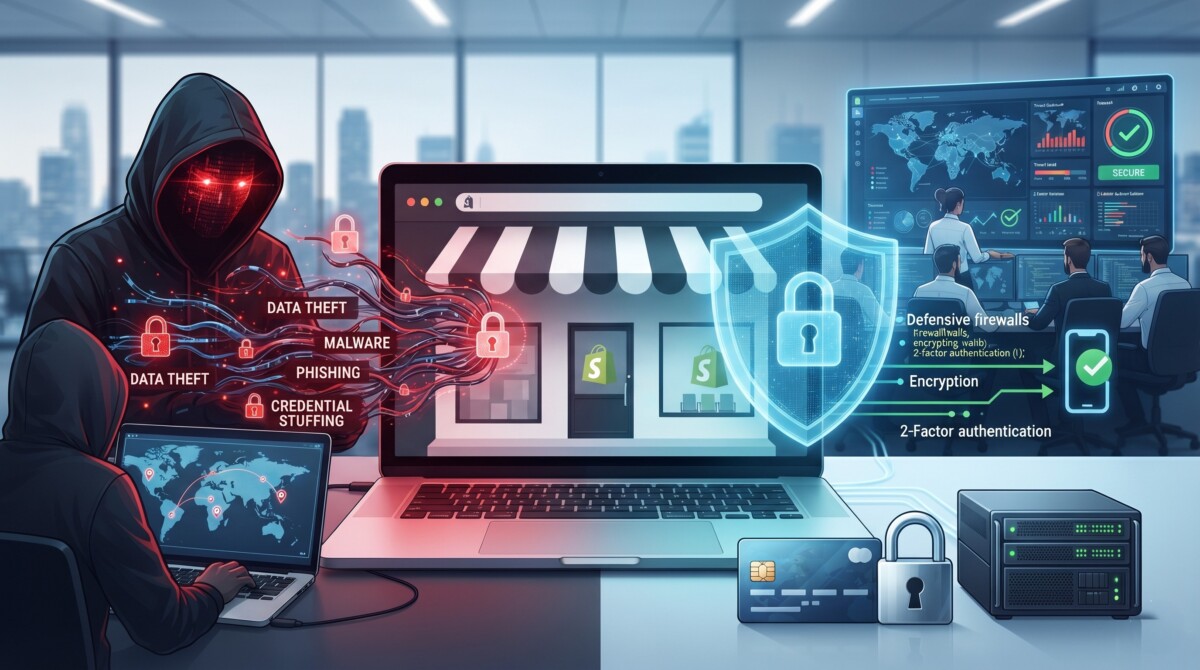
Your Shopify store is a serious cyber target because of the data and access it holds, and protecting it now is far cheaper than recovering from a breach later—especially if you consolidate your security stack instead of stitching together point tools.
Shopify secures its platform; it does not secure your laptops, your inboxes, your apps, or your people—and that is exactly where attackers come in.
You’ve nailed the product. The Shopify store looks great. The ads are running. Revenue is climbing.
And somewhere right now, a cybercriminal is looking at your store as an opportunity.
That might sound dramatic, but the numbers back it up. Ecommerce businesses are among the most targeted organisations in the cyber threat landscape – not because hackers have a grudge against DTC brands, but because of what you hold: payment data, customer PII, order histories, supplier access, and email lists worth more than most people realise.
The uncomfortable truth is that most Shopify merchants focus obsessively on customer acquisition and conversion rate optimisation, while treating cybersecurity as an afterthought – or assuming Shopify handles it for them. Shopify does an excellent job securing its platform infrastructure. What it cannot secure is your business: your team’s devices, your third-party app integrations, your email accounts, your supplier portals, and the people clicking links in their inboxes.
That gap is exactly where attacks happen.
Understanding the risk starts with knowing what you’re up against. These aren’t theoretical threats. They’re hitting ecommerce businesses at scale, right now.
Ransomware. Attackers encrypt your files, your order management systems, your customer database – then demand payment to unlock them. Research shows that 60% of SMBs hit by ransomware shut down within six months. For an ecommerce brand mid-season, a ransomware event isn’t just an IT problem. It’s an existential one.
Phishing and business email compromise (BEC). Email is still the number one attack vector globally – 94% of cyberattacks originate from email. For ecommerce operators, this means fake supplier invoices, fraudulent refund requests that your team processes without realising, or attackers impersonating your payment processor to capture credentials. BEC incidents have more than doubled in cost in recent years, averaging $183,000 per breach.
Supply chain attacks. Your Shopify store likely runs 10, 20, maybe 30 third-party apps. Each of those is a potential entry point. Attackers increasingly target app developers and integrations rather than the store itself – meaning you can be compromised through a tool you barely think about.
Credential theft and account takeover. If a team member reuses passwords across platforms – and statistically, they do – one breach on an unrelated site can hand attackers the keys to your Shopify admin, your ad accounts, your email platform, and more. Account takeover was involved in 28% of breaches in 2023.
DNS attacks. Nearly 79% of organisations experienced a DNS attack in 2020. For ecommerce stores, a compromised DNS can redirect customers to fake storefronts – destroying trust and handing payment details to attackers – while you don’t even know it’s happening.
Three structural realities make growing DTC brands softer targets than they should be.
Lean teams move fast and patch slowly. Speed is a competitive advantage in ecommerce. But the same bias toward action that helps you launch a product in 72 hours also means software updates get deferred, access controls stay sloppy, and no one owns security because everyone is focused on growth metrics.
Tool sprawl creates blind spots. The average scaling Shopify brand runs a sprawling stack – email platforms, review tools, inventory management, fulfilment integrations, analytics, paid media platforms. Every integration is a trust relationship. Not all of them deserve it, and very few operators audit them.
Customer data is high-value and under-protected. You’re sitting on a goldmine that you’ve barely thought about defending. Names, addresses, purchase histories, payment tokens – a mid-sized DTC brand with 50,000 customers is holding data that’s worth serious money on the dark web, and serious liability if breached under GDPR or equivalent regulations.
Here’s the practical part. You don’t need an enterprise security team. You need the right tools and the right approach.
Every laptop, every phone, every device your team uses to access your store admin, your ad accounts, or your supplier portals is a potential entry point. Next-generation antivirus (NGAV) with behavioural detection is the baseline – it catches threats that signature-based tools miss.
But endpoint protection alone isn’t enough. You also want endpoint detection and response (EDR) capabilities, which give you visibility into what’s happening across your device estate and the ability to respond when something suspicious occurs.
This one is underrated and underused outside of enterprise IT. DNS-layer security intercepts malicious connections before they’re established – blocking access to known bad domains, command-and-control servers, and phishing sites at the network level. For ecommerce teams where people are constantly clicking links in emails, Slack messages, and supplier communications, this is a high-impact, low-friction layer of defence.
Given that email is the primary attack vector, it warrants specific protection beyond whatever your email provider includes by default. Look for solutions that detect phishing, business email compromise, and CEO fraud before they reach inboxes – with deep inspection of URLs, attachments, and sender behaviour rather than simple spam filtering.
Unpatched software is one of the most common and most preventable causes of compromise. Attackers routinely exploit known vulnerabilities in operating systems and third-party applications – vulnerabilities that vendors have already issued patches for. Automating patch management across your device estate removes this risk without requiring manual effort from your team.
Not everyone in your business needs access to everything. A warehouse manager doesn’t need Shopify admin access. A customer service rep doesn’t need your payment gateway credentials. Privileged access management (PAM) enforces the principle of least privilege – ensuring people only access what they genuinely need, and that elevated access is controlled, audited, and time-limited.
Standard EDR is strong, but ransomware often initiates its encryption process after the initial endpoint compromise – meaning it can slip through the gap. Ransomware Encryption Protection (REP) solutions monitor file system activity in real-time, detecting and blocking encryption attempts before data is impacted. For a business where your product catalogue, order data, and customer database are your operational lifeline, this matters.
Here’s where a lot of growing brands go wrong: they stitch together five different point solutions from five different vendors, each with its own dashboard, its own alert queue, and its own support team. The result is complexity, alert fatigue, and gaps between tools that attackers are very good at finding.
The smarter approach – increasingly adopted by IT-mature businesses – is platform consolidation. A unified security platform that covers endpoint protection, DNS security, email security, patch management, PAM, and detection and response from a single console gives you complete visibility, shared threat intelligence across layers, and significantly lower operational overhead.
Heimdal is built precisely around this philosophy. Its XDR (Extended Detection and Response) platform consolidates 10+ security modules – NGAV, EDR, DNS Security, Email Security, Ransomware Encryption Protection, Patch & Asset Management, Privileged Access Management, and more – into a single unified console. Rather than managing a fragmented stack, your IT function (whether in-house or outsourced to an MSP) works from one dashboard with bi-directional telemetry across its products.
The practical benefit for a scaling ecommerce operation is significant. One platform means one vendor relationship, one support team, one contract – and critically, no blind spots between products. Heimdal’s platform also integrates with RMM and PSA tools commonly used by managed service providers, making it a strong fit for brands that outsource their IT management rather than running it internally.
For brands that want fully managed protection without maintaining any internal security expertise, Heimdal also offers MXDR (Managed Extended Detection and Response) – a 24/7 SOC service that monitors, investigates, and responds to threats on your behalf.
For brands evaluating how to manage the device and infrastructure layer of their IT estate, Remote Monitoring and Management (RMM) tools are a common consideration – particularly for those working with MSPs or building out internal IT operations.
If you’re at the stage of evaluating RMM platforms, a thorough ninjaone vs atera comparison is a useful starting point. Both are popular choices for IT teams managing distributed environments, and understanding where each excels – from patch deployment to remote access to pricing models – will help you make the right call for your operational setup.
The important thing to remember is that an RMM tool manages your devices and infrastructure. It does not replace a cybersecurity platform. The strongest setups pair RMM capability with a dedicated security layer – exactly the architecture Heimdal’s platform supports through its native RMM and PSA integrations.
If you’re starting from a low baseline of security maturity, here’s how to prioritise:
Audit your access. List every person and every app with access to your Shopify admin, your email platform, your ad accounts, and your payment systems. Revoke anything that doesn’t need to be there. Enable multi-factor authentication everywhere it’s available.
Get endpoint protection on every device. Every laptop your team uses – remote or office-based – should have modern endpoint security running. This is non-negotiable.
Talk to an MSP. If you don’t have internal IT capability, a managed service provider gives you access to professional IT management and security monitoring without the overhead of hiring. Ask them specifically what security tools they use and whether they provide a unified platform or a patchwork of separate products.
Think about data like a liability, not just an asset. Your customer database is both. GDPR compliance isn’t just a legal obligation – it’s a forcing function for good data hygiene. Knowing what you hold, where it lives, and who can access it is the foundation of defensible security.
Plan for the breach, not just the prevention. No security posture is perfect. Having an incident response plan – even a basic one – means that when something happens, you’re not making critical decisions under pressure for the first time.
The most expensive security decision a growing ecommerce brand can make is to delay taking security seriously until after an incident. By then, the cost isn’t just technical remediation – it’s customer trust, brand reputation, potential regulatory fines, and in the worst cases, the business itself.
The good news is that meaningful protection doesn’t require an enterprise budget or an internal security team. It requires the right platform, the right partner, and the discipline to treat security as an operational priority rather than an IT afterthought.
Your store is worth protecting. Start treating it that way.
Shopify secures its own platform infrastructure—servers, core software, and payment processing flows—but it cannot secure your team’s devices, your email accounts, your third‑party apps, or your internal access controls.
Most successful attacks on Shopify merchants exploit those external surfaces, which is why you need your own security stack on top of what Shopify provides.
The practical minimum is modern endpoint protection on every device, DNS‑layer security, and dedicated email security, plus automated patch management for operating systems and key apps.
From there, adding privileged access management and ransomware‑specific protection significantly reduces the damage attackers can do if they get in.
Consolidating tools reduces complexity, lowers the chance of gaps between products, and gives you a single place to see and respond to threats across endpoint, network, and email.
It also simplifies vendor management and support, which matters for lean teams that cannot afford to juggle multiple dashboards and alert queues.
IT management tools (RMM) help you monitor, patch, and remotely manage devices, but they are not full security solutions on their own.
The ideal setup is to pair an RMM with a dedicated security platform (like Heimdal) so device management and threat protection work together instead of leaving blind spots.
A sensible first move is to audit access to your Shopify admin, email platform, ad accounts, and payment systems, revoke anything unnecessary, and enable multi‑factor authentication everywhere.
In parallel, deploy endpoint protection on every laptop your team uses and start discussions with an MSP or security‑savvy IT partner about rolling out DNS and email security as your next layers.