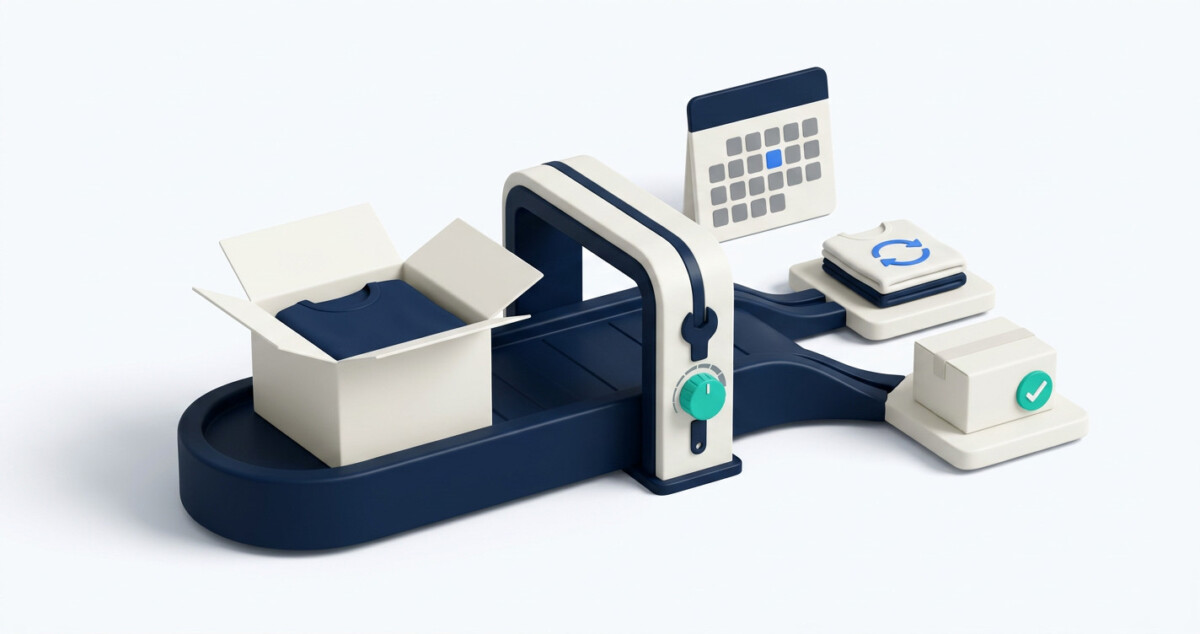
A $1M to $5M Shopify store can still ship two of Loop’s five pre-season return moves by October 23: a holiday return window and an exchange-first flow. Add a one-hour audit for Shopify Tax’s new US return shipping fee tax, and park the rest until January.
BFCM revenue is a headline. What you actually keep gets decided in January, at the return portal, by a choice you configure in October.
Retailers told the National Retail Federation they expect 17% of holiday sales to come back as returns, according to the 2025 Retail Returns Landscape report from NRF and Happy Returns. Applied to a $1M BFCM weekend, that rate puts roughly $170,000 of revenue still in play after the confetti settles. Whether it walks out the door as a refund or stays in your business as an exchange is not decided in January. The return flow you have live before the first Black Friday order ships decides it.
That is the argument at the center of a new Loop post, The BFCM Returns P&L: Exclusive 2026 Data from Loop, published October 5, 2026. Loop calls the post-holiday return period Q5, and its data comes from more than 5,000 merchants and 23.4 million returns processed on its platform. Loop is a returns vendor and a partner of this site, so I read its numbers as vendor network data, useful but not neutral.
Two things are missing from the conversation, though. The first is a Shopify Tax change on return shipping fees that takes effect on October 23, 2026, right before peak, and that Loop’s post doesn’t mention at all. The second is the question a $1M to $5M operator actually has: of everything recommended, what can I safely ship in the 17 days between October 6 and October 23, before my team should be freezing the stack?
Loop’s data says that offering an exchange first keeps materially more holiday revenue than leading with a refund or store credit. In its network, merchants running exchange-first flows retained 19% more return-driven revenue than the network overall. Exchanges converted at 24.5%, compared with 8.2% for store credit, and the average exchange through Shop Now (Loop’s feature that lets a shopper exchange for any product in the catalog, not just a different size) carried a $22 upsell on top of the original order.
The most interesting figure is about January itself. Loop reports that merchants who turned Shop Now on saw a 4.2-percentage-point lift in January retention, while merchants who left it off saw a 4.1-point drop over the same window. Loop describes this as a causal test. The post does not publish the method, the sample size for that comparison, or how retention is defined, so I would treat it as a strong directional signal rather than a forecast for your store.
Timing matters as much as the flow. Boxing Day was Loop’s highest volume return day on record last season, with 183,609 returns, up roughly 15% from 159,093 the year before. Retained revenue also swung by region: 38% in the US, 14% in the UK, and 52% in Australia and New Zealand.
These are Loop’s own merchants, who chose to pay for a returns platform, so they skew toward brands already taking returns seriously. Still, the direction matches the independent picture. The NRF and Happy Returns survey of 2,006 shoppers found that 76% are more likely to choose a return option that provides an instant refund or exchange. Shoppers will take the exchange if you make it the easy path.
Illustrative example, assuming $2M of Q4 revenue and the NRF’s 17% expected holiday return rate: about $340,000 of revenue comes back through returns. Every 10 points of that returned value you move from refund to exchange keeps roughly $34,000 in the business before any upsell, and before the cost of shipping the replacement. That is the size of the lever you are configuring this month.
Starting October 23, 2026, Shopify Tax will automatically calculate and charge sales tax on return shipping fees for US orders, the same way it already taxes outbound shipping. Shopify announced the change in its changelog post on September 25, 2026, and it applies to merchants in the United States using Shopify Tax or Tax Platform.
The details, per the Shopify Help Center section on tax for return fees, are narrower than the headline. Tax is calculated only when the order shipped to a US address, and only if shipping is taxable in the jurisdiction it shipped to. Your existing shipping tax settings stay as they are, so a state that does not tax shipping stays untaxed. Restocking fees are not taxed. Orders shipped outside the US, orders using a different tax service, and tax-exempt orders are excluded. When tax applies, it shows up alongside the return shipping fee when the return is created and is included in the return’s total tax and in your reports.
Why does a tax plumbing change belong in a BFCM returns article? Because the timing puts it in front of every holiday return you process. Any merchant who charges a flat return shipping fee, or deducts a label cost from refunds, will run every November, December, and January return through the new logic. Until now, Shopify notes, those fees may have shown up with $0 tax. If you sell into states that tax shipping, the customer’s deduction on a taxable return fee will now include tax, and your reports will show it.
Which states tax shipping varies widely; our state-by-state guide to ecommerce sales tax and shipping taxability lays out each state’s treatment.
If you do not run a manual workaround for tax on return shipping fees today, Shopify says no action is required. If you do, you need to review it before October 23 so you don’t double-count tax. That is the entire official instruction, and for most stores it will be a non-event. The work is confirming which bucket you are in.
A workaround can hide in a bookkeeper’s monthly reconciliation, a third-party tax tool, a journal entry pattern, or a returns app that adds its own tax line. Any of those will collide with Shopify Tax doing the same job from October 23 onward. Spend 30 minutes with whoever owns your sales tax filings and ask one question: do we calculate, collect, import, or reconcile tax on return shipping fees anywhere outside Shopify today?
There is one gap the official material does not answer. If a third-party returns app creates returns through Shopify and passes a return shipping fee into the return, the documentation doesn’t explicitly say how every app’s fees will be treated. Shopify’s community announcement of the return shipping tax update says the goal is to reduce the need for merchants or partners to calculate this tax manually, which suggests partner-created returns are in scope. I would not assume. Ask your returns vendor, in writing, whether their fees flow into Shopify’s return fee field and whether they currently add tax themselves.
Then run one test after October 23. Create a return on a test order shipped to a state that taxes shipping, apply a return shipping fee, and check the tax line on the return and in your reports. It takes ten minutes and is far cheaper than finding a double-counted tax line in January.
A $1M to $5M store can realistically ship two of Loop’s five moves before October 23, can partially ship a third, and should park the other two unless they are already in place. Loop’s five moves are: extend your return window for the holidays, turn on exchange-first flows, fund the safety net with Checkout+ (Loop’s optional, shopper-paid return coverage sold at checkout), route only flagged returns to manual review, and add self-serve order editing. Here is how I would sort them for a store with a small team and a code freeze coming in November.
The holiday window is the easiest win. Shopify’s native return rules already support custom windows and overrides, so this is a policy decision: pick a firm January end date for November and December orders, publish it everywhere a shopper looks, and make sure your returns tool enforces the same date.
The exchange first flow is the move with the most money attached, and it is shippable only on the tool you already run. Shopify’s admin supports native returns with exchange items, and most returns apps, including Loop, AfterShip Returns, and ReturnGO, let you put the exchange option ahead of the refund. Reorder the options, write clear copy, and test with your actual top ten products, including what happens when the exchange variant is out of stock.
Switching returns platforms, adding a new checkout fee, or installing a new order-editing app in the weeks before BFCM adds risk during the one period when you can least afford it. I would park all three unless they are already live and tested, and I’d say that only if each one has a real case behind it.
Take shopper paid return coverage first. Loop reports that Checkout+ adoption is up 418% year over year, and that roughly 58% of a typical Checkout+ merchant’s returns now come from orders where the shopper accepted it. Other vendors fund free returns differently; our Redo review covering its free returns portal and coverage model explains one alternative. The economics can be good. But it is a new line item at checkout, and checkout during BFCM is the worst place to discover how your shoppers react to one. If you want it, test it in January when a dip in conversion costs less.
Flagged returns review is the one I would partly ship. You do not need an AI fraud model to stop treating every return the same. Loop reports that 28% of returns over $800 in its network contain fraud signals, and the NRF and Happy Returns survey found retailers estimate 9% of all returns are fraudulent. A simple rule that sends high-value returns, repeat returners, and returns from new accounts to a human, while everyone else gets an instant label, captures most of the benefit. Our breakdown of the seven common types of retail return fraud is a good checklist for what those rules should catch. The more sophisticated scoring that vendors like Loop, Narvar, and Happy Returns sell is a January evaluation.
Self-serve order editing prevents returns before they exist by letting shoppers fix a size or address before the order ships. It also touches your order pipeline during peak, and if it breaks on Black Friday, the fix lands on your support team in your busiest week.
This is the pattern I worry about most at the $500K to $2M stage: premature complexity. The fastest way to lose money in Q4 is to install three new tools in October because a good article made each one sound urgent. Our four-week BFCM operations playbook makes the same case for a feature freeze in the final week before peak, and it applies as much to your returns stack as to your theme.
The right returns plan for this BFCM depends far more on what you already run than on what the best brands in Loop’s network do. Here is how I would think about it across the stages that matter for this piece.
If you are between $500K and $2M, you may be on Shopify’s native returns or an entry-level app with a small team. Do the holiday window, put exchanges first in whatever tool you have, run the tax workaround check, and stop there. Your biggest January risk is not missing a feature; it is support drowning in policy questions. Write your holiday policy in plain language and pre-write the five replies your team will send most.
If you are between $2M and $5M, you may already pay for a returns platform. The question is whether you are using what you pay for. It is common to buy a returns app for automation and never turn on the exchange incentives or routing rules. Spend your 17 days configuring and testing what is already installed, including the simple fraud rules. Our guide to building a Shopify returns workflow that protects margin with rules, exchanges, and store credit is a useful map for that configuration pass.
If you sell into the UK or Australia as well as the US, take Loop’s regional numbers seriously. A single return window and a single exchange incentive across all three markets will be wrong for at least one of them. At minimum, check that your return window end dates make sense against Boxing Day, which Loop’s data shows is the peak.
The returns moves you park this month should land on a January calendar, because January is when you have the best data you will get all year about how your returns actually behave. Your return reasons, exchange rate, fraud flags, and the support tickets your team answered over and over are all fresh, and the peak pressure is gone.
Loop argues that Q5 decides how much of BFCM you keep. Q5 is also the cheapest time to test what is too risky in October: shopper paid coverage, order editing, a platform switch, and smarter fraud scoring, each with a control period and a clear success measure.
When I think about what separates the brands that handled peak well from the ones that did not, from my years as a Senior Merchant Success Manager at Shopify, the difference was rarely the tool. It was whether the returns policy, the support replies, and the operational owner were decided before November. That is the real job for the next 17 days: decide, configure what you already have, check the tax plumbing, and leave the shiny additions for a quieter month.
Book a two-hour returns review for the second week of January now. Bring the exchange rate, the top five return reasons, and the list of moves you parked. That meeting is where next year’s BFCM returns plan gets written.
Yes, starting October 23, 2026, Shopify Tax calculates tax on return shipping fees for orders shipped to a US address, the same way it taxes outbound shipping. It applies to merchants using Shopify Tax or Tax Platform, and tax is charged only where shipping is taxable in the destination jurisdiction, so states that do not tax shipping stay untaxed. Restocking fees are not taxed, and orders shipped outside the US, tax-exempt orders, and orders using a different tax service are excluded. The tax appears with the return shipping fee when the return is created and flows into your reports. If you do not use a manual workaround for this tax today, Shopify says no action is required.
Review and switch off the manual workaround before October 23, 2026, so tax is not counted twice once Shopify Tax starts doing it automatically. Workarounds can live in several places: a bookkeeper adding tax during reconciliation, a third-party tax tool, an accounting import, or a returns app that adds its own tax line. Ask whoever owns your sales tax filings whether you calculate, collect, import, or reconcile tax on return shipping fees anywhere outside Shopify. If you use a returns app, ask the vendor in writing how its fees flow into Shopify. After October 23, process one test return to a state that taxes shipping and confirm the tax line looks right.
Exchanges usually keep more revenue than refunds because the sale stays in your business instead of leaving. Loop’s network data, drawn from more than 5,000 merchants, shows merchants running exchange-first flows retained 19% more return-driven revenue than the network overall, and exchanges converted at 24.5% compared with 8.2% for store credit. Those numbers come from a returns vendor’s own customers, so treat them as directional rather than a promise for your store. Exchanges also carry costs: outbound shipping on the replacement, inventory you need in stock, and handling time. They work best when the shopper’s problem is fit or preference, not product quality.
Most stores extend the return window for holiday purchases so gifts opened late in December can still be returned, with a fixed end date in January. Shopify’s return rules support custom windows and per-product overrides, so you can set this without an app. The exact date matters less than consistency: publish it on your policy page, product pages, and order confirmation emails, and make sure your returns tool enforces the same date your policy states. Loop’s data shows returns peak on Boxing Day, so a window ending in mid to late January covers the bulk of gift returns. Avoid an open-ended or vague policy that support has to interpret case by case.
No, for most stores switching returns platforms in October is the wrong call, because peak season is the worst time to discover integration problems or a confusing new return flow. A better use of the weeks before BFCM is to configure what you already have: put exchanges ahead of refunds, set a clear holiday window, and add simple rules that send high-value or suspicious returns to manual review. If you are unhappy with your current tool, use January, when return data is fresh and pressure is low, to evaluate options such as Shopify’s native returns, Loop, AfterShip Returns, ReturnGO, Redo, Narvar, or Happy Returns, and plan the migration well before the next holiday season.
Retailers expect about 17% of holiday sales to be returned, according to the 2025 Retail Returns Landscape report from the National Retail Federation and Happy Returns, published in October 2025. The same report estimated that 19.3% of online sales would be returned across 2025 and that 9% of all returns are fraudulent. The figures come from two summer 2025 surveys: 2,006 consumers who had returned an online purchase and 358 ecommerce professionals at large US merchants. Your own rate depends heavily on category; apparel and footwear typically run far higher than consumables. Use your own last holiday season as the baseline, and the industry figure only as a sanity check.