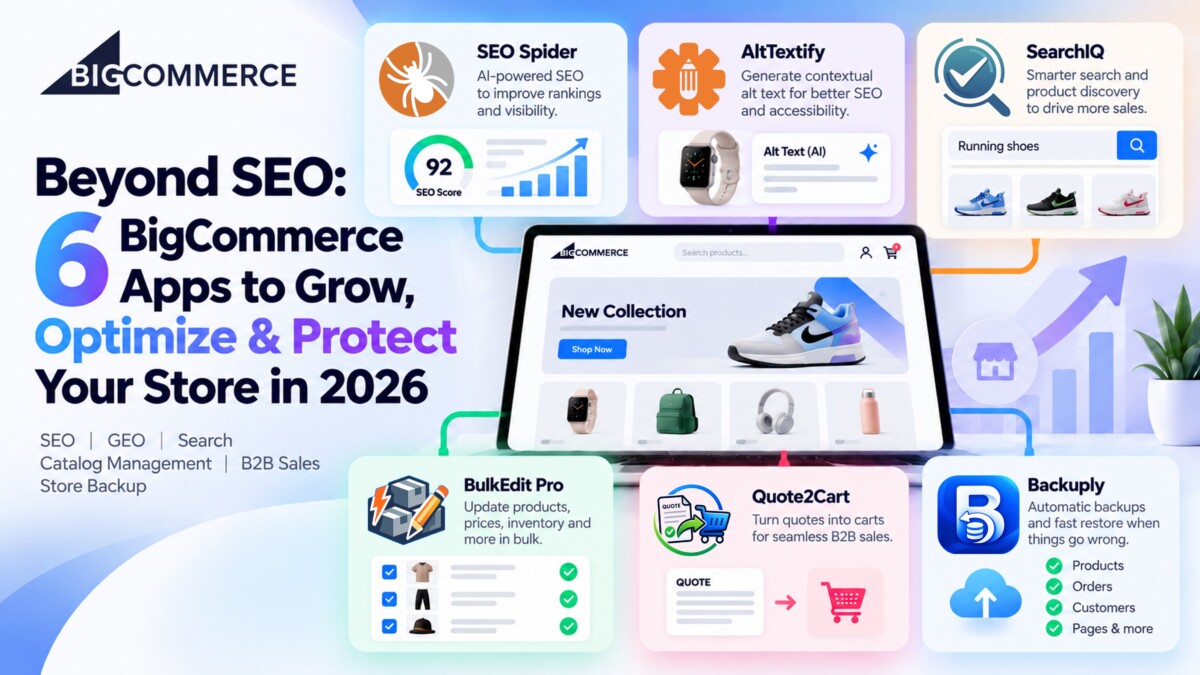
Six BigCommerce apps solve six different problems: SEO Spider for store wide SEO, AltTextify for alt text, SearchIQ for on site search, BulkEdit Pro for catalogue edits, Quote2Cart for B2B quotes, and Backuply for recovery. Install the one that matches your bottleneck, not all six.
The merchants who get the most out of an app marketplace are the ones who can name their bottleneck before they open it. The ones who get the least install six apps over a weekend and spend the next quarter untangling them.
A 400 product BigCommerce store and a 14,000 product BigCommerce store run on identical software and have almost nothing in common operationally. At 400 products, a merchant fixes a weak meta description by opening the product and typing a better one. At 14,000, the same instinct is a six week project nobody finishes, which is why most large catalogues carry thousands of pages that have never been optimised at all.
That gap is what the six apps below exist to close. Each one takes a job that is trivial at small scale and becomes structurally impossible somewhere between 1,000 and 10,000 SKUs: store wide SEO, image alt text, on site search, bulk catalogue editing, B2B quoting, and recovery when a bulk change goes wrong. They are listed alphabetically, not ranked, and this piece does not pick a winner. The value is in matching the app to the bottleneck, and the bottleneck depends entirely on your stage and your catalogue.
One note on why a BigCommerce roundup is sitting on a Shopify first publication. The six problems here are platform agnostic. Every growing catalogue hits all six eventually, and the sequence in which they hurt is the same regardless of what the store runs on. What differs is the ecosystem solving them, and reading another platform’s app shelf is one of the cheaper ways to pressure test your own. Shopify operators looking for the equivalents on their side of the fence can start with our roundups of top rated Shopify SEO apps for traffic and rankings and the broader app stack guide for growing Shopify brands, which makes the same argument this piece does about app count discipline. Nothing below is a recommendation to change platforms.
Four criteria were applied uniformly to every app on this list. One, the app is listed on the BigCommerce app marketplace with a price that could be read and verified in October 2026, which is also the pricing quoted in every section below. Two, it solves a problem that gets measurably worse as the catalogue grows, rather than one that costs the same at any size. Three, at least two real limitations can be named before a merchant installs it, which is the test that separates a tool from a pitch. Four, each app covers a distinct job, so no two entries are substantially interchangeable.
Two categories were considered and excluded. Google Shopping and marketplace feed apps were excluded because a feed problem is a channel problem rather than a catalogue problem, and including them would have made the list incomparable. BigCommerce’s own native SEO fields and built in search were treated as the baseline these apps are measured against rather than as entries, because they ship with the plan and are not apps.
AltTextify is a BigCommerce app that generates SEO and accessibility focused alt text for product images automatically, built for stores carrying more images than a person can realistically describe by hand.
AltTextify – AI Alt Text Generator does one job and does not pretend to do others. It reads your product images, combines what it sees with the product information surrounding each image, and writes alt text intended to satisfy both search engines and screen readers. The marketplace listing describes the output as SEO friendly and ADA compliant, with bulk processing, API access, and generation in more than 140 languages. The accessibility standard behind that output is the W3C Web Accessibility Initiative images tutorial, which separates informative images that need a description from decorative ones that should carry an empty alt attribute.
As of October 2026, the BigCommerce marketplace listing for AltTextify shows no upfront fee and no recurring fee. Treat that as the listing price rather than a guarantee: a free tier that becomes metered at volume is a planning risk worth resolving with the vendor before you build a workflow on it.
The strength that matters here is context, not recognition. An image model can tell you a photograph contains a blue sofa, which is not alt text a shopper or a crawler can use. AltTextify combines the image with the product title, category and page context, which is the difference between “blue sofa” and alt text that identifies the specific product. The second real strength is language breadth, which matters disproportionately for merchants running one catalogue across several markets. The third is that bulk processing plus API access makes an existing image backlog and all future uploads the same workflow rather than two.
Two limitations. Alt text generated from product data inherits whatever is wrong in your product data, so a catalogue full of titles like “Item 4471 Blue” produces alt text that faithfully says exactly that, at scale, forever. And it is a single purpose app. If your real problem is missing meta descriptions and oversized images as well as missing alt text, you are looking at the wrong entry on this list.
Best fit: BigCommerce stores with more than 2,000 product images, an accessibility obligation they need to document, or the same catalogue running across multiple language markets.
Skip if: You have fewer than 500 product images, or you already run a broader SEO suite that generates alt text as one of its functions, in which case you would be paying twice for the same field.
Backuply is a BigCommerce app that takes automatic backups of store data and restores it selectively, built for merchants who run bulk operations, imports or automations against a live catalogue.
Backuply – Store Backup & Restore runs scheduled backups in the background and keeps the copies in cloud storage separate from the live store, so recovery stays available when the production data is the thing that broke. The data it covers, per the marketplace listing, includes products and images, categories, brands, customers, orders, inventory, pages and redirects. Restores can be granular, meaning a single record or a selected set rather than a wholesale rollback, and the backup history lets a merchant look at what changed and when before deciding what to restore. The listing notes compatibility with Catalyst and Multi Storefront and a single click install.
As of October 2026, Backuply is listed at $9 per month with no upfront fee and a seven day free trial.
The strength worth paying for is granular, point in time restore. The difference between “we can restore yesterday” and “we can restore these 340 products to yesterday” is the difference between an afternoon of cleanup and a week of it, because a full rollback on a live store also rolls back the orders, inventory movements and price changes you wanted to keep. The second strength is simply that the copies live outside the store, which is what makes the backup a backup rather than a second copy of the same risk.
Two limitations, and they are the reason this app is listed as a precondition rather than an upgrade. A backup app does not prevent a bad change. It shortens the recovery, which is valuable and is not the same thing. And the marketplace listing does not state retention length or how long a restore takes at catalogue scale, which are precisely the two numbers that decide whether a backup is useful during an incident. Ask the vendor both before you rely on it.
Best fit: Any BigCommerce store above roughly 1,000 SKUs that runs bulk edits, scheduled imports, or app driven automation against the live catalogue. If you plan to install any of the operational apps on this list, install this one first.
Skip if: Your catalogue changes rarely, or an agency, ERP or PIM already holds the authoritative copy of your product data and can repopulate the store from it.
BulkEdit Pro is a BigCommerce app for editing large numbers of products at once, built for merchants whose catalogue has grown past the point where opening individual product records is a realistic way to change anything.
BulkEdit Pro – Powerful Bulk Editing With Full Rollback Control applies changes across hundreds or thousands of products in a single operation. Per the marketplace listing it covers pricing, inventory, SEO fields, categories, product attributes, variants and options, product type and product status, and it adds text find and replace, attribute cloning, image gallery management and shipping method changes. The listing’s framing is “Edit boldly. Revert instantly,” and the mechanism behind that is an operation log: every bulk change is tracked and can be reverted, which is the feature the product name leads with.
As of October 2026, BulkEdit Pro is listed at $5.99 per month with no upfront fee.
Three strengths stand out. Rollback at the operation level is the one that changes behaviour, because it lowers the cost of trying a change rather than only the cost of fixing one. Find and replace across text fields is the quietly useful one: a brand rename, a discontinued material, or a spelling that propagated through 4,000 descriptions is a two minute job rather than a quarter. And variant and option editing is where most bulk tools stop, which matters because variants are where SKU counts actually explode.
Two limitations that merchants consistently underestimate. Rollback restores the field you changed, not the consequences of having changed it: reverting a price does not un send the price drop email your marketing automation already fired, and does not recall the feed update that already reached Google Shopping. Second, a bulk editor makes a mistake faster rather than smaller. The discipline that protects you is running every operation against a filtered subset of 20 products first, and that discipline is yours to supply, not the app’s.
Best fit: BigCommerce stores above roughly 1,000 SKUs doing seasonal repricing, catalogue reorganisation, inventory corrections, or large scale SEO field work.
Skip if: You are under 200 SKUs, or a PIM or ERP owns your product data and pushes it into BigCommerce, in which case editing in the storefront creates two sources of truth and the next sync overwrites your work.
Quote2Cart is a BigCommerce app that adds a structured quote request and negotiation workflow to the storefront, built for merchants whose buyers do not purchase at list price.
B2B Quote2Cart – Quotes to Orders lets a customer build a list of products while browsing and submit it as a quote request, or convert an existing cart into one. The merchant works the request from a central dashboard, adjusts quantities and pricing, and sends a professional quote by email or PDF carrying the negotiated figures. Requests route automatically to the right sales representative, merchants control which products are quotable at all, and an accepted quote converts back into a cart so the buyer finishes through normal checkout. That last step is what separates a quoting tool from a PDF generator.
As of October 2026, Quote2Cart is listed at $14.99 per month with no upfront fee and a seven day free trial. It is the most expensive app on this list and the only one that touches revenue directly rather than efficiency.
The strength is the closed loop. The workflow it replaces is a buyer emailing a spreadsheet, a rep rebuilding those line items by hand, and somebody retyping the agreed prices, which is where quantity and pricing errors enter. Rep routing is the second strength, and it is the difference between a quote queue and an inbox.
Two limitations. A quoting tool does not fix a pricing policy. If your discount logic lives in one rep’s head, the app formalises that improvisation rather than resolving it, making the inconsistency auditable rather than fixed. Second, it covers quoting and not the rest of B2B. Company accounts, payment terms and tax exemption handling sit outside its scope, so a merchant with genuine wholesale operations is still buying or building those. Shopify positions those pieces as native B2B features including company profiles, custom catalogs and volume pricing, with quoting notably absent, so neither platform hands a merchant the whole workflow in one place. Our step by step guide to adding wholesale sales covers the groundwork that has to exist before a quoting tool earns its keep.
Best fit: Wholesalers, distributors, manufacturers, and any merchant selling configurable or higher value products where negotiated pricing is the norm rather than the exception.
Skip if: You sell retail only, or your average order value is low enough that a quote cycle costs more in rep time than the order returns in margin.
SearchIQ is a BigCommerce app that replaces native store search with instant search, filtering, merchandising controls and search analytics, built for catalogues large enough that browsing categories has stopped working.
Smart Store Search & Merchandising by SearchIQ surfaces relevant products, categories and suggestions as a shopper types, handles typos and synonyms so the words shoppers use find the words your catalogue uses, and adds filtering by category, attribute, brand and price. On top of that sit merchandising controls to pin, prioritise, reorder or hide products for specific queries, a Featured Deals capability for surfacing promotions inside search, popular search suggestions, and reporting on search behaviour. A shopper on a 50 product store navigates categories. A shopper on a 10,000 product store expects the search box to understand them first time, and Baymard Institute’s benchmark of 344 major US and European ecommerce sites found search usability underperforming across the board.
As of October 2026, SearchIQ is listed at $5 per month with no upfront fee and a 14 day free trial.
The most valuable feature is the least glamorous one: the no results report. Every search that returned nothing is simultaneously a demand signal and a catalogue gap, and it is the only report on this list that tells you something about your business you could not have learned any other way. Merchandising control is the second strength, because search results do not have to be whatever the algorithm decides. The third is Featured Deals, which turns the search box into a promotional surface at the moment purchase intent is highest.
Two limitations. Better search surfaces catalogue problems rather than solving them: if half your products carry thin titles and no attributes, a smarter engine will fail to find them more efficiently. And merchandising controls are a standing commitment rather than a setup task. Stores without a named owner for search merchandising drift back to algorithmic defaults within a quarter, paying for a feature they stopped using. Shopify merchants comparing options have Shopify’s own free Search and Discovery app, which covers filters, synonyms and product boosting but carried a 2.7 out of 5 rating across 506 reviews as of October 2026. Our guide to on site search tools covers the third party alternatives there.
Best fit: BigCommerce stores above roughly 1,000 products with measurable site search volume and someone whose job includes looking at it.
Skip if: You are under 200 products, or your store receives fewer than a few hundred site searches a month, in which case there is not yet enough signal to optimise against.
SEO Spider is a BigCommerce app that audits a whole store for SEO problems and then fixes them at scale, built for merchants with large catalogues and no dedicated SEO resource.
SEO Spider – AI SEO Optimizer is the broadest app on this list. It starts with a store wide audit across products, categories and pages, which turns a vague sense that SEO needs attention into a prioritised list of missing meta descriptions, weak titles, absent alt text and indexing problems. It then acts on that list: AI generated titles and meta descriptions built from actual product and page content, bulk optimisation, reusable templates, and an Auto SEO function that keeps optimising new catalogue content as it is added. Image compression, resizing, filename optimisation and contextual alt text sit in the same workflow, and keyword rank tracking plus competitor monitoring close the loop. Google’s own image SEO guidance is blunt about why that half matters: images are often the largest contributor to overall page size.
As of October 2026, SEO Spider is listed at $6 per month with no upfront fee.
Its real differentiator is the AI discovery layer. The app supports the IndexNow Protocol, which notifies participating search engines the moment a store URL is added, changed or removed instead of waiting for a crawl, and it generates LLMs.txt and LLMs-full.txt files intended to make store content easier for AI systems to parse. Worth being precise here, because the marketing around IndexNow usually is not: indexnow.org currently lists five participating engines, Microsoft Bing, Naver, Seznam.cz, Yandex and Yep. Google is not among them. IndexNow is cheap and worth having, and it is not a Google indexing shortcut. Our GEO playbook on optimising for AI discovery makes the fuller case that clean structured product data does more for AI visibility than any file you can generate.
Three limitations. The first is overlap: SEO Spider generates contextual alt text, which means running it alongside AltTextify is paying twice for the same field, and its bulk SEO editing partly duplicates BulkEdit Pro. Second, AI generated metadata inherits the quality of your product data: at scale you get consistency, not the title a human who understands the product would have written. Third, LLMs.txt is an emerging convention with no committed support from the major AI vendors, so treat it as cheap insurance rather than a distribution channel you can plan revenue around.
Best fit: BigCommerce stores above roughly 1,000 SKUs with no in house SEO specialist, where the realistic alternative to automated optimisation is no optimisation.
Skip if: An agency or in house specialist already owns your metadata, or your catalogue is small enough that a focused afternoon would fix it properly by hand.
The right first app is the one that matches your current bottleneck, and the bottleneck moves predictably with catalogue size and business model. Here is how the six map onto four common situations.
If you are under $500K with 200 to 1,000 SKUs, pick exactly one. SEO Spider is usually the answer at this stage because it covers the widest surface for $6 per month and most stores at this size have more unoptimised pages than unfindable products. If your analytics already show meaningful site search volume, SearchIQ at $5 per month is the better first move, because search intent is the highest value traffic you already have.
If you are between $500K and $2M with 1,000 to 10,000 SKUs, this is where the pattern worth naming shows up. Stores at this stage fail from premature complexity far more often than from missing capability. Install Backuply first, then one operational app, and give that app a full quarter before adding another. The sequencing is not about cost. All six apps at list price as of October 2026 total $40.98 per month, which is less than a single hour of agency time, and that is exactly the problem: the price will never be the reason to say no, so the decision has to be made on attention instead.
If you are above $2M and any part of your revenue is wholesale, Quote2Cart is the only app here that affects revenue rather than efficiency. A quote cycle that takes three days instead of three hours loses orders, and that loss does not appear in any dashboard. Fix it before you optimise metadata.
If you have an accessibility obligation to document, or you run one catalogue across several language markets, AltTextify is the targeted answer and the only one of the six with no recurring fee on its listing.
The honest trade off runs between the focused app and the suite. SEO Spider overlaps AltTextify on alt text and partly overlaps BulkEdit Pro on bulk SEO fields. The focused app wins when the job really is the only job and you want the better implementation of it. The suite wins when you have three of these jobs, one person, and a realistic chance of actually using one login rather than three. Neither answer is universally right, which is why this list is unranked.
There is no best BigCommerce app in this category, which is why nothing above is ranked or labelled a top pick. All six earn their place against a real problem, and the problems arrive in a different order for every store. What does generalise is the sequencing discipline: name the bottleneck from your own data before you open the marketplace, install one app, measure whether the bottleneck moved, and only then consider the next one.
The merchants who come out of this well are the ones who can finish the sentence “the thing slowing us down right now is” without hedging. If you cannot finish it, the next useful step is not an app. It is 45 minutes with your site search report, your product data, and an honest count of how many pages in your catalogue have never been touched since the day they were created. The answer to that audit will point at one of the six above, and one is the right number to install this month.
There is no single best BigCommerce SEO app, because the right choice depends on what is actually broken in your store. For merchants with large catalogues and no dedicated SEO resource, SEO Spider covers the widest surface area at $6 per month as of October 2026, handling store wide auditing, AI generated titles and meta descriptions, bulk optimisation, image compression and contextual alt text in one place. For merchants whose only real gap is missing alt text across thousands of images, a focused app like AltTextify is the better fit and shows no recurring fee on its marketplace listing. If an agency already owns your metadata, neither is worth installing. Audit first, then choose.
The six apps covered here range from no listed recurring fee to $14.99 per month as of October 2026, and all six together total $40.98 per month at list price. Specifically: AltTextify shows no recurring fee on its listing, SearchIQ is $5 per month, BulkEdit Pro is $5.99 per month, SEO Spider is $6 per month, Backuply is $9 per month, and Quote2Cart is $14.99 per month. None carries an upfront fee. SearchIQ offers a 14 day free trial, while Backuply and Quote2Cart each offer seven days. Because the prices are this low, cost is rarely the constraint on app selection. Attention and operational complexity are.
AltTextify does one job and SEO Spider does many, including that job. AltTextify generates SEO and accessibility focused alt text for product images in more than 140 languages, with bulk processing and API access, and nothing else. SEO Spider audits an entire store for SEO problems and then fixes them at scale: titles, meta descriptions, bulk optimisation, templates, image compression, contextual alt text, keyword rank tracking, IndexNow support and LLMs.txt generation. The practical consequence is that running both means paying twice for alt text generation. Choose AltTextify if alt text is genuinely your only gap and you want the specialist. Choose SEO Spider if you have three or more SEO problems and one person to solve them.
No. IndexNow does not include Google among its participating search engines. The protocol’s own site at indexnow.org lists five participants: Microsoft Bing, Naver, Seznam.cz, Yandex and Yep. IndexNow works by notifying those engines immediately when a URL is added, updated or deleted, so changes reflect in their results without waiting for a scheduled crawl. That is genuinely useful for a store publishing or retiring products continuously, and it is not a substitute for Google indexing, which still runs on crawling and sitemaps. Any app that markets IndexNow support as a way to get into Google faster is overstating what the protocol does. Treat it as coverage for the engines that participate.
Hosting protects you against infrastructure failure, not against your own changes, which is the risk a backup app addresses. BigCommerce keeps your store running. It does not restore the 2,400 product descriptions a failed import overwrote on Tuesday, or the category structure a bulk operation flattened. Backuply, at $9 per month as of October 2026, takes scheduled backups of products, images, categories, brands, customers, orders, inventory, pages and redirects, keeps them in cloud storage separate from the live store, and restores selectively rather than all at once. If you never run bulk edits, imports or automations against your live catalogue, you can reasonably skip it. If you do, install it before the tool that makes those changes.
Switch when a single field change across your catalogue takes more than about an hour, which for most stores lands somewhere between 500 and 1,000 SKUs. The clearer signal is behavioural rather than numerical: if you have started avoiding catalogue wide improvements because of how long they would take, the cost of manual editing has already exceeded the cost of the app. BulkEdit Pro is listed at $5.99 per month as of October 2026 and covers pricing, inventory, SEO fields, categories, attributes, variants and product status with operation level rollback. The one exception is a store whose product data lives in a PIM or ERP, where storefront bulk editing creates a second source of truth that the next sync will overwrite.