

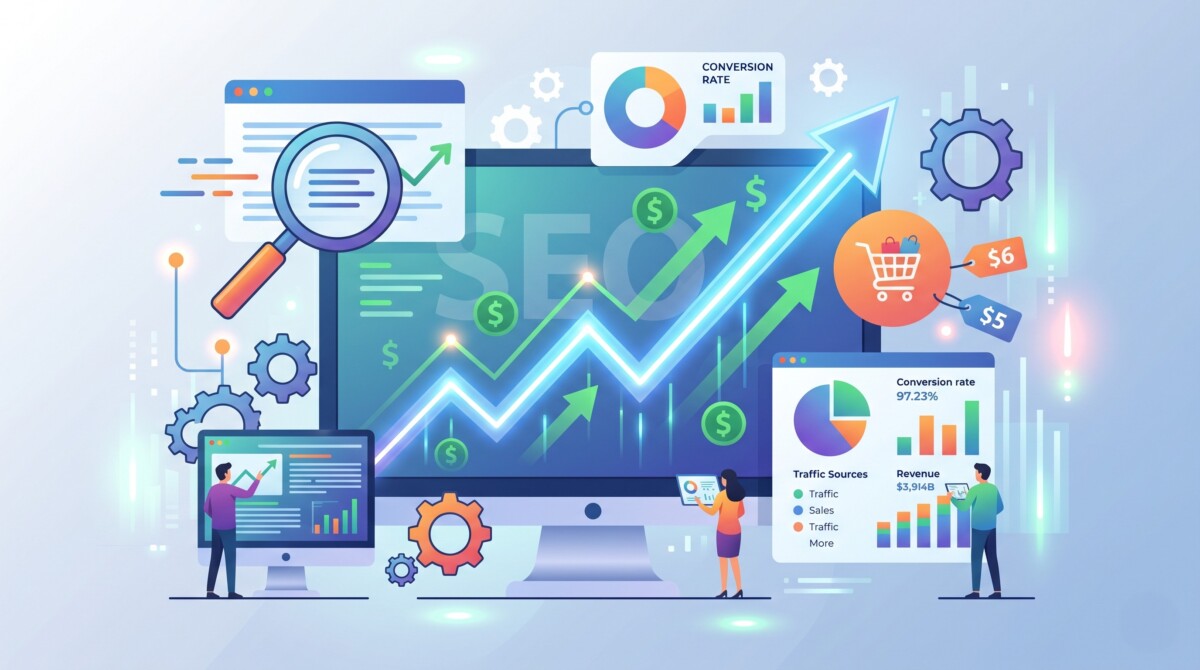
For most ecommerce brands, the strongest growth comes from pairing revenue-focused SEO with disciplined analytics, so you can attract high-intent organic traffic and then use data to continuously improve conversion and customer experience.
Organic traffic only becomes a growth engine when your SEO targets commercial intent and your analytics tell you exactly where that traffic converts, stalls, or leaks out of the funnel.
In today’s highly competitive e-commerce landscape, attracting visitors to an online store is only half the battle. It’s equally important to drive qualified traffic, understand customer behaviour, and continuously optimise the shopping experience.
While PPC can deliver immediate results, sustainable long-term growth often comes from SEO and data-driven analytics.
Successful e-commerce brands understand that SEO and analytics need to be combined to create a powerful framework for attracting high-intent customers, improving conversion rates, and maximising your ROI.
Organic search remains one of the most valuable acquisition channels for e-commerce businesses. Unlike paid campaigns, which stop generating traffic when budgets are paused, strong organic visibility can continue driving visitors and sales for months or even years.
Consumers frequently turn to search engines during the buying process to research products, compare options, and look for specific solutions. This makes appearing prominently in search results essential.
However, modern e-commerce SEO extends far beyond keyword placement. Search engines increasingly prioritise user experience, content quality, site performance, and relevance.
If you need help implementing your SEO strategy, experts such as Maratopia can help you on the path to success.
One of the biggest mistakes e-commerce businesses make is focusing exclusively on high-volume keywords, however despite generating traffic, this traffic doesn’t always lead to sales.
Revenue-focused SEO strategies prioritise commercial-intent keywords, product-specific searches, and comparison queries.
By identifying and targeting these valuable search opportunities, businesses can attract visitors who are much closer to making a purchase decision.
SEO brings visitors to a website, but analytics reveals what happens after they arrive.
Modern analytics platforms, such as Google Analytics, provide e-commerce businesses with valuable insights into user behaviour, customer journeys, and conversion performance.
Key metrics such as bounce rates, session duration, product engagement, cart abandonment rates, and conversion paths help identify opportunities for improvement.
When businesses consistently analyse these insights, they can make informed decisions that directly impact revenue.
The most successful e-commerce brands use analytics to guide and refine their SEO efforts.
By reviewing performance data, marketers can identify which landing pages generate the highest revenue, which keywords attract the most valuable customers, and where users encounter friction during the buying process.
This information allows businesses to focus their SEO resources on pages and opportunities with the greatest potential impact. Rather than chasing rankings alone, they can prioritise strategies that contribute directly to revenue growth.
Technical performance has become an increasingly important factor in e-commerce success.
Slow-loading pages, broken links, duplicate content, and poor mobile experiences can negatively affect both search visibility and user engagement. In fact, with 92% of internet users browsing from a mobile device, mobile first has become more important than ever.
Regular technical audits help businesses identify and resolve problems before they impact performance, and many e-commerce companies work with specialist providers to ensure their websites meet modern SEO standards.
Have you seen a boost to your brand with the help of data-driven SEO? Share your tips and tricks in the comments below!
Organic search is still important alongside PPC because it creates a sustainable traffic channel that keeps working when ad budgets pause, while also capturing research-driven and high-intent queries over the long term.
Commercial-intent keywords for ecommerce are search terms that show a strong buying signal, such as product names, “buy” or “shop” phrases, comparison queries, and queries that include brand or model details close to a purchase decision.
Ecommerce brands should monitor bounce rate, session duration, product views, add-to-cart rate, cart abandonment, and conversion rate by channel and landing page to understand where their funnel is working or leaking.
You can use analytics to improve SEO by identifying which landing pages and keywords drive the highest revenue, then prioritising optimisation and content expansion around those pages instead of chasing rankings that only generate low-value traffic.
Technical SEO is critical for ecommerce sites because site speed, crawlability, clean architecture, and mobile usability influence both search rankings and user experience, which together determine how much organic traffic converts into revenue.




