

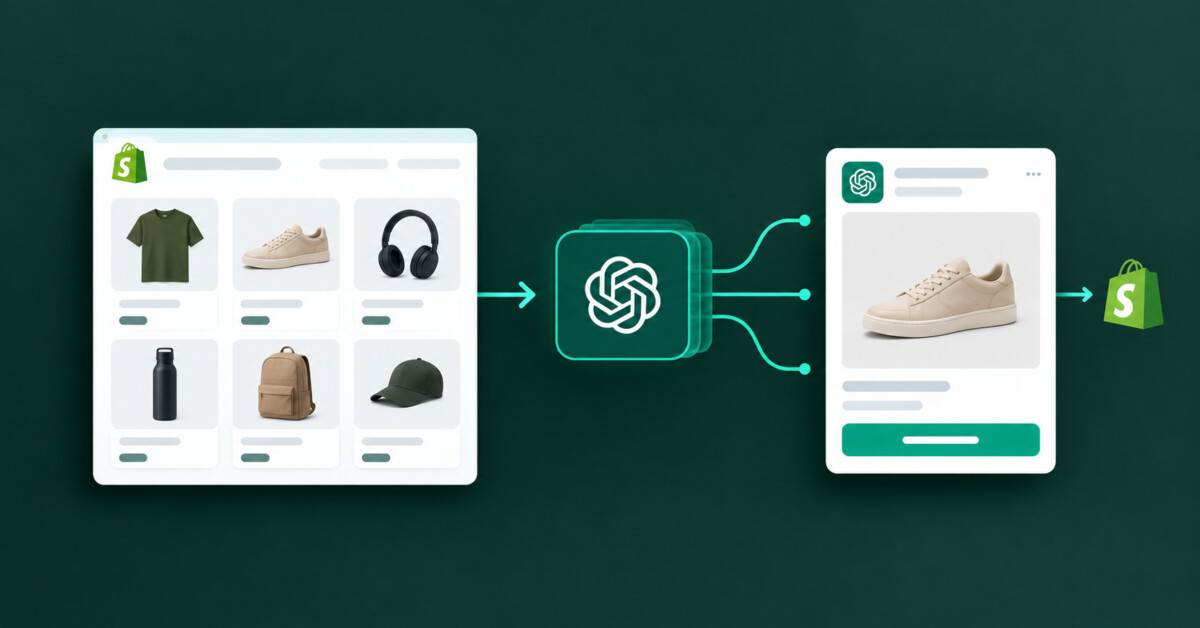
ChatGPT Ads gives Shopify merchants paid placement inside AI answers, but the catalog that feeds the ad is the same catalog that feeds the free citation. Above $500K, fix the product data first, then buy the click.
Shopify’s own number is the one worth sitting with. Conversion from AI powered search runs twice as high as conversion from scraped data. The ad does not move that multiple. Your product copy does.
Shopify reported in August that AI driven traffic and orders to its stores each tripled year over year in the second quarter of 2026. Buried in the same set of numbers was a detail that got far less attention than the growth rate: conversion from AI powered search runs about twice as high as conversion from scraped data, and roughly 80% higher than traditional organic search. That is not a statement about AI. It is a statement about the difference between a machine reading structured product data and a machine guessing from a web page.
On September 16, OpenAI put a buy button on top of that system. The announcement covered three things: a ChatGPT Ads app in the Shopify App Store for US merchants, natural language campaign creation through an Ads Manager plugin, and a closed test of Sponsored Agents, where a shopper who clicks an ad opens a conversation with a business sponsored agent before ever reaching the store. International availability opens September 23.
Every agency newsletter this week will tell you to go test it. Most of them will be right, and most of them will skip the part that decides whether the test tells you anything. If you are doing $500K to $10M and you have been putting off the product data work since the spring, this is the week that decision starts costing you money in two places at once.
OpenAI shipped one thing you can buy today and one thing you cannot. The buyable part is the ChatGPT Ads app in the Shopify App Store, which is free to install, published by OpenAI, and quietly went live on September 3 before the announcement caught up with it on the 16th. It connects or creates a ChatGPT Ads account from inside your Shopify admin, syncs your product inventory automatically, installs a Shopify server pixel for conversion tracking, and lets you build campaigns without leaving the admin.
The part you cannot buy is Sponsored Agents. That is a test running with selected US advertisers, and OpenAI published no pricing, no performance data, and no measurement methodology alongside it. Treat it as a signal about direction rather than a channel. Anyone selling you a Sponsored Agents strategy this month is selling you a press release.
The Ads Manager itself is not new. OpenAI dropped its previous $50,000 and $200,000 minimums when the self serve beta opened on May 5, 2026, so any approved US advertiser has been able to run campaigns with whatever budget they felt like risking for four months. What changed on September 16 is the distance between your Shopify catalog and a live campaign, which went from a feed integration project to an app install.
That distance collapsing is the actual news. It is also the reason this lands differently than the protocol announcements that have arrived roughly monthly all year. Those asked you to build something. This one asks you to spend something, which is a much easier yes, and a much easier way to spend badly.
Your paid placement and your free citation are both fed by the same product data, which means improving that data raises both and neglecting it caps both. The ChatGPT Ads app does not build a separate ad feed. It syncs the product inventory already sitting in your Shopify admin, the same inventory that Shopify Catalog syndicates to AI platforms for organic discovery.
This is where the industry’s two year sales pitch quietly reverses on itself. For most of 2025 and 2026 the entire generative search category sold merchants on earning the citation, and the implicit promise was that good data would get you found for free. That promise still holds. What just arrived alongside it is a second, faster route to the same shelf, priced per click. The reason to care is not that one replaces the other. It is that both are reading the same file.
I wrote in the ChatGPT shopping index breakdown two weeks ago that on most Shopify themes, the snippet an AI grounds its answer on is a breadcrumb, a vendor name, and a star widget. Nothing about buying a click changes that. The ad gets the shopper into the conversation. The catalog decides what the model can say about you once they are in it.
Shopify’s own guidance on what makes product data agentic ready names four attributes that matter: parent and child variant grouping so an agent understands options, taxonomy specificity (“men’s insulated winter boots” rather than “footwear”), literal descriptive language instead of marketing copy, and real time pricing and inventory delivered by API rather than scraped. None of those four are things you can bid your way past.
Sponsored Agents relocate objection handling from your product page to your product data, which is a bigger shift than the ad format it arrives inside. In the current model, an ad earns a click and your landing page does the work: the sizing chart, the ingredient list, the shipping threshold, the comparison against the thing the shopper was also considering. In the Sponsored Agents model, the shopper asks those questions inside ChatGPT, and something answers before your site gets a turn.
Whatever answers is working from what your catalog says. If your product description is 40 words of brand voice and your attributes are inherited from a supplier spreadsheet, the agent is going to be vague in exactly the moment where vagueness loses the sale. If the shopper asks whether the boot fits a wide foot and the data does not say, the agent either hedges or moves on to a competitor whose data does say.
This is the same mechanism I described when Anthropic open sourced a working shopping agent two weeks ago and made the software free. The agent was never the expensive part. The catalog underneath it was, and still is. OpenAI charging for distribution to that agent does not change which half of the system is the bottleneck.
There is a real opportunity in here for anyone selling something that generates questions. Considered purchases with a genuine specification conversation, the kind where a good salesperson outperforms a good product page, are where a competent agent should earn its keep. Just be honest about whether your data can carry that conversation today, because the test will tell you either way and the ad spend is the tuition.
The published economics put ChatGPT Ads at roughly $3 to $5 per click on a clicks objective, against a default maximum bid of $60 per thousand impressions, with real world CPMs reported as low as $25. Those figures come from WebFX’s pricing analysis, citing Digiday reporting on observed rates, and they describe a relevance weighted second price auction, so what you actually pay depends on ad quality and conversation relevance rather than your ceiling alone.
Take the headline number at face value and it looks reasonable. A $4 click sits below most B2B Google costs and above Meta. But a cost per click is only half of a cost per acquisition, and the other half is the conversion rate, which is where Shopify’s 2x figure stops being a nice statistic and starts being a line in your model.
The logic behind that table is simple enough to check yourself. Two merchants bid the same $4 and win the same click. The one whose catalog carries real attributes converts at the structured data rate. The one whose catalog carries supplier titles converts closer to the scraped rate. Same click price, materially different cost per order, and the gap gets charged to the second merchant every single click for as long as the data stays broken. That is what paying twice looks like in practice.
Every impressive AI conversion figure in circulation this quarter was published by a company with a position in AI commerce, and that does not make them wrong, it makes them worth reading carefully. Shopify’s 2x and 80% figures came from its Q2 2026 results coverage, in a quarter where the company grew revenue 34% and had every reason to attribute that growth to AI. Harley Finkelstein described Shopify in the same breath as probably the most AI pilled company in the world, which is a useful piece of framing to hold while reading his numbers.
Adobe’s data points the same direction from a different vantage. Its 2026 Prime Day analysis found AI sourced traffic converting 40% better than non AI channels including paid search, email, and social, which is a full reversal from the prior year when AI traffic underperformed those channels by 23%. Adobe sells analytics, so it also benefits from the channel mattering. Two interested parties agreeing is stronger than one, and still not the same as independent verification.
What survives the scepticism is the direction and the mechanism, not the precise multiple. High intent shoppers arrive through AI surfaces having already done the comparison work, and they convert better than average because of the intent, not because of the pixel. That is worth planning around. The specific multiple is worth treating as directional, which is the same discipline I laid out in the piece on why AI commerce statistics contradict each other.
Run the catalog audit first, then a small test, and hold the two apart so you can tell which one moved. The sequence matters more than the speed, and there are ten weeks before Black Friday, which is enough for both if you start this week and not enough for either if you start in late October.
Export your top 20 revenue SKUs. For each one, check the four attributes Shopify names: is the variant grouping correct, is the product type specific rather than generic, does the description use literal language a machine can parse instead of brand voice, and is the inventory syncing in real time. That is a 90 minute job for most catalogs of that size and it costs nothing. If you want a broader diagnostic across the whole store rather than the top 20, that is what the AI visibility audit is for.
Then, if you are above $500K, install the app and run one campaign against those same 20 SKUs with a budget you would be comfortable writing off, somewhere around $300 to $500. Set a stop rule before you start. Two weeks is the minimum honest read, because a second price auction needs enough volume to settle.
The reason to test at small scale now rather than at real scale in November is that you are buying information, not revenue. The merchants who came out of the 2025 AI search shift ahead were not the ones who found the channel first. They were the ones whose product data was in shape when the channel found them.
If you are under $500K a year, the correct move is to ignore ChatGPT Ads entirely this quarter and spend the equivalent hours on your product titles. This is not caution for its own sake. It is the same pattern I watched repeat across hundreds of merchant accounts in the $500K to $2M band, where the failure is almost never a missing channel and almost always premature complexity: another surface, another dashboard, another integration, layered on top of fundamentals nobody finished.
There is a second group who should sit it out, and it has nothing to do with revenue. If you cannot currently tell the difference between AI sourced traffic and direct traffic in your analytics, a ChatGPT Ads test will produce a number you cannot interpret and a conclusion you cannot trust. Fix the measurement, then buy the traffic. A campaign you cannot read is more expensive than no campaign, because it generates confident decisions from noise.
Ask the question that matters in eighteen months rather than this week. In eighteen months, will the merchants who win on AI surfaces be the ones who bid earliest, or the ones whose catalogs answered the question the shopper actually asked? Paid placement inside AI answers is going to be permanent and it is going to get more expensive as more advertisers arrive. The catalog work gets cheaper the earlier you do it, and it is the only input in this system that pays you back on the free side too.
ChatGPT Ads run roughly $3 to $5 per click on a clicks objective, with a default maximum bid of $60 per thousand impressions and observed CPMs reported as low as $25. There is no minimum spend, because OpenAI removed its previous $50,000 and $200,000 floors when the self serve Ads Manager beta opened on May 5, 2026. The auction is relevance weighted and second price, which means you generally pay just enough to beat the next highest bid rather than your full ceiling, and your effective cost depends on ad quality and how relevant your product is to the conversation. Budget $300 to $500 for a first test that produces a readable result.
Yes, functionally, because the ChatGPT Ads app syncs the same product inventory that Shopify Catalog syndicates to AI platforms. The app installs from the Shopify App Store and handles the connection automatically, so there is no separate feed to build. What this means in practice is that the quality of your product data determines both your organic visibility in AI answers and the performance of your paid campaigns. If your titles are generic, your variants are ungrouped, or your product types are broad rather than specific, you will carry that weakness into the paid channel and pay for it on every click.
Sponsored Agents let a shopper who clicks an ad open a conversation with a business sponsored agent inside ChatGPT, asking follow up questions before visiting the merchant’s website. As of September 2026 they are a closed test running with selected advertisers in the United States, and OpenAI has published no pricing, no performance data, and no measurement methodology. You cannot buy them today. The practical implication for merchants is directional rather than tactical: if agents will answer product questions on your behalf, your product data is about to do work your landing page used to do, which is worth preparing for now.
No. Under $500K a year, the hours are better spent on product titles, variant grouping, and attribute completeness than on any paid AI surface. The reason is mechanical rather than philosophical: paid placement buys attention into a system whose close rate is set by your catalog, so a merchant with weak product data pays the click price and absorbs the worse conversion rate at the same time. The failure pattern at this stage is almost always premature complexity, adding a channel before the fundamentals underneath it are finished. Fix the data first, which costs nothing, then revisit paid AI placement when you are above $500K.
International availability opens September 23, 2026, in markets where ChatGPT Ads already operates, which covers more than 40 countries. The Shopify App Store listing supports English only at launch. US based merchants have roughly a six day head start, which is short enough that it is not a real competitive advantage on its own but long enough to complete a catalog audit before the channel opens in your market. Non US merchants should use the window the same way a US merchant should use this week: export the top 20 revenue SKUs, check variant grouping and attribute specificity, and have the data ready before the spend is possible.




