

How tailored product discovery turns existing traffic into revenue.
Most ecommerce teams spend the back half of the year fighting for traffic. Paid channels cost more than they did a year ago, organic reach keeps tightening, and the visitors you do win are more distracted with shorter attention spans. This makes it critical to convert the shoppers that are already on your site. What’s holding them back? Is the experience they land on personalized for them or does it feel generic?
Hyper-personalizing the shopping experience is the highest-return lever most retailers have left. McKinsey found that personalization most often drives a 5 to 15 percent revenue lift, and that faster-growing companies pull 40 percent more of their revenue from it than slower-growing peers.1 Against a widely reported industry conversion rate of 2 to 3 percent, retailers that connect shoppers to the right products consistently convert in the double digits, and Athos customers regularly see conversion rates above 13 percent.
Can we add another product recommendation carousel? Sure. But it’s more about whether your on-site search, your product recommendations, and your follow-up email all recognize the individual shopper and respond in the moment. When they do, you sell more to the traffic you already paid for. When they don’t, you spend more to replace the shoppers who left because nothing on the page felt relevant.
A shopper decides whether your site is worth their time in the first few seconds on page. Google’s research with SOASTA found that as a mobile page’s load time grows from one second to ten, the probability that the visitor leaves rises by 123 percent.2 Attention is short and getting shorter, so a tailored experience is worth little if it arrives late. Relevance that shows up after the shopper has already scrolled past, or bounced, never had a chance to convert.
A lot of personalization fails right here. Producing a personalized result is compute-heavy, and if the system stops to think every time a shopper loads a page, the page slows down and the tailoring costs you the conversion it was meant to win.
Neil Lofgren, who leads personalization engineering at Athos Commerce, uses a self-driving-car analogy. A self-driving car cannot wait for a round trip to the cloud before it decides whether to brake. The same principle applies to a storefront. Athos does the heavy machine-learning work offline, enriching the product catalog and analyzing behavior in the background, then serves live personalization through refined algorithms that respond in under ten milliseconds. The shopper feels an experience that is relevant and instant, and never sees the work behind it.
Personalization is often treated as a single product recommendation carousel added near the bottom of a page. That view sells the idea short. A tailored experience is the entire visit responding to the individual: the order products appear in on-site search results, how a category page ranks its items, which banners load, and what a follow-up email highlights after the shopper leaves.
Shoppers now expect that level of attention. Twilio Segment reports that 62 percent of consumers say a brand will lose their loyalty if the experience is not personalized.3
One Athos capability shows how far this can go. Rather than fixing an email’s product recommendations at the moment it is sent, Athos inserts a placeholder and resolves the recommendation from the shopper’s most recent behavior at the moment they open the message. A shopper who browsed hiking boots an hour before opening the email sees boots, not last week’s guess. The experience follows the shopper instead of freezing at send time.
Three parts of the shopping experience do most of the work in turning a visit into a sale. Each is something your team can direct, and each gets sharper when AI handles the execution and your merchandisers set the direction.
When a shopper types into your on-site search bar, they are telling you exactly what they want. A generic search engine matches their words to product titles and returns a wall of loosely related items, or worse, a zero-results page. AI-powered search reads the intent behind the words, handles natural language and misspellings, and ranks results for the individual shopper. A returning customer who favors a particular brand or size sees those products first. Recovering dead-end searches alone returns revenue that most teams never realize they are losing, because a shopper who searches is far closer to buying than one who browses.
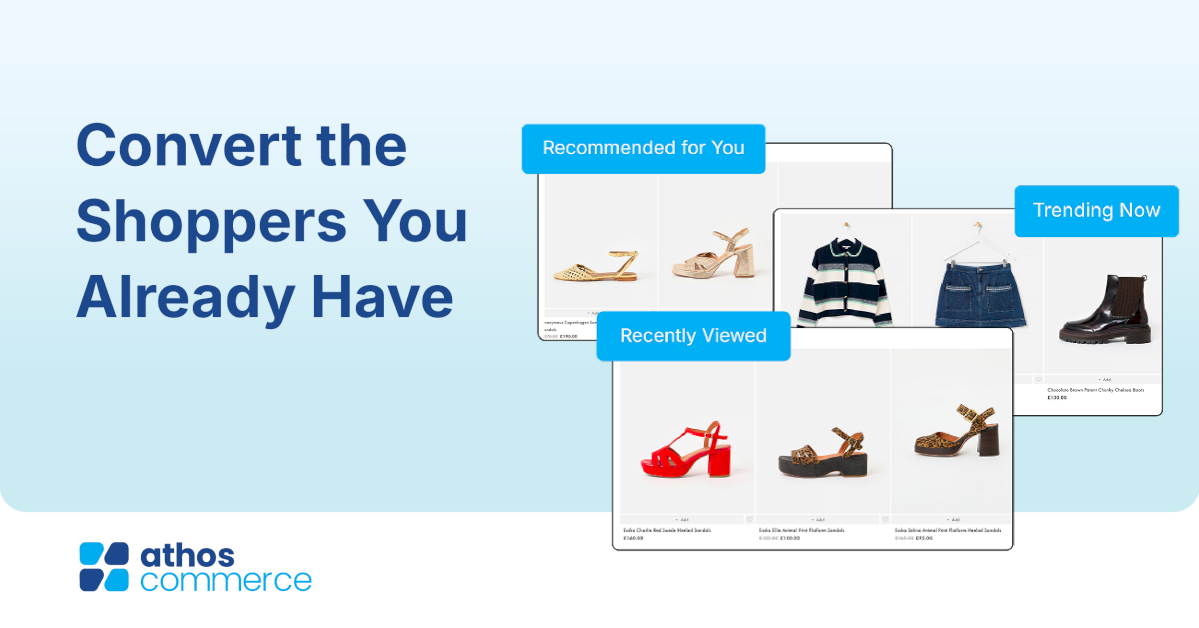
Recommendations are where tailoring becomes visible revenue. Instead of showing the same best sellers to everyone, one-to-one product recommendations draw on each shopper’s history, real-time behavior, and the patterns of similar shoppers to suggest what this person is most likely to want next. The revenue adds up. The fashion brand Aje generates roughly 10 percent of its revenue through Athos product recommendations.4
The most common worry about automation is that it takes the store away from the merchandiser. Built well, it does the opposite. Dynamic merchandising lets your team set the strategy, which products to feature, which margins to protect, and which collections to lead with, then lets AI handle the execution across thousands of products and every individual visit. Merchandisers move from hand-ranking products to setting the rules and running experiments. They keep full control of the strategy while software does the repetitive work.
The three levers are powerful on their own, but they compound only when they draw on the same understanding of the shopper and the same product data. This is where most retailers hit a wall. Their search comes from one vendor, recommendations from another, merchandising from a third, and email from a fourth. Each tool holds a partial picture, so the shopper gets four disconnected versions of your brand, and none of them learns from the others.
A unified platform closes that. When search, personalization, merchandising, and product feed management run on one enriched product catalog and one shopper profile, a signal captured in search improves the recommendations, and a behavior seen on a category page informs the next email. The experience stays consistent as the shopper moves from a Google listing to your site to their inbox. Athos was built around a single product data model for exactly this reason, so the whole journey is tailored by one connected system rather than four tools each personalizing their own slice.
You do not have to rebuild everything at once. The fastest returns come from finding where the experience is still generic and tailoring it first.
The common thread is that each of these works best when the tools share one product profile rather than acting in isolation. Running the levers on one platform also lets you attribute which tailoring decisions moved conversion, so the lift becomes a number you can prove rather than a claim you have to trust. Starting with a single connected platform, or a discovery audit of where your current setup leaves shoppers stranded, is the lowest-friction way in.
Shoppers reward the brands that make finding the right product effortless, and they leave the ones that make them work for it. Tailored product discovery, search that reads intent, recommendations built for the individual, and merchandising that adapts in real time, are how you earn that reward from the traffic you already have. Athos Commerce brings search, personalization, merchandising, and product feed management together in one intelligent discovery platform, so every shopper interaction becomes a chance to connect the right person to the right product and turn a visit into a sale.
A tailored shopping experience is one where a retailer’s on-site search, product recommendations, category pages, and email adapt to the individual shopper in real time rather than showing everyone the same thing. It draws on the shopper’s history, live behavior, and the patterns of similar shoppers to connect them with the products they are most likely to buy. The goal is to convert more of a store’s existing traffic by making every visit relevant.
Personalization improves ecommerce conversion rates by showing each shopper products that match their intent, which shortens the path from landing to purchase. McKinsey found that personalization most often drives a 5 to 15 percent revenue lift, and that faster-growing companies pull 40 percent more of their revenue from it. Against a widely reported industry conversion rate of 2 to 3 percent, retailers that connect shoppers to the right products often convert in the double digits.
It should not, if the personalization is engineered for speed. A slow page drives shoppers away, and bounce probability rises 123 percent as a mobile page’s load time grows from one to ten seconds, so real-time relevance has to be instant. Athos does the heavy machine-learning work offline to enrich the product catalog, then serves live personalization through refined algorithms that respond in under ten milliseconds, so the shopper gets a relevant page without a speed penalty.
Personalization decides what an individual shopper sees based on their behavior and intent. Merchandising is how a retail team sets the strategy for which products to promote, protect, or lead with. The two work together in a tailored experience: merchandisers set the rules and run experiments, and AI applies personalization to execute those rules across thousands of products and every individual visit. The team keeps control of strategy while software handles the repetitive work.
Start by auditing where the experience is still generic. Zero-result and low-result on-site searches are the highest-return fix, because a shopper who searches is close to buying and a dead end sends them away. Next, replace one-size product recommendations with one-to-one recommendations on high-traffic pages like the home page, cart, and product detail pages. Then move merchandising from manual ranking to rules and experiments. Each works best when the tools share one product profile rather than acting in isolation.





