MCP runs in two directions for Shopify merchants. The shopper-facing half is already enabled by default and requires almost nothing from you. The operator-facing half, connecting Klaviyo, Triple Whale, and Fairing to Claude or ChatGPT, is where merchants under $10M still have real leverage in 2026.
Most of the agentic commerce industry spent 2026 selling merchants readiness for a protocol their platform had already turned on. The half nobody sold them is the half they could have used on Monday morning.
In the first quarter of 2026, Shopify reported that AI-driven traffic to its stores grew eight times year over year, while orders from AI-powered searches grew close to thirteen times. New buyers arriving through AI channels placed orders at nearly twice the rate of buyers from other channels. Those are the platform’s own figures, and they are the reason a whole service category appeared almost overnight, promising to make your store agent-ready.
Here is what I keep running into when I actually look at what those engagements deliver. Most of them are selling merchants integration work that Shopify shipped for free, months earlier, and switched on without asking. Meanwhile, the same underlying protocol has a second use, pointed in the opposite direction, that almost nobody is talking to operators about.
This piece is about that second direction. If you want the full explainer on how the three shopping protocols relate to each other, I wrote a retailer’s guide to ACP, UCP, and MCP that covers the stack layer by layer. Read this one for the part that the guide does not cover: what MCP does for you rather than to you.
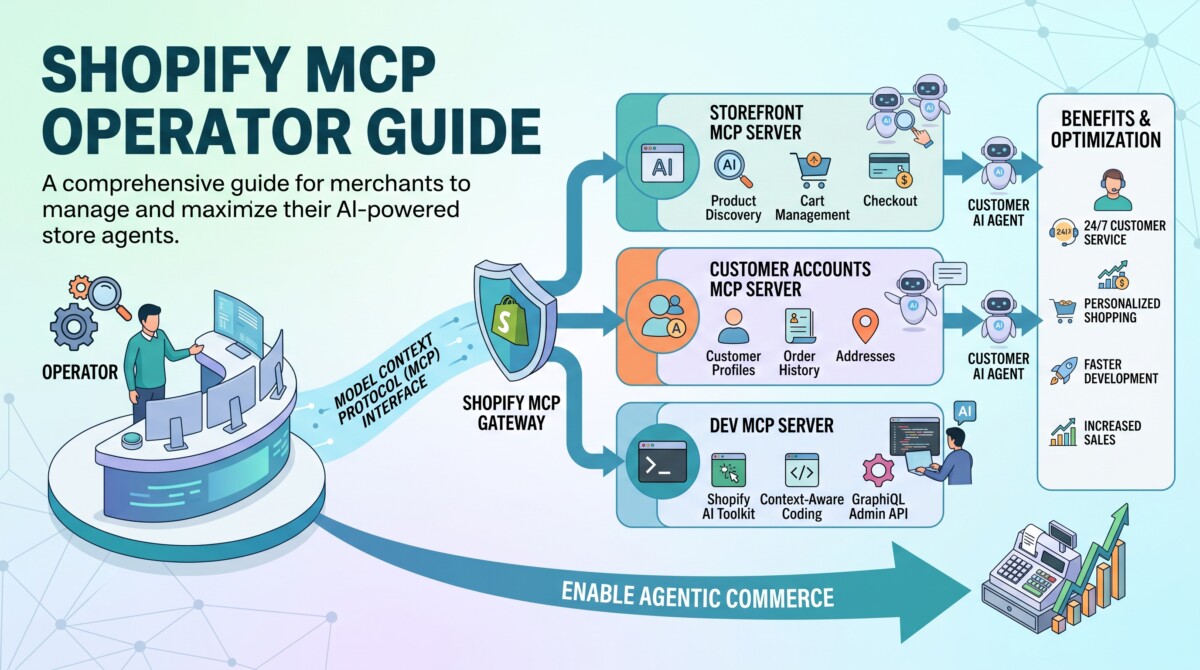
The Model Context Protocol is a two-way standard, and Shopify merchants are typically only shown the inbound direction. Inbound is an AI agent querying your store: ChatGPT asking your catalog whether you carry a waterproof boot in a wide 11. Outbound is you querying your own tools: asking Claude what your Klaviyo win-back flow earned last month against what those same customers said in your post-purchase survey.
Same protocol. Same open standard Anthropic released in late 2024. Completely different economics for a merchant doing $2M a year.
The inbound direction is a distribution channel you mostly cannot control. Whether an agent recommends you comes down to your product data, your policies, and your reviews, and the platform sits between you and the shopper. The outbound direction is a capability you own outright. Nobody ranks you. Nobody takes a percentage. You connect a tool you already pay for, and a question that used to take your analyst two hours takes ninety seconds.
I have watched this asymmetry play out before. When Shopify opened its API surface a decade ago, the conversation for two years was entirely about apps merchants could install. The operators who quietly got the most out of it were the ones who realized they could pull their own data out and ask better questions of it. The tooling layer got the attention. The operating layer got the compounding advantage.
The same split is live right now, and the outbound half has almost no competition for your attention because there is no vendor whose growth depends on selling it to you.
If you are on a paid Shopify plan, your store already has a live MCP endpoint and UCP support, and you did not enable either one. Shopify activated Agentic Storefronts by default for eligible US merchants in late March 2026. On June 17, 2026, the Spring ’26 Edition removed the approval gate on UCP entirely, so any developer can now register an agent profile and call the public endpoint against millions of merchant catalogs. Shopify Catalog handles the syndication. You configure nothing.
This matters because the readiness checklists circulating in 2026 mostly consist of items Shopify already handled. Publish a UCP manifest: done for you. Expose a catalog endpoint: done for you. Negotiate agent capabilities: done for you, and Shopify’s engineering team documented the architecture publicly if you want to see how the capability negotiation works.
One item on those checklists is real, and it is the only one worth your calendar time: your product data. A typical Shopify listing carries five to eight structured attributes. Agents filtering against a shopper’s stated constraints need considerably more before they will recommend you with confidence. That is a catalog problem, not a protocol problem, and I have covered it separately in why data hygiene is the single biggest lever in the age of AI.
So the honest inbound answer for a Shopify merchant in 2026 is short. Confirm Agentic Storefronts is active under Settings, then Sales channels. Spend your real effort on the attributes for your top twenty SKUs by revenue. Then stop, because there is nothing else on that side of the protocol you can buy your way into.
If you are on Adobe Commerce, Salesforce, or a headless build, none of the above applies and the integration work is genuinely yours to do. The rest of this article still applies exactly as written, because the outbound half is platform independent.
The most useful data point in agentic commerce so far is a product that got cancelled. OpenAI launched Instant Checkout inside ChatGPT on September 29, 2025, and pulled it in early March 2026, roughly five months later. Forrester analyst Emily Pfeiffer put the number of live Shopify merchants at around thirty as of February 2026, against a platform with millions of stores. Reporting from The Information put the figure closer to a dozen.
OpenAI’s own explanation was that the first version lacked the flexibility they wanted, so merchants would use their own checkout while OpenAI focused on product discovery. Multi-item carts never shipped. Sales tax remittance was never built. Inventory sync at catalog scale never worked reliably.
Two lessons come out of that, and only one of them gets repeated.
The recurring theme is that discovery is where AI creates value, and checkout stays on your storefront. That is correct, it is now the consensus architecture, and I wrote about the week it became obvious in the six announcements that all pointed the same direction.
The lesson nobody repeats is the one that should change how you allocate this quarter. Merchants who spent real engineering hours in late 2025 building against a specification with a live surface behind it got roughly five months of runway before that surface disappeared. The specification survived. The thing they built for did not. Being early to a protocol is not the same as being early to a market, and the merchants who came out ahead were the ones who spent that same period fixing product data, which paid off across every AI surface regardless of which one survived.
Apply that filter to anything you are being sold as protocol readiness right now. Ask what happens to the work if the surface it targets gets canceled. Catalog work survives. Endpoint work often does not.
The outbound half of MCP means connecting the tools you already pay for to Claude or ChatGPT so you can ask questions across them in plain English. This is not a future capability. The major ecommerce vendors shipped it during 2026 and most merchants have not noticed.
Klaviyo runs an official MCP server covering campaigns, flows, profiles, segments, and metrics, and in May 2026 expanded it across the Claude ecosystem including Cowork, adding direct access to the aggregate metric data that powers in-app reporting. Triple Whale ships a read-only MCP connection for ROAS, CAC, and channel performance, deliberately scoped so it can answer questions but never change anything. Gorgias exposes support ticket data. Fairing exposes post-purchase survey responses through six tools, and published a library of forty-four prompts organized by the decision the merchant is trying to make, which is the best example I have seen of a vendor teaching operators what to actually do with a connection.
Setup for most of these is a URL you paste into your AI client’s connector settings, then an OAuth approval. Twenty minutes for the first one, less for each after that. There is no engineering ticket and no middleware unless you want one.
Here is the part that makes it worth doing. Connecting one tool gives you a faster interface to your existing dashboard. Connecting three gives you answers that do not exist in any dashboard, because no single vendor holds both sides of the question. That is the whole return, and it only arrives at the second and third connection.
The questions worth asking are the ones that span systems, because those are the ones your current reporting structurally cannot answer. A single-tool question is a dashboard you already own. A cross-tool question is the thing you have been guessing at for two years.
The volume thresholds in that table are my working rules of thumb rather than published benchmarks, and I would treat them as a floor rather than a target. The logic behind them is simple. Once you slice a month of orders by discovery channel and then by first-time versus repeat, a store doing 200 orders is looking at cells with six responses in them. The model will still write you a confident paragraph about those six. That is the failure mode to design around, and it is the reason the thresholds exist at all.
The highest-value question in this category, for most Shopify brands I talk to, is the disagreement between stated and tracked attribution. Your survey says podcast. Your UTM says paid search. Both are partially right, and until those two data sets sit in one place you have been settling that argument with opinions. If you have already read how attribution breaks when there is no click to track, this is the same measurement gap approached from the tooling side.
Three things go wrong with operator MCP, and all three are avoidable if you decide about them before you connect anything rather than after.
The first is sample size, and it is the one that will actually cost you money. A language model asked to rank your five discovery channels by average order value will rank them, cheerfully, on eleven responses. It will not volunteer that the ranking is noise. Build the guardrail into the question itself: tell it to report the response count behind every segment and to flag any cell below thirty as unreliable. That single instruction changes the output more than any prompt engineering trick.
The second is write access. Start read-only on everything, without exception. Triple Whale ships read-only by design. Klaviyo lets you scope permissions. Shopify’s Admin API surface can create, edit, and delete real records, and there is no version of “the agent misread a variant” that you want happening against live inventory. Read-only for the first quarter is not caution, it is just correct sequencing, and you can widen the scope once you have watched the thing work.
The third is a governance question most merchants have not thought about. Connecting a tool routes your customer data through an AI provider. For most brands under $10M that is a documented processor relationship and nothing more, but if you sell into the EU, handle health-adjacent data, or have an enterprise customer with a vendor questionnaire, that connection belongs on your data map before it goes live. Twenty minutes with whoever handles your privacy policy, once, covers it.
None of this makes the capability risky. It makes it a decision rather than an accident, which is the difference between a tool you keep and a tool your ops lead quietly stops trusting after it gets one number badly wrong.
Your stage determines whether this is a priority or a distraction, and the honest answer for a meaningful share of readers is distraction. The pattern I have seen repeat for years is merchants at $500K to $2M adding capability before the foundation underneath it is solid, and this is a textbook opportunity to do exactly that.
If you are under $500K, close this tab and go fix your catalog. Nothing in the outbound half beats clean product data at your stage, and your order volume will not support the analysis anyway.
If you are between $500K and $2M, the discipline is picking one question and one pair of tools. Not a stack audit. One recurring question you currently answer with a spreadsheet, connected read-only, run weekly for a month. If it changes a decision, connect a third tool. If it does not, you have lost forty minutes and learned something real. The failure mode at your stage is connecting seven tools in an afternoon and never opening six of them again, which is the same premature complexity trap I described in why your store now has two customers.
Above $2M, the constraint shifts from setup to consistency. The value shows up when the same question runs the same way every Monday and you start seeing the trend rather than the snapshot. That is an operating habit, not a tool.
MCP, or the Model Context Protocol, is an open standard that lets AI assistants connect to external data sources and tools through one common interface instead of a custom integration for each pairing. Anthropic released it in late 2024 and Google, Microsoft, and OpenAI all adopted it. Your Shopify store has a Storefront MCP endpoint because Shopify deployed one to every store on the platform by default, no install required, so that AI shopping agents can query your catalog, cart, and policies directly. You did not turn it on and you cannot meaningfully turn it off. What you can control is the quality of the product data sitting behind it.
For the protocol layer, no, and this is the part most readiness checklists get wrong. Shopify activated Agentic Storefronts by default for eligible US merchants in March 2026, and UCP support ships with your plan. The real work is entirely on your product data. A typical listing carries five to eight structured attributes and agents filtering on shopper constraints need substantially more before they will recommend you confidently. Confirm Agentic Storefronts is live under Settings, then Sales channels, then spend your time adding materials, dimensions, compatibility, care instructions, and clear policy language to your top twenty products by revenue.
Both vendors run official MCP servers and connecting takes about twenty minutes with no developer involved. In Claude, open the connector settings, browse the connector directory or add a custom connector using the vendor’s published MCP URL, then approve the OAuth permissions. Klaviyo requires an Owner, Admin, or Manager role on the account, and the connector is available on paid Claude plans. Triple Whale offers OAuth as the preferred path and an API key method for tools that do not support OAuth. Start with read-only scopes on both, and connect the second tool before you judge whether the first was worth it, because the cross-system questions are where the value lives.
It is manageable if you make three decisions before connecting rather than after. First, use read-only scopes everywhere to start, because an agent misreading a variant against write access to live inventory is a real failure mode with no upside. Second, treat the AI provider as a data processor and add it to your data map, particularly if you sell into the EU or answer enterprise vendor questionnaires. Third, instruct the model to report sample sizes with every segmented answer, because the practical risk for most merchants is not a breach, it is acting confidently on eleven survey responses that the output presented as a trend.
OpenAI discontinued Instant Checkout in early March 2026, about five months after its September 2025 launch, after fewer than roughly thirty Shopify merchants ever went live with it. The company said the initial version lacked the flexibility it wanted and refocused on product discovery while merchants keep their own checkout. It changes your build priorities in one specific way: work that targets a single AI surface can disappear with that surface, while work on your catalog pays off across every surface regardless of which ones survive. Discovery in the assistant, purchase on your own store, is now the consensus architecture across Shopify, Google, and OpenAI.