

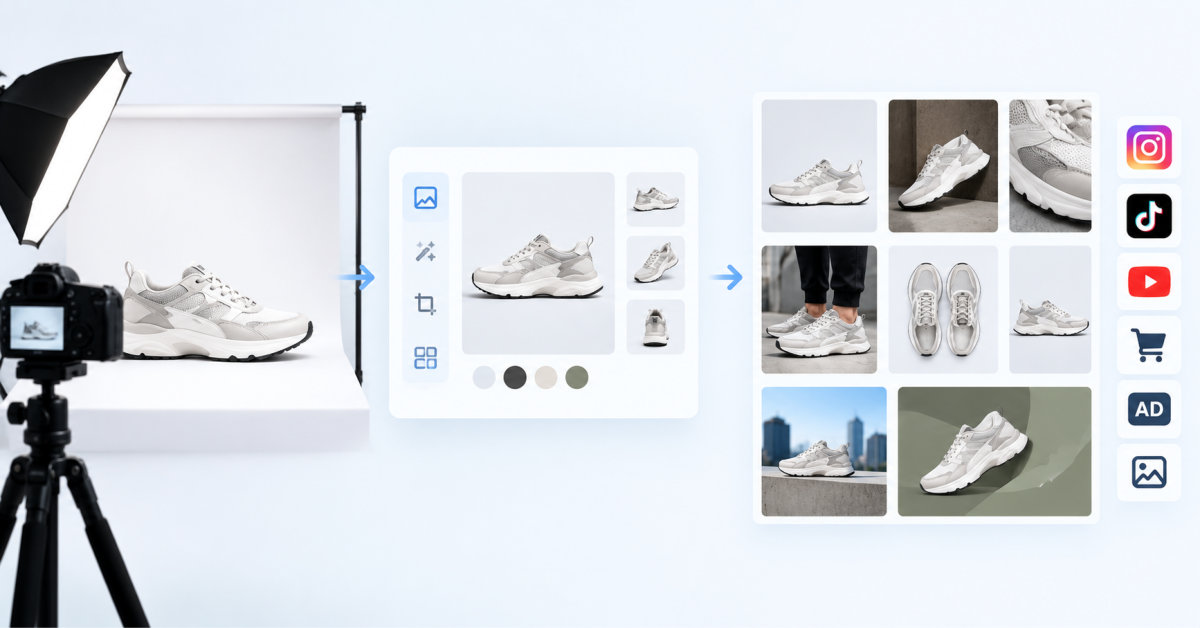
A reliable product-launch creative system starts with an approved photographic base set for every customer-visible truth, then produces channel-specific derivatives from those source frames without changing the product’s color, scale, features, fit, or functionality.
A product shoot is not a launch creative strategy. It is the source material for one.
Most merchants approach a product launch by booking a shoot. A photographer, a half day, a studio, and roughly fifteen usable images at the end of it.
Then the launch actually begins, and the fifteen images meet a demand they were never scoped against. The product page needs a gallery and a video. Paid social needs variants in three aspect ratios and several hooks. Email needs a banner and flow images. The marketplace listing has its own rules. Retention flows need something. By week two somebody is cropping a hero image to 9:16 and hoping nobody notices the product is now partially out of frame.
The problem is not the shoot. It is that a shoot produces assets while a launch consumes a system, and almost nobody counts the difference before committing the budget.
Here is the count, honestly done, and the structure that covers it without tripling your production budget.
Do this once for a single SKU and the rest of this article will feel obvious.
The product page needs a hero image, four to six gallery images covering front, back, detail, scale and in-use, a dimensions or specification graphic, and a product video. That is already eight to ten.
Paid social needs static variants in square, four-by-five and vertical, because cropping one file across three placements produces three compromised compositions. Assume four concepts across three ratios, which is twelve, plus three to six video hooks. Call it fifteen to eighteen.
Email needs a launch announcement banner, two or three images for the welcome and abandoned cart flows, and something for the post-purchase sequence. Five or six.
Organic social needs three to five feed posts, plus stories and short-form video that will not be the same cuts as the paid assets.
Marketplace listings have their own requirements entirely. Amazon expects a main image on pure white with the product filling most of the frame and no text, graphics or props, then a gallery, then A-plus content modules with their own dimensions.
Add retargeting variants carrying reviews or social proof, and seasonal versions if the product sells through Q4.
Sixty is a conservative total for a single SKU. Fifteen images does not cover it, and the gap gets filled by cropping, reusing, and quietly shipping worse work than you intended. Most merchants never do this count, which is why the shortfall arrives as a surprise every single launch.
Being clear about this first protects everything that follows, because the answer is not nothing.
Texture and material need photographing. Fabric weave, grain, finish, the way light behaves on a surface. These are the details a customer inspects before buying and complains about afterward.
True color needs photographing, and this one has real money attached to it. Color misrepresentation is a well-documented driver of returns, and a single return costs you the outbound shipping, the return shipping, the restocking labor, the margin and quite often the customer. No amount of creative efficiency justifies risking that.
Scale needs photographing, ideally in a hand or against a familiar object. Generated scale references are the fastest way to receive a complaint that the product is smaller than expected.
And a genuinely functioning product needs photography. If it opens, folds, stacks or attaches, capture it doing so.
Everything on that list shares a property: a customer could be materially misled if it were wrong. That is the boundary, and it is a useful one to state before anyone gets enthusiastic about efficiency.
The base set is your photographed, approved source of truth, and everything else derives from it. Getting it right is the highest-leverage hour of the entire launch.
Shoot the product on white, cleanly lit, from the front, back, both sides, top and any functional detail. These are your derivation sources, so they need to be sharp, correctly colored and generous with framing.
Shoot it in the hand, or against a familiar object as a scale reference.
Shoot the texture close, filling the frame entirely.
Shoot it actually functioning, as a short sequence rather than a single frame.
Shoot at least one genuine lifestyle image in a real environment, because you will want one asset that is unquestionably real.
That is roughly twelve to fifteen frames, which is precisely what a half-day shoot delivers. The difference is that you are now commissioning a base set rather than a finished library, and briefing the photographer that way changes what you get.
Then color-check against the physical product under neutral light, and record the reference values somewhere permanent. Every derivative inherits this, so an error here does not stay contained. It propagates quietly through all sixty assets and you find out from a return.
Everything the base set does not cover is a derivation from it rather than a new production.
Environment and context variants come first. The same product, correctly colored and correctly proportioned, placed in seasonal settings, different rooms, or contexts matching different customer segments.
Aspect ratio recompositions come next, and these must be genuine recompositions rather than crops. A vertical asset needs the product positioned for vertical, not a square asset with the sides removed.
Then video, which is where the gap between what a shoot delivers and what a launch needs is widest. A photo shoot rarely produces the demonstration clips, motion loops and short-form cuts that product pages and paid social both require, and commissioning video separately doubles the production cost. Animating from an approved base frame keeps the product accurate while producing the motion the channels expect, and whichever tool you use, the requirement is consistency across the set rather than impressive output from any single generation. ImagineArt is one option, and among the Best Video Generator choices the property worth testing is whether it holds a reference image faithfully rather than reinterpreting the product each time.
Two disciplines govern this layer, and both matter more than they sound.
Every derivative traces back to one specific approved base frame, recorded somewhere.
And nothing derives from another derivative. Errors compound through a chain, and nobody can audit a variant three generations removed from a photograph.
Ad creative deserves separating out, because it is the highest-volume requirement and it is structurally different from the rest.
A product page needs one correct set and then leaves it alone. Paid social needs many variants, refreshed continuously, because creative fatigue is fundamentally a supply problem rather than a quality problem. A merchant with four ads and a climbing frequency curve has a production constraint, not a media buying constraint, and adjusting bids will not fix it.
The structure that works treats an ad as three layers. A product core that stays constant. An offer or message overlay that changes with every promotion. And a hook, meaning the opening few seconds or the top third of a static, which is where relevance and interruption actually happen.
Built this way, a discount changing from twenty percent to thirty means updating one overlay rather than reproducing eleven assets. Anyone who has run a Q4 promotional calendar will recognize how much time that saves.
This is where an AI Ad Maker earns its place in a launch workflow, generating the variant volume that testing requires while the product itself stays anchored to the approved base. The alternative is testing three ads and calling it a test.
Keep the naming disciplined from the first file, because a folder of forty ad variants with no convention becomes unusable by week three, and you genuinely will not remember which one was winning. An AI Ad Maker will happily produce more variants than your filing system can survive.
This is the section most articles about generated creative omit, and it is the one that protects your business.
Never generate a feature the product does not have. Not an extra pocket, not a finish you do not stock, not a color variant you have not manufactured.
Never alter the product color. It is the single most consequential attribute for returns, and a saturated version that looks better in the feed produces disappointment on delivery.
Never generate a scale or fit representation. This includes clothing on a body type you have not verified the product suits.
Never fabricate social proof. Generated review screenshots or invented testimonials are straightforwardly deceptive advertising, and advertising standards require claims to be substantiated regardless of how the creative was produced.
Respect platform-specific rules rather than assuming they are guidance. Amazon’s main image requirements are strict about the white background, the proportion of frame the product must fill, and the complete absence of added text, graphics or props. A generated composite will fail them, and a suppressed listing during a launch week is an expensive way to learn that.
And check your disclosure obligations, since several platforms now require AI-generated content to be labeled and the rules are tightening rather than loosening. Assume you will need to disclose, and design the workflow around that assumption rather than discovering it after a campaign is live.
The underlying test is simple. If a customer receiving the product would feel the creative misled them, the creative was wrong, and no efficiency gain covers that cost.
Two unglamorous systems make the whole thing survivable at volume.
One named person approves accuracy. Not a committee, and specifically not the person who produced the assets. Somebody who has physically held the product and can confirm that the color, the proportions and the features are all correct. They approve the base set formally, and after that they spot-check derivatives rather than reviewing every file.
Then name files so they explain themselves. SKU, asset type, aspect ratio, version, and whether it is a base or a derivative. Something like sku1042-lifestyle-4×5-v2-derived. It looks fussy on day one and it is the reason you can find the winning variant in November.
Keep the base set and the derivative library in separate locations. The most common failure in a system like this is not deliberate misrepresentation. It is somebody grabbing a generated variant as a source for something new because it was in the same folder.
The point of building this is not to launch one product well. It is that the second launch takes a fraction of the effort.
Write the asset count for your business once. Your channel mix determines it, and it will not change much between products.
Write the base shot list once, so every photographer receives the same brief and every launch produces a comparable set.
Build your ad layer templates once, so the core, overlay and hook structure is already there and each launch fills it in.
Then run a post-launch review comparing which assets actually got used against everything you produced. Most merchants discover they systematically overproduce for one channel and underproduce for another, and correcting that imbalance is worth considerably more than any single creative improvement they could make.
A shoot produces assets. A launch consumes a system, and the mismatch is why so many launches ship cropped heroes and no product video.
Count the real requirement for your channels. Commission a base set rather than a finished library, and photograph the things a customer could be misled about. Derive everything else from those approved frames, never from another derivative. Treat advertising as a layered assembly so a promotional change costs one overlay rather than a reshoot. Put one accountable person on accuracy, and name your files like you will need them in six months.
Do that once and the sixty assets stop being a scramble. They become a checklist you run, which is the only version of this that survives your fourth launch of the year.
You should plan for roughly 60 creative assets per e-commerce product launch when the SKU needs to support a product page, paid social, email, organic social, retargeting, and marketplace listings. The exact total varies by channel mix, but a product page alone can require eight to 10 assets, while paid social may need 12 static variations plus several video hooks. Instead of treating this as a requirement for 60 separate photos, create an approved photographic base set of about 12 to 15 frames, then build compliant derivatives, aspect-ratio compositions, and campaign variants around it.
Product images must be photographed when they communicate color, material, texture, scale, fit, functionality, or any feature a customer could reasonably rely on when deciding to buy. These attributes can create returns, complaints, or misleading advertising if they are wrong. Photograph the product’s true color under neutral light, close-up texture, real-world scale reference, and functional actions such as folding, opening, attaching, or charging. AI-generated or derivative creative can be useful for environmental context, aspect-ratio recomposition, and certain motion treatments, but it should remain anchored to an approved product source image.
You can use AI-generated product imagery in Meta ads and Shopify product pages only when the creative does not misrepresent the product’s color, features, scale, materials, fit, or functionality. The safest approach is to use approved product photography as the source of truth, then use generated creative for contextual environments, composition alternatives, backgrounds, motion, or campaign variations. Every finished asset should be reviewed by someone who knows the physical product. Do not use generated creative to invent features, colorways, product performance claims, customer reviews, or visual proof that the brand cannot substantiate.
You should organize product-launch creative files with a naming convention that includes the SKU, asset type, aspect ratio, version, and whether the file is an approved base asset or a derivative. A file name such as sku1042-lifestyle-4x5-v2-derived.jpg tells the team what the file is before they open it. Keep the approved photographic base set in a separate folder or digital-asset-management collection from generated or derivative files. This prevents someone from accidentally using a derivative as a new source image and makes it easier to identify which specific creative version performed best.
The best way to create many e-commerce ad variations without reshooting products is to treat each ad as a modular assembly of an approved product core, a changeable offer overlay, and a testable hook. The product core protects accuracy, while the overlay can change for discounts, bundles, shipping offers, and seasonal promotions. The hook changes the opening message, visual interruption, or first few seconds of a video. This structure allows a team to test more creative ideas while avoiding unnecessary reshoots and without changing the underlying product representation that customers will receive.




