

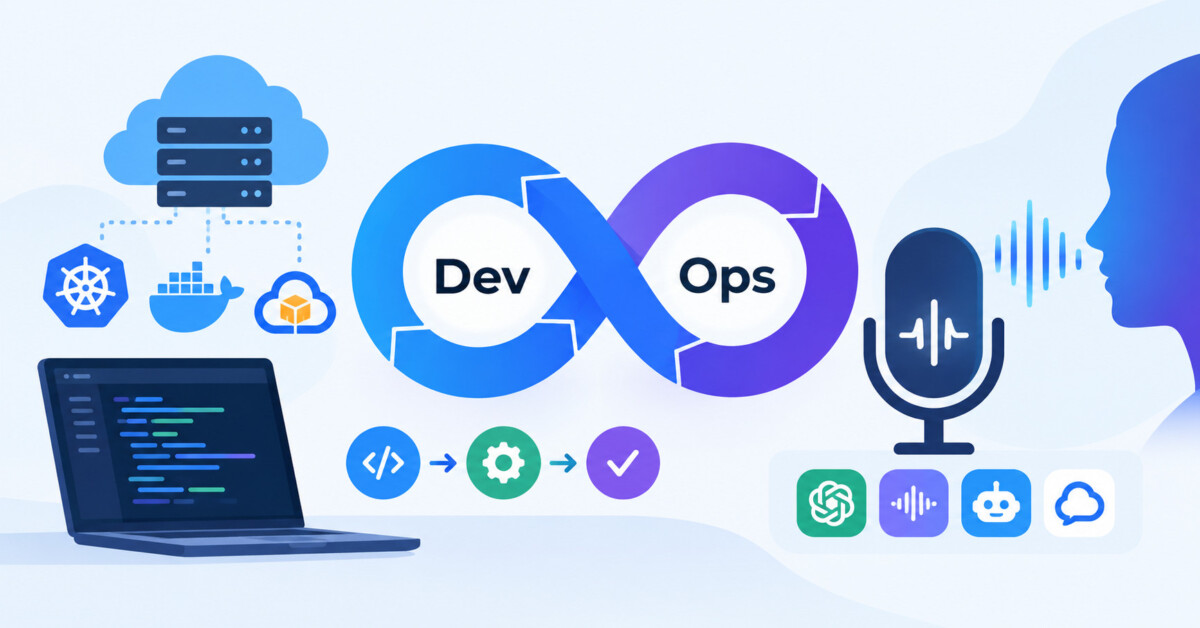
DevOps for voice AI means testing, releasing, observing, and recovering voice agents as production software, not just refining a prompt. Telnyx, LiveKit, and Vapi support different agent-building and operations needs; Coval specializes in evaluation. The right stack depends on your telephony, deployment control, and testing requirements.
A voice agent does not fail only when the model says the wrong thing. It also fails when a call drops, a tool returns stale order data, or a customer cannot reach a person.
DevOps is changing the rules of the game by offering smooth automation for the entire system. Traditional voice systems could follow basic conversational paths and end in a bad call for customers, and in 2026 that is no longer an option.
In this article, we reviewed and compared the top 4 platforms and tools for Voice AI relying on DevOps. By going through the features and tools, you can choose the best platform that matches your goals and intentions.
These features can help you understand what you should look for.
| Platform | Main focus
|
|---|---|
| Telnyx | Voice AI infrastructure, CI/CD deployment, monitoring consolidation, canary deployments, incident management |
| LiveKit | Voice agents, reliable production, observation, conversations and AI models |
| Vapi | Real-time monitoring, security concepts, deployment assistance, AI guardrails, testing and agent integration |
| Coval | CI/CD for voice agents, monitoring and integration |
For teams that need a platform combining Voice AI agents, networking, and voice services, Telnyx is a strong fit. Through DevOps Automations Voice AI, you can access DevOps automation tools for AI voice agents that offer high-performance and effective infrastructure for voice systems, including a STT API and a speech-to-text API in the same stack.
Telnyx allows you to manage network services, voice applications, telephony, phone numbers, and connection and routing configuration via APIs.
Build and deploy functions with one click. Teams can run CI/CD pipelines without managing and controlling complicated runtime environments.
Easy and fast to create AI coding features with Telnyx MCP server.
Telnyx offers call tracing, timing and performance analysis, latency breakdowns, and transcription tools for Voice AI.
AI assistants help catch errors and issues in the system. Even with a tiny percentage of traffic, Telnyx’s team can revert the release.
Manage and monitor metrics, speech-to-text, text-to-speech layers, and API calls for a better experience.
Alerts and structured incident response during conversation breakdowns.
Telnyx provides smooth and powerful tools for provisioning, deployment, regression, targeting, observability, and rollbacks for teams and AI infrastructure. In one stack, you can have it all. These features are key to improving voice agents in production and finding best practices for your teams and companies.
LiveKit is a developer platform for building voice, video, and AI agents in production. You can integrate Voice AI quickstarts, telephony, voice agent starter apps, and LiveKit Cloud for your workplace.
The platform allows you to create voice agents with SDKs and a developer monitoring process.
Manage infrastructure, routing, and agent deployment. You can ship and connect agents to web, iOS, and other platforms.
Track outcomes and insights; get session reports, conversation history, and database.
Through built-in agents, you can remove and manage additional noise and interruptions.
Use tools and models with the LiveKit platform.
Vapi is a platform for API integrations, AI voice creation, and business automation. The platform handles infrastructure for integrating voice and conversion into telephony and production.
Track and manage the working process and improve the experience for the business.
Explore SSO, OAuth, and RBAC, which are essential services for safe integration and access management.
An attached engineer helps you find deployment assistance for launching AI voice systems.
For blocking dangerous inputs and technical controls, the platforms offer AI guardrails for the system.
Validate and track changes before the final release.
Through agents, SOC 2, HIPAA and PCI compliant, businesses can run the system.
For voice AI testing, production, integration, and evaluation, infrastructure with AI agents is a main component of Coval. The platform offers voice agents, behaviors, vendor bakeoffs, and in-house builders for teams and companies.
Here you can find automated evaluation tools for coding, changing prompts and blocking releases.
Observe and check whether the platform offers smooth production.
Through the platform, customers can run tests, review transcripts, and manage failure breakdowns in case of emergencies.
You can change a base prompt based on customers’ preferences and scenarios. Also, you can cut off background noise, interruptions and conversations.
Connect and manage integration with Langfuse, Langsmith, Arize, and other platforms for tracing and production.
In 2026, modern platforms are offering features for creating voice AI agents with the smoothest performance and engagement.
The best platforms that provide Voice AI with DevOps, modern voice agents, and models can guarantee a dynamic workflow. Voice AI platforms are not limited to deployment and monitoring, but offer AI-powered testing, infrastructure performance, agent flexibility, and production control.
Before choosing the best platform, ask yourself the following questions:
You can choose the best platform for your team and business.




