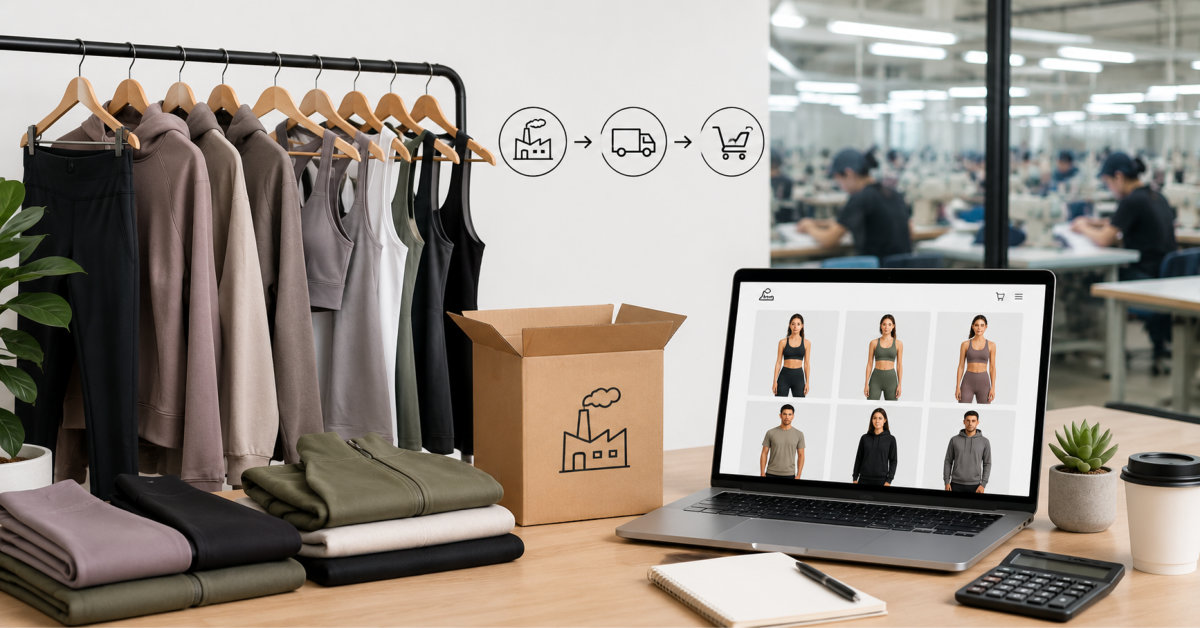
Sodalemons is a vertically integrated, Guangdong‑based activewear supplier built to protect boutique Shopify brands’ unit economics through open‑pack MOQs, strict quality control, and scalable partnership models from wholesale to regional exclusivity.
The boutiques that win this $647‑billion athleisure wave won’t simply advertise better—they’ll run tighter supply chains with suppliers who treat their margins like their own.
Picture this: the global athleisure market just crossed USD 415.28 billion, and it’s not slowing down — a 9.28% CAGR is set to push it past USD 647 billion by 2031. Online retail sales of activewear are growing even faster, at an 11.36% clip, with clothing commanding 55.86% of the market and the premium segment accelerating at 10.45% annually.
The numbers paint a picture of almost absurd demand. Yet, for many Shopify boutique owners, that demand feels more like a tease than a payday.
The culprit isn’t a lack of customers. It’s the structural headaches baked into traditional wholesale supply chains: rigid pre-pack ratios that force you to buy sizes your customers won’t touch, hidden fees that nibble away at already thin margins, and a quality-control lottery that turns every shipment into a game of returns roulette.
These aren’t minor annoyances — they’re silent margin killers that make scaling a boutique far harder than it needs to be.
So here’s the question: what if a supplier engineered its entire model specifically to protect the unit economics of a growing DTC brand?
Enter Sodalemons, a Guangdong-based B2B platform that was built from day one to answer that very question, flipping the supplier-boutique relationship from adversarial to aligned.
Sodalemons was founded in 2016 and is based in Foshan City, Guangdong. It has a partner manufacturer located in Guangzhou, which also serves as the design and R&D center. These provinces, together with Dongguan and Shenzhen, form a major sportswear manufacturing base on the planet.
China alone accounts for over 40% of global activewear production, as ActivewearWorks notes, making this region the go-to for rapid sampling, custom designs, and trend-responsive manufacturing.
This isn’t a drop-ship middleman playing shell games with inventory. Sodalemons runs a vertically integrated production system that covers everything from fabric sourcing and cutting to sewing and trims.
That vertical control is what allows them to promise flexibility — open-pack orders, low minimums, and consistent quality — without the usual trade-offs.
International compliance certifications like OEKO-TEX, BSCI, and WRAP, along with eco-friendly fabrics such as recycled polyester and TENCEL™, add a layer of trust that’s rare for a direct-from-factory supplier.
With a design team of 10+ trend-spotters and OEM, ODM, and private label capabilities built in, the engine isn’t just robust — it’s designed to let boutiques punch above their weight.
If you’ve ever stared at a pile of XS and 3XL leggings that refuse to move, you know the pain of rigid pre-packs. Traditional wholesalers love them because they shift inventory risk onto you. Sodalemons takes a different approach.
Their open-pack wholesale lets you order as few as 4 pieces per style, in the sizes and colors your customers actually buy. No forced assortments, no dead stock that gathers dust while tying up capital.
Why does this matter so much? Because poor cash flow management sinks 82% of small businesses — and 69% of owners are losing sleep over it, according to research compiled by K38 Consulting. Excess inventory is often the villain: the same research shows that better inventory management can free up 20–30% of cash that’s currently locked in stock.
When you can buy small batches and reorder fast (in-stock items ship in 3–7 business days), you stop hemorrhaging money on markdowns and storage — and you start putting that cash back into marketing, new product launches, or just a better night’s sleep.
Sodalemons sweetens the deal with a tiered volume discount that starts at 5% off orders over $500 and climbs to 20% off when you cross $5,000.
For qualified buyers, Net 30 payment terms add another cash-flow lever. It’s a model that practically forces you to rethink your inventory planning for Shopify brands — when you’re not overbuying just to hit a minimum, you can run a leaner, more profitable operation.
Cash flow is one side of the margin coin. The other is returns, and in apparel ecommerce, returns are a bloodbath. Return rates hover between 20% and 40%, driven largely by sizing and fit uncertainty, and processing a single return can cost anywhere from $10 to $45.
For a boutique, a few bad QC days can wipe out a month’s profit.
Sodalemons seems to have built its quality control as a direct answer to this problem. They report a QC pass rate exceeding 95% and a 4.8/5 customer rating from 2025 to Q1 2026. That’s not just a feel-good stat — it’s a margin-protection strategy.
When the product arrives consistently well-made, with accurate sizing, your return rate drops. Your customer service inbox stays manageable. And you’re not eating $15 return shipping on every third order.
The operational transparency is striking. Sodalemons’ order cancellation rate from 2025 to Q1 2026 was just 3.6%, compared to an industry average of 2–8%. In Q2 2026 alone, they fulfilled over 650 orders with a perfect merchandising score of 100.
And if a defect does slip through, their 14-day refund policy doesn’t require you to ship anything back — photo or video evidence is enough. That’s the kind of accountability that turns a supplier into a partner.
Sodalemons doesn’t lock you into one way of doing business. Instead, they’ve built a ladder of four partnership models that grow with you.
The smart move is to treat this like any new partnership: order a small, low-cost sample first. Hop on a video call with your rep. Test their defect return policy with a single item before you ship hundreds of units to your warehouse.
Ecommerce Fastlane has a solid guide on how to vet wholesale clothing vendors that walks through exactly this process — it’s worth 10 minutes of your time.
Here’s the core thesis, plain and simple: Sodalemons is betting that the direct-from-factory, high-transparency model is the next evolution of athleisure wholesale for the Shopify entrepreneur.
And the evidence lines up. Flexible open-pack buying puts you back in control of your cash flow. Verified QC pass rates above 95% and a no-return-needed defect policy protect you from the return-rate monster that devours margins.
And low-barrier private labeling — with an MOQ of just 50 pieces — turns your boutique from a reseller into a brand, with the margin math to match.
As the athleisure market compounds toward that $647 billion horizon, the boutiques that win won’t be the ones with the flashiest ads. They’ll be the ones partnered with suppliers who treat their margins like their own — and Sodalemons looks engineered for exactly that.
Sodalemons’ open‑pack model improves cash flow by letting you order as few as 4 pieces per style in the exact sizes and colors your customers buy, instead of overstocking slow‑moving sizes just to meet pre‑pack requirements. This reduces dead inventory and frees up 20–30% of the cash that might otherwise be locked in unsold stock, which you can redeploy into marketing, creative, or simply maintaining a healthier buffer.
Sodalemons differentiates itself from generic wholesale marketplaces by operating as a vertically integrated manufacturer based in Guangdong rather than as a pure intermediary, controlling fabric sourcing, cutting, sewing, and trims in‑house. That factory‑first setup, combined with compliance certifications, eco‑friendly fabrics, and a 95%+ QC pass rate, gives boutiques more predictable quality and faster restocks than they typically get from anonymous, listing‑driven platforms.
The best way to vet Sodalemons is to treat them like any strategic supplier: start with discounted samples and a small open‑pack order, measure fit and fabric quality for your target segments, and test their defect policy with a single return scenario. Pair that with a video call to assess communication and responsiveness, and only scale your order volume once you’re confident their operational performance matches your brand’s standards.
It makes sense to move into private label with Sodalemons once you have reliable sales data on specific styles and can confidently commit to a 50‑piece MOQ while maintaining healthy sell‑through. At that point, attaching your own brand to proven silhouettes lets you capture additional margin, differentiate from other boutiques using similar vendors, and build longer‑term equity that is not dependent on any single platform or algorithm.
The Regional Agent model is best for established boutiques or operators who already have a strong presence in a city or region and want to formalize a moat around that territory. By locking in exclusivity and earning up to roughly 25% off as a de facto local distributor, you can protect your positioning against nearby competitors while justifying deeper commitments through better unit economics.