

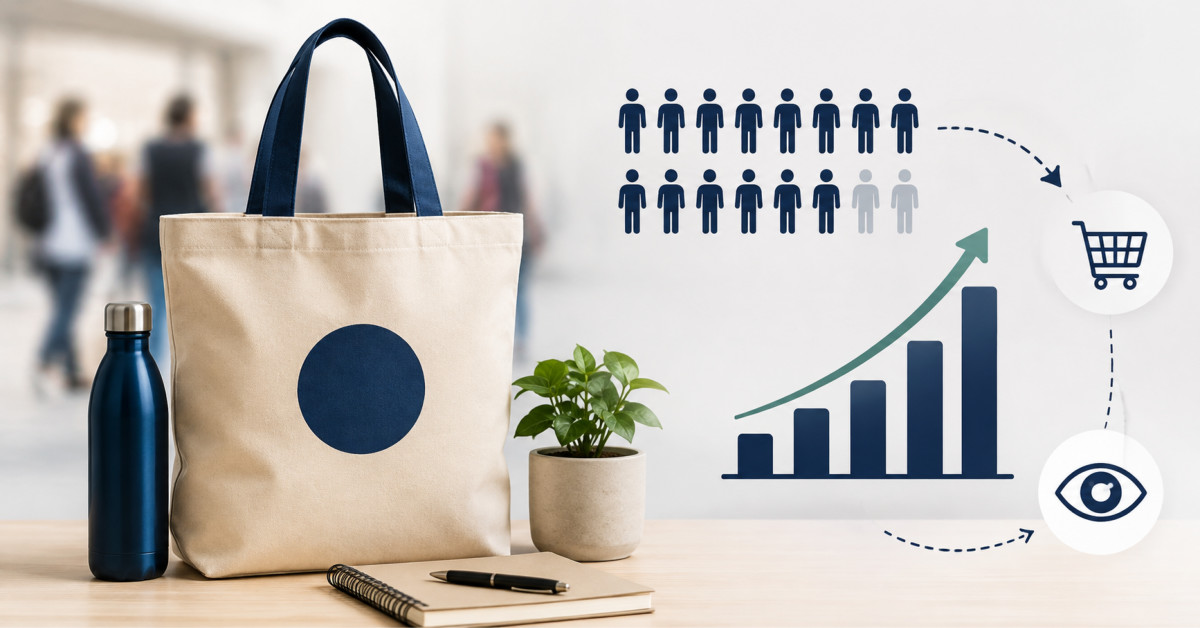
Promotional bags deliver roughly 4,900 lifetime impressions at about a tenth of a cent each, which beats every paid channel on cost alone. They only work when the bag is good enough to keep, which is where most merchant budgets get wasted.
A tote bag that ends up shoved under the sink is not cheap advertising. It is a write-off with your logo on it.
Walk through any major transit hub on a weekday morning and start counting branded tote bags. You will hit double digits before you reach the platform. Almost every one of those bags was paid for out of a marketing budget, and almost none of them were measured after the invoice cleared.
That is the odd thing about branded bags. They are one of the few advertising formats where the audience volunteers to carry the ad around for months, and one of the few where nobody checks the return. Merchants who would not spend $500 on a paid campaign without a dashboard will happily sign off on 500 totes on gut feel.
The difference between a bag that earns its slot in the budget and one that becomes storage clutter is almost entirely a sourcing decision made in the first ten minutes. Suppliers of promotional bags in Australia and every other market will quote anything from a dollar to twenty per unit, and the cheap end of that range is where most of the waste happens. What follows is the math that tells you which end you should be shopping at.
Branded bags outperform pens, drinkware, and lanyards because they are used in public, and public use is where impressions actually accumulate. A logoed mug lives on one desk and is seen by the same three colleagues every day. A bag moves through supermarkets, gyms, offices, airports, and school pickup lines, and every trip puts the logo in front of people who have never heard of you.
The industry research supports the gap. The Advertising Specialty Institute has measured lifetime impressions and cost per impression across product categories since 2006, and in the 2026 edition a roughly $6 tote generates close to 5,000 impressions over its life at a cost per impression of about a tenth of a cent. The same research puts advertiser recall at 85% of people who received a logoed item, which is a higher recall figure than television or digital advertising produce.
Bags also carry an unusual amount of goodwill. ASI looked at how consumers respond to sustainably made bags specifically and found 86% would view the advertiser more favourably after receiving a sustainable bag, and 87% after receiving one made in a socially responsible way, both higher than any other product category tested. That matters more for a DTC brand than for a bank. Your customers already have an emotional relationship with the packaging you send them, which is the same reason the unboxing experience drives retention the way it does. A bag extends that moment past the doorstep.
The catch is that all of these numbers assume the bag survives. Impressions are a function of longevity, and longevity is a function of quality. A bag that fails at ten uses does not produce a tenth of 5,000 impressions. It produces a customer who now associates your logo with a broken handle.
A $6 branded tote works out to roughly one tenth of a cent per impression, which is an order of magnitude cheaper than any paid social placement you are currently buying. That comparison is the entire commercial argument for the category, and almost nobody runs it before ordering.
Here is how the main categories compare in the 2026 ASI study.
Now the honest part, because this is where vendor content stops and useful content starts. An impression on a tote bag is not equivalent to an impression in a targeted ad. The person who glimpses your logo on a train platform has no intent, no context, and no path to your store. Paid social buys intent alongside the impression, and you pay a premium for exactly that. The correct framing is not that bags are cheaper than Meta. It is that bags buy a different thing at a much lower unit cost, and the two are not substitutes.
Stage changes the answer. At $10K to $50K a month, a 250 unit minimum order is real money against a thin marketing budget, and the same spend put into a post purchase flow will produce measurable revenue this quarter. Bags make sense at that stage only if you are already doing in-person events. Above roughly $1M a year, the calculus flips: you have brand equity worth reinforcing, enough order volume to justify a decent unit price, and enough analytics maturity to actually track what happens.
Choose material on durability first and environmental story second, because a bag that fails after ten uses generates neither impressions nor goodwill, and an unsubstantiated green claim creates legal exposure you did not budget for. This is the single most common mistake in the category: a 90gsm non-woven polypropylene bag ordered at eighty cents a unit, described in the campaign copy as eco-friendly.
Regulators have been unambiguous about that word. The Australian Competition and Consumer Commission reviewed 247 Australian businesses and found more than half making concerning claims about their environmental credentials, with clothing and footwear among the worst offending sectors. Regulators in the United States, United Kingdom and European Union have moved in the same direction over the same period.
Businesses making environmental claims need to substantiate them honestly or risk breaching Australian consumer law. Broad, unqualified terms are the specific problem. Calling a bag green, eco-friendly, or sustainable without saying what part of it is better and why is precisely the pattern the sweep flagged. Naming the actual material and its recycled content is defensible. A leaf icon and a vague adjective is not.
The exposure is not theoretical. The ACCC’s eight principles for making environmental claims now sit alongside penalties whose fixed component for corporations reached $100 million for conduct on or after 28 March 2026. No promotional order is worth that risk for the sake of an adjective.
On materials themselves: heavyweight cotton canvas at 250gsm to 340gsm, recycled PET, and jute all survive daily use in a way that lightweight non-woven does not. Ask any supplier for the GSM before you ask for the price, because GSM is the number that predicts lifespan. If you are already thinking about material claims across your packaging stack, the same substantiation logic applies to how compostable packaging claims actually hold up in practice.
The design decision that most determines whether a bag survives is logo size, and smaller consistently wins. A bag with a modest logo mark reads as a bag someone owns. A bag with a 30cm print across the full panel reads as an advertisement someone is being asked to carry for free, and it goes in the cupboard.
ASI’s research found that more than two thirds of consumers keep a promotional item specifically because it is useful, not because they like the brand. Utility is doing the work, so design for utility. A wider gusset, ideally 10cm or more, turns a flat tote into something that holds groceries. A 60cm handle drop clears a winter coat and lets the bag sit on the shoulder rather than the crook of the elbow. One internal pocket sized for a phone changes how often someone reaches for it. A zip closure roughly doubles the range of situations the bag works in.
Colour follows the same logic. Neutral base fabrics in natural, black, or navy get carried with more outfits and age better than a saturated brand colour that looks tired after six months of sun. Put your brand colour in the print, not the body.
Apply your own product design standard here. If you would not ship the bag as a product, do not ship it as a gift. Merchants who obsess over the weight of their mailer box and the finish on their tissue paper routinely hand out a bag they would be embarrassed to sell, then wonder why the campaign felt flat.
Hand bags out at moments where the recipient needs a bag within the hour, because same-day use is what starts the impression clock. A tote given at a trade show gets loaded with brochures before the recipient leaves the hall. The same tote posted to a client in a padded envelope sits in a drawer for a month.
For a DTC brand, the highest value moments are narrower than the generic advice suggests. In-person events come first: markets, expos, and pop-ups, where the bag solves a problem the attendee has right now. If you are running one of those, set KPIs for an in-person event before you spend, because merch handed out without a defined goal is the fastest way to convert a marketing line item into a vanity metric.
The second moment is a gift-with-purchase threshold in your online store. Setting the threshold at roughly 1.4 times your current average order value gives you a measurable AOV lift alongside the impressions, and it self-selects for customers with enough purchase intent to be worth the unit cost. The third is a genuine VIP tier: your top 2% of customers by lifetime value, wholesale buyers, and long-running affiliates, where a good bag reads as a thank you rather than a promotion.
What does not work is stuffing a bag into every order. The unit economics collapse immediately, and the gesture stops registering as a gesture. If the goal is to lift repeat purchase inside the box, the cheaper and better-tested lever is one of the packaging insert formats that earn a second order, which cost cents rather than dollars and can be targeted to what the customer just bought.
Print a dedicated short URL or QR code with its own UTM parameters so the bag has a measurable destination, then judge it on the cohort rather than on the click. Most merchants hand out several hundred bags and never learn anything, which is why the category has a reputation for being unmeasurable when it is really just unmeasured.
The setup takes about twenty minutes. Create a campaign-specific URL with UTM tags so traffic lands in its own row in Shopify Analytics. Issue a unique discount code tied to that event, not a code you use anywhere else. If you are handing bags out at an in-person event, capture email and SMS consent at checkout through Shopify POS so the attendee cohort is identifiable later.
Then set expectations honestly. QR scan rates on physical merchandise are typically low single digits, so the code is a directional signal, not your attribution model. The number that actually tells you something is the 60 day repeat purchase rate of the cohort who received a bag compared with your baseline. That comparison is the same discipline behind planning a first physical pop-up as an online brand, where the honest measure is how the attendee cohort performs against your online benchmarks rather than how many people walked through the door.
Run the same design across two or three events and the pattern gets useful fast. You learn which audiences respond, which bag style survives longest, and whether the spend deserves a second order. Brands that track this consistently end up buying fewer, better bags for narrower audiences, which is almost always the right answer.
Branded bags are a poor fit for any merchant who needs attributable revenue this quarter, and they carry three costs that supplier quotes rarely surface. Being clear about these is the difference between a channel decision and an impulse purchase.
The first is minimum order value. Suppliers commonly set floors around $500, and unit pricing improves sharply with volume, which pushes you toward ordering more than you can distribute. Unused bags are dead inventory occupying space you are already paying for. The second is lead time. Production typically runs five to ten working days after artwork approval, plus freight, and that clock starts only once decoration is signed off. Ordering for a specific event with three weeks of runway is how brands end up paying rush fees or missing the date entirely.
The third is the intent problem covered earlier, and it is the one that should govern the decision. Bags buy awareness among people who have shown you nothing. That is a legitimate thing to buy, but it compounds slowly and it will not rescue a quarter. If your acquisition costs are climbing and your retention numbers are soft, the bag is not the intervention. Fix the funnel first, then come back to this when brand reinforcement is the actual constraint.
For merchants who do clear that bar, the case holds up. A well-made bag handed to the right person at the right moment puts your logo in public circulation for a year or more at a cost per impression no digital channel can approach. Pick the material on durability, keep the logo small, hand it out when it solves a problem, and measure the cohort. Do those four things and a branded bag punches considerably above its unit price. Skip any one of them and you have bought storage.
Promotional bags are worth it for a small ecommerce brand only if you already run in-person events or have a defined VIP customer tier. Below roughly $50K a month in revenue, a minimum order of 250 units represents real budget that would produce faster measurable returns in a post purchase email flow or a retention campaign. Bags buy awareness among people with no purchase intent, which compounds slowly. The exception is markets, expos, and pop-ups, where a bag solves an immediate problem for the recipient and starts generating impressions the same day. If you are not doing those, wait.
A branded tote bag generates roughly 4,900 impressions over its lifetime according to the 2026 ASI Ad Impressions Study, which works out to about one tenth of a cent per impression on a $6 bag. That figure is calculated by multiplying how long recipients keep the item by how often they use it and how many people see it during use. Bags score high because they are used in public spaces. The number assumes the bag survives, though, so it applies to a durable canvas or jute bag rather than a lightweight non-woven giveaway that fails within weeks.
Choose heavyweight cotton canvas between 250gsm and 340gsm, recycled PET, or jute, and ask every supplier for the GSM before you ask for the price. GSM is the number that predicts how long the bag survives, and survival is what produces impressions. Lightweight non-woven polypropylene at around 90gsm is the cheapest option on most quote sheets and the one most likely to fail early. If sustainability is part of your brand positioning, recycled PET and organic cotton both give you something specific and verifiable to say, which matters for the compliance reasons covered below.
Calling a promotional bag eco-friendly without qualifying the claim is risky in most major markets and is specifically flagged by the ACCC as the kind of vague, unqualified language that draws scrutiny. The safer approach is to name the actual attribute: the recycled content percentage, the certification, or the specific material. An ACCC internet sweep of 247 businesses found more than half making concerning environmental claims, and penalties under Australian consumer law now reach a $100 million fixed component for corporations. Regulators in the US, UK and EU have tightened comparable rules. Say what is true and specific, or say nothing.
Track promotional bags by printing a campaign-specific short URL with its own UTM parameters and issuing a unique discount code tied to that distribution event only. Expect QR scan rates in the low single digits, so treat the code as directional rather than as your attribution model. The measurement that actually tells you something is the 60 day repeat purchase rate of the cohort who received a bag compared against your normal customer baseline. Capture email and SMS consent at the point of handover, run the same setup across two or three events, and the pattern becomes readable within a quarter.




