

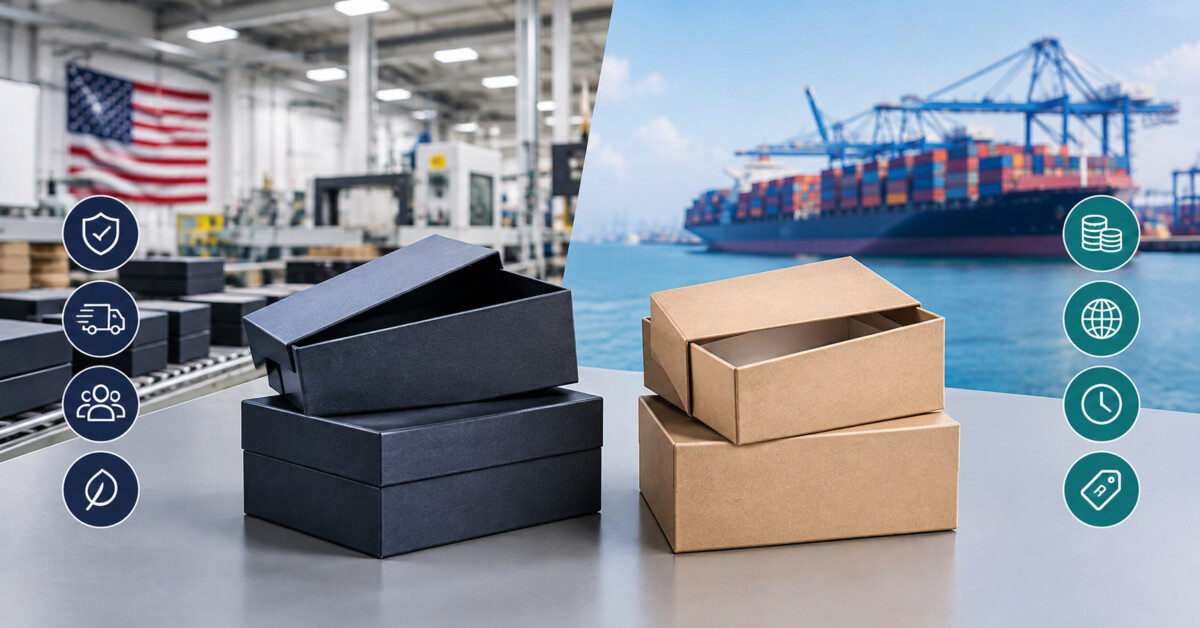
Domestic rigid box production wins when your launch date is inside six to eight weeks or your reorders are small and frequent. Overseas production wins on landed cost once you can plan a quarter ahead and order at volume.
The unit price is the only number on a rigid box quote that both suppliers agree to put in writing, which is exactly why it is the worst number to decide on.
A standard rigid box ships assembled rather than flat, which means you pay freight on the air inside it, and that single structural fact is what makes rigid box sourcing behave differently from every other pack you buy. A mailer or a folding carton arrives as a stack of flat blanks and gets erected at your fulfillment center. A rigid box, chipboard wrapped in printed paper and glued at the factory, arrives finished.
That changes which number drives your freight bill. Carriers and forwarders bill on whichever is greater, actual weight or volumetric weight, and the conversion ratios are not the same across modes. Air freight converts at 6,000 cubic centimeters to the kilogram, which is aggressive enough that almost any pallet of empty boxes will bill on volume. Ocean LCL converts at 1,000 kilograms to the cubic meter, which is gentler, but a pallet of assembled rigid boxes is still light for the space it occupies. Volume governs.
This is also where structure becomes a sourcing decision rather than a design one. Collapsible rigid boxes are engineered to ship flat and be assembled on arrival, and reducing shipped volume is one of the main reasons brands choose that construction for overseas production. If you are quoting a magnetic closure box from a factory eleven thousand kilometers away, ask what the collapsible version does to the container count before you ask what it does to the unit price.
The same geometry follows the box out of your warehouse. Dimensional weight is what turns a modestly oversized shipper into a parcel surcharge, and Fastlane’s breakdown of how right sizing packaging offsets 2026 carrier increases puts numbers on the outbound half of this: carriers announced increases of 5.9 to 7.8 percent for 2026, while brands report 8 to 12 percent once dimensional weight and surcharges land. A rigid box that is 20 percent larger than it needs to be costs you twice, once inbound and once on every order you ship.
Compare landed cost per box, because the unit price on a rigid box quote is one line of what the box actually costs you by the time it is sitting on a shelf in your warehouse. Every serious comparison between a US converter and an overseas factory starts by rebuilding both quotes into the same seven lines.
Shopify’s own walkthrough of landed cost for ecommerce shows the shape of the gap with an illustrative apparel example, where a $2 manufacturing cost becomes $6.38 delivered, a 219 percent increase once freight, duty and overhead are counted. That figure is for a t-shirt rather than a rigid box, so treat it as an illustration of the ratio rather than a benchmark for packaging. The lesson transfers: the number on the quote is not the number that hits your margin.
Two lines deserve more attention than the rest. The first is import duty, and the honest answer is that nobody writing an article can give you your rate. Tariff treatment of Chinese goods has moved repeatedly since 2024. The USTR four year review of the Section 301 tariffs and the September 2024 notice of modification raised rates across fourteen strategic product groups on a staged schedule running into 2026, covering categories such as electric vehicles at 100 percent and steel and aluminum at 25 percent. Paper packaging is not named in those strategic lists, which is worth knowing, because it means your rate is set by your HTS classification and the general tariff picture rather than by a headline you read about tariffs on China. Ask your customs broker for the current rate on your classification, and ask every overseas supplier for a delivered duty paid quote so the duty is inside the number you are comparing rather than arriving as a surprise six weeks later.
The second is tooling. Dies, cutting formes and print plates are a first run cost at both kinds of supplier, and on a repeat program that cost is paid once and then amortized across every reorder. This is the line that quietly flips the comparison for brands with steady volume. What matters more than the tooling charge itself is the answer to two questions most buyers never ask: how long does the supplier keep your tooling, and do they charge storage on it. Get both in writing before the first purchase order, at either supplier.
Domestic production removes the ocean, and for a launch with a fixed date that single fact often decides the question before landed cost is even calculated. A US converter running a repeat structure can typically turn a job inside the window where an overseas first order is still waiting on sample approval.
Overseas production has more legs, and every one of them belongs on your plan rather than in your optimism. As a worked example, one Chinese rigid box manufacturer’s published lead times list sampling at 7 to 20 days depending on structure complexity, mass production at 15 to 20 days after sample approval, and roughly 40 days by sea, with air and courier available as faster options. Those are one supplier’s stated figures for their own lanes, not an industry benchmark, and your factory and your port pair will produce different numbers. Ask for them in the same breakdown.
Add that example up and a sea freighted first order runs about 62 to 80 days from kickoff to port, before customs clearance and inland delivery. Budget another 7 to 14 days for those two, and you are looking at roughly ten to thirteen weeks before boxes are available to pick. That is entirely workable for a holiday program planned in spring. It is not workable for a product launching next month, and no amount of supplier goodwill compresses an ocean crossing.
The practical rule holds across stages. If your date is fixed and close, go domestic or pay for air freight and accept what air does to your landed cost. If you can plan a quarter ahead, overseas production is genuinely on the table. Brands at $50K a month usually cannot plan that far out because their forecast is not stable enough to commit; brands at $1M a month usually can, and the ones that do not are leaving margin on the table out of habit rather than strategy.
The sampling stage carries duty and formal entry costs it did not carry two years ago, and most brands still budget for it as though it were free. This is the change that has caught out the most buyers over the past year, and it is worth understanding before you request samples from five factories at once.
Executive Order 14324 suspended duty free de minimis treatment for shipments from all countries, effective August 29, 2025. Low value parcels that previously entered the United States duty free are now subject to applicable duties, taxes and fees. Customs and Border Protection followed with an interim final rule making that suspension indefinite for merchandise arriving through all modes other than the international postal network, effective June 24, 2026, with statutory repeal of the exemption scheduled for July 1, 2027.
For a rigid box program this lands in one specific place. Your bulk order was always a formal entry and nothing about it changed. Your samples were often the thing that slipped in under $800 duty free, and now they do not. If you are sampling three structures from two overseas factories, that is six inbound parcels, each carrying duty, brokerage and paperwork. A domestic converter’s samples arrive by courier from Ohio with none of that attached.
The practical adjustment is to consolidate. Ask each overseas factory to ship all structures in one parcel rather than as they finish, and get the sample cost quoted delivered rather than ex works. At $500K a year in packaging spend this is a rounding error. At the point where you are evaluating four suppliers for a program you have not committed to, it is real money spent before a single box is produced.
Overseas economics push you toward larger orders, and the cost of that is working capital sitting in cardboard rather than in inventory or acquisition. Freight is cheaper per unit in bigger shipments, and no operator wants to repeat a ten week procurement cycle every month, so the rational overseas order is a big one.
For a brand with steady volume that is fine and often correct. For a brand still testing a product, it is how you end up with eighteen months of packaging for a SKU you discontinue in month five. One published manufacturer figure puts the practical minimum around 500 units for a qualified rigid box project, with the caveat that minimums function as a product of budget and project scope rather than a fixed number, but the order that actually makes the overseas freight math work is usually a multiple of that.
A domestic converter lets you order closer to demand. You pay more per box and less in carrying cost, and you keep the option to change the structure after the first thousand units tell you something. For early stage brands that trade is often worth it on its own, before any of the timeline arguments are considered.
Where the cash constraint is the binding one rather than the preference, the answer may be financing rather than a different supplier. Fastlane’s overview of revenue based funding and other flexible options for ecommerce operators covers the structures that flex repayment against actual sales, which is the profile that suits a seasonal packaging buy better than a fixed term loan does. Whatever you use to track stock, treat packaging as a real SKU with a reorder point inside your inventory management stack rather than as something the ops team notices is running low.
Premium packaging lives or dies on consistency between runs, and the thing that reduces that risk is process, not geography. A reorder that arrives a shade off the first run, or with a softer magnet, is visible to every customer who owns both boxes, and it reads as a brand getting worse rather than a supplier getting sloppy.
This risk exists at every supplier. A domestic converter with three QC staff and no written spec will drift exactly as fast as an overseas factory with the same gap. What separates suppliers is whether three specific controls exist and are written down. First, a physical sample approved before production and retained by the supplier as the reference standard for every subsequent reorder, not a PDF proof and not a photograph. Second, color managed to Pantone references rather than to a screen proof, because no two monitors agree and neither does any two print runs without a physical target. Third, written quality checks on color, assembly and packing carried out before the shipment leaves, with the results sent to you rather than filed.
Ask all three questions of every supplier you are quoting, domestic and overseas alike, and pay attention to how quickly the answers come back. A supplier who has these controls describes them in specifics within a minute. A supplier who does not will talk about their commitment to quality. Fastlane’s framework for building a resilient DTC operations system makes the same point about supplier vetting more broadly: lead time, defect rate and pre shipment inspection are the criteria that predict how a relationship performs at volume.
Match the supplier to the constraint that is actually binding on your business right now, because the same brand will correctly give a different answer in two different quarters. Most of the decision resolves cleanly once you name which of timing, cash or unit economics is the thing you cannot flex.
Many established brands stop treating this as a single choice and run both. A domestic converter covers launches, limited runs and urgent top ups. An overseas factory covers the planned core program at a lower landed cost. That split costs you a second supplier relationship to manage and a second set of tooling, which is why it tends to make sense above roughly $2M rather than below it, but it removes the situation where a fixed launch date forces you into an air freight bill that erases a year of unit savings.
If you are running packaging through a third party logistics partner, factor in their receiving terms before you size the order. Receiving fees charged per pallet and storage that escalates in Q4 are both real costs of the larger overseas order, and Fastlane’s comparison of 3PL providers for Shopify and DTC brands covers how those fee structures differ between providers.
Do not compare unit prices, because the unit price is the one line where the two options look most different and matter least. Compare landed cost per box, total calendar time from kickoff to your warehouse, and the cash each option ties up for how long.
Then ask every supplier the same short list of questions: where the box is made, what the sample process is and what it now costs to get samples across a border, how reorders are color matched to an approved physical standard, how long they hold your tooling, and what the delivered price is at your door with duty inside it. The supplier who answers those in specifics is usually the safer choice, wherever they happen to be.
Overseas production is usually cheaper per box and not always cheaper per box delivered. The unit price gap is real, but an overseas program adds ocean or air freight billed on volume, import duty at your HTS classification, customs brokerage per entry, and inland freight from the port. Domestic converters carry none of those lines and charge a higher unit price instead. Rebuild both quotes into the same seven cost lines and compare the totals. For steady volume programs ordered a quarter ahead, overseas usually wins on landed cost. For small frequent reorders, the freight and entry costs are spread across too few units and domestic often wins outright.
Budget ten to thirteen weeks from kickoff to boxes available to pick, if you are shipping by sea. One Chinese manufacturer publishes sampling at 7 to 20 days, mass production at 15 to 20 days after sample approval, and roughly 40 days by sea, which totals about 62 to 80 days to port. Customs clearance and inland delivery typically add another 7 to 14 days on top. Air freight compresses the ocean leg substantially but changes your landed cost enough to be worth modelling before you commit. Get the same leg by leg breakdown from your own supplier rather than assuming an industry average applies to your lane.
Yes, and the rate depends on your HTS classification rather than on any headline figure. Tariff treatment of Chinese goods has changed repeatedly since 2024, though the Section 301 strategic sector increases target categories such as electric vehicles, steel and semiconductors rather than paper packaging specifically. Separately, duty free de minimis treatment was suspended for all countries in August 2025 and made indefinite in June 2026, so low value sample parcels are now dutiable too. Ask your customs broker for the current rate on your classification, and request a delivered duty paid quote from every overseas supplier so duty sits inside the number you compare.
Expect a practical floor around 500 units at many overseas factories, with the real minimum set by budget and project scope rather than a published number. Rigid box tooling and finishing carry setup work that does not scale down, so a 200 unit order often costs nearly what a 500 unit order costs. The more useful question is not the supplier’s stated minimum but the order size at which your freight and tooling amortize sensibly, which for an overseas program is usually well above the stated MOQ. Domestic converters generally accept smaller runs at a higher unit price, which is what makes them the better fit for brands still testing a product.
Approve a physical sample before the first production run and require the supplier to retain it as the reference standard for every reorder. Three controls do most of the work. A retained physical sample beats a PDF proof or a photograph, because neither reproduces the substrate or the finish. Color managed to Pantone references rather than to a screen proof removes the monitor variable entirely. Written pre shipment checks on color, assembly and packing, with results sent to you before the goods leave, catch drift while it is still the supplier’s problem. Ask every supplier how they handle all three, domestic and overseas alike, because this is a process question rather than a geography question.




