

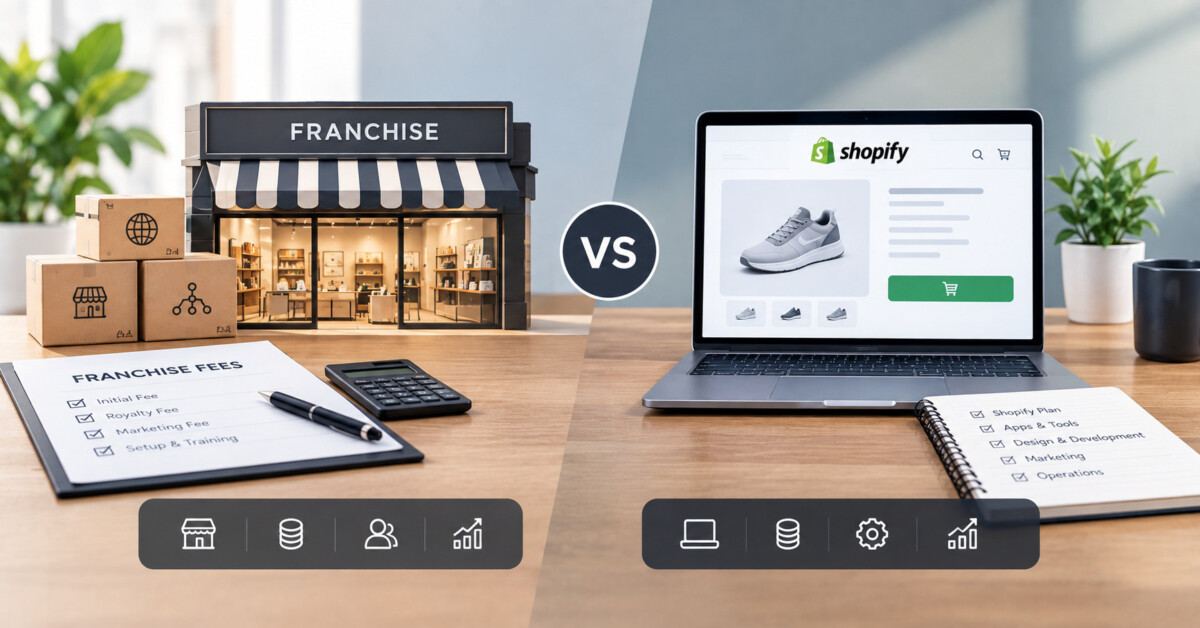
An ecommerce franchise buys a faster year one launch and a small early survival edge, in exchange for 3 to 13 percent of every sale for life; a self-built Shopify store costs $29 to $105 a month and keeps all the revenue, at the cost of doing the work yourself.
A franchise fee buys you a manual and a brand. It has never once bought you a customer.
An ecommerce franchise sells you three things you would otherwise have to build alone: a tested product or service, a documented operating playbook, and a brand name customers already half trust before they’ve seen your site. That’s the entire pitch, and for a first-time operator with zero retail or ecommerce background, it’s a genuinely useful trade. You skip the eighteen months most independent founders spend figuring out what to sell, who wants it, and how to talk about it, because the franchisor already ran that experiment across dozens or hundreds of other locations.
What you’re actually buying is time compression, not certainty. The franchisor hands you supplier relationships, a proven checkout and fulfillment flow, marketing templates, and a support line for when something breaks. Most franchise systems also front-load a defined onboarding window, often two to six weeks of structured training plus an ongoing check-in cadence, so a first-time operator isn’t guessing at inventory levels, ad creative, or customer service scripts in month one the way an independent founder usually is. Whether that’s worth the price depends entirely on how much you’d otherwise pay, in time and mistakes, to build the same thing yourself, and on how much of your budget the ongoing fees quietly consume once you’re operating. Our primer on franchising when ecommerce isn’t the right fit for you covers the broader decision; the rest of this piece is about the specific math.
A typical US-based franchise carries an initial franchise fee of $25,000 to $75,000, with total starting investment, including that fee, initial inventory, equipment, and working capital, running $150,000 to $500,000 depending on the brand and category. That’s the number every franchisor leads with. It’s also only the entry cost.
Every franchise then charges an ongoing royalty, almost always a percentage of gross sales, collected weekly or monthly for the life of the agreement. Across more than 1,800 franchise systems, the average royalty rate runs 7.1 percent, and once you add in marketing or ad fund contributions, the average total ongoing fee rate climbs to 8.7 percent of gross revenue, according to an analysis of total ongoing franchise fees across the sector. Retail franchises sit at the low end, around 6.4 percent combined; business services franchises run closer to 11.5 percent. That percentage doesn’t stop once you’ve paid off the franchise fee. It runs for as long as you own the business.
Run the math on a franchisee doing $400,000 in annual revenue at the sector average 8.7 percent total ongoing rate: that’s $34,800 a year in fees, or $174,000 over five years, on top of whatever you paid to get in the door. Our own breakdown of franchise fees and royalties for new owners walks through how those numbers vary by industry. The playbook and brand recognition you’re paying for have to be worth that ongoing draw on your margin, every year, indefinitely.
The franchise fee itself is also just the headline number, not the total ask. Most Franchise Disclosure Documents list separate line items for a grand opening marketing package, a point-of-sale or ecommerce platform license fee the franchisor controls, mandatory technology fees running $200 to $800 a month per location, and renewal fees due whenever the agreement term expires. None of those show up in the franchise fee a franchisor quotes on a call. They show up in Item 6 of the FDD, which is exactly why reading the actual disclosure document, not the sales page, is the first real diligence step before you commit capital to any specific franchise.
A self-built Shopify store costs $39 to $399 a month on Shopify’s three core plans as of September 2026 ($29 to $299 a month if you commit to annual billing), and 0 percent of your revenue in ongoing royalty, no matter how large the store grows. That’s the entire structural trade against franchising: you give up the tested playbook and brand recognition, and in exchange you keep every dollar of gross margin instead of handing a slice of it away for the life of the business.
That last row is the part most first-time buyers underweight. The Shopify column isn’t zero; apps, a paid theme, and paid traffic can easily add $50 to $300 a month once a store is live, and none of that includes your own time or ad spend. But the gap is still enormous, and it means a Shopify store lets you test real demand for a fraction of what a single franchise fee costs, before you’ve committed to a brand you didn’t build and can’t change. Our step-by-step guide to starting a Shopify store walks through the actual build, plan by plan.
There’s also no multi-year contract to break if the idea doesn’t work. Most franchise agreements run 5 to 10 years, with early termination clauses that can leave you owing the remainder of your royalty obligation even if you close the doors. A Shopify store can be paused, pivoted, or shut down in an afternoon, at the cost of whatever inventory or ad spend you’ve already committed. For a first product idea you haven’t validated yet, that flexibility is worth more than it looks on a spreadsheet.
A directory like UK Franchise Opportunities is a genuinely useful research starting point, a free, searchable list of franchise listings with a simple enquiry form that saves you from cold emailing franchisors one at a time. It’s also worth being honest about how it’s funded: directories like this are almost always paid by the franchisor side, per qualified lead or per listing, not by the person doing the research. That doesn’t make the content dishonest. It does mean the site’s incentive is to get your enquiry form submitted, not to talk you out of a franchise that’s wrong for you.
That distinction matters because e-commerce is a competitive industry, with consumer behavior, ad costs, and platform rules all shifting fast enough that a franchise system built two or three years ago may already be fighting yesterday’s playing field. A directory can hand you the shortlist. It cannot tell you whether that specific franchisor’s unit economics still work in 2026, whether existing franchisees are actually profitable, or whether the territory you’d be assigned still has room to grow. That research, reading the Franchise Disclosure Document and calling three to five existing franchisees directly, stays yours to do no matter how good the directory is. Item 20 of every FDD lists the contact information for current and former franchisees specifically so you can call them; skipping that step and relying on the directory listing or the franchisor’s own pitch is the single most common mistake first-time buyers make.
The oft repeated claim that only 4 percent of franchises fail within five years, against roughly 50 percent of independent startups, does not hold up against the peer reviewed research it’s loosely based on. The real advantage is smaller, and it mostly disappears once a business survives its first year or two.
Research from the University of Michigan’s Ross School of Business, led by economist Francine Lafontaine, found the one-year survival rate for new franchised businesses runs about 6.3 percentage points higher than for independent ones, and the two-year gap widens slightly to 8.4 points. Once you control for the factors that lead a particular person to choose franchising in the first place rather than independence, that gap shrinks to roughly 5 and 6 percentage points respectively. And conditional on surviving that first year or two, the survival difference between franchised and independent businesses disappears almost entirely. Lafontaine’s own conclusion: “while we find some evidence of a survival and growth advantage of franchising, this advantage is rather small and concentrated in the first year or two.”
It’s also worth knowing the research doesn’t universally agree. An earlier study by Wayne State University economist Timothy Bates, tracking firms started between 1984 and 1987, found independent business startups were actually more profitable and had better long-run survival prospects than franchise operations of the same age, despite franchisees starting with more capital and larger-scale operations on average. Bates’ explanation was that franchisors screen for and attract better-capitalized owners in the first place, which flatters the raw franchise survival numbers without proving the franchise model itself is what’s driving the outcome. The Lafontaine research above is more recent and controls more carefully for exactly that selection effect, which is why it’s the stronger read, but the disagreement between the two studies is itself the honest answer: franchising’s safety edge is real, contested in its size, and nowhere close to the “4 percent versus 50 percent” gap that shows up in franchise marketing decks.
That’s a meaningfully different story than the marketing statistics suggest. Franchising buys real downside protection in year one, when an untested operator is most likely to make an expensive early mistake. It does not buy a permanently safer business. Once you’re past year two, your odds look a lot more like everyone else’s, franchised or not, and you’re still paying the royalty either way.
The honest answer is that “now” was never really the variable that mattered; your available capital, your appetite for building versus following a system, and how much you value that first-year survival bump are the actual inputs. A few concrete starting points by budget:
Under $30,000 in available capital, a franchise is usually out of reach once the total investment is counted, and a Shopify store at $29 to $105 a month leaves the rest of your budget for the paid traffic and inventory testing that actually answers whether your idea works. Between $50,000 and $150,000, and specifically wanting training, supplier relationships, and ongoing support built in, franchising’s real edge is concentrated in that first year, so it’s worth pricing out how much of that same training you could get from Shopify’s free Academy courses, a paid mentor, or an agency, against what the royalty costs you every year after.
If you already have a validated concept or an existing customer base, comparing a franchise fee against buying an existing profitable Shopify store outright is worth doing too, since you’d inherit proven traffic and reviews either way, without the ongoing royalty attached. And whichever path you’re leaning toward, don’t skip the phone calls. A franchise’s brochure and a directory’s listing both describe the system as designed; only three to five existing or former franchisees, reached independently rather than through a reference list the franchisor supplied, will tell you how it actually runs day to day. Our guide to evaluating an ecommerce franchise before you buy is the next step before you sign anything.
Most US-based ecommerce franchises carry an initial franchise fee of $25,000 to $75,000, with total starting investment, including that fee, initial inventory, equipment, and working capital, running $150,000 to $500,000 depending on the brand. That sticker price is only the entry cost. Every franchise also charges an ongoing royalty, typically 3 to 13 percent of gross sales depending on industry, collected for as long as you own the business, so the five-year cost of ownership runs well past the initial fee alone.
Franchising is somewhat safer in the first year, not dramatically safer overall. Research from the University of Michigan’s Ross School of Business found franchised businesses have a one-year survival rate about 6.3 percentage points higher than independent ones, narrowing to roughly 5 points once you control for who tends to choose each path. That gap mostly disappears once a business survives its first year or two, meaning the safety franchising buys is concentrated early and doesn’t persist indefinitely.
Shopify’s three core plans run $39, $105, and $399 a month on monthly billing, or roughly $29, $79, and $299 a month if you pay annually, as of Shopify’s official pricing page in September 2026. That covers hosting, checkout, and the core platform, but not a paid theme, apps, or ad spend, which can add another $50 to $300 or more a month once a store is actually selling.
The typical franchise royalty runs 3 to 13 percent of gross sales depending on industry, with an all-sector average around 7.1 percent and a total ongoing fee rate, royalty plus marketing or ad fund contributions, averaging 8.7 percent across more than 1,800 systems analyzed. Retail franchises tend to sit at the lower end, closer to 6.4 percent combined, while business services franchises often run above 11 percent.
Yes, directories like UK Franchise Opportunities are free for prospective franchisees to browse and submit enquiries through, because the site is paid by franchisors for qualified leads rather than by the person doing the research. That funding model is worth keeping in mind: the directory’s incentive is to get your enquiry submitted, so reading the Franchise Disclosure Document and speaking directly with existing franchisees still falls to you before you commit any capital.




