

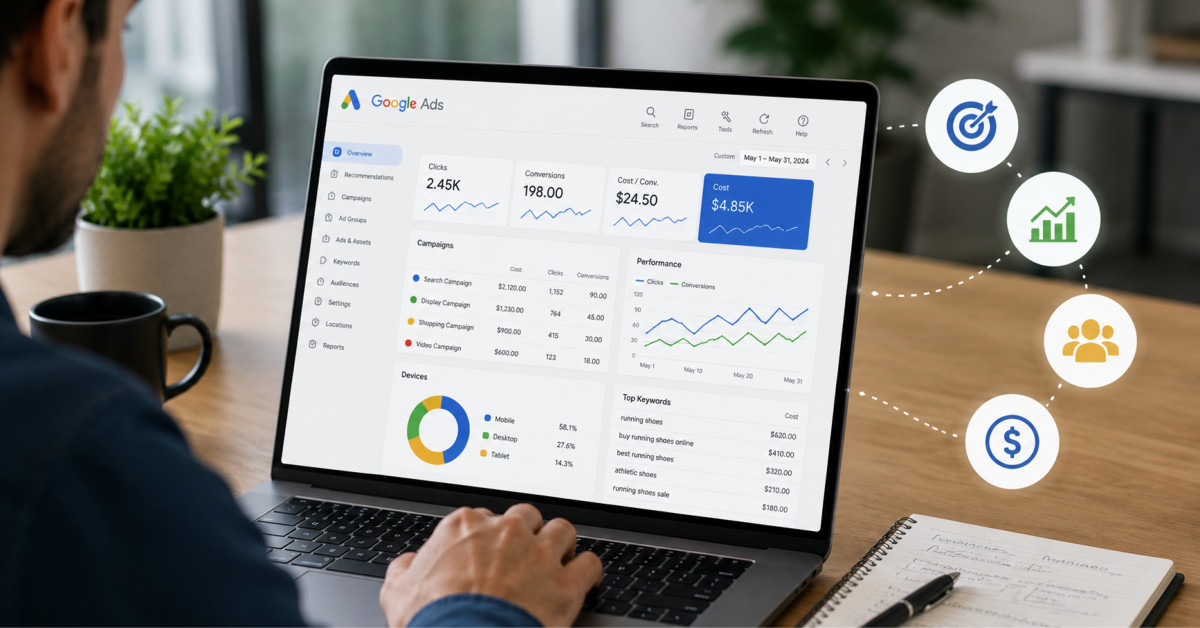
Expert Google Ads management removes guesswork by connecting search intent, geographic reach, landing-page relevance, conversion tracking, and budget decisions to measurable business outcomes. The right manager does not simply generate more clicks; they build a system that identifies which searches produce profitable customers and which spend should stop.
Google Ads rarely fails because an advertiser cannot write a headline. It fails because the account does not know which click became a customer, which search should never have triggered an ad, or whether the landing page delivered the promise that earned the click.
Running an online advertising campaign may seem straightforward at first, yet the reality often becomes much more complicated after the first few days. Budgets disappear faster than expected, clicks arrive without producing inquiries, and the results become difficult to understand. Many business owners searching for the best advertising services for businesses in Hawaii are not simply looking for someone to launch a few ads. They want experienced professionals who understand how every part of a campaign works together, from keyword selection to landing page performance, creating advertising that reaches the right audience while producing measurable business results instead of unnecessary spending.
One of the biggest misconceptions about Google Ads is that success comes from creating an advertisement and waiting for customers to click. Professional campaign management starts much earlier than that. Every decision is built around a carefully planned strategy that considers business goals, customer behavior, competition, and available budget.
An experienced advertising specialist begins by learning how the business operates. Understanding the products or services being offered, identifying the ideal customer, and defining meaningful objectives all help shape a campaign that serves a real purpose.
Rather than trying to appear in every possible search, professionals focus on the searches most likely to produce valuable inquiries. This targeted approach helps eliminate unnecessary spending while increasing the likelihood that every click comes from someone with genuine interest.
When strategy comes before advertising, campaigns become far more efficient and much easier to improve over time.
Keywords sit at the heart of every Google Ads campaign, yet choosing them requires much more thought than selecting phrases with the highest search volume. The goal is to understand what potential customers type into Google when they are genuinely ready to take action.
Some searches reflect curiosity, while others reveal strong purchasing intent. Knowing the difference allows experienced professionals to build campaigns around the people most likely to become customers.
Careful keyword research also helps identify negative keywords, preventing advertisements from appearing in searches that have little connection to the business. This simple but valuable practice reduces wasted clicks and allows more of the advertising budget to support meaningful opportunities.
Every improvement in keyword targeting strengthens the overall campaign, helping advertisements appear in front of the audience that matters most.
Not every business serves customers nationwide. Many companies focus on specific cities, neighborhoods, or service areas, making location targeting one of the most valuable features within Google Ads.
Professional campaign managers carefully define where advertisements should appear. This prevents businesses from paying for clicks generated outside their service area while increasing visibility where potential customers actually live or work.
Imagine a local service provider receiving inquiries from hundreds of miles away. Those clicks consume a valuable budget but rarely generate useful business opportunities. Geo targeted campaigns solve this problem by directing advertising toward locations where real customers are most likely to be found.
Location targeting can also be refined further by adjusting campaigns for different regions, demographics, or customer behaviors. These refinements improve campaign efficiency while helping businesses connect with audiences that closely match their ideal customer profile.
An excellent advertisement may attract attention, but the customer experience continues after the click. This is where landing pages become incredibly important.
Visitors expect to arrive on pages that immediately answer their questions and make it easy to continue. Slow websites, confusing layouts, or unrelated information often cause people to leave before contacting the business.
Experienced Google Ads specialists understand this connection. They evaluate whether advertisements and landing pages work together naturally, creating a smooth journey from search result to inquiry.
Clear headlines, informative content, simple navigation, and visible contact options all encourage visitors to remain engaged. Small improvements throughout the page often produce significant increases in conversion rates because customers feel confident they have reached the right place.
Advertising succeeds most consistently when every part of the customer journey feels connected rather than disconnected.
Perhaps the greatest advantage of professional Google Ads management is the ability to make decisions based on real performance instead of assumptions.
Every campaign generates valuable information. Specialists study click through rates, conversion rates, keyword performance, cost per conversion, audience behavior, and numerous other metrics that reveal exactly how advertisements perform.
This information guides future improvements.
Underperforming advertisements are revised or replaced. High performing keywords receive greater attention. The budget is shifted toward campaigns producing stronger returns. Landing pages continue improving as user behavior becomes clearer.
Instead of hoping campaigns improve naturally, professionals rely on measurable data to make informed decisions. Every adjustment serves a specific purpose, gradually increasing efficiency while reducing unnecessary spending.
Continuous optimization means campaigns remain active, responsive, and aligned with changing customer behavior. As markets evolve and competitors introduce new advertising strategies, experienced managers adapt quickly without losing focus on long term business goals.
Many businesses initially manage Google Ads themselves because the platform appears simple enough to learn. Over time, however, they often discover that successful advertising involves much more than creating headlines and setting a daily budget.
Campaign structure, bidding strategies, audience segmentation, conversion tracking, quality scores, landing page optimization, and performance analysis all influence results. Missing even one important detail can reduce campaign effectiveness while increasing advertising costs.
Working with experienced professionals removes much of this uncertainty. Instead of relying on trial and error, businesses benefit from proven strategies developed through ongoing testing, analysis, and refinement.
Perhaps even more importantly, owners gain valuable time to focus on serving customers, growing their teams, and improving daily operations while specialists manage the technical side of digital advertising.
Google Ads remains one of the most powerful tools available for connecting businesses with customers who are actively searching for products and services. Yet the platform delivers its greatest value when every campaign is guided by careful planning, thoughtful optimization, and continuous analysis. Professional management transforms complex advertising decisions into practical strategies that produce meaningful results. Rather than spending valuable resources guessing which adjustments might work, businesses can move forward with confidence, knowing every campaign is built around attracting qualified prospects, improving return on investment, and supporting steady, sustainable growth through smarter digital advertising.
Expert Google Ads management includes campaign strategy, keyword and search-intent research, match-type selection, negative-keyword management, geographic targeting, ad-copy testing, landing-page review, conversion tracking, budget allocation, reporting, and ongoing optimization. The goal is not simply to increase traffic. A capable manager connects paid-search activity to meaningful business outcomes such as qualified leads, booked appointments, purchases, revenue, profit, or customer value. Before hiring a manager, confirm how they define conversions, review search terms, validate lead quality, report results, and decide when budget should increase, decrease, or move to another campaign.
Google Ads management usually needs at least 30 days to validate tracking, identify irrelevant search terms, assess conversion quality, and make initial improvements, while 60 to 90 days provides a more reliable evaluation period for meaningful trends. The timeline depends on budget, search volume, sales cycle, conversion volume, competition, and whether the business has accurate conversion tracking. An account with a small budget or long sales cycle needs more time to collect useful data. Early improvements often come from removing waste, refining location targeting, improving landing-page relevance, and fixing conversion measurement before advanced bid strategies are evaluated.
Negative keywords are words or phrases that prevent a Google Ads campaign from showing for searches that contain terms the advertiser does not want to target. They help reduce wasted spend by excluding irrelevant intent, such as “free,” “jobs,” “salary,” “DIY,” or unrelated product categories when those searches do not serve the business. Negative keywords must be managed carefully because they work differently from positive keyword match types and can unintentionally block valuable searches if applied too broadly. Review the search-terms report regularly, add proven irrelevant terms, and maintain separate negative lists for account-wide exclusions and campaign-specific exclusions.
Local businesses should use Google Ads location targeting to focus budget on the cities, neighborhoods, zip codes, service areas, or travel radiuses where they can realistically serve customers and profitably fulfill work. Start with your actual service coverage rather than a broad statewide target, then review geographic performance by cost, conversion rate, lead quality, revenue, travel time, and close rate. Exclude locations that consistently produce unqualified clicks or low-margin work. For businesses serving Hawaii, this may mean separating campaigns by island or community rather than treating the entire state as one equivalent market.
An ecommerce business should track completed purchases and purchase value as primary Google Ads conversions, then use secondary conversions such as add to cart, checkout started, email capture, product-quiz completion, or back-in-stock sign-up for diagnostic context. Track new versus returning customers where possible, and review refunds, shipping costs, product margins, subscription starts, and repeat-purchase behavior so acquisition decisions reflect commercial value rather than top-line revenue alone. The strongest setup connects Google Ads, Shopify, analytics, and customer data into one reporting model that helps the brand evaluate customer acquisition cost and contribution margin by campaign or product category.
A business should hire a Google Ads agency or specialist when campaign complexity, rising spend, weak measurement, inconsistent lead quality, multi-location targeting, or the founder’s time cost makes continued trial-and-error more expensive than expert management. Hire based on process transparency rather than broad promises. A credible specialist should explain how they define and track conversions, review search terms, use negative keywords, validate lead quality, manage location settings, test landing pages, and report business outcomes. Maintain ownership of your Google Ads account, analytics access, landing pages, and performance data regardless of who manages campaigns.




