

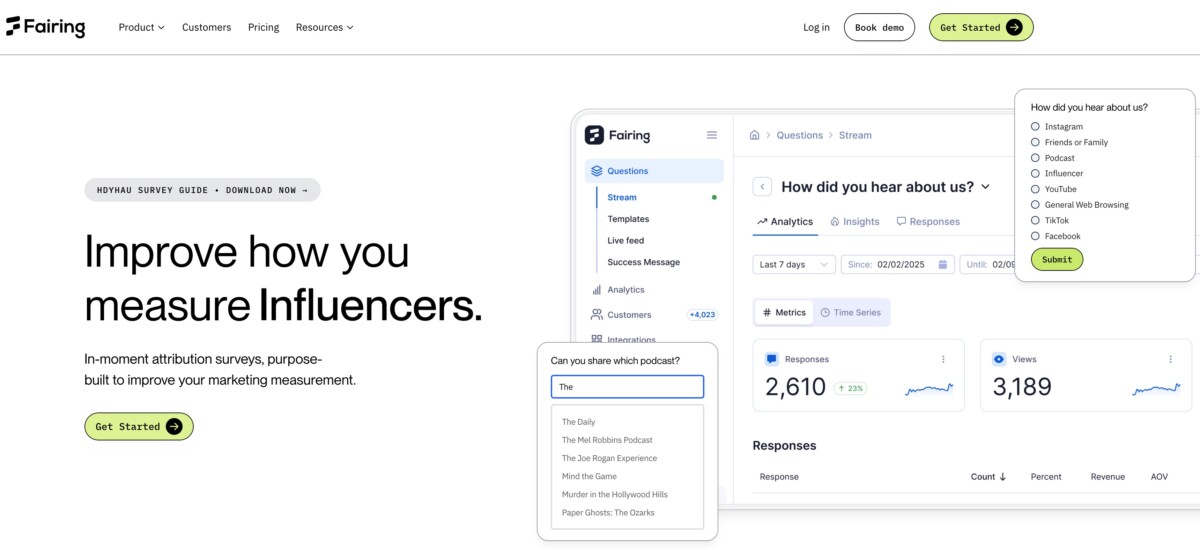
If you ask ten fast-growing Shopify brands what’s holding their marketing back, most point right to unreliable attribution, rising customer acquisition costs, and third-party analytics that never quite reflect reality. Data lives in silos, attribution gets blurry, and costly decisions stack up. I’ve seen these gaps stall brands that should be leading, not lagging.
I’m Steve Hutt from EcommerceFastlane. Over the last decade, I’ve interviewed founders and operators, watched what breaks under scale, and helped teams sort fact from fiction when the spreadsheet doesn’t add up. Every review, including this one, aims to summarize what actually moves the needle for Shopify brands doing real volume—no fluff, just proven frameworks.
Fairing.co surfaced as the answer a lot of operators wanted: a Shopify-native, post-purchase survey platform that closes the attribution gap and gives you direct, first-party answers from your customer, not guesswork from an algorithm. In 2026, brands looking for real attribution, actionable insights, and a way to grow without burning cash need a tool like this in their stack.
Let’s cut straight to it—Fairing.co is not for everyone. After watching what works across dozens of ambitious Shopify brands, I can tell you that this platform shines brightest for teams who want clarity over their customer journey and are itching to improve how they spend, market, and grow. In this section, I’ll break down exactly who stands to gain the most, and who might want to hold off or stick with other tools for now.
If you’re a founder, CMO, or growth lead who stares at blended CAC but isn’t sure if Facebook, TikTok, or word of mouth is pulling the weight, Fairing.co is worth a hard look. The brands I’ve seen do best with this tool are already running significant paid acquisition and are tired of chasing incomplete analytics from pixels and UTM strings. These teams use Fairing.co to ask *in-the-moment* attribution questions, right after conversion, when memories are fresh and clicks haven’t faded into the noise.
Key signs you’re a fit:
The result? You get high completion rates on surveys that don’t feel like a hassle and direct feedback that actually shapes your budget instead of giving you “averages” to guess at. Brands like Earth Fed Muscle have credited Fairing with unlocking deep insights into where customers come from, and what *actually* influenced their decisions—helpful for brands that want to double down—or shut down—certain channels.
Let’s talk to the operators and consultants for a moment. If your role is to help multiple Shopify brands squeeze more revenue from their marketing, you know how hard it is to trust third-party attribution data. Fairing.co simplifies the process, letting you sync survey responses directly with Klaviyo, [Google Sheets](https://apps.shopify.com/fairing), and even advanced BI tools. This allows you to create unified dashboards that combine customer-declared insights with transactional and behavioral data.
Agencies love it because you can:
One consultant told me they finally had “answer keys” for their media mix modeling after plugging in Fairing.co survey data. That means less guesswork, more confident recommendations, and real evidence to justify marketing changes—a must-have for anyone managing brands with meaningful spend and complexity.
Are you obsessed with squeezing more from your post-purchase funnel or building smarter journeys based on real customer motivations? Fairing.co helps you capture not only why someone bought, but also what nearly stopped them, which content convinced them, and what else they want from your brand. Top-performing Shopify brands use this data to drive segmented retention flows, onsite personalization, and even new product development.
Here’s where it gets tactical:
– Responses sync with Klaviyo, so you can build targeted post-purchase campaigns
– Trigger personalized offers or education based on survey answers
– Inform site content or merchandising with top-of-funnel motivations and objections
For teams who want *more* than just NPS or a “how did you hear about us,” this unlocks next-level personalization. For a deeper dive into personalization best practices and pitfalls, see these common mistakes when personalizing shopping experiences
Fairing.co is overkill if you’re just starting, can’t act on new data, or don’t yet have traction in multiple channels. Also, if your stack is already glued together by feature-rich, all-in-one CRMs with detailed attribution baked in, you may only see incremental gains.
Fairing may not be for you if:
– You’re a micro-merchant or brand pre-product-market fit
– You don’t have time or bandwidth to read and act on survey insights
– Your team prefers “set it and forget it” reporting, not dynamic, qualitative insights
If you’re in a place where getting responses is as far as you go, save your money. But if you’re scaling, spending, and seeking answers that actually direct hard choices in budget and creative, Fairing.co becomes more of a “when” than an “if.”
For brands invested in building long-term, customer-first data ecosystems, integrating Fairing’s surveys with your [first-party data collection strategy](https://ecommercefastlane.com/holiday-season-first-party-data-why-you-should-start-collecting-customer-data-now/) can be a real differentiator, especially as privacy regulations keep squeezing traditional analytics.
If you want opinions or benchmarks from other operators, check the latest [Fairing Post Purchase Surveys reviews](https://apps.shopify.com/fairing/reviews). You’ll see a common thread—teams who care about getting closer to their customer always find upside with Fairing.
Ready for the next level? Make sure you’re the right fit before investing time in setup. The best results come when this insight becomes a core part of your growth ops, not just a set-and-forget widget.
When my team gets into a Fairing.co Review, it stops being about another “survey tool” and becomes an operational advantage. The value isn’t just the raw features. It’s about how this platform helps fast-moving brands replace guesswork with direct insight, sharpen marketing ROI, and move from reactive to proactive in months, not quarters. Here’s where the platform actually delivers on its promise.
Fairing.co isn’t your garden-variety survey app. This is the “source of truth” for teams tired of attribution fog and looking to actually measure what’s working.
Here’s what makes Fairing a linchpin for scale:
By merging this self-reported survey data with your behavioral and lifetime value analytics, you unlock compound learning. Picture LTV cohorts by “how did you hear about us” (HDYHAU) split—not by what you think is working, but what customers know is. That is how scaling brands uncover untapped growth and optimize every stage of their buyer journey. For a more nuanced dive into how zero-party data drives this advantage, see this primer on zero-party attribution data for DTC brands.
An underrated strength of Fairing.co is its network of native integrations. This isn’t something you duct tape together with Zapier and pray it holds.
Fairing connects—instantly and reliably—to more than twenty leading tools in the modern Shopify growth stack. That includes:
The real impact is in the automation. Once set up, survey data routes straight to the right system, triggering segmentation, reporting, and optimization in near real time. Your team acts while the insight is still actionable, not weeks later.
Instead of downloading spreadsheets or waiting on data pulls, insights from every customer touchpoint instantly power your campaign testing, retention logic, and attribution recalibration. The result: you spot what’s working, cut waste, and fuel every function—from email to paid to product—with customer-declared truth.
If you want a practical example of operationalizing this kind of integration amidst peak demand, especially for high-traffic periods like Black Friday/Cyber Monday, check out the highlights from Fairing’s BFCM analysis, where 13 million surveys and $71M in GMV showed how integrated data syncs led to smarter, faster pivots for Shopify brands.
Pulling it together, Fairing’s integration ecosystem isn’t just a technical differentiator—it’s what makes self-reported insight a live asset for every function in your business. That’s the difference between data and direction.
If your team has ever sweated over whether a SaaS bill is genuinely fueling growth or just padding overhead, you’re not alone. Let’s get under the hood of Fairing.co’s pricing, where money spent turns into strategic advantage, and see how the ROI shakes out in practice. You want to know not only, “Can I afford it?” but “Will this line item win back its cost and then some?” Here’s the field-tested view, from one founder to another.
Fairing.co uses clear, tiered pricing. Every plan is billed in USD on a recurring 30-day basis. The big takeaway: there’s a “right-sized” plan whether you’re testing attribution surveys on a single store or knitting dozens of client brands into your stack.
Let’s break down the structure in a quick-glance format:
Fairing also offers a free trial on most paid plans, so there’s no reason not to validate fit before you spend real money. For full details on current pricing tiers, check out Fairing.co’s official pricing page.
Here’s what I see, having benchmarked Fairing across dozens of brands:
The payout shows up in several places:
Before Fairing.co, you’re squinting at pixel data and hoping you picked the right campaign. After, you’ve got clarity that tightens creative, corrects budget, and lets your team act with speed.
Building this insight in-house or duct-taping disparate tools can quietly add up. That’s the real “complexity tax” you pay—not just in cash, but in confusion and missed upside. When you stack up your typical MarTech toolbox (a standalone survey tool, attribution reporting, custom integrations), the monthly total often surpasses Fairing’s fee, and you still don’t get a purpose-built workflow.
Fairing lets you:
As a strategic peer, here’s my rule: If a tool makes my team smarter, faster, and my spend tighter by even 2-3 percent of net revenue, it’s worth five times the SaaS cost.
If you’re craving more context about how zero-party data can shift attribution power and ROI, take a look at this deep dive on using zero-party attribution to boost DTC marketing.
Across hundreds of reviews, the pattern is clear: Operators consistently call out Fairing’s ROI as measurable and fast. Brands point to the “aha” moment of learning where their best customers actually came from, using that insight to drive six-figure budget changes—not next year, but in the current quarter.
Some popular ROI themes:
If you want to see other operators’ ROI benchmarks and candid stories, browse the Fairing review section on the Shopify App Store. You’ll notice fast-lane teams aren’t shy about sharing where they’ve found outsized returns.
Let’s put numbers to it:
Typical Siloed Stack:
Total: $300-450/mo (plus extra team hours)
Fairing:
That nets a direct monthly savings—plus the non-monetary value of speed, accuracy, and insight. The real payoff is in your ability to act on truth, not guesses, so budget meets results in a single dashboard.
Quick question: Where are you currently pulling your attribution data from, and is it shaping decisive spend shifts? Drop your answer in the comments—I’ll share what’s working for brands in your revenue stage.
For an analysis of how brands optimized campaigns at record speed using agile survey feedback, explore this practical review from the Norway Black Friday and Cyber Monday 2024 guide, where real Fairing data moved budgets to winning channels in days, not weeks.
Fairing.co’s true cost lifts the fog, exposes spend that isn’t pulling its weight, and buys back your team’s time. That’s what strategic SaaS is supposed to deliver, and in my experience, it pays back fast.
User experience can make or break whether a tool actually gets adopted across a growing team. In this part of the Fairing.co Review, I want to paint a clear picture of what it feels like to roll out Fairing.co in a real, scaling Shopify environment—beyond the sales talk. From the day-one setup to ongoing support, here’s what you and your team can expect, based on real brand feedback and my own hands-on perspective.
With Fairing, you don’t get bogged down in a maze of settings or forced training sessions. Most brands report being able to launch their first live post-purchase survey within an hour of installing the app. The interface is direct and easy to follow—think “Shopify-native” levels of simplicity—not another clunky dashboard that takes a week to figure out.
The actual time-to-value is short. I’ve watched teams go from signup to first actionable insights (think: “where did this customer come from?” or “what convinced them to buy?”) in about a day, not weeks. That’s rare for attribution or analytics tools.
Adoption doesn’t depend on having a “data champion” or a power user. Fairing.co is designed for marketers, CX leads, and executives to all get what they need, fast. Here’s the consistent pattern:
High survey completion rates (often over 70% when surveys are well-timed) mean teams actually have signal—not just noise—to inform decisions. It’s common to see a quick culture shift where everyone, from the VP of Growth to Customer Support, refers back to survey insights instead of only top-level analytics.
Here’s where Fairing stands out: the support team doesn’t just solve technical issues—they anticipate the real questions brands have as they scale. Several multi-year operators (some using Fairing for 3-5 years) highlight the hands-on approach, whether they’re troubleshooting a Google Sheets connection or rethinking their entire post-purchase flow.
One comparable example: Brands have specifically praised Fairing support when integrating attribution data with platforms like Klaviyo or when setting up advanced data syncing for detailed reporting. These aren’t just edge cases—this level of guidance is routine.
For more direct user accounts of Fairing’s support and high adoption among scaling teams, the Fairing app reviews page is full of stories from brands that have seen clear, quick wins.
Let’s break out the operational reality—where Fairing.co delivers, and what to watch for as you ramp up:
What Works Well:
Areas Scaling Teams Should Be Aware Of:
Patterns are clear when watching 7- and 8-figure brands scale on Fairing:
If you want a real-world look at the types of survey questions top brands rely on with Fairing, see this list of top post-purchase survey questions from ecommerce experts.
The result: adoption sticks, the insight pipeline delivers fast, and your team actually acts on what they learn. When support is this engaged and UX is built for operators, Fairing doesn’t gather dust on the app shelf—it drives real outcomes for scaling brands.
This is where things get real for any scaling brand owner or operator considering Fairing.co—not every tool fits every team or every stage. You want straight talk on strengths, trade-offs, and what you should compare before you commit. I’ve run this decision through the Fastlane lens, using a simple but powerful grid framework similar to a weighted decision matrix, to help founder-level operators get off the fence and onto a path that drives the right change for their P&L.
Drawing from both hands-on experience and detailed peer feedback, here’s what consistently puts Fairing.co on shortlists for 7- and 8-figure Shopify brands:
No tool is perfect, and you need to know where the rough edges or limitations sit before you rip out your old stack. Here’s what stands out from honest Fairing.co Review work and peer discussions:
Many brands end up with Fairing at the top of their short list, but you owe it to your team to actively weigh options using this decision grid. Laying out business requirements and scoring options side by side is a powerful, CEO-level move before you invest.
Below are the most common alternatives Fairing competes against for post-purchase insights and attribution, along with where each solution pulls ahead:
And if you want to see how to adapt the weighted decision grid method for your own brand’s critical app picks, the Weighted Average Decision Matrix is a clear starting point. This process makes your thinking transparent and turns gut feel into business logic.
Every growth-stage brand has its own list of must-haves. Here’s how I suggest applying the Fastlane Decision Grid:
When you make big tech decisions with this kind of discipline—not based on vendor hype, but your hard criteria—your odds of picking a winner jump up fast.
The pattern I see every cycle: savvy teams don’t over-complicate, but they don’t guess either. Apply the Fastlane Decision Grid, weigh what matters, and move forward knowing you aren’t just picking a tool—you’re picking tomorrow’s results.
The Fairing platform delivers what Shopify brands actually need—reliable first-party attribution, fast setup, and the kind of support that doesn’t leave you in a ticket queue. If you’re a brand growing past six figures, frequently asking where your marketing dollars go, or craving actionable signals over analytics noise, this is the tool to put in your stack.
Here’s your move: connect your Shopify store, launch Fairing’s proven post-purchase survey template, and let the support team help you sync deeper insights straight into your day-to-day workflows. This shift arms you with the high-quality data required for sharper campaign decisions, less wasted budget, and measurable growth improvements—especially as privacy rules tighten.
Scan Fairing’s ratings and real merchant reviews on the Shopify App Store so you see how other top brands use it to cut through attribution guesswork. In a market where customer trust and direct insight are the edge, adopting a focused platform like Fairing sets you up to act with clarity and speed.





