Fake signups turn paid acquisition into fraud funding: a disposable email, a burner phone number, and a VPN address enter your database before any check runs. Verify email, phone, and IP at the form, using one unified API or a small stack matched to your volume.
The fifty dollars you paid for a fake signup is the cheap part. The bad data it leaves in your CRM keeps costing you long after the click.
Here is an illustration, not a measured case. You spend fifty dollars to acquire a new user. They land on your site, open the pricing page, and fill out the registration form.
Congratulations. You just paid fifty dollars for a disposable email address, a fake phone number, and a VPN IP address routed through a server in Eastern Europe.
Your dashboard still counts that signup as a win. Acquisition reports track clicks and cost per signup, and they rarely track whether the signup is a person. Run the same scenario across a month of paid traffic and the gap between signups and real people becomes a budget line.
The damage compounds quietly. Junk records fill your CRM and email platform, burn SMS credits, skew conversion reports, and decay until the people who use that data stop trusting it. Many teams leave the front door unguarded because nothing breaks on the day a fake record arrives.
Once the damage becomes impossible to ignore, teams panic and try patching the leaks by cobbling a fractured data verification API stack together just to stop the bleeding.
A patchwork verification stack costs more than its subscription fees, because every added tool brings its own integration, its own billing cycle, and its own blind spot. The instinct to verify incoming data is right. The way most teams build the workflow is where the money leaks.
A typical build goes like this: you buy one tool to validate phone numbers, a second to check for temporary emails, a third to flag high-risk IP addresses, and a fourth to pull company data. Now your developers maintain four API integrations, your finance team reconciles four billing cycles, and none of the vendors talk to each other.
That last point matters most. Each tool judges one field in isolation. A phone number can pass its check, the email can pass its check, and the IP can sit just under the risk threshold, while the three together would have looked suspicious to anyone reviewing the signup as a whole. Gaps between tools are where bad actors slip through.
Poor data is expensive well beyond signup forms. Gartner’s data quality guidance puts the average annual cost of poor data quality to organizations at $12.9 million (published July 2021). That is an enterprise figure, so read it as evidence the problem is real, not as a benchmark for a store doing $2M a year.
Disjointed verification data costs you the acquisition fee on every junk signup, plus the overhead of tools you only half use. Do the math on a fractured system and the real cost goes well beyond monthly subscription fees.
Here is the worked version. Illustrative example, assuming a $50 cost per paid signup and that 10% of signups are junk (swap in your own numbers): 1,000 signups cost $50,000, and the 100 junk signups account for $5,000 of it. That is spend with no possible return, before you count the CRM capacity, SMS messages, and reporting noise those records create.
Then there is the tool side. Some vendors set monthly minimums or plan tiers, so you can end up paying for capacity you barely use just to cover a blind spot. Your data stays disjointed, and bad actors still slip through the cracks.
A single verification API lets you check the email, phone number, and IP address of each signup under one key and one credit balance, so you get one view of the signup instead of four partial ones. The catch is that you cannot manually review every signup or CRM entry. You do not have the hours, and manual review defeats the purpose of automation.
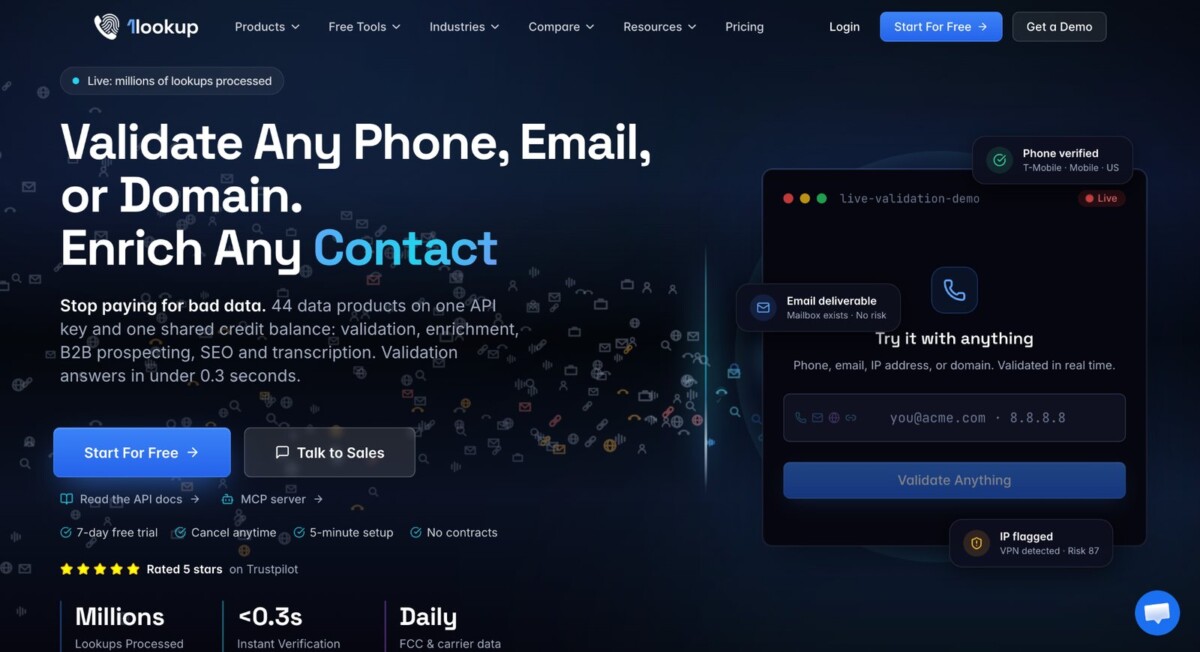
You need intelligence at the infrastructure level, and you need to block the garbage before it touches your database. This is where a unified infrastructure becomes necessary. A system like 1Lookup collapses the verification stack behind one API key and one credit balance.
You plug it in once. When a user hits submit, the API checks the email, pings the phone number, screens the IP address, and can append company data, all under a single key. According to 1Lookup’s published pricing (as of October 2026), plans start at $99 a month for 20,000 credits, there are no contracts, and unused credits roll over for up to three months. Core email, phone, and IP checks cost one credit each, and every plan starts with a 7-day free trial.
Here is the screening math, as an illustration at the Starter rate of $0.005 per credit (as of October 2026). Running all three core checks on 1,000 signups uses 3,000 credits, about $15 of credit value. The Starter plan covers roughly 6,600 signups a month at that depth. At only 1,000 signups a month, the $99 plan rather than the per-check rate is your real cost, close to ten cents a signup against the $50 of acquisition spend in the example above. Heavier lookups cost more: the same page lists an HLR lookup at 5 credits and company firmographics at 75.
Your database stays cleaner, and your developers manage one vendor instead of four. Unified does not mean perfect, though. A screening API reduces junk; it does not catch every bad actor.
A single API is the wrong choice when one check does nearly all the work in your business, or when your real exposure is mainly fraudulent orders rather than junk signups. Each option below fits a different problem, and all prices and limits are as of October 2026.
Choose Twilio Lookup if phone quality is your main problem; basic validation is free, and paid add-ons cover line type, SMS pumping risk, and reassigned numbers. Choose ZeroBounce if email is the weak point, such as a list that bounces or a form flooded with disposable addresses; it flags disposable addresses, spam traps, and catch-all domains, and its free account includes 100 verifications a month. Choose IPQualityScore if you want email, phone, IP, and device checks from a vendor built around fraud scoring; it advertises 1,000 free lookups to start.
Choose MaxMind minFraud if the exposure is mainly paid orders and promotion abuse; it scores transactions using IP, email, card, device, and address signals, lists no monthly minimums, and can also screen signups, so it overlaps with the single-API route. Choose 1Lookup if you want email, phone, and IP checks plus enrichment under one key and one credit balance, and a monthly plan starting at $99 suits your volume.
If your losses come from orders and chargebacks, signup screening will not fix them, and our roundup of fraud solutions for Shopify covers order screening tools and one option that also automates chargeback disputes.
Screen signups in three steps: block fraud at the door, buy checks from one pool of credits, and run deeper phone checks only where a number’s status matters. Here is how you deploy that intelligence across your systems.
Block Fraud at the Door: A fake signup wastes server space and support time. Configure the API to screen IPs and detect disposable emails at the exact moment of registration, and reject the clear bad actors instantly. Decide in advance what counts as clear, which the next section covers.
Leverage the Single Credit Model: One pool of credits replaces separate commitments across several platforms. You can spend it on a phone check today and a company append tomorrow, and rollover softens the quiet months. It is still a monthly plan, so size it to your real signup volume instead of the biggest tier on offer.
Run Deep Phone Intelligence: A basic check only tells you whether a number has ten digits. An HLR lookup queries the carrier network to learn whether a number is active or disconnected, and line type data separates mobile, landline, and VoIP numbers. At five credits, an HLR lookup costs five times a core check, so reserve it for signups where the phone number drives cost or risk, such as SMS opt-ins and high-value accounts.
Match the depth to your stage; the thresholds here are a starting point, not a rule. Under roughly $10K a month, free tiers plus form-level controls are usually enough, and a paid plan is premature. Between $50K and $500K a month with paid acquisition feeding your list, a single email and phone check at the form often earns its keep. Above $1M a month, add rules, a review queue, and order-level fraud tools on top. In between, test one check on your weakest field first and measure what it catches.
Treat a flag as a reason to route a signup, not automatically to reject it: block the clear cases, hold the ambiguous ones, and let everything else through. A disposable email on a first-order discount popup is a clear block for most stores. A VPN flag is different, because VPN traffic is not proof of fraud on its own; ordinary privacy-minded users route traffic the same way.
Tiered scoring handles that gap. As our guide to spotting suspicious customer behavior in real time explains, you approve clear low-risk sessions, hold clear high-risk ones, and send ambiguous cases to manual review, so not every suspicious session gets a hard decline.
Over-blocking has its own price. Our write-up of a 2026 industry fraud report, how cautious fraud settings turn away good customers, adds that those lost orders rarely show up in reports.
Signup screening is also one layer, not a full defense. A check at registration says nothing about what a verified account does afterward, which is why layered fraud defense pairs identity checks with ongoing monitoring across the customer journey.
Consolidating verification is worth the teardown because the migration is a one-time cost, while a fractured stack charges you every month in fees, maintenance, and data gaps. Teams often put the move off because tearing down the old system feels like too much work.
Do it in stages. Run the new API in monitor-only mode beside your current tools for a short window, compare what each one flags, and retire the vendor whose signal the new API duplicates first. Keep any specialist tool that catches something the unified API does not.
Stop hoarding disjointed APIs. Stop letting burner accounts and fake users bloat your CRM. Protect your infrastructure, and give your team accurate data they can actually trust.
The goal was never to build the most complex tech stack. It is to build a clean, efficient database, because that is the version of your business that scales.
A data verification API is a service your signup form or backend calls to check whether a contact is real before you store it. Typical checks cover email deliverability and disposable addresses, phone validity and line type, and IP reputation such as proxy, VPN, or datacenter traffic. Some APIs also append company or contact data after the checks pass. You send the details a user submitted, the API returns flags or a risk score within a moment, and your own rules decide whether to accept, hold, or reject the signup.
Core real-time checks cost about half a cent each on 1Lookup’s entry plan, as of October 2026, and several vendors offer free tiers. Plans start at $99 a month for 20,000 credits, with core email, phone, and IP checks at one credit each. ZeroBounce includes 100 free verifications a month, and IPQualityScore advertises 1,000 free lookups to start. Twilio Lookup’s basic validation is free, with line type and risk data sold as paid add-ons. At low volume, the plan price matters more than the per-check rate, so estimate your monthly signups first.
No, a VPN alone is not enough reason to block a signup. Many real customers use VPNs for privacy, so treat the flag as one signal among several. Combine it with a disposable email, a failed phone check, or a datacenter IP before rejecting. A reasonable pattern is to block when several signals agree, hold the signup for review when only one risky signal appears, and allow it when everything else checks out. That keeps fraud out without turning away privacy-minded buyers.
Usually not at the smallest stage. Under roughly $10K a month, or with only a few hundred signups a month, free tiers and form-level controls are typically enough, and a paid verification plan is premature. The case strengthens once paid acquisition feeds a growing email or SMS list, because every junk contact costs you the acquisition fee and then keeps costing you in messaging and reporting. Start with one check on the field that hurts most, usually email or phone, and add more only when the data shows a problem.
An HLR lookup queries the carrier network to learn whether a phone number is active or disconnected. It goes deeper than a format check, which only confirms a number has the right number of digits. It is worth paying for when the phone number drives real cost or risk, such as SMS marketing opt-ins, high-value accounts, or orders that depend on delivery updates. It is usually not worth running on every signup, since core phone validation is cheaper, and 1Lookup prices HLR at 5 credits against 1 for a core check as of October 2026.