

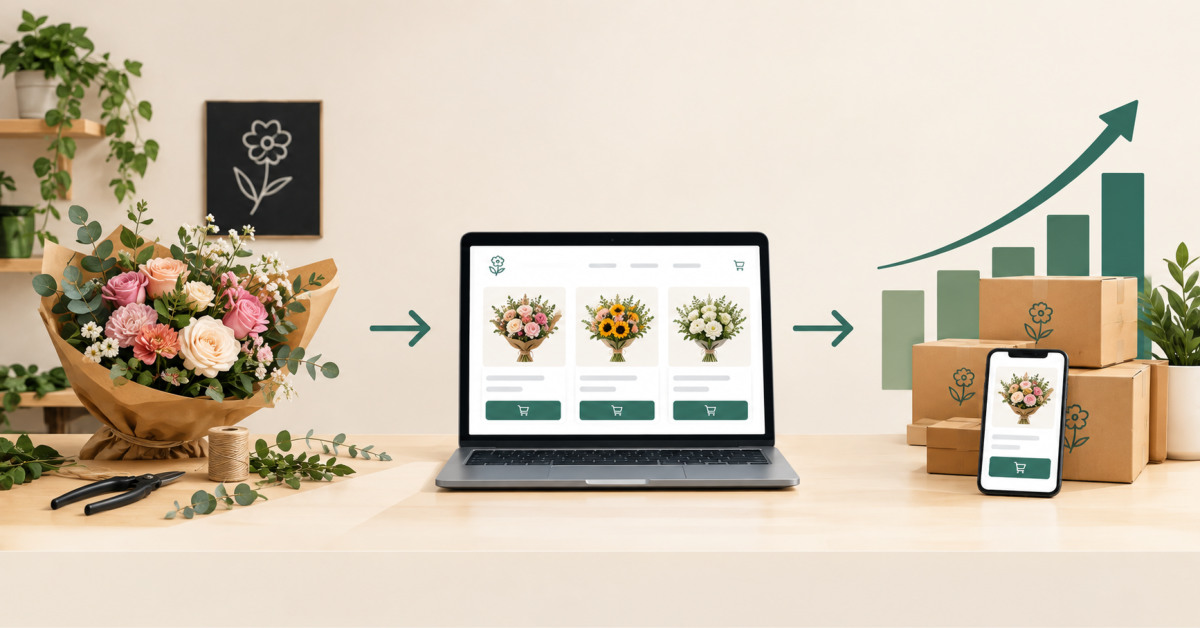
A floral business scales online by separating what travels from what doesn’t: sell standardized hard goods and a short menu of arrangements nationally, keep fresh flowers inside a local delivery radius, and document every repeatable step before spending on traffic. Revenue without repeatable margin isn’t scale.
A flower business can triple its revenue and keep none of it. The florists who scale well are rarely the ones with the biggest catalog. They are the ones whose tenth order of the day looks exactly like their first.
In 2019, Farmgirl Flowers did $34 million in revenue and made $36,000 in profit. That is the $36,000 lesson. The pandemic pushed the company to $60 million in 2020, then sales collapsed as the world reopened and 2021 ended in a loss of about $5.5 million. According to Fortune’s 2025 profile of founder Christina Stembel, she has since overhauled the business model four times, moved bouquet assembly outside the company while keeping design in-house, and brought Farmgirl back to about $35 million in sales with roughly 15% net profit expected. Same revenue as 2019. Completely different business.
Running a successful floral business already takes creativity, product knowledge, and an eye for what customers want. Turning it into a scalable ecommerce brand adds a different challenge: building systems that let sales grow without the same increase in manual work. For florists, that means inventory, packaging, photography, fulfillment, customer experience, and repeat purchases all need attention, while keeping the visual identity and personal touch that made customers care in the first place.
This guide is for owners at every stage, from a single shop adding online orders to a multi-location operation with a wholesale arm. The steps below apply to all of them. What changes with size is how much of each step you can afford to skip.
Sell the products online first that staff can prepare, photograph, and deliver the same way every time, and treat custom work as a premium exception rather than the default. A physical flower shop can substitute stems, rebuild an arrangement on the spot, and absorb unusual requests. That flexibility becomes expensive as online order volume climbs, because every custom order reintroduces the decisions you were trying to remove.
Farmgirl Flowers is the clearest example of the principle. Stembel built the company around a short menu of arrangements rather than a catalog of hundreds, and told Fortune in 2016 that offering no flower-by-flower choices cut waste by about 40%, because a shop that doesn’t know which flowers customers will pick has to overbuy and throw out what doesn’t sell. She also found the limit of that approach. In a 2025 Forbes interview marking Farmgirl’s 15 years, she said her first pivot was adding sizes, then plants and vase arrangements, because her early repeat customers were buying for themselves rather than as gifts. A menu that is too narrow fails the gift buyer; a menu that is too wide fails the operation.
Start with your own numbers. Review the last 12 months of sales and sort products into three groups: easy to prepare, package, and photograph consistently; sells well but generates frequent special requests; and rarely sells or eats staff time. Then organize what survives into categories customers understand quickly, such as arrangements, containers, accessories, seasonal collections, and event supplies.
Draw a second line between fresh and hard goods. Fresh arrangements have a shelf life measured in days and belong inside a local delivery radius. Vases, dried and preserved stems, faux florals, and event supplies can ship nationally. Many florists find their fastest online growth in that second group, simply because it is the only part of the catalog that can travel.
Standardize floral operations by writing down how routine work gets done, then narrowing the materials that work depends on. A packing method that works for 10 orders a day becomes a bottleneck at 40, and most of the friction comes from small decisions each staff member makes differently.
Create documented procedures for the tasks that repeat every day: preparing and checking orders before they leave, packing each product type, updating inventory after in-store and online sales, handling damaged goods, processing returns and refunds, and answering the ten questions customers ask most. A one page procedure with photos of the finished result is usually enough. The test is whether a new seasonal hire can pack a vase order correctly on their second day without asking anyone.
Some of that work doesn’t need a person at all. If a sold-out arrangement stays live on your store, you will spend the next morning apologizing and refunding. Automatically unpublishing sold-out products with Shopify Flow and sending a low stock alert to whoever places reorders removes one of the most common online florist headaches.
Product sourcing deserves the same discipline. A recognizable, consistent assortment of containers, floral supplies, and decorative pieces makes purchasing, photography, and packing easier. Choosing two or three cylinder heights and one bud vase style that you buy in cases, rather than 30 container SKUs, means one packing insert fits most orders and one set of product photos covers most listings. For example, businesses developing their vase selection can look at suppliers such as Jamali Garden, a New York wholesale floral supplier that sells many glass cylinders in sets of 6 or 12, when considering glass vases for inventory or floral work. A regional floral wholesaler you can visit in person is worth comparing on price, lead time, and breakage terms before you commit to any single source.
The goal is not to remove creativity from the business. It is to build repeatable processes around routine work so designers spend their hours on the arrangements that genuinely need judgment.
A floral product page should answer every question a customer would ask a florist standing next to them: exact size, what is included, what may be substituted, how long it will last, and how to care for it. Online shoppers can’t pick up a vase, walk around an arrangement, or ask for advice, so the page has to do that work.
Photography matters more in floristry than in almost any other category, and the broader elements of a high-converting product page, from variant-linked images to detailed descriptions, apply doubly when the product is fragile or perishable. Show each product from at least two useful angles and include one image with a scale reference, such as a hand, a standard mug, or a tape measure beside the vase. Customers remember the photo, and if the delivered arrangement looks noticeably smaller, you are handling a complaint regardless of how accurate the description was.
Descriptions should replace vague promotional language with specifics. For containers, list height, opening diameter, base width, material, and whether the piece is sold singly or as a set. For arrangements, give the approximate stem count, the height range, the vase included (if any), and a realistic vase life range. For fresh products, state your substitution policy plainly: if a specific stem is unavailable, you will replace it with one of equal or greater value in the same color family. That single sentence prevents a surprising number of disputes.
Think about the questions customers repeatedly ask at the counter. If shoppers regularly want to know the height of a vase or what size arrangement fits inside it, that information belongs on the product page, ideally as a short “pairs well with” note linking the two products. It answers the question and lifts order value at the same time.
Good product information also reduces avoidable customer service contacts. Every question answered on the page is one less email your team handles during a Valentine’s week rush, and that capacity is what lets order volume rise without adding hours.
Florists should manage inventory as two different clocks: fresh stock that must sell within days, and hard goods that can sit for months without losing value. Treating both with the same reorder logic is how shops end up composting roses while carrying three years of slow-moving urns.
Start by creating one reliable record of what comes in, what sells, and what needs replenishing, shared by your shop counter and your website. When the two channels track stock separately, the same last vase sells twice. Syncing in-store and online inventory through a florist-ready POS is often the first system worth paying for once online orders become regular. It also matters for delivery: Shopify only offers local delivery at checkout when a single location has enough inventory to fulfill the entire order, so inaccurate counts can quietly remove delivery as an option for your customers.
Next, separate products by how they behave commercially. Some sell steadily all year, like bud vases, floral tape, and a signature everyday bouquet. Others are tied to weddings, Valentine’s Day, Mother’s Day, and holiday decorating. For the steady sellers, set clear reorder points based on how many units you sell during your supplier’s lead time, plus a buffer. For seasonal items, plan purchasing deliberately instead of treating last year’s demand as a guarantee, because a holiday that falls midweek instead of on a weekend shifts which days the orders land on.
Fresh product needs its own discipline. Buy against confirmed pre-orders where you can, cap the menu for peak days, and decide in advance what happens to unsold stems: a same-day markdown, a dried arrangement line, or a donation. Farmgirl’s short menu model worked partly because it let the company buy flowers it knew it would use.
Better inventory control also makes marketing easier. There is little benefit in promoting a collection the business cannot reliably fulfill, and a paid campaign that sells out in four hours often creates more refund emails than profit.
Pack and deliver floral orders by matching the method to the product: local delivery for fresh arrangements, tested protective packaging for glass and decor that ships, and clear policies that tell customers exactly what happens if something arrives damaged. Fulfillment is not what happens after the sale. It is the part of the purchase customers remember.
Fresh flowers are hard to ship well. Stembel told Fortune in 2016 that shipping perishables to states where it is 110 degrees or below freezing was the problem that took her longest to solve, and national shipping arrived years after launch. For most florists, local delivery is the realistic fresh channel. Shopify’s local delivery settings let you set up to 10 delivery zones per location, by radius up to 100 miles or by postal code, each with a minimum order price and up to three additional price rules. Two limits matter for florists: customers can’t ship some items and have others locally delivered on the same order, and local delivery doesn’t appear with accelerated checkouts other than Shop Pay.
For glass and decor that ships, test packaging before you increase volume. Pack five of your most fragile items, ship them to staff or friends in different regions, and open them on camera. Look for unnecessary materials and steps, but don’t cut corners on protection. A packing method that saves $1 per order becomes expensive the first week it produces broken vases, refunds, reshipments, and one-star reviews.
Give customers clear information about delivery windows, cutoff times for same-day orders, and exactly what to do if something arrives broken, such as sending a photo within 48 hours. Straightforward policies reduce uncertainty for customers and give staff a consistent script when problems happen.
As volume grows, watch where fulfillment slows down. A small change in storage layout, bin labeling, a dedicated packing station, or batching orders by delivery zone can remove a surprising amount of repetitive walking and rework.
Floral ecommerce brands drive repeat purchases by building around the occasions customers already have, delivering reliably the first time, and staying useful between orders. More traffic helps, but finding new customers for every sale is the most expensive way to grow, and existing customers already know and trust the business.
Give customers reasons to return that fit how they buy. Seasonal collections bring previous buyers back at relevant moments, and an occasion reminder a week before a recorded anniversary or birthday is an email with a built-in reason to open. Care content keeps the brand useful between purchases: a how-to post-purchase email that helps customers get more from what they bought, like trimming stems every two days or reusing a vase for a new bouquet, builds familiarity without a discount. Complementary products help too, which is the lesson in Farmgirl adding plants and vases once it saw who was actually reordering.
Pay equal attention to the post-purchase experience. Accurate orders, sensible packaging, useful delivery updates, and fast answers to problems decide whether someone feels comfortable ordering again, especially when the order was a gift they never saw arrive.
Most importantly, let customer behavior guide the next decision. Frequently purchased products, recurring questions, return reasons, and categories that attract visits but no orders all show where the store is meeting or missing customer needs.
Those stage lines are editorial judgment, not measured benchmarks. The pattern behind them is one I saw repeatedly with Shopify merchants in the $500K to $2M range: growth stalls from adding channels, apps, and product lines faster than the basics can support them. Farmgirl reached $34 million before learning that lesson. Turning a floral business into a scalable ecommerce brand is less about chasing rapid growth and more about building an operation that can handle growth when it arrives, while protecting the creativity, service, and attention to detail that made customers care in the first place.
A florist can ship fresh flowers nationally from Shopify, but it is one of the hardest parts of floral ecommerce and rarely the right starting point. Perishable arrangements need insulated packaging, hydration, overnight or two-day carriers, and a plan for extreme heat and cold. Farmgirl Flowers founder Christina Stembel has said national shipping took her years to solve for exactly those reasons. Most florists grow faster by keeping fresh arrangements inside a local delivery radius and shipping only hard goods, such as vases, dried or preserved stems, and event supplies, nationally. Once local operations run smoothly, test national fresh shipping on a small menu with a few friendly customers before opening it to everyone.
The easiest floral products to sell online are the ones you can prepare, photograph, and pack identically every time. Glass vases, containers, dried and preserved flowers, faux florals, ribbon, and event supplies top the list because they don’t expire and can ship anywhere. Among fresh products, a short rotating menu of signature arrangements in two or three sizes works better than a large catalog of custom options, because it limits waste and keeps fulfillment consistent. Start by reviewing 12 months of sales and keep the products that sell steadily without generating special requests. Treat highly custom work as a premium, consultation-based service rather than an add-to-cart item.
A new floral ecommerce store should launch with a small, focused menu that staff can fulfill perfectly, often a handful of signature arrangements in two or three sizes plus a curated set of containers and accessories. There is no universal number, but the right range is whatever your team can photograph accurately, stock reliably, and pack without improvising. Farmgirl Flowers started with a single daily arrangement, then added sizes, plants, and vase arrangements after learning customers needed more choice for gifting. That sequence is useful: launch narrow, watch what customers ask for and reorder, and expand in response to demand rather than guessing at a full catalog on day one.
Shopify local delivery can reach up to 100 miles, or 160 kilometers, from a verified store location when you set it up by radius, or you can define zones by postal code instead. Each location supports up to 10 delivery zones, and each zone can have its own minimum order price, delivery fee, and up to three additional price rules based on order value. Florists should know two limits: customers can’t combine shipped items and locally delivered items in a single order, and local delivery isn’t offered when a customer starts with an accelerated checkout other than Shop Pay. The delivery location also needs inventory for the entire order.
Florists reduce glass vase breakage by testing packaging before scaling and standardizing the containers they sell. Choose a small set of vase sizes so one tested insert or box fits most orders. Before increasing volume, ship several of your most fragile items to different regions and inspect how they arrive, adjusting cushioning until breakage stops. Double-box heavier pieces, keep glass from touching the outer carton walls, and label packages clearly. Publish a simple damage policy, such as sending a photo within 48 hours, so customers know what to do. Track every breakage by product and carrier, because patterns usually point to one container or packing step causing most of the problems.




