

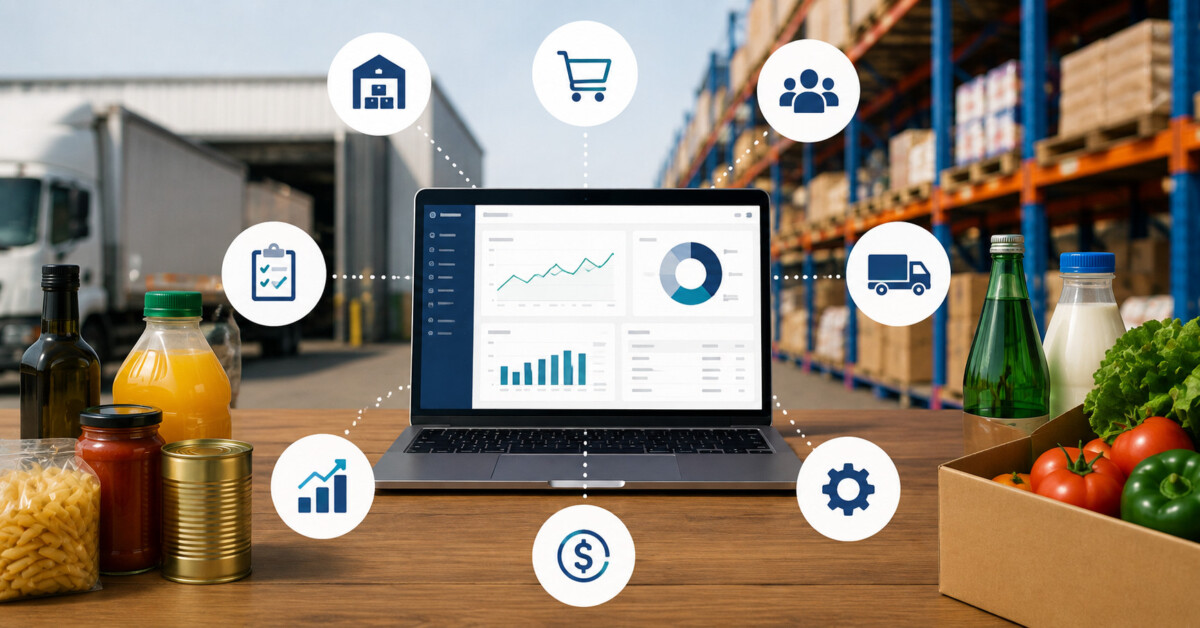
Food and beverage distributors improve margins fastest when they build a seven-layer tech stack that captures clean data from order to traceability, sequencing investments so each layer feeds the next without manual rework.
The stack that wins is not the one with the most tools; it is the one where a cooler-room order becomes a pick, a route, a delivery record, and a lot trace with zero manual handoffs.
Food and beverage distribution runs on volume and precision. U.S. foodservice distributors move 12 billion cases a year — roughly 33 million every day — across 168,300 vehicles and 17,100 operating locations, according to the International Foodservice Distributors Association. The same data puts the industry’s median net profit margin at 2.9%, which means every point of operating efficiency lands straight on the bottom line.
That is the opportunity food distribution technology unlocks. A well-built stack turns each of those touchpoints — the order, the pick, the route, the proof of delivery, the lot record — into structured data you can act on. This guide walks through the seven layers of that stack, what each one is responsible for, and the sequence that gets you to payback fastest.
U.S. manufacturing and wholesale distribution sales reached $15.12 trillion in 2025, per Digital Commerce 360, with overall growth flat at 0.4% while digital commerce expanded at a double-digit pace. Growth in this market is coming from how orders get placed and fulfilled, not from the market getting bigger. That makes a deliberate B2B ecommerce strategy part of the operations plan rather than a separate marketing project.
That reframes the software question. The win is not “which platform is best.” It is how cleanly your systems hand data to each other, so a rep’s order becomes a pick list, a route, an invoice, and a traceability record without anyone retyping it.
Here is the full stack at a glance.
| Layer | What it owns | What to look for |
|---|---|---|
| 1. ERP / financial core | Accounting, purchasing, pricing, AR/AP | Food-specific costing, catch weight, deal and rebate handling |
| 2. Inventory & warehouse | Stock, lots, expiry, picking | Lot/batch tracking, FEFO logic, barcode scanning |
| 3. Order capture | Rep orders, customer self-service | Mobile app, offline mode, customer-specific pricing |
| 4. Routing & delivery | Route plans, ePOD, driver app | Time windows, live tracking, signature and photo capture |
| 5. Traceability & compliance | Lot codes, CTE records, recalls | One-up/one-back records, 24-hour retrieval, sortable export |
| 6. Analytics | Margin, fill rate, rep and route performance | Reporting at SKU, customer, and rep level |
| 7. Integration layer | Data flow between all of the above | Open API, prebuilt connectors, sync monitoring |
Your ERP is the system of record for money and product master data. For food and beverage, generic ERP often needs help with catch weight items, tiered and customer-specific pricing, deal and rebate accruals, and shelf-life-driven costing.
Two viable paths: a food-specific ERP that handles this natively, or a general ERP paired with specialized tools that own the operational layers. Mid-market distributors frequently choose the second path because it lets them upgrade one layer at a time.
Get this layer stable first. Every downstream system inherits its item masters, customer records, and pricing rules.
Perishability makes food inventory a different problem. You are tracking lots, expiry dates, temperature zones, and case-vs-unit conversions at the same time.
What earns its keep here:
A distributor with clean lot data at this layer gets the traceability layer almost for free later.
This is where most distributors find their fastest return, because it is the point where information first enters the system. Every order captured digitally is an order nobody rekeys, mis-transcribes, or loses in a voicemail.
Two channels, one dataset:
The catch is that both channels have to write to the same order queue and the same inventory position. When they do, reps stop spending visit time on order entry and start spending it on shelf position, new SKUs, and account growth.
Purpose-built distribution software combines mobile order capture, customer self-service, inventory visibility, and route planning in one place, which is what makes this category worth evaluating alongside your ERP rather than after it.
Pro tip: Measure this layer on time-to-invoice, not on adoption. If an order placed at 2:15 p.m. is picked, invoiced, and on a route plan the same afternoon, the layer is working.
Delivery is one of the largest controllable cost lines in distribution. The American Transportation Research Institute puts non-fuel marginal operating costs at $1.779 per mile in 2024 — up 3.6% and the highest it has recorded — with truck and trailer payments alone climbing 8.3% to $0.390 per mile.
Those numbers make route intelligence a direct margin lever. The tooling to look for:
Electronic proof of delivery pays twice: fewer delivery disputes, and faster cash collection because the invoice ships with evidence attached. These are the same fundamentals that govern B2B logistics more broadly — visibility, accountability, and a clean record at every handoff.
The FDA’s Food Traceability Rule under FSMA Section 204 requires firms handling foods on the Food Traceability List to maintain Key Data Elements tied to Critical Tracking Events — harvesting, cooling, initial packing, shipping, receiving, and transformation — and to produce those records to the FDA within 24 hours of a request. Congress extended the compliance date to July 20, 2028, which gives distributors a genuine runway to build this properly rather than retrofit it.
What food traceability software needs to do:
The distributors who treat this as a data-architecture project rather than a paperwork project end up with a recall capability measured in minutes and a compliance answer they can hand to any customer’s quality team.
IFDA reports median sales per employee of $757,277 across foodservice distributors. Productivity at that scale is a measurement problem before it is a management problem.
The reporting worth building:
You do not need a data warehouse on day one. Applied at this level, supply chain analytics is less about dashboards and more about each operational system exporting clean, joinable data so the questions stay answerable as you grow.
This is the layer distributors underestimate and then rebuild. Ask three questions of every vendor before signing:
A tool with 80% of the features and clean integration outperforms one with 100% of the features and a nightly CSV drop. Data that arrives late arrives useless.
Order of operations, from fastest payback to longest:
Each step feeds the next. Start at the top of the chain, where the data is created, and quality compounds downstream. Sequenced this way, the stack stays aligned with your broader retail distribution strategy, because every layer makes the next channel easier to serve.
The food distribution technology stack that works is not the one with the most tools. It is the one where an order placed on a phone in a walk-in cooler becomes a pick, a route, a delivery record, and a lot trace without a single manual handoff. The same discipline driving food and beverage ecommerce growth on the consumer side applies here: clean data, fast fulfillment, no manual rework. Build it in layers, start where the data enters, and let each layer make the next one easier.
At minimum: an ERP or accounting core, inventory management with lot and expiry tracking, a digital order capture channel for reps and customers, and route planning with electronic proof of delivery. Traceability, analytics, and integration tooling follow as you scale. Most distributors run three to five systems rather than one, connected through an integration layer.
Pricing varies widely by module and headcount. Mid-market distributors typically see per-user monthly pricing for field sales and order management tools, and annual licensing for ERP and WMS. Evaluate on cost per order processed rather than sticker price — a system that cuts order-to-invoice time pays back differently than one that only cuts license fees.
The FDA’s compliance date for the Food Traceability Rule is July 20, 2028, after Congress directed the agency not to enforce the rule before that date. Firms handling foods on the Food Traceability List must maintain Key Data Elements for Critical Tracking Events and provide records to the FDA within 24 hours of a request.
Both work. All-in-one reduces integration overhead and vendor management. A connected stack lets you pick a stronger tool for each layer and upgrade one at a time without replacing the whole system. The deciding factor is usually whether your ERP can stay in place — if it can, a connected stack is faster to deploy.
Start with order capture and delivery execution. Digital ordering removes rekeying errors and shortens order-to-cash, while route optimization and electronic proof of delivery attack the largest controllable cost line. Both produce measurable results within a quarter and generate the clean data the rest of the stack depends on.




