
Generative engine optimization for Shopify is mostly index health plus clean product data, not a separate discipline. In fourteen days, our logs showed 49,559 crawler visits, roughly 100 from AI vendor bots, while ChatGPT still referred 613 human sessions.
Every vendor selling AI visibility wants you to believe a new crawler is judging you. Our logs say the crawler doing the judging is the one that has been there since 2009.
In fourteen days this month, 49,559 crawler visits hit ecommercefastlane.com. 45 of them came from OpenAI’s crawler. 16 came from Anthropic’s. 30 came from Perplexity’s. Together, the three bots that every merchant forum argues about accounted for roughly one-fifth of one percent of the crawl.
In that same window, ChatGPT sent 613 real people to the site. Perplexity sent 44. Anthropic sent 23. So the assistants were recommending pages at volume while barely fetching any. Something else was doing the fetching, and it wasn’t subtle: Microsoft’s crawlers hit the site 26,347 times, and Google’s hit it 12,088 times.
That gap is the whole story of generative engine optimization for a Shopify merchant in 2026, and it is the opposite of what most of the tooling in this category is priced on. This piece is the operating model: what GEO actually is once you strip the agency framing off it, what our own logs show about where AI answers are sourced, which four surfaces decide whether an assistant recommends you, and what to do first depending on how big you are. One honest caveat before we start, because it matters: this site is a publisher, not a store. A catalog’s crawl profile differs. The direction of the finding holds; treat the ratios as directional rather than as your numbers.
Generative engine optimization is the work of making your store retrievable, quotable, and recommendable inside an AI-generated answer, and for a Shopify merchant it is mostly product data hygiene and index health rather than a new content discipline. The term comes from a 2023 research paper by Pranjal Aggarwal and colleagues, the study that introduced generative engine optimization and the GEO-bench benchmark, which found that specific content changes could lift visibility in generative responses by up to 40 percent.
Read that paper closely, and one thing becomes obvious. It was written about text content. The optimizations it tested included adding citations, quotations, and statistics to written passages. That is a publisher’s playbook. Your catalog is not a written passage. A product page for a 14-ounce merino base layer in four colorways is a structured record with a price, an availability state, a size chart, a return window, and a shipping promise attached to it. When an assistant decides whether to put your product in front of someone, it reads that record, not your prose.
This is where most merchants take the wrong turn. They read a GEO guide written for a B2B SaaS marketing team, conclude they need to publish more articles, and spend six months producing content while the thing an assistant actually needs from them stays broken. Look at who ranks for the term itself and the pattern is plain: the top results are an encyclopedia entry, Google’s own documentation, a search tool vendor, a course platform, an email platform and a venture capital firm. Not one of them is writing for someone who has a catalog to sell.
So hold a working definition that fits your business. Generative engine optimization for a store is the practice of making your product data complete, your policies explicit, your pages crawlable, and your claims corroborated outside your own domain. Everything below elaborates on those four things.
Across 14 days of first-party crawler logs, the bots built by AI companies accounted for roughly 100 visits out of 49,559, while conventional search engine crawlers accounted for more than 38,000. The split is stark enough that it is worth seeing as a list rather than as a sentence.
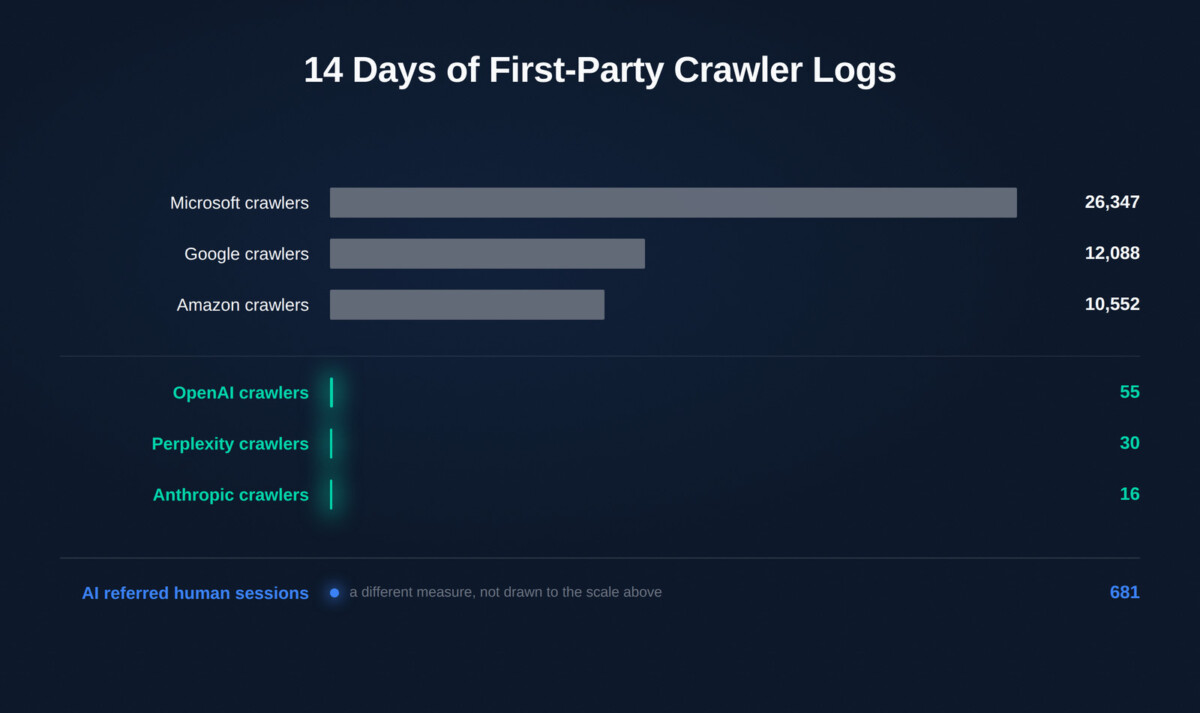
Two details inside that data are worth more than the headline. The first is that only one crawler fetched the sitemap at all during the window, roughly every 2.2 days, and it was Bingbot. Not one AI vendor crawler asked for the sitemap once in fourteen days. The second is where the crawl budget went. A meaningful share of the most crawled URLs were machine-translated locale variants of the same articles, which is the tax you pay for URL sprawl whether the crawler is feeding a blue link or an AI answer.
The operational read is uncomfortable for anyone who has spent money on this category. If you have been auditing your robots.txt for GPTBot, negotiating with a vendor about AI crawler access, or evaluating an llms.txt implementation, you have been optimizing a surface that represented about two tenths of one percent of the crawl on a real, live, reasonably authoritative site. Meanwhile, the crawler that fetched your sitemap, discovered your new products, and fed the index behind a large share of AI answers is one you have had access to since Bing Webmaster Tools existed.
ChatGPT referred 613 human sessions while its own crawler visited 55 pages, a ratio of roughly eleven to one, which means the answers being generated were not built from fresh fetches of the site. They were built from an index. When an assistant answers a shopping question, it usually runs a search behind the scenes against a conventional web index, reads the results, and composes an answer from them. The vendor’s own crawler is doing something narrower: gathering training data, or fetching a specific page a user pasted in.
Google has been unusually direct about this. Its published guidance states plainly that optimizing for generative AI search is optimizing for the search experience, and therefore still SEO, because features like AI Overviews run on Google’s core search ranking and quality systems. The same page states that a page must be indexed and eligible to appear with a snippet in order to be eligible for generative AI features at all. That is not marketing language. That is a dependency being stated out loud.
This reframes the whole exercise. Your AI visibility depends on your index health. If Bingbot cannot crawl your collection pages because a faceted filter is generating a million URLs, if your product pages are not indexed because they are variants of variants, if your snippet is suppressed, then no amount of AI-specific work rescues you. The assistant never sees you because the index it queries never had you.
The practical consequence is that the cheapest AI visibility work available to most stores is boring. Submit and verify a clean sitemap in Bing Webmaster Tools, not just Google Search Console. Check which of your product URLs are actually indexed in both. Kill the parameter sprawl. Confirm your snippets are not suppressed. For a merchant at $500K doing this for the first time, it is a Tuesday afternoon, and it moves more than a quarter of content production would.
An assistant deciding whether to recommend your product draws on four distinct surfaces, and most merchants have worked on only one. Naming them separately helps because they fail separately and different people fix them.
The first surface is your structured product data: the fields, the feed, the attributes. This is what an agent queries when it wants price, availability, size, material, or shipping time for a specific item. The second is your own pages, where an assistant goes for facts a feed doesn’t carry, such as how your return window actually works or whether the jacket runs small. Adobe’s analysis of over one trillion visits to US retail sites, published as its finding that retail sites are not machine readable enough for AI traffic, found product pages scoring lowest for machine readability of any page type, and we covered exactly which facts go missing in the guide to the nine purchase decision facts most Shopify product pages leave out. That piece is the field-level work; this one is the operating model around it.
The third surface is third-party corroboration: every place on the internet outside your domain that says something about you. Reviews, forum threads, comparison articles, press. An assistant weights these heavily because they are the only evidence it has that is not your own marketing. The fourth is the commerce channel itself, meaning the feed and protocol plumbing that lets an agent see your catalog inside the assistant rather than on your site.
Merchants under $500K should work surfaces one and two and leave three and four mostly alone, because corroboration is earned slowly and channel plumbing is increasingly handled for you. Merchants above $2M should work all four and notice that surface three is the one no agency can honestly shortcut. If you want the strategic picture of what happens once agents are transacting rather than just recommending, that lives in our complete guide to agentic commerce for Shopify merchants rather than here.
Shopify enabled Catalog by default for eligible merchants in its Spring 2026 edition, which means your products may already be syndicated to AI channels whether you have thought about it or not. The company’s own Spring 2026 edition release notes state that Shopify Catalog automatically standardizes and enriches product data, and claim that data syndicated by Shopify drives twice the conversion in AI chats compared with scraped data. Treat the 2x figure as the vendor’s number, but treat the default as a fact you should verify in your admin this week.
That syndication reaches ChatGPT, Microsoft Copilot, Google AI Mode, Gemini and the Shop app. The Universal Commerce Protocol that carries it went generally available in the same release, co-developed with Google and backed by a long list of platforms. Alongside it, Agentic Storefronts landed as an admin hub with channel toggles, performance analytics and conversion diagnostics, which is the first time most merchants have had a place to see whether any of this is working.
The action here is small, and almost nobody has taken it. Open Agentic Storefronts, confirm which channels are live, and read the diagnostics that tell you which product attributes are missing. That last part is the highest leverage screen in Shopify admin right now, because it is the platform telling you exactly which fields are stopping an agent from recommending you, for free, on your own catalog.
If you sell outside Shopify as well, or you want to understand the schema an assistant expects, OpenAI’s product feed specification for agentic commerce documents the canonical fields and the submission methods directly. Read it once even if Shopify is handling your feed. It tells you what good product data looks like from the buyer side of the transaction, which is a useful corrective to a catalog built for a theme.
Assistants lean heavily on third-party sources when answering product questions, and those sources move fast enough that chasing them is a losing strategy. Semrush’s analysis of 230,000 prompts across ChatGPT, Google AI Mode and Perplexity, covering more than 100 million citations between July and October 2025, is the clearest public look at this. Its study of the most cited domains in AI answers found Reddit, Wikipedia, LinkedIn and YouTube dominating the citation mix across all three engines.
Now look at what happened inside that window. Reddit’s share of ChatGPT citations fell from close to 60 percent in early August to around 10 percent by mid September. Wikipedia went from roughly 55 percent of responses to under 20 percent. Those are 2025 figures and the current mix is different again, which is exactly the point. A citation source that loses fifty points of share in six weeks is not a channel you build a strategy on. It is weather.
What holds is the underlying principle. Assistants want evidence about you that you did not write. That means real reviews on your product pages and on the platforms your buyers use, genuine presence in the communities where your category gets discussed, and coverage from publications that cover your space. It does not mean seeding Reddit threads. Google’s guidance names pursuing inauthentic product mentions as something not to do, and the platforms enforcing this have gotten better at it, not worse.
The stage-aware version is simple. Under $500K, your corroboration work is collecting and displaying real reviews properly. Between $500K and $2M, it’s genuinely present and useful in two or three communities where your category lives. Above $2M, it earns coverage and comparison placements, which is slow, expensive, and why larger brands keep their AI visibility while smaller ones flicker.
Google published a list of things that are unnecessary for generative AI search, and several of them are currently being sold as services. Its guide to optimizing for generative AI features on Google Search names four in particular: creating llms.txt files or other special markup, chunking content into tiny pieces, rewriting existing content specifically for AI systems, and overfocusing on structured data. It also states that structured data is not required for generative AI features at all, though it continues to support rich results in classic search.
That last point deserves care rather than celebration. Structured data still earns you rich results, still helps disambiguate your products, and still costs almost nothing on Shopify because the theme does much of it. Keep it. What Google is saying is that adding more schema types will not buy you AI visibility, which is a different claim from schema being useless. The failure mode it is warning about is a merchant adding six schema types to a product page that still does not state the return window in plain text.
The llms.txt point is the one worth internalizing, because it has become a proxy for looking serious about AI. Our own logs give it a second death. Not one AI vendor crawler fetched our sitemap in fourteen days, let alone a bespoke file we invented for them. A file that nothing fetches cannot influence anything. We worked through the broader version of this argument in our fact check of what Google actually said about AI search in 2026, and the conclusion has held up since.
If a vendor’s pitch leads with any of the four items on Google’s list, that is a useful filter. It does not automatically mean they are wrong about everything. It does mean they are selling against the explicit published guidance of the company whose index most of these answers are built on, and they should be able to explain why.
You can measure AI visibility adequately with three things you already have: your referral report, your server logs, and a spreadsheet of twenty questions. This matters because the tooling in this category is priced for enterprise budgets and most merchants under $2M do not need it yet.
Start with referrals. In your analytics, segment sessions by source for the assistant domains. That gives you the number that actually matters, which is how many humans an assistant sent you and what they did when they arrived. Adobe’s data across US retail sites found AI referred traffic converting 42 percent better than non AI traffic in March 2026, reversing a position from a year earlier when it converted 38 percent worse, and also found those visitors spending 48 percent longer on site. Those are Adobe’s aggregates, not a promise about your store, but they tell you this traffic is worth counting properly.
Then go to logs. If you can get server or CDN logs, count crawler visits by bot and check for errors. You are looking for two failures: conventional search crawlers being blocked or throttled on pages that matter, and crawl budget being burned on URL variants nobody should see. Both are fixable in an afternoon and both cap everything downstream.
Finally, build the prompt set. Write down the twenty questions a real buyer would ask an assistant before buying from your category, including the unflattering ones about sizing and returns. Run them monthly in two assistants, record whether you appear and what gets said, and keep the answers. That log is more useful than a visibility score because it tells you what to fix rather than how you rank. If you want a structured version of the self test, our breakdown of why most Shopify stores get filtered out before a shopper sees them walks the checklist.
The right first move depends almost entirely on revenue, because the constraint at $50K is completeness and the constraint at $10M is attribution. Doing the $2M work at $50K is the premature complexity trap that stalls stores in that band, and it is the single most common failure I have watched play out.
A note on the middle two rows, because that is where most readers of this site sit. If you are between $500K and $2M, the temptation is to hire the problem away, and the honest answer is that almost everything on your list is work only you can do, because it lives in your product data and your policies. An agency cannot write your return window for you. What an agency can do is the corroboration work in the $2M row, which is exactly why hiring one before the first two rows are clean is money spent to hide a foundation problem.
Three categories of spend in this space are not worth it for most merchants right now, and saying so costs us affiliate revenue. The first is AI visibility monitoring software below roughly $2M in revenue. The dashboards are real, and the data is real, but a visibility score does not tell you what to fix, and at your size the twenty-prompt spreadsheet gives you the same signal for the cost of an hour a month.
The second is llms.txt implementations and AI-specific markup services. Google has said these are unnecessary; our logs show vendor crawlers aren’t even fetching the standard files they could, and nothing has fetched an llms.txt on our domain. If this changes, we will say so, because it might. Right now it is a line item that buys the appearance of readiness.
The third is AI-targeted content rewrites. This is the most expensive of the three because it consumes months. Rewriting an article so it reads more like an encyclopedia entry is exactly what Google named as unnecessary, and for a store it is doubly wrong, because your retrieval problem lives in product records rather than in prose. If you are evaluating outside help anyway, our field guide to AI SEO agencies for Shopify and DTC brands lays out which ones fit which stage, and takes the same position: fix fundamentals first.
Apply the eighteen month test to anything in this category. Will this still matter in eighteen months? Clean product data will. An explicit return policy will. Being indexed will. A file format invented in 2024 that no crawler requests probably will not, and neither will a dashboard measuring a citation mix that moved fifty points in six weeks. Spend on the parts of this that would have been good ideas in 2019, because those are the parts that are still going to be good ideas in 2028.
No, and Google says so directly: optimizing for generative AI search is optimizing for the search experience, and therefore still SEO. The features that generate AI answers run on the same core ranking and quality systems, and a page must be indexed and snippet-eligible before it is eligible for generative AI features at all. What is genuinely different for a store is emphasis rather than discipline. Classic ecommerce SEO leans on keywords, titles, and links. Generative engine optimization leans on product data completeness, explicit policies, and corroboration from sources you do not own. Same infrastructure, different pressure points.
Allowing them helps at the margin, but it is far less important than most merchants assume. Over fourteen days on our own site, OpenAI’s crawler made 55 visits while ChatGPT referred 613 human sessions, a ratio of roughly eleven visitors for every page crawled. That tells you the answers were being composed from a conventional search index rather than from fresh fetches by the vendor’s own bot. Microsoft’s crawlers made 26,347 visits in the same window. Unless you have a specific reason to block them, leave AI crawlers allowed, then spend your actual attention on being indexed and crawlable by Bing and Google.
No. Google’s published guidance calls creating llms.txt files and other special markup unnecessary for generative AI search, and our crawler logs support that from the other direction: no AI vendor crawler fetched even our standard sitemap during a fourteen-day window, and nothing requested an llms.txt at all. A file that nothing fetches cannot influence anything. If a vendor is charging you to implement one, ask them to show you fetch logs proving it is being read. Spend that time confirming your product pages are indexed and your policies are written in plain text where a crawler can read them.
Segment your analytics referral report by the assistant domains and read the sessions directly. That single report tells you how many humans arrived from an assistant and what they did, which is the number that matters more than any visibility score. Adobe’s analysis of US retail sites found AI-referred traffic converting 42 percent better than non-AI traffic in March 2026 and spending 48 percent longer on site, so this segment deserves proper tracking even when it is small. Add a monthly log of twenty buyer questions run through two assistants, recording whether you appear, and you have a measurement system that costs an hour a month.
Possibly, because Shopify enabled Catalog by default for eligible merchants in its Spring 2026 edition, syndicating product data to ChatGPT, Microsoft Copilot, Google AI Mode, Gemini, and the Shop app. Check Agentic Storefronts in your Shopify admin; it shows which channels are live and runs diagnostics on missing product attributes. Most merchants have never opened that screen. Do it before buying anything, because it tells you exactly which fields are preventing an agent from recommending your products, for free, against your own catalog.
Fill in every required product field, publish a shipping and returns policy in plain text, and confirm your product pages are indexed in both Google and Bing. That is the entire list, and it beats anything else available to you at that size. The failure pattern at this stage is buying tools and retainers to solve a problem that is actually incomplete data, which delays the fix and adds cost. Once those three are genuinely done, move to your twenty best-selling products and make sure each one answers the questions a buyer asks before purchase, including sizing, materials, and delivery time.