

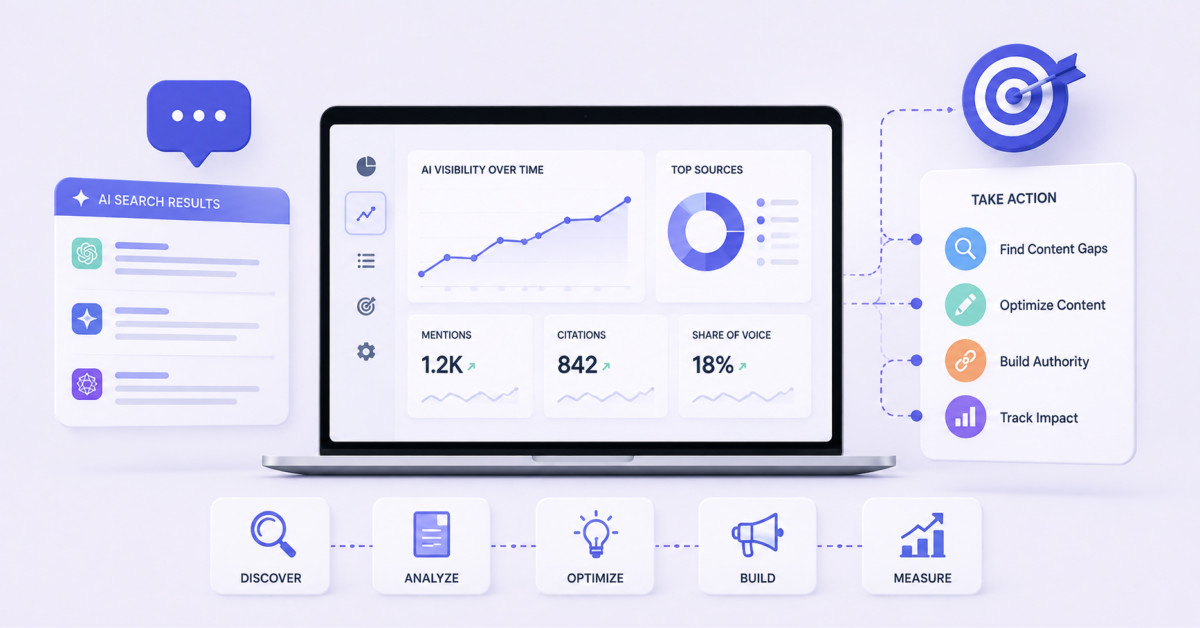
GEO tools are useful only when they turn AI visibility data into a prioritized execution plan: which buyer prompts to defend, which pages and product data to fix, which competitive gaps to close, and which trusted third-party sources to build next.
A visibility score is a smoke alarm. It tells you something needs attention, but it does not tell the team which room is on fire or who needs to respond.
Generative Engine Optimization has become a priority for teams that want to stay visible in ChatGPT, Gemini, Perplexity, Grok, AI Overviews, and other answer-driven search experiences. But many companies approach GEO the same way they approached early SEO analytics: they look for a score, export a report, and then struggle to turn the findings into work. A score may create awareness, but it does not fix positioning gaps, missing citations, weak content structure, or poor third-party presence.
The real value of GEO is execution. AI search visibility is shaped by many signals working together: crawlability, content clarity, source authority, topical consistency, competitor mentions, and the platforms where the brand appears outside its own site. A tool that only says visibility is low leaves the team with another dashboard to interpret. A better GEO workflow identifies which pages need improvement, which topics need external reinforcement, which claims need stronger sourcing, and which platforms AI systems already seem to trust for that query space.
PallasAI generative engine optimization tools is a strong option for teams that want GEO to become an operating system, not a monthly report. The page’s positioning is built around helping brands scale AI presence without scaling manual work. That distinction matters. In AI search, opportunities do not stay still for long. A competitor can publish a comparison asset, earn third-party mentions, or become the default recommendation for a buyer prompt before traditional rankings show a meaningful change.
A good GEO process also needs to separate monitoring from diagnosis. Monitoring tells the team what changed. Diagnosis explains why it changed. Execution closes the gap. For example, a brand may appear in AI answers for awareness prompts but disappear from buying prompts. That could mean its educational content is strong but its proof, comparison coverage, and third-party validation are weak. Another brand may appear in one AI platform but not another because one platform is reading sources that the other platform ignores. Without that breakdown, teams tend to respond with more content, even when the actual problem is authority or distribution.
The best GEO tools should help teams answer four practical questions. First, where is the brand visible today? Second, where is it absent despite having a relevant offer? Third, why are competitors being selected instead? Fourth, what should be created, updated, or distributed next? Those answers connect monitoring to action. For lean teams, that means less time guessing what to fix. For larger teams, it creates a shared workflow across SEO, content, PR, and demand generation.
This also changes how backlink campaigns should be planned. Backlinks should not only point to a homepage with a broad brand anchor. They should support specific AI search associations: generative engine optimization tools, AI visibility monitoring, AEO audits, competitive intelligence, and answer engine optimization workflows. When external articles repeat those associations clearly, they help build the context AI systems use to understand the brand. GEO is not about chasing every new AI search trend. It is about making the brand easier for AI systems to find, understand, trust, and recommend.
A GEO tool should turn AI search visibility into a prioritized action plan, not simply report how often your brand appears. It should show which buyer prompts matter, where competitors are cited, which sources influence each answer, and whether the likely fix is technical, editorial, product-related, or off-site. The most useful output is a ranked backlog with owners and retest dates. For example, a tool should help you distinguish between a page that needs clearer answer-first copy and a category where you need independent reviews or a stronger comparison asset.
You can tell whether an AI visibility problem is a content problem or an authority problem by studying the cited sources behind the answers where you are absent. It is usually a content or technical problem when your pages lack clear, extractable answers, complete product information, valid schema, or accessible HTML. It is more likely an authority problem when competitors have similar on-site quality but repeatedly appear through trusted third-party publications, reviews, expert roundups, or category resources. Many brands have both gaps, so fix your controlled on-site evidence first, then build external validation around the associations you want to own.
Shopify brands should track awareness, evaluation, and purchase-intent prompts that reflect how customers actually shop. Start with 20 to 30 prompts, including category questions, use-case questions, “best for” comparisons, brand-versus-brand prompts, price or fit objections, shipping questions, and product-specific buying requests. A supplement brand might track “best electrolyte powder for long-distance running” alongside “brand A vs brand B electrolyte powder” and “electrolyte powder without artificial sweeteners.” Review the set quarterly because customer language, products, competitors, and AI behavior all change.
GEO backlink campaigns should not point only to the homepage because AI visibility depends on specific category associations and evidence-rich pages. A homepage link can support broad brand authority, but a contextual editorial mention of a useful guide, comparison page, product collection, or original framework can reinforce the exact association you want an AI system to understand. Prioritize relevant sources and useful context over anchor-text volume. The objective is for independent publications to accurately explain what your brand solves, who it serves, and why it belongs in a particular buyer conversation.
Most Shopify teams should review GEO visibility monthly, while larger brands with active content and PR programs should monitor major prompts weekly and conduct a full diagnosis monthly. A monthly cadence is enough to spot meaningful shifts without turning the team into dashboard watchers. Use the review to compare prompt-level visibility, cited sources, competitor movement, referral traffic, and completed actions. Then assign only the highest-impact fixes for the next cycle. If a major competitor launches a comparison page, lands significant category press, or changes product positioning, run an additional review within a few days.




