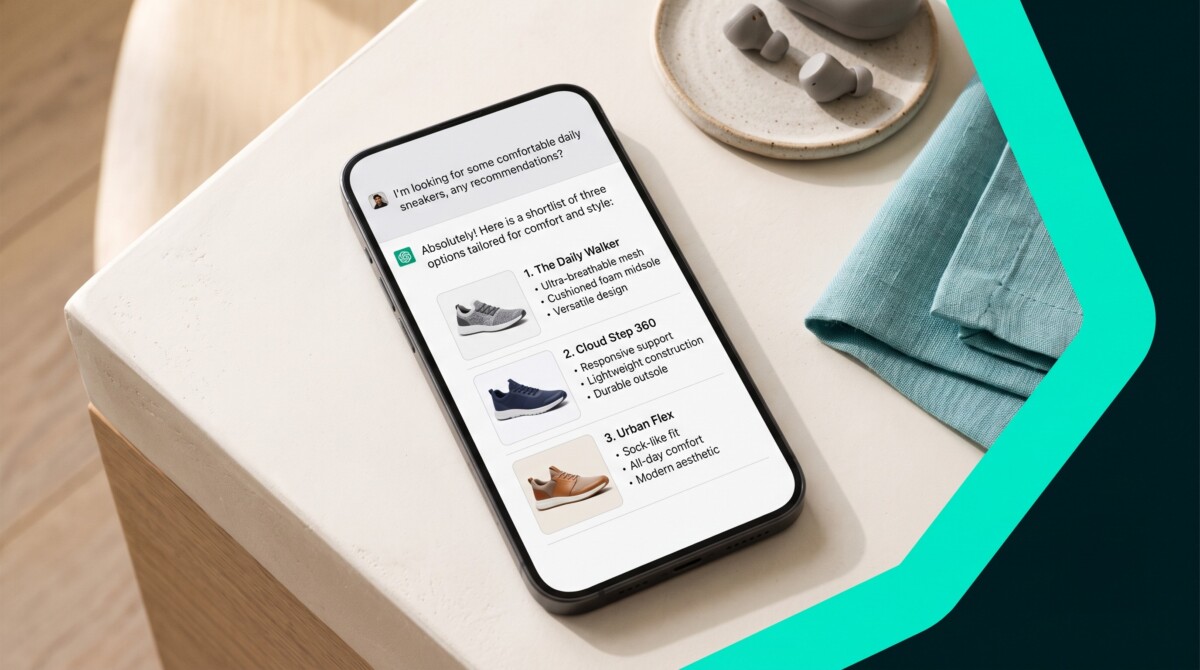
Getting your Shopify store recommended by AI search starts with fixing your product and collection page data so models can understand what you sell and who it is for. Most stores under $2M can do this themselves; an agency earns its fee once you are scaling past that stage.
AI sends most Shopify stores a small slice of their traffic today, and converts it at nearly twice the rate of traditional organic search. The brands getting recommended are not the ones with the biggest budgets. They are the ones an AI can actually understand.
A shopper opens ChatGPT and types: best waterproof hiking boots for wide feet under $200. In about four seconds they get three brand names, a one line reason for each, and a link. If your store is one of those three, you just earned a high intent buyer you never paid for. If it is not, you are not on page two of anything. You are not in the conversation at all.
This is not a someday problem. On Shopify’s Q1 2026 earnings call, president Harley Finkelstein reported that AI-driven traffic to Shopify stores grew eight times year over year, that orders from AI-powered searches grew nearly thirteen times, and that new buyers arriving from AI search converted at close to twice the rate of traditional organic search. You can read the figures in Shopify’s Q1 2026 report on AI-driven traffic and order growth. AI is still a small slice of total sales for most stores, but it is the fastest growing channel Shopify has ever tracked, and it converts.
I dug into what that actually means for a store owner with Robert Langenback, president of the search agency Eight Oh Two, on a recent eCommerce Fastlane podcast episode. His team runs search for mid-market and enterprise retail brands, so he watches this shift play out across a lot of accounts at once. What follows is the practical version of that conversation: how to test whether AI already recommends you, the product and collection page work that actually moves the needle, and the honest answer to when you should stop doing this yourself. Whether you are doing $20K months or $2M months, the first steps are the same.
AI-referred traffic is still only about one to five percent of revenue for most Shopify stores, yet it converts well enough that the work of getting recommended pays off long before AI becomes a large share of your sales. Langenback told me his agency sees that same one to five percent range across clients who track it, paired with conversion rates that sit between non-brand and branded search, which for many stores means two to three times their non-brand baseline.
The reason is intent. Someone who asks ChatGPT for the best natural deodorant that actually works, then refines with a follow up about sensitive skin, has done their research inside the tool and arrives at your store close to a decision. That is very different from the top of funnel visitor who used to land from a broad Google search and bounce. The catch, and Langenback was candid about this, is that you lose visibility into the research phase. Shoppers refine their questions inside the model without ever clicking, so you only see them when they finally arrive.
This is why a drop in raw organic traffic can be misleading. If sessions are down but revenue is holding or climbing, you may be trading low quality clicks for high quality AI-referred buyers, which is a healthy swap, not a decline. The way to know is to watch AI referrers in GA4, where ChatGPT and Perplexity show up as referral sources, and track whether that segment grows month over month. If you have never separated it out, that is the first thing to fix, and there is a full walkthrough in this guide on why your Shopify store may be invisible in AI search and how to track it.
Before you change a single product page, run a fifteen minute test: write ten prompts a real buyer would type, run each one separately in ChatGPT, Claude, Perplexity, and Google AI Overviews, and record whether your store shows up and which competitors do. This one exercise tells you more than any dashboard, and it costs nothing.
The rules matter. Do not use your brand name, because you already rank for yourself. Describe the product category, the use case, the constraint, and the buyer, the way a real person talks. For premium dog treats, that might be single ingredient dog treats made in the USA under $25 for a dog with a chicken allergy. Run each prompt in a fresh session, because these tools personalize and you want a clean read. Then log three things for each one: whether you appear at all, whether the information is accurate, and which brands appear instead of you and why the model might prefer them. Ask the AI to build the spreadsheet for you if you want to move faster.
There is a smart shortcut Langenback uses to find the prompts in the first place. Ask ChatGPT or Claude how a customer would find you and why they would choose you over an alternative, then take those answers and run them back as searches. Because the prompts are so hyper personalized, you will never see the exact same query twice, so you are looking for patterns across a handful of high value searches, not a single ranking. Are you showing up directionally? Is one competitor showing up everywhere? That is your baseline.
For the DIY crowd, you can go a long way with the tools you already have. Claude and ChatGPT for the prompt testing, SEMrush or Moz for your traditional Google baseline, and a monitoring tool like one of the current GEO tracking tools such as Peec AI, Scrunch, or Profound once you want ongoing measurement instead of a one time snapshot. When you are ready to turn the test into fixes, the full checklist lives in the Shopify AI Visibility Audit.
AI recommends your product when your product page states, in plain language, exactly what the item is, who it is for, and which specific constraints it satisfies. Vague titles and clever names get filtered out before a shopper ever sees them. Langenback put it more bluntly: plenty of brands forget to call a shirt a shirt. One of his clients named products things like the Emma, which tells a model nothing about what it actually is.
Start with the product type, because that is the failure that quietly costs the most. If a page does not clearly say it is a linen wrap dress, an AI has no reliable way to match it to someone shopping for a linen wrap dress. From there, the winning move is use case copy that answers the hyper specific questions buyers now ask. For a swimwear client, that meant writing product copy around a phrase like the best long sleeve swimsuit for someone with sun sensitive skin who spends long days on the beach, and making sure the page states plainly that it is UPF 50. Those are searches you would never have targeted as keywords two years ago, and they are exactly how people talk to AI now.
Fill in the attribute fields that let a model say this matches your need because X: materials, dimensions, weight, fit, care, and what is included. Add variant schema markup so the sizes, colors, and patterns are machine readable, which helps both the LLMs and the product grids that now dominate Google results. You do not need to boil the ocean here. Fix your top 20 revenue SKUs first, then expand. The bonus is that every one of these fixes also raises conversion for the human shoppers who were already on the page.
Your collection pages are the most underrated AI visibility asset in your store, because category level shoppers have not chosen a brand yet, and a collection page with real buying guidance is what puts you in that decision. Langenback called the collection page the most underrated SEO asset in ecommerce, and after watching hundreds of stores, I agree with him.
Here is the logic. Someone searching for a specific model name has already decided; they will go straight to a product page or to Amazon. But someone asking for the best waterproof hiking boots, or the best kayak for a beginner on a budget, is still deciding, and that is the exact moment you want to be in the room. Most Shopify themes treat the collection page as a filterable holding area, a grid of products with a one line heading. That is a missed opportunity. The stores winning here add real copy: what makes a good version of this product, what to look out for, which option fits which use case and price point, and comparison blocks that guide the choice.
Langenback’s team goes a step further and builds granular subcategory collections organized around specific needs rather than broad product types, so a shopper who wants trail runners for wide feet lands somewhere built for exactly that. Blog content plays the same supporting role when you apply one filter to it: will this piece help a real buyer make a decision? A post on the best running shoes for different situations can get cited by an AI and pull a shopper toward the right product page. A generic brand update will not. If it does not help someone buy, it is not doing AI visibility work.
Do this work on your own Shopify store first, not on Amazon, because on your store you own the customer, the pricing, and the data, while on a marketplace you are one undercut away from losing the buy box and one knockoff away from losing the listing. Langenback and I have both watched the same pattern play out, and it is worth being clear eyed about before you pour effort into the wrong surface.
Amazon has real pull, especially earlier on, because you can list a product and generate revenue almost immediately. But the moment you do well there, competition arrives. Sellers undercut you for the buy box, and I have seen well known brands get a message from Amazon saying it intends to buy wholesale and control the listing, pricing, and narrative itself. Knockoffs follow the same trail, scraping your reviews and your bestselling items and copying them, sometimes badly enough that a confused customer shows up at your support desk about a product you never sold them.
None of this means avoid Amazon. For many brands it is a necessary channel because the demand is genuinely there. It means know what you own. On your Shopify store you keep the customer relationship, you can remarket by email, and the lifetime value is higher because you get to earn the repeat purchase. On a marketplace you are renting the audience. So when you invest in the product and collection page work above, do it where it compounds, on the store you control, and treat the marketplace as reach rather than home.
Handle AI visibility yourself while you are under roughly $2M in revenue; a search agency becomes worth the retainer once you are scaling past that, have a real marketing budget, and need an execution layer rather than another tool. This is not me being cagey to avoid recommending anyone. It is the honest stage line, and Langenback drew it himself: he said Eight Oh Two’s sweet spot is brands in the scaling phase, moving from a couple of million toward $5M, $10M, or beyond, while newer stores under $2M are usually best served doing this work internally.
That tracks with the pattern I have watched for years. The most common way merchants stall at the $500K to $2M stage is premature complexity: buying tools and signing retainers before the fundamentals are solid. If your product pages still call a shirt the Emma, an agency is not your bottleneck, and a monitoring subscription just gives you a prettier view of a problem you can fix yourself this week. Be honest about which side of that line you are on.
When you do cross it, choose carefully, because the AI visibility wave has produced a lot of agencies that simply relabeled their old SEO deck. The ones worth hiring are search native and transparent about fit, and they treat traditional and AI-era search as one practice rather than bolting GEO onto an unrelated menu. If you want to compare options honestly, the 2026 field guide to AI SEO agencies for Shopify and DTC brands lays out ten of them, unranked, so you can match one to your stage and vertical. Eight Oh Two is one search first option in that category; they set up a free thirty minute consultation for Fastlane listeners if you want an outside read on where your store stands today. And if you are still under that line, the right move is genuinely to run the test, fix your top SKUs, and check your own progress in a couple of weeks.
Run a short test inside ChatGPT, Claude, and Perplexity using prompts that describe your product category, use case, and buyer constraints without naming your brand. For example, if you sell organic skincare, try best fragrance free moisturizers for sensitive skin under $40. If your store does not appear, or appears with wrong details, you have an AI visibility gap. Run it across five to ten realistic buyer scenarios, use a fresh session each time so the tools do not personalize the answer, and write down which competitors show up instead of you. That list is your baseline, and it tells you what the brands beating you are doing right that you are not yet doing.
The fastest high impact fix is rewriting your product titles and data on your top 20 revenue SKUs so an AI can understand exactly what each item is and who it is for. Vague titles like Blue Hoodie and clever product names that hide the product type are the most common reasons stores get filtered out. Replace them with the material, fit, sizing, and use case stated plainly, then fill in attribute fields like dimensions, materials, and care. These changes usually show up in how AI tools describe your products within one to two weeks, and they lift conversion for human shoppers at the same time, so the effort pays off on two fronts.
AI search traffic converts at a meaningfully higher rate than traditional organic search, even though it is still a small share of total sales for most stores. On Shopify’s Q1 2026 earnings call, the company reported that new buyers arriving from AI search converted at close to twice the rate of traditional organic search. Agencies working across many stores report similar patterns, with AI-referred traffic making up roughly one to five percent of revenue today but converting well because the shopper has already done their research inside the tool before they arrive. It is a small channel that behaves like a high intent one, which is exactly why doing the work now is worth it.
You can do it yourself while you are under roughly $2M in revenue, and for most stores at that stage you should. The core work, testing your visibility with real prompts, rewriting product and collection pages, and cleaning up your data, is all doable inside your Shopify admin with tools you already have, plus a monitoring tool if you want ongoing tracking. An agency becomes worth the retainer once you are scaling past $2M, have a marketing budget, and need an execution layer rather than another dashboard. If your fundamentals are not solid yet, hiring out is usually premature complexity that slows you down rather than a shortcut.
Prioritize your own Shopify store, because that is the surface you actually control. On your store you own the customer relationship, set your own pricing, keep the data, and earn a higher lifetime value through repeat purchases. On Amazon you are renting the audience, and you can lose the buy box to an undercut or lose the listing to a knockoff with little warning. Amazon can still be a necessary channel because the demand is real, so treat it as reach rather than home. Put your product data and collection page work where it compounds, on the store you own, and let the marketplace be an additional channel rather than your foundation.